


Shura Council Agrees to Change SAMA Name, System

Shura Council Agrees to Change SAMA Name, System
TT

Shura Council Agrees to Change SAMA Name, System

Shura Council Agrees to Change SAMA Name, System

The Saudi Shura Council approved on Monday a new draft law, which includes changing the name of the Saudi Arabian Monetary Agency (SAMA) to the Saudi Central Bank, with the aim of giving the new bank more power and flexibility to achieve economic and financial goals.

During a regular session, the Council heard an expanded report by the chairman of the Finance Committee and unanimously voted on the proposed system.

In remarks to Asharq Al-Awsat, Saleh Al-Khelwi, Chairman of the Financial Committee, said that the new system would transform SAMA into a central bank that enjoys the same specifications and standards of global central banks.

He noted that 65 years have passed since the establishment of the agency, underlining the need to develop it.

Moreover, the new system would give the Saudi central bank additional powers and a form of independence and flexibility in investments and would allow it to perform all kinds of financial and banking transactions.

SAMA’s establishment dates back to the era of King Abdulaziz, who issued two royal decrees in 1952 to launch the agency that would be based in Jeddah.

The agency’s tasks include, among other, printing and supporting the national currency (the Saudi riyal), consolidating and stabilizing its internal and external value, as well as managing the Kingdom’s foreign exchange reserves, while supervising the monetary policy to maintain price stability and exchange rates.



Euro Zone Yields Fall after Iran Raises Prospect of Hormuz Reopening

Euro banknotes (Reuters)
TT

Euro Zone Yields Fall after Iran Raises Prospect of Hormuz Reopening

Euro banknotes (Reuters)

Euro zone bond yields fell for a second straight day on Tuesday, hitting their lowest in almost two weeks after Iran raised the prospect of reopening the Strait of Hormuz and Washington hinted it could restart talks with Tehran, pushing oil prices lower.

Germany's 10-year bond yield, the benchmark for the bloc, fell 1 basis point to 3.44% after rising as much as 4 bps earlier in the session. It fell 7 bps on Monday as energy prices retreated.

A senior Iranian official told Reuters that the strait, which carried about a fifth of global energy supplies before the war, could reopen within seven days if the US also lifts its blockade of Iranian ports.

The official added that Iran's delegation to a UN meeting in New York this week has full authority to revive diplomacy over the conflict.

US Secretary of State Marco Rubio told NBC's "Today" show that Washington was open to speaking with Tehran.

The dip in energy prices helped pull yields lower globally after a surge in recent weeks fuelled by expectations of further interest-rate hikes to combat energy-driven inflation. Traders are pricing in around 35 bps of additional European Central Bank tightening this year, down from 40 bps on Friday.

Germany's two-year bond yield, which is sensitive to interest-rate expectations, fell 1 bp to 3.19%, following a 6-bp drop on Monday.

Rabobank senior rates strategist Lyn Graham-Taylor said lower oil prices following the Iranian comments were weighing on bond yields.

Brent crude futures were last down 1% to $100 a barrel after earlier falling to $97.40, the lowest in two weeks.


Libya's NOC Says Sharara Crude Pipeline Closure Losses at 130,000 bpd

General view of the Sharara oil field in Libya (Reuters)
TT

Libya's NOC Says Sharara Crude Pipeline Closure Losses at 130,000 bpd

General view of the Sharara oil field in Libya (Reuters)

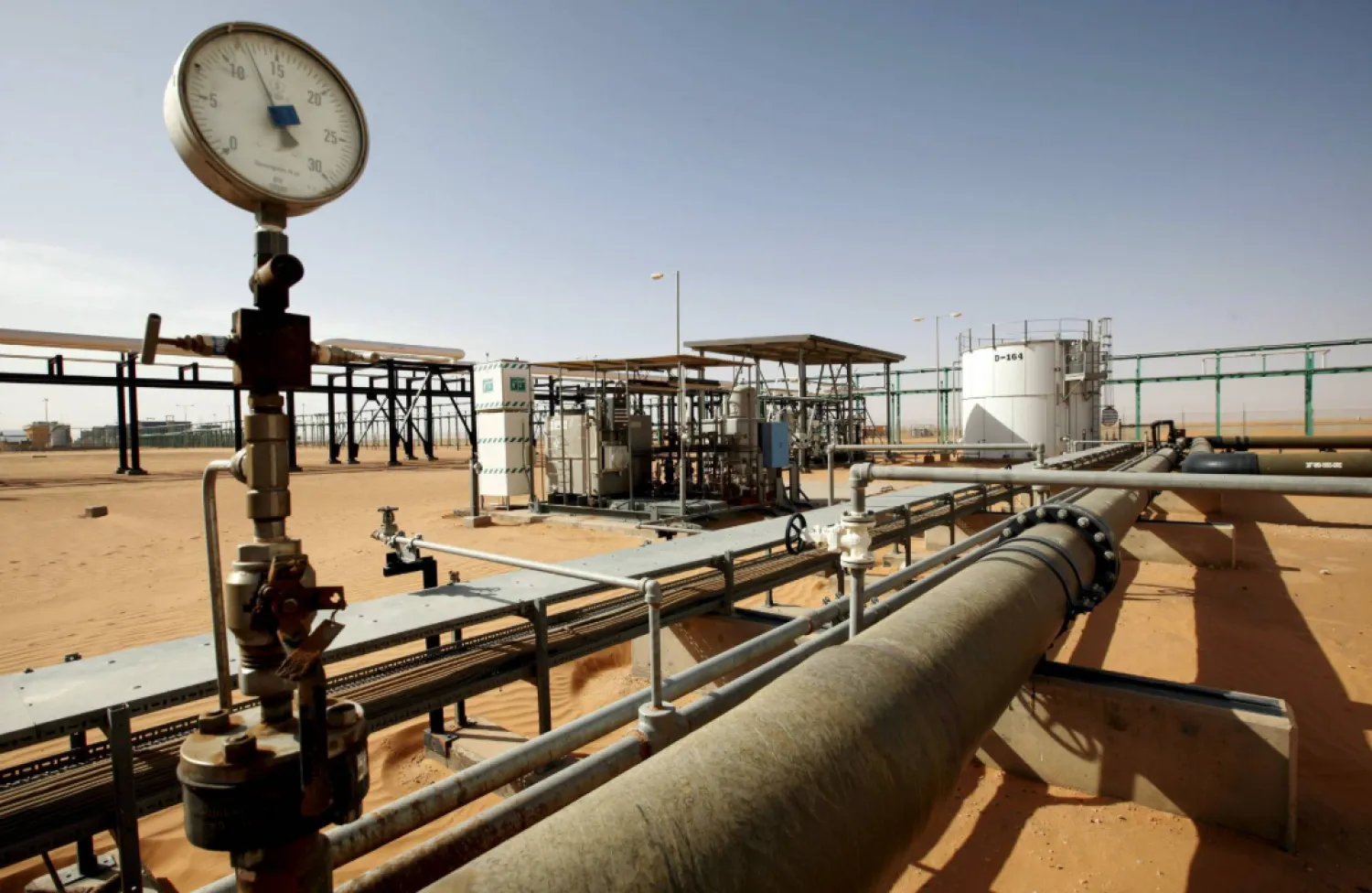
Libya's National Oil Corporation said on Tuesday that the Sharara-Zawiya crude loading pipeline closure has led to daily losses of about 130,000 barrels per day, Reuters reported.

An armed military group closed valve seven on the Sharara crude pipeline to Zawiya port on Monday, resulting in a significant decline in production at the Sharara oilfield, the National Oil Corporation said in a statement.


Sources: Saudi Arabia Restarts East-West Oil Pipeline

FILE PHOTO: A model of an oil pump is seen in front of a Saudi Arabian flag in this illustration taken January 9, 2026. REUTERS/Dado Ruvic/Illustration/File Photo
TT

Sources: Saudi Arabia Restarts East-West Oil Pipeline

FILE PHOTO: A model of an oil pump is seen in front of a Saudi Arabian flag in this illustration taken January 9, 2026. REUTERS/Dado Ruvic/Illustration/File Photo

Saudi Arabia has restarted operations at its East-West Pipeline and could resume exports from the Red Sea port of Yanbu later on Tuesday, three sources briefed on the matter said.

Drone attacks forced Saudi Arabia to shut its East-West Pipeline on September 13, halting crude loadings at the kingdom's Yanbu port.

The resumption of supplies on Tuesday helped to drive selling on global oil markets, traders said. Brent crude futures fell by more than $2 a barrel to its lowest since September 8.

Two trading sources said traders were getting ready for Saudi oil loadings by moving tankers to Egypt's Mediterranean Port Said for ship-to-ship transfers and also to Sidi Kerir.