

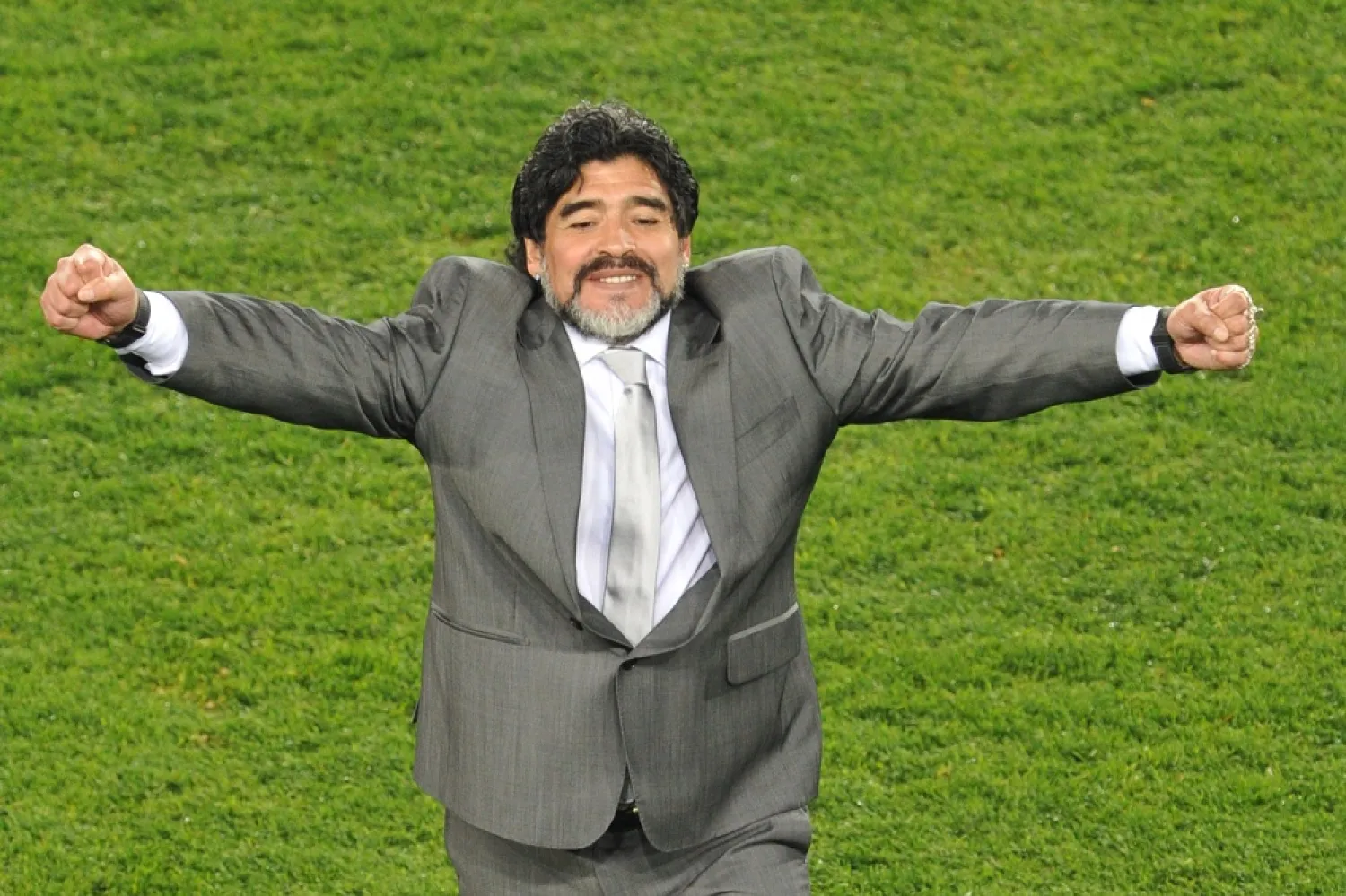

Football Legend Maradona Dies at 60

Diego Maradona. (AFP)
TT

Football Legend Maradona Dies at 60

Diego Maradona. (AFP)

Diego Maradona, the Argentine football great who was among the best players ever and who led his country to the 1986 World Cup title before later struggling with cocaine use and obesity, has died. He was 60.

The office of Argentina's president will decree three days of national mourning because of Maradona's death on Wednesday, and the Argentine football association expressed its sorrow on Twitter.

Maradona died two weeks after being released from a Buenos Aires hospital following brain surgery.

Famed for the “Hand of God” goal in which he punched the ball into England’s net during the 1986 World Cup quarterfinals, Maradona captivated fans over a two-decade career with a bewitching style of play that was all his own.

Although his reputation was tarnished by his addictions and an ill-fated spell in charge of the national team, he remained idolized in football-mad Argentina as the “Pibe de Oro” or “Golden Boy.”

The No. 10 he wore on his jersey became synonymous with him, as it also had with Pele, the Brazilian great with whom Maradona was regularly paired as the best of all time.

Bold, fast and utterly unpredictable, Maradona was a master of attack, juggling the ball easily from one foot to the other as he raced upfield. Dodging and weaving with his low center of gravity, he shrugged off countless rivals and often scored with a devastating left foot, his most powerful weapon.

“Everything he was thinking in his head, he made it happen with his feet,” said Salvatore Bagni, who played with Maradona at Italian club Napoli.

A ballooning waistline slowed Maradona’s explosive speed later in his career and by 1991 he was snared in his first doping scandal when he admitted to a cocaine habit that haunted him until he retired in 1997, at 37.

Hospitalized near death in 2000 and again in ’04 for heart problems blamed on cocaine, he later said he overcame the drug problem. Cocaine, he once said famously, had proven to be his “toughest rival.”

But more health problems followed, despite a 2005 gastric bypass that greatly trimmed his weight. Maradona was hospitalized in early 2007 for acute hepatitis that his doctor blamed on excessive drinking and eating.

He made an unlikely return to the national team in 2008 when he was appointed Argentina coach, but after a quarterfinal exit at the 2010 World Cup in South Africa, he was ousted — ultimately picking up another coaching job with the United Arab Emirates club Al Wasl.

Maradona was the fifth of eight children who grew up in a poor, gritty barrio on the Buenos Aires outskirts where he played a kind of dirt-patch football that launched many Argentines to international stardom.

None of them approached Maradona’s fame. In 2001, FIFA named Maradona one of the two greatest in the sport’s history, alongside Pele.

“Maradona inspires us,” said then-Argentina striker Carlos Tevez, explaining his country’s everyman fascination with Maradona at the 2006 World Cup in Germany. “He’s our idol, and an idol for the people.”

Maradona reaped titles at home and abroad, playing in the early 1980s for Argentinos Juniors and Boca Juniors before moving on to Spanish and Italian clubs. His crowning achievement came at the 1986 World Cup, captaining Argentina in its 3-2 win over West Germany in the final and decisive in a 2-1 victory against England in a feisty quarterfinal match.

Over the protests of England goalkeeper Peter Shilton, the referee let stand a goal by Maradona in which, as he admitted years later, he intentionally hit the ball with his hand in “a bit of mischief.”

But Maradona’s impact wouldn’t be confined to cheating. Four minutes later, he spectacularly weaved past four opponents from midfield to beat Shilton for what FIFA later declared the greatest goal in World Cup history.

Many Argentines saw the match as revenge for their country’s loss to Britain in the 1982 war over the Falkland Islands, which Argentines still claim as “Las Malvinas.”

“It was our way of recovering ‘Las Malvinas,’” Maradona wrote in his 2000 autobiography “I am Diego.”

“It was more than trying to win a game. We said the game had nothing to do with the war. But we knew that Argentines had died there, that they had killed them like birds. And this was our revenge. It was something bigger than us: We were defending our flag.”

It also was vindication for Maradona, who in what he later called “the greatest tragedy” of his career was cut from the squad of the 1978 World Cup — which Argentina won at home — because he was only 17.

Maradona said he was given a football ball soon after he could run.

“I was 3 years old and I slept hugging that ball all night,” he said.

At 10, Maradona gained fame by performing at halftime of professional matches, wowing crowds by keeping the ball airborne for minutes with his feet, chest and head. He also made his playing debut with the Argentinos Juniors youth team, leading a squad of mostly 14-year-olds through 136 unbeaten matches.

“To see him play was pure bliss, true stardom,” teammate Carlos Beltran said.

Maradona played from 1976-81 for first division club Argentinos Juniors, then went to Boca Juniors for a year before heading to Barcelona for a world-record $8 million.

In 1984, Barcelona sold him to Napoli, in Italy. He remade its fortunes almost single-handedly, taking it to the 1987 Italian league championship for its first title in 60 years.

A year after losing the 1990 World Cup final to West Germany, Maradona moved to Spanish club Sevilla, but his career was on the decline. He played five matches at Argentine club Newell’s Old Boys in 1994 before returning to Boca from 1995-97 — his final club and closest to his heart.

Drug problems overshadowed his final playing years.

Maradona failed a doping test in 1991 and was banned for 15 months, acknowledging his longtime cocaine addiction. He failed another doping test for stimulants and was thrown out of the 1994 World Cup in the United States.

In retirement, Maradona frequented Boca matches as a raucous one-man cheering section and took part in worldwide charity, sporting and exhibition events. But the already stocky forward quickly gained weight and was clearly short of breath as he huffed through friendly matches.

In 2000, in what doctors said was a brush with death, he was hospitalized in the Uruguayan resort of Punta del Este with a heart that doctors said was pumping at less than half its capacity. Blood and urine samples turned up traces of cocaine.

After another emergency hospitalization in 2004, Maradona was counseled for drug abuse and in September of that year traveled to Cuba for treatment at Havana’s Center for Mental Health. There he was visited by his friend, Cuban President Fidel Castro.

In Cuba, Maradona took to playing golf and smoking cigars. He frequently praised Castro and Argentine-born revolutionary “Che” Guevara, who fought with Castro in the Cuban revolution — even sporting a tattoo of Guevara on his right arm.

Maradona said he got clean from drugs there and started a new chapter.

In 2005, he underwent gastric bypass in Colombia, shedding nearly 50 kilograms (more than 100 pounds) before appearing as host of a wildly popular Argentine television talk show. On “10’s Night,” Maradona headed around a ball with Pele, interviewed boxer Mike Tyson and Hollywood celebrities, and taped a lengthy conversation with Castro in Cuba.

In retirement, Maradona also became more outspoken. He sniped frequently at former coaches, players — including Pele — and the pope. He joined a left-wing protest train outside the Summit of the Americas in 2005, standing alongside Venezuelan President Hugo Chavez to denounce the presence of then-President George W. Bush.

His outsider status made it all the more surprising when he was chosen as Argentina coach following Alfio Basile’s resignation.

He won his first three matches but his tactics, selection and attention to detail were all questioned after a 6-1 loss to Bolivia in World Cup qualifying equaled Argentina’s worst-ever margin of defeat.

Victor Hugo Morales, Argentina’s most popular football broadcaster, said Maradona will ultimately be remembered for a thrilling style of play that has never been duplicated.

“He has been one of the great artists of my time. Like great masters of music and painting, he has defied our intellect and enriched the human spirit,” Morales said. “Nobody has thrilled me more and left me in such awe as Diego."



PSG’s Mental Strength Hailed as they Come from Behind to Win at Monaco

Soccer Football - UEFA Champions League - Play Off - First Leg - AS Monaco v Paris St Germain - Stade Louis II, Monaco - February 17, 2026 Paris St Germain coach Luis Enrique reacts REUTERS/Manon Cruz
TT

PSG’s Mental Strength Hailed as they Come from Behind to Win at Monaco

Soccer Football - UEFA Champions League - Play Off - First Leg - AS Monaco v Paris St Germain - Stade Louis II, Monaco - February 17, 2026 Paris St Germain coach Luis Enrique reacts REUTERS/Manon Cruz

Paris Saint-Germain coach Luis ‌Enrique hailed the mental strength of his side in coming from two goals down to win 3-2 away at Monaco in the Champions League on Tuesday, but warned the knockout round tie was far from finished.

The first leg clash between the two Ligue 1 clubs saw Folarin Balogun score twice for the hosts in the opening 18 minutes before Vitinha had his penalty saved to compound matters.

But after Desire Doue came on for injured Ousmane Dembele, the ‌match turned ‌and defending champions PSG went on to ‌secure ⁠a one-goal advantage ⁠for the return leg.

"Normally, when a team starts a match like that, the most likely outcome is a loss,” Reuters quoted Luis Enrique as saying.

“It was catastrophic. It's impossible to start a match like that. The first two times they overcame our pressure and entered our half, they scored. They ⁠made some very good plays.

“After that, it's difficult ‌to have confidence, but we ‌showed our mental strength. Plus, we missed a penalty, so ‌it was a chance to regain confidence. In the ‌last six times we've played here, this is only the second time we've won, which shows how difficult it is.”

The 20-year-old Doue scored twice and provided a third for Achraf Hakimi, just ‌days after he had turned in a poor performance against Stade Rennais last Friday ⁠and was ⁠dropped for the Monaco clash.

“I'm happy for him because this past week, everyone criticized and tore Doue apart, but he was sensational, he showed his character. He helped the team at the best possible time.”

Dembele’s injury would be assessed, the coach added. “He took a knock in the first 15 minutes, then he couldn't run.”

The return leg at the Parc des Princes will be next Wednesday. “Considering how the match started, I'm happy with the result. But the match in Paris will be difficult, it will be a different story,” Luis Enrique warned.


Mbappe Calls for Prestianni Ban over Alleged Racist Slur at Vinicius

TOPSHOT - Real Madrid's French forward #10 Kylian Mbappe talks with SL Benfica's Portuguese head coach Jose Mourinho during the UEFA Champions League knockout round play-off first leg football match between SL Benfica and Real Madrid CF at Estadio da Luz in Lisbon on February 17, 2026. (Photo by PATRICIA DE MELO MOREIRA / AFP)
TT

Mbappe Calls for Prestianni Ban over Alleged Racist Slur at Vinicius

TOPSHOT - Real Madrid's French forward #10 Kylian Mbappe talks with SL Benfica's Portuguese head coach Jose Mourinho during the UEFA Champions League knockout round play-off first leg football match between SL Benfica and Real Madrid CF at Estadio da Luz in Lisbon on February 17, 2026. (Photo by PATRICIA DE MELO MOREIRA / AFP)

Real Madrid forward Kylian Mbappe said Benfica's Gianluca Prestianni should be banned from the Champions League after the Argentine was accused of directing a racist slur at Vinicius Jr during the Spanish side's 1-0 playoff first-leg win on Tuesday.

Denying the accusation, Prestianni said the Brazilian misheard him.

The incident occurred shortly after Vinicius had curled Real into the lead five minutes into the second half in Lisbon.

Television footage showed the Argentine winger covering his mouth with his shirt before making a comment that Vinicius and nearby teammates interpreted as a racial ‌slur against ‌the 25-year-old, with referee Francois Letexier halting the match for ‌11 ⁠minutes after activating ⁠FIFA's anti-racism protocols.

The footage appeared to show an outraged Mbappe calling Prestianni "a bloody racist" to his face, Reuters reported.

The atmosphere grew hostile after play resumed, with Vinicius and Mbappe loudly booed by the home crowd whenever they touched the ball. Despite the rising tensions, the players were able to close out the game without further interruptions.

"I want to clarify that at no time did I direct racist insults to Vini Jr, ⁠who regrettably misunderstood what he thought he heard," Prestianni wrote ‌on his Instagram account.

"I was never racist with ‌anyone and I regret the threats I received from Real Madrid players."

Mbappe told reporters he ‌heard Prestianni direct the same racist remark at Vinicius several times, an allegation ‌also levelled by Real's French midfielder Aurelien Tchouamen.

Mbappe said he had been prepared to leave the pitch but was persuaded by Vinicius to continue playing.

"We cannot accept that there is a player in Europe's top football competition who behaves like this. This guy (Prestianni) doesn't ‌deserve to play in the Champions League anymore," Mbappe told reporters.

"We have to set an example for all the children ⁠watching us at ⁠home. What happened today is the kind of thing we cannot accept because the world is watching us.

When asked whether Prestianni had apologized, Mbappe laughed.

"Of course not," he said.

Vinicius later posted a statement on social media voicing his frustration.

"Racists are, above all, cowards. They need to cover their mouth with their shirt to show how weak they are. But they have the protection of others who, theoretically, have an obligation to punish them. Nothing that happened today is new in my life or my family's life," Vinicius wrote.

The Brazilian has faced repeated racist abuse in Spain, with 18 legal complaints filed against racist behavior targeting Vinicius since 2022.

Real Madrid and Benfica will meet again for the second leg next Wednesday at the Bernabeu.


Second Season of ‘Kings League–Middle East' to Kick off in March in Riyadh 

The second season of the Kings League-Middle East will kick off in Riyadh on March 27. (Kings League-Middle East on X)
TT

Second Season of ‘Kings League–Middle East' to Kick off in March in Riyadh 

The second season of the Kings League-Middle East will kick off in Riyadh on March 27. (Kings League-Middle East on X)

The Kings League-Middle East announced that its second season will kick off in Riyadh on March 27.

The season will feature 10 teams, compared to eight in the inaugural edition, under a format that combines sporting competition with digital engagement and includes the participation of several content creators from across the region.

The Kings League-Middle East is organized in partnership with SURJ Sports Investments, a subsidiary of the Public Investment Fund (PIF), as part of efforts to support the development of innovative sports models that integrate football with digital entertainment.

Seven teams will return for the second season: DR7, ABO FC, FWZ, Red Zone, Turbo, Ultra Chmicha, and 3BS. Three additional teams are set to be announced before the start of the competition.

Matches of the second season will be held at Cool Arena in Riyadh under a single round-robin format, with the top-ranked teams advancing to the knockout stages, culminating in the final match.

The inaugural edition recorded strong attendance and wide digital engagement, with approximately a million viewers following the live broadcasts on television and digital platforms.