


EU Nations on Med Coast Renew Push for Migrant Quotas

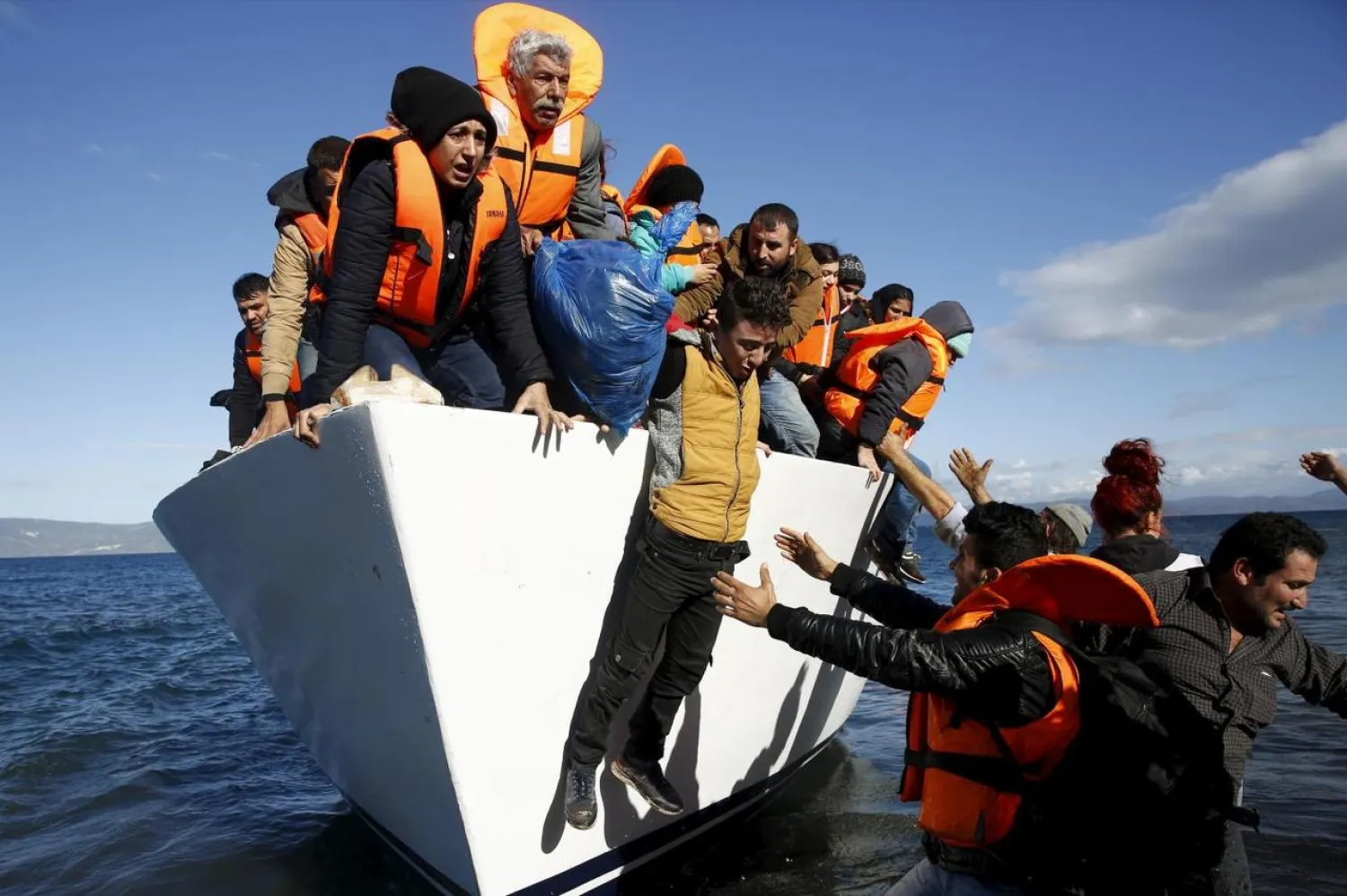
Refugees and migrants jump off a boat as they arrive on the Greek island of Lesbos, November 26, 2015. REUTERS/Giorgos Moutafis
TT

EU Nations on Med Coast Renew Push for Migrant Quotas

Refugees and migrants jump off a boat as they arrive on the Greek island of Lesbos, November 26, 2015. REUTERS/Giorgos Moutafis

The four European Union countries hardest hit by the arrival of hundreds of thousands of unauthorized migrants over the past five years said Thursday they fear that new proposals to revamp the EU’s asylum system will continue to leave them shouldering most of the burden.

Greece, Italy, Malta and Spain said in a joint paper that mandatory quotas for sharing out people who qualify for refugee status among the 27 EU countries must be pursued, despite the outright rejection of such a move by Austria, the Czech Republic, Hungary, Poland, Slovakia and others.

The four's demands could be a major setback for the asylum reform plans.

“The front-line member states cannot face the migratory pressure on the whole European Union,” said the text. It was sent to the president of the European Commission, which drew up the new asylum proposals, the EU Council representing member countries and Germany, which holds the bloc’s presidency.

The entry in 2015 of well over 1 million migrants, mostly people fleeing conflict in Syria, sounded the death knell for the EU’s asylum system, and sparked a deep political crisis that continues to echo even though entries have dropped to a relative trickle.

The row over who should take responsibility for people when they arrive and how much other EU countries should assist has helped fuel public support for far-right parties across the bloc. Populist governments in Hungary and Poland, notably, challenged a previous system of migrant quotas at Europe’s top court.

In the text, seen by The Associated Press, Greece, Italy, Malta and Spain argue that their responsibilities as countries where most unauthorized migrants arrive across the Mediterranean Sea are strict and clear in the “New Pact for Migration and Asylum,” but that the duties of their EU partners are not.

“The solidarity mechanism remains complex and vague,” the four countries said.

“The notion of mandatory relocation should remain and be pursued as the main solidarity tool,” the text continued.

Under the proposed reforms, migrants arriving at Europe’s outside borders without permission to enter would be screened within five days. They would then enter an asylum procedure or be deported, both within 12 weeks. People could be held in detention and would not be deemed to have officially entered the EU.

EU countries would then face two choices: take in some of the refugees or provide other material and logistical support; or if they are not willing to do that, they could take charge of deporting people whose applications are refused. Mandatory refugee quotas have been abandoned.

Broadly speaking, countries that agree to host refugees would receive 10,000 euros ($11,900) per person in assistance from the EU’s coffers. The others, dubbed “Europe’s bouncers,” would have up to eight months to deport people not allowed in or be forced to accept them.

In recent years, only about a third of all people ordered to be sent home were actually deported.

Germany has said it wants to reach a political agreement between EU countries and the European Parliament on the asylum reforms by the end of the year, in the hope that they could be officially endorsed early in 2021.



Top Trump Iran Negotiator Says Visits US Aircraft Carrier in Middle East

US Special Envoy Steve Witkoff delivers a press conference upon the signing of the declaration on deploying post-ceasefire force in Ukraine, during the so-called "Coalition of the Willing" summit, at the Elysee Palace in Paris, France, January 6, 2026. (Reuters)
TT

Top Trump Iran Negotiator Says Visits US Aircraft Carrier in Middle East

US Special Envoy Steve Witkoff delivers a press conference upon the signing of the declaration on deploying post-ceasefire force in Ukraine, during the so-called "Coalition of the Willing" summit, at the Elysee Palace in Paris, France, January 6, 2026. (Reuters)

US President Donald Trump's lead Iran negotiator Steve Witkoff on Saturday said he visited the USS Abraham Lincoln aircraft carrier currently in the Arabian Sea, with Washington and Tehran due to hold further talks soon.

"Today, Adm. Brad Cooper, Commander of US Naval Forces Central Command, Jared Kushner, and I met with the brave sailors and Marines aboard the USS Abraham Lincoln, her strike group, and Carrier Air Wing 9 who are keeping us safe and upholding President Trump's message of peace through strength," said Witkoff in a social media post.

Iranian Foreign Minister Abbas Araghchi said on Saturday he hoped talks with the United States would resume soon, while reiterating Tehran's red lines and warning against any American attack.


Israel’s Netanyahu Expected to Meet Trump in US on Wednesday and Discuss Iran

Israeli Prime Minister Benjamin Netanyahu delivers a speech during a special session to mark the 77th anniversary of the Knesset's establishment and the 60th anniversary of the dedication of the current building at the Knesset, the Israeli parliament, in Jerusalem, 02 February 2026. (EPA)
TT

Israel’s Netanyahu Expected to Meet Trump in US on Wednesday and Discuss Iran

Israeli Prime Minister Benjamin Netanyahu delivers a speech during a special session to mark the 77th anniversary of the Knesset's establishment and the 60th anniversary of the dedication of the current building at the Knesset, the Israeli parliament, in Jerusalem, 02 February 2026. (EPA)

Israeli Prime Minister Benjamin Netanyahu is expected to meet US President Donald Trump on Wednesday in Washington, where they will discuss negotiations with Iran, Netanyahu's office said on Saturday.

Iranian and US officials held indirect nuclear ‌talks in the ‌Omani capital ‌Muscat ⁠on Friday. ‌Both sides said more talks were expected to be held again soon.

A regional diplomat briefed by Tehran on the talks told Reuters Iran insisted ⁠on its "right to enrich uranium" ‌during the negotiations with ‍the US, ‍and that Tehran's missile capabilities ‍were not raised in the discussions.

Iranian officials have ruled out putting Iran's missiles - one of the largest such arsenals in the region - up ⁠for discussion, and have said Tehran wants recognition of its right to enrich uranium.

"The Prime Minister believes that any negotiations must include limiting ballistic missiles and halting support for the Iranian axis," Netanyahu's office said in a ‌statement.


Italy FM Rules Out Joining Trump’s ‘Board of Peace’

Italy's Minister for Foreign Affairs Antonio Tajani speaks to the press during the EPP Leaders’ meeting, in Zagreb, Croatia, 30 January 2026. (EPA)
TT

Italy FM Rules Out Joining Trump’s ‘Board of Peace’

Italy's Minister for Foreign Affairs Antonio Tajani speaks to the press during the EPP Leaders’ meeting, in Zagreb, Croatia, 30 January 2026. (EPA)

Italy will not take part in US President Donald Trump's "Board of Peace", Italian Foreign Minister Antonio Tajani said Saturday, citing "insurmountable" constitutional issues.

Trump launched his "Board of Peace" at the World Economic Forum in Davos in January and some 19 countries have signed its founding charter.

But Italy's constitution bars the country from joining an organization led by a single foreign leader.

Prime Minister Giorgia Meloni, a Trump ally, last month noted "constitutional problems" with joining, but suggested Trump could perhaps reopen the framework "to meet the needs not only of Italy, but also of other European countries".

Tajani appeared Saturday to rule that out.

"We cannot participate in the Board of Peace because there is a constitutional limit," he told the ANSA news agency.

"This is insurmountable from a legal standpoint," he said, the day after meeting US Secretary of State Marco Rubio and US Vice President JD Vance at the Olympics in Milan.

Although originally meant to oversee Gaza's rebuilding, the board's charter does not limit its role to the Palestinian territory and appears to want to rival the United Nations.