


Germany Preps Vaccine Drive as COVID Cases Hit 1 Million

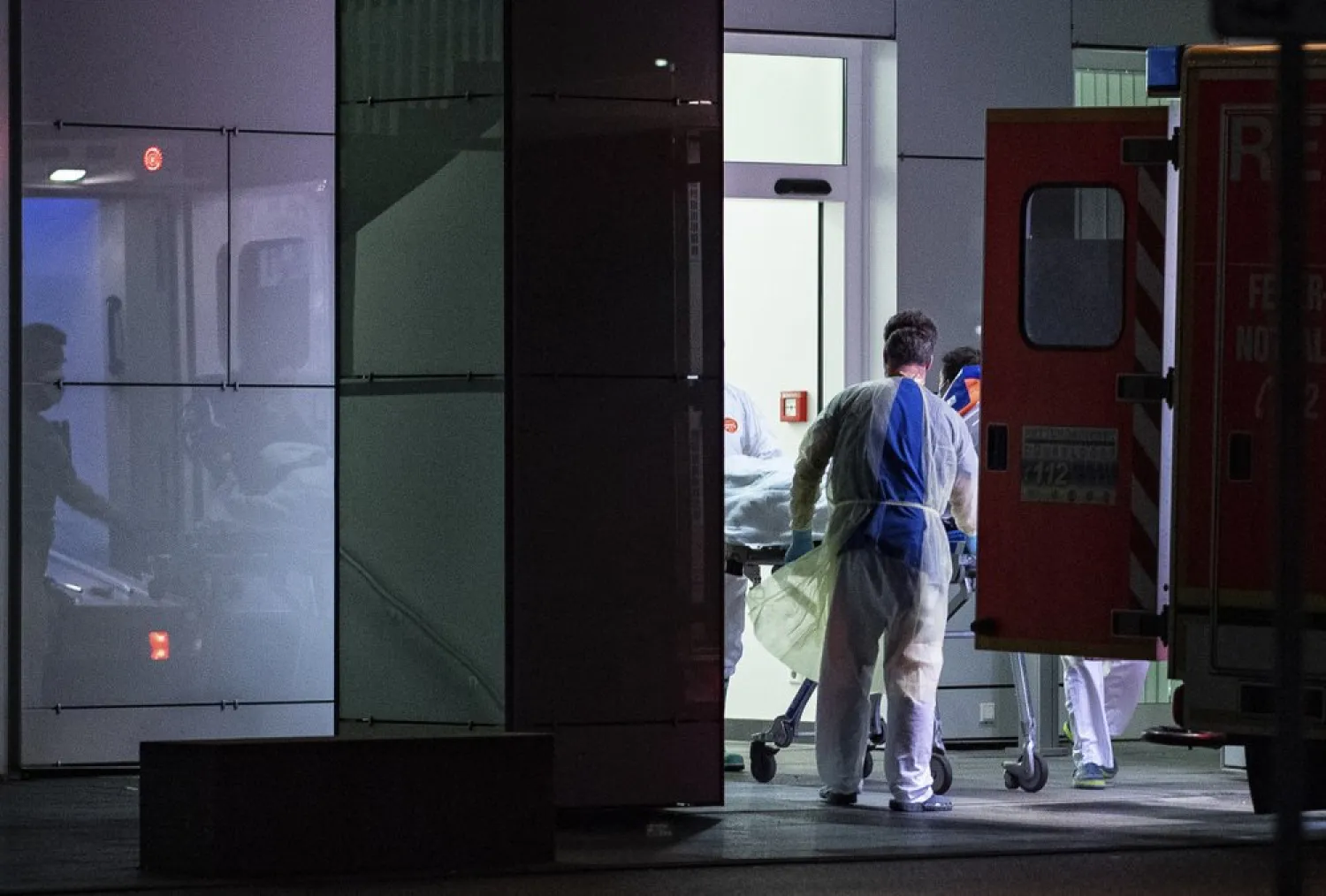
Medical staff in carry the first person infected with the coronavirus in the German state of North Rhine Westphalia out of an ambulance into the Liver and Infection Center of the University Hospital in Duesseldorf, Germany, Wednesday, Feb 26, 2020. (Guido Kirchner/dpa via AP)
TT

Germany Preps Vaccine Drive as COVID Cases Hit 1 Million

Medical staff in carry the first person infected with the coronavirus in the German state of North Rhine Westphalia out of an ambulance into the Liver and Infection Center of the University Hospital in Duesseldorf, Germany, Wednesday, Feb 26, 2020. (Guido Kirchner/dpa via AP)

Hulking gray boxes are rolling off the production line at a factory in the southern town of Tuttlingen, ready to be shipped to the front in the next phase of Germany's battle against the coronavirus as it became the latest country to hit the milestone of 1 million confirmed cases Friday.

Man-sized freezers such as those manufactured by family-owned firm Binder GmbH could become a key part of the vast immunization program the German government is preparing to roll out when the first vaccines become available next month.

That's because one of the front-runners in the race for a vaccine is BioNTech, a German company that together with US pharmaceutical giant Pfizer has developed a shot it says is up to 96% effective in trials but comes with a small hitch: it needs to be cooled to minus 70 degrees Celsius (minus 94 degrees Fahrenheit) for shipping and storage.

Ensuring such temperatures, colder even than an Antarctic winter, is just one of the many challenges that countries face in trying to get their populations immunized.

The effort has been compared to a military operation. Indeed some countries, including Germany, are relying on military and civilian expertise to ensure the precious doses are safely transported from manufacturing plants to secret storage facilities, before being distributed.

Germany has benefited from the market power that comes with being a member of the European Union. The 27-nation bloc’s executive Commission — led by former German Defense Minister Ursula von der Leyen — has spearheaded negotiations with vaccine makers, ordering more than a billion doses so far.

German officials have said the country hopes to secure up to 300 million doses from the EU orders and bilateral deals with three manufacturers in Germany, including BioNTech and CureVac, a company based in Tuebingen that says its vaccine can be stored at regular refrigerator temperatures for up to three months. Its trials are not as far along, however, as Pfizer/BioNTech and others.

The figure of 300 million is contingent on all vaccines being developed making it to market. That would be more than enough to immunize Germany's population of 83 million, even if two shots are required, as seems likely.

How exactly the vaccine is delivered to patients differs from country to country. In Germany, the federal government has delegated the task to its 16 states, which are now working to build large vaccination centers.

The city-state of Berlin has drafted in Albrecht Broemme, a veteran of disaster management. The former Berlin fire chief later led Germany's federal civil protection organization THW, where he helped organize disaster relief operations for floods, storms and quakes around the world.

The 67-year-old is now coordinating the setting-up of six vaccine hubs in Berlin in a convention center, two former airports, an ice skating rink, a concert hall and an indoor cycle race track, The Associated Press repored.

Authorities want them ready by mid-December to begin vaccinating more than 3,000 people per day at each location. With just a few minutes to deliver each shot and mindful of keeping the number of people in each center at a minimum, Broemme and his colleagues are devising a one-way flow system similar to that found in large stores like furniture company Ikea.

Each site will be run by a medical aid group, such as the Red Cross, with volunteers to help register and guide people through the venue.

Like elsewhere, the first phase of vaccination in Berlin will likely focus on immunizing health care workers and vulnerable groups such as the elderly and those with chronic illnesses. About 20,000 people will be vaccinated each day, returning after three weeks for a booster shot.

Demand is likely to outstrip supply at first, but that will change as more vaccines come onto the market.

“We're hopeful that approvals in the field of vaccination will be issued very quickly,” German Chancellor Angela Merkel told parliament on Thursday. “That won't solve the problem immediately, but there's a light at the end of the tunnel.”

Broemme has said he expects four-fifths of the vaccines initially available to need ultra-low cooling. That means every center will need a pharmacy that handles both the storage and thawing of vaccines.

At the other end of the country in Tuttlingen, Binder GmbH, one of hundreds of medical device manufacturers in the town, some with a history dating back to the 19th century, is seeing demand for its freezers surge.

Priced at 13,000-15,000 euros ($15,500-17,900), each device can keep tens of thousands of vials of vaccine at optimum temperature, says Peter Wimmer, the company's head of innovation.

“It’s plug and play," he told the AP. "All you need is an electrical socket, switch it on and the device is ready to go.”

Having the whole vaccination system ready to go at the touch of a button is a different matter, though.

It is still unclear who will actually administer the vaccines in Berlin. Unlike Britain, which has a centralized National Health Service organizing the immunization drive, Germany is relying on doctors associations to provide the necessary medical staff.

Doerthe Arnold, a spokeswoman for the Berlin branch of Germany's Association of Statutory Health Insurance Physicians, said they are still waiting for the state government to provide details on what will be required of doctors.

“Despite the positive feedback from doctors practices that they're willing to help out even more, providing medical personnel for the six vaccination centers will be a challenge,” she said.

The limits of medical logistics were tested in spring, when huge worldwide demand for ventilators, therapeutic drugs, face masks and other protective equipment prompted bidding wars, bottlenecks and reports of faulty products.

Global logistics company DHL estimates that to provide worldwide coverage of vaccines over the coming two years may require 15,000 flights.

“The challenge is the sheer number of doses and the fact that it’s not clear which vaccine needs to go where,” Sabine Hartmann, a DHL spokeswoman, told AP.

“It’s not something a single company can do on its own. All logistics companies have to work together on this.”



Top Trump Iran Negotiator Says Visits US Aircraft Carrier in Middle East

US Special Envoy Steve Witkoff delivers a press conference upon the signing of the declaration on deploying post-ceasefire force in Ukraine, during the so-called "Coalition of the Willing" summit, at the Elysee Palace in Paris, France, January 6, 2026. (Reuters)
TT

Top Trump Iran Negotiator Says Visits US Aircraft Carrier in Middle East

US Special Envoy Steve Witkoff delivers a press conference upon the signing of the declaration on deploying post-ceasefire force in Ukraine, during the so-called "Coalition of the Willing" summit, at the Elysee Palace in Paris, France, January 6, 2026. (Reuters)

US President Donald Trump's lead Iran negotiator Steve Witkoff on Saturday said he visited the USS Abraham Lincoln aircraft carrier currently in the Arabian Sea, with Washington and Tehran due to hold further talks soon.

"Today, Adm. Brad Cooper, Commander of US Naval Forces Central Command, Jared Kushner, and I met with the brave sailors and Marines aboard the USS Abraham Lincoln, her strike group, and Carrier Air Wing 9 who are keeping us safe and upholding President Trump's message of peace through strength," said Witkoff in a social media post.

Iranian Foreign Minister Abbas Araghchi said on Saturday he hoped talks with the United States would resume soon, while reiterating Tehran's red lines and warning against any American attack.


Israel’s Netanyahu Expected to Meet Trump in US on Wednesday and Discuss Iran

Israeli Prime Minister Benjamin Netanyahu delivers a speech during a special session to mark the 77th anniversary of the Knesset's establishment and the 60th anniversary of the dedication of the current building at the Knesset, the Israeli parliament, in Jerusalem, 02 February 2026. (EPA)
TT

Israel’s Netanyahu Expected to Meet Trump in US on Wednesday and Discuss Iran

Israeli Prime Minister Benjamin Netanyahu delivers a speech during a special session to mark the 77th anniversary of the Knesset's establishment and the 60th anniversary of the dedication of the current building at the Knesset, the Israeli parliament, in Jerusalem, 02 February 2026. (EPA)

Israeli Prime Minister Benjamin Netanyahu is expected to meet US President Donald Trump on Wednesday in Washington, where they will discuss negotiations with Iran, Netanyahu's office said on Saturday.

Iranian and US officials held indirect nuclear ‌talks in the ‌Omani capital ‌Muscat ⁠on Friday. ‌Both sides said more talks were expected to be held again soon.

A regional diplomat briefed by Tehran on the talks told Reuters Iran insisted ⁠on its "right to enrich uranium" ‌during the negotiations with ‍the US, ‍and that Tehran's missile capabilities ‍were not raised in the discussions.

Iranian officials have ruled out putting Iran's missiles - one of the largest such arsenals in the region - up ⁠for discussion, and have said Tehran wants recognition of its right to enrich uranium.

"The Prime Minister believes that any negotiations must include limiting ballistic missiles and halting support for the Iranian axis," Netanyahu's office said in a ‌statement.


Italy FM Rules Out Joining Trump’s ‘Board of Peace’

Italy's Minister for Foreign Affairs Antonio Tajani speaks to the press during the EPP Leaders’ meeting, in Zagreb, Croatia, 30 January 2026. (EPA)
TT

Italy FM Rules Out Joining Trump’s ‘Board of Peace’

Italy's Minister for Foreign Affairs Antonio Tajani speaks to the press during the EPP Leaders’ meeting, in Zagreb, Croatia, 30 January 2026. (EPA)

Italy will not take part in US President Donald Trump's "Board of Peace", Italian Foreign Minister Antonio Tajani said Saturday, citing "insurmountable" constitutional issues.

Trump launched his "Board of Peace" at the World Economic Forum in Davos in January and some 19 countries have signed its founding charter.

But Italy's constitution bars the country from joining an organization led by a single foreign leader.

Prime Minister Giorgia Meloni, a Trump ally, last month noted "constitutional problems" with joining, but suggested Trump could perhaps reopen the framework "to meet the needs not only of Italy, but also of other European countries".

Tajani appeared Saturday to rule that out.

"We cannot participate in the Board of Peace because there is a constitutional limit," he told the ANSA news agency.

"This is insurmountable from a legal standpoint," he said, the day after meeting US Secretary of State Marco Rubio and US Vice President JD Vance at the Olympics in Milan.

Although originally meant to oversee Gaza's rebuilding, the board's charter does not limit its role to the Palestinian territory and appears to want to rival the United Nations.