


The Long Road to US Charges Against ISIS 'Beatles'

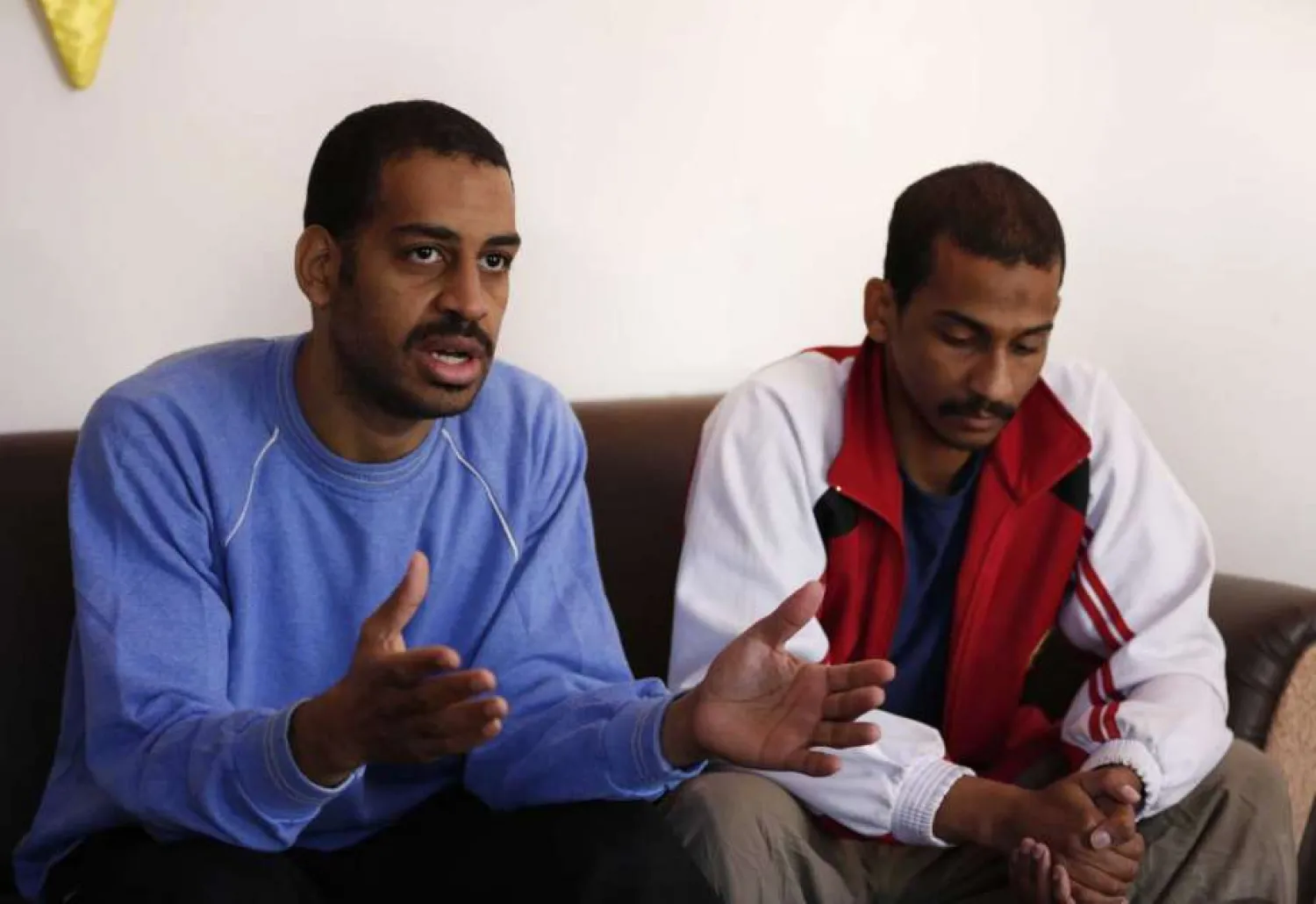
In this March 30, 2019, file photo, Alexanda Amon Kotey, left, and El Shafee Elsheikh, who were allegedly among four British militants who made up a brutal ISIS cell dubbed "The Beatles," speak during an interview with The Associated Press at a security center in Kobani, Syria. (AP Photo/Hussein Malla, File)
TT

The Long Road to US Charges Against ISIS 'Beatles'

In this March 30, 2019, file photo, Alexanda Amon Kotey, left, and El Shafee Elsheikh, who were allegedly among four British militants who made up a brutal ISIS cell dubbed "The Beatles," speak during an interview with The Associated Press at a security center in Kobani, Syria. (AP Photo/Hussein Malla, File)

As two ISIS militants faced a judge in Virginia, Diane Foley listened from home through a muffled phone connection. She strained to make out the voices of the men prosecutors say kidnapped her son before he was murdered.

Alexanda Kotey and El Shafee Elsheikh stand accused of belonging to an ISIS cell dubbed "the Beatles," an incongruously lighthearted nickname for Britons blamed for the jailing, torture, and murder of Western hostages in Syria.

After geopolitical breakthroughs and stalemates, military actions in Syria and court fights in London, the Justice Department´s most significant terrorism prosecution in years was finally underway in October. For Foley, who months earlier had pleaded with Attorney General William Barr to secure justice by forswearing the death penalty, that the case was happening at all felt miraculous.

"We'd met so many blocks over the years, I couldn´t believe it was happening," Foley said. "I was in awe of it, really, and almost didn´t trust it - a bit incredulous. Is this really happening?"

The prosecution is a counterterrorism success in the Trump administration's waning months. But it almost didn´t happen.

Interviews with 11 people connected to the case make clear the hurdles along the way, including a death penalty dispute that required two normally close allies, the US and UK, to navigate fundamental differences in criminal justice systems. In the end, the interviews show, grieving families reached a gradual consensus to take capital punishment off the table while a key commitment by Barr to do the same enabled the US to obtain crucial evidence it needed.

"There was never a time when I thought we didn't have any case," said John Demers, assistant attorney general for national security. But, "we didn't want to bring them here unless we had really good charges, a really strong case, and ultimately expected a conviction that was going to result in a very significant prison sentence."

The group of militants, called "the Beatles" by their captives because of their British accents, came to embody ISIS barbarism with the 2014 release of grisly propaganda videos depicting the beheadings of American hostages. The first showed James Foley, who was captured as a freelance journalist covering Syria´s civil war, kneeling in the desert in an orange jumpsuit beside a masked man in black brandishing a knife to his throat.

An airstrike killed that man, known as Jihadi John, the group´s most notorious member. Another member was prosecuted in Turkey.

Kotey and Elsheikh were captured in Syria in 2018 by American-backed Syrian forces.

Inside the Justice Department, officials weighed whether the men should be tried in the UK or US or even transferred to the US military prison at Guantanamo Bay, Cuba.

US officials initially leaned toward a UK prosecution. British authorities had accumulated compelling evidence, and US policy encouraged other nations to repatriate and prosecute their citizens who´d joined ISIS.

But the UK, which had stripped the men of their British citizenship, resisted doing the case, in part over concerns about the ability to get convictions and significant prison terms.

The British also imposed a condition on any prosecution the US might bring, refusing to share evidence without assurances the US wouldn't seek the death penalty, which was abolished in the UK. US officials considered such evidence vital.

The British eventually relented, agreeing to share evidence without the assurances. But Elsheikh's mother sued, and, last March, a British court effectively blocked the evidence-sharing.

Despite the ruling, prosecutors pressed forward. G. Zachary Terwilliger, the US attorney for the Eastern District of Virginia, whose office is handling the prosecution, argued internally that getting the defendants to the US was more important than leaving the death penalty on the table.

The families, too, began uniting around the idea of removing the death penalty from consideration. That was notable because they had not always held the same views of the case.

The executions of Foley and two other hostages, Steven Sotloff and Peter Kassig, were documented on camera, the men´s fates apparent to the world.

But the circumstances of the death of a fourth, Kayla Mueller, who prosecutors say was sexually abused by late ISIS leader Abu Bakr al-Baghdadi, were less established. Her parents initially believed keeping the death penalty on the table could be leverage to get answers.

Mueller's mother, Marsha, said in a text message the couple had not wanted anyone to die but simply wanted information. Ultimately, though, when it came to the death penalty, "The other families who we care so deeply for wanted the men brought here and this seemed to be the only way they would come."

Current and former FBI officials who had been advising the families encouraged them to speak out to prod the Trump administration. Ali Soufan, a former FBI counterterrorism agent, told the families that the straightest path to justice involved waiving the death penalty.

Other options were hardly optimal. The likelihood of a legitimate trial in Iraq, where the men were being held in U.S. military custody, was uncertain. And proceedings there would risk a human rights outcry.

Over the summer, as the families made clear their wishes to remove the death penalty from consideration and as the case dragged on without an obvious resolution, Barr agreed to break the logjam.

Barr vowed in an Aug. 18 letter to UK Home Secretary Priti Patel that the US government would forgo the death penalty, and said if the Justice Department received the evidence by Oct. 15, it would proceed with prosecution. If not, the US would transfer the men to Iraqi custody.

The evidence came, resulting in a 24-page indictment with terrorism counts punishable by life in prison.



Top Trump Iran Negotiator Says Visits US Aircraft Carrier in Middle East

US Special Envoy Steve Witkoff delivers a press conference upon the signing of the declaration on deploying post-ceasefire force in Ukraine, during the so-called "Coalition of the Willing" summit, at the Elysee Palace in Paris, France, January 6, 2026. (Reuters)
TT

Top Trump Iran Negotiator Says Visits US Aircraft Carrier in Middle East

US Special Envoy Steve Witkoff delivers a press conference upon the signing of the declaration on deploying post-ceasefire force in Ukraine, during the so-called "Coalition of the Willing" summit, at the Elysee Palace in Paris, France, January 6, 2026. (Reuters)

US President Donald Trump's lead Iran negotiator Steve Witkoff on Saturday said he visited the USS Abraham Lincoln aircraft carrier currently in the Arabian Sea, with Washington and Tehran due to hold further talks soon.

"Today, Adm. Brad Cooper, Commander of US Naval Forces Central Command, Jared Kushner, and I met with the brave sailors and Marines aboard the USS Abraham Lincoln, her strike group, and Carrier Air Wing 9 who are keeping us safe and upholding President Trump's message of peace through strength," said Witkoff in a social media post.

Iranian Foreign Minister Abbas Araghchi said on Saturday he hoped talks with the United States would resume soon, while reiterating Tehran's red lines and warning against any American attack.


Israel’s Netanyahu Expected to Meet Trump in US on Wednesday and Discuss Iran

Israeli Prime Minister Benjamin Netanyahu delivers a speech during a special session to mark the 77th anniversary of the Knesset's establishment and the 60th anniversary of the dedication of the current building at the Knesset, the Israeli parliament, in Jerusalem, 02 February 2026. (EPA)
TT

Israel’s Netanyahu Expected to Meet Trump in US on Wednesday and Discuss Iran

Israeli Prime Minister Benjamin Netanyahu delivers a speech during a special session to mark the 77th anniversary of the Knesset's establishment and the 60th anniversary of the dedication of the current building at the Knesset, the Israeli parliament, in Jerusalem, 02 February 2026. (EPA)

Israeli Prime Minister Benjamin Netanyahu is expected to meet US President Donald Trump on Wednesday in Washington, where they will discuss negotiations with Iran, Netanyahu's office said on Saturday.

Iranian and US officials held indirect nuclear ‌talks in the ‌Omani capital ‌Muscat ⁠on Friday. ‌Both sides said more talks were expected to be held again soon.

A regional diplomat briefed by Tehran on the talks told Reuters Iran insisted ⁠on its "right to enrich uranium" ‌during the negotiations with ‍the US, ‍and that Tehran's missile capabilities ‍were not raised in the discussions.

Iranian officials have ruled out putting Iran's missiles - one of the largest such arsenals in the region - up ⁠for discussion, and have said Tehran wants recognition of its right to enrich uranium.

"The Prime Minister believes that any negotiations must include limiting ballistic missiles and halting support for the Iranian axis," Netanyahu's office said in a ‌statement.


Italy FM Rules Out Joining Trump’s ‘Board of Peace’

Italy's Minister for Foreign Affairs Antonio Tajani speaks to the press during the EPP Leaders’ meeting, in Zagreb, Croatia, 30 January 2026. (EPA)
TT

Italy FM Rules Out Joining Trump’s ‘Board of Peace’

Italy's Minister for Foreign Affairs Antonio Tajani speaks to the press during the EPP Leaders’ meeting, in Zagreb, Croatia, 30 January 2026. (EPA)

Italy will not take part in US President Donald Trump's "Board of Peace", Italian Foreign Minister Antonio Tajani said Saturday, citing "insurmountable" constitutional issues.

Trump launched his "Board of Peace" at the World Economic Forum in Davos in January and some 19 countries have signed its founding charter.

But Italy's constitution bars the country from joining an organization led by a single foreign leader.

Prime Minister Giorgia Meloni, a Trump ally, last month noted "constitutional problems" with joining, but suggested Trump could perhaps reopen the framework "to meet the needs not only of Italy, but also of other European countries".

Tajani appeared Saturday to rule that out.

"We cannot participate in the Board of Peace because there is a constitutional limit," he told the ANSA news agency.

"This is insurmountable from a legal standpoint," he said, the day after meeting US Secretary of State Marco Rubio and US Vice President JD Vance at the Olympics in Milan.

Although originally meant to oversee Gaza's rebuilding, the board's charter does not limit its role to the Palestinian territory and appears to want to rival the United Nations.