


UN Experts: South Sudan's Latest Peace Effort Has Stalled

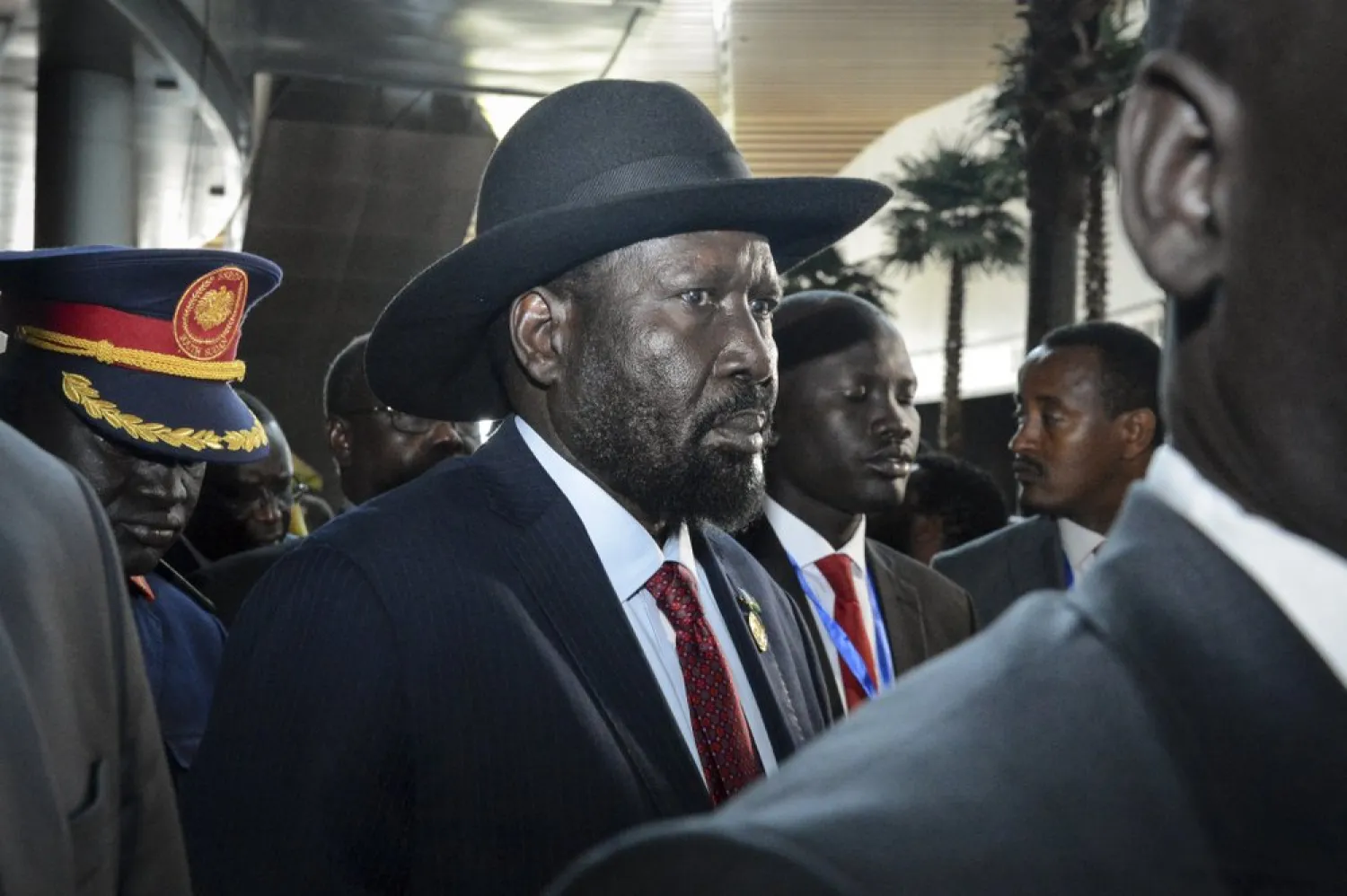
South Sudan's President Salva Kiir arrives for the opening session of the 33rd African Union (AU) Summit at the AU headquarters in Addis Ababa, Ethiopia Sunday, Feb. 9, 2020. Topics on the table for discussion included the situations in Libya and Sudan, as well as President Donald Trump's Middle East initiative. (AP Photo)
TT

UN Experts: South Sudan's Latest Peace Effort Has Stalled

South Sudan's President Salva Kiir arrives for the opening session of the 33rd African Union (AU) Summit at the AU headquarters in Addis Ababa, Ethiopia Sunday, Feb. 9, 2020. Topics on the table for discussion included the situations in Libya and Sudan, as well as President Donald Trump's Middle East initiative. (AP Photo)

UN experts said South Sudan’s latest peace effort has stalled, with the coalition government formed in February failing to meet deadlines and President Salva Kiir locking opposition leader and now First Vice President Riek Machar “out of the government’s decision-making process.”

The panel of experts said it was told by senior leaders of Machar’s Sudan People’s Liberation Movement in Opposition that the first vice-president has been “de facto under house arrest,” and that Kiir’s faction has monopolized government policies, giving opposition ministers “ceremonial roles” and also excluding them from decision-making.

“While government officials have attributed the stagnation of the peace agreement to the spread of COVID-19, multiple sources within the government, including ministers and aides close to the president, told the panel that the lack of implementation is a consequence of political disagreements,” the experts' said in the 56-page report circulated Tuesday.

There were high hopes that South Sudan would have peace and stability after gaining its long-fought independence from neighboring Sudan in 2011. But the world’s youngest nation slid into ethnic violence in December 2013, when forces loyal to Kiir, a Dinka, started battling those loyal to Machar, his former vice president who belongs to the Nuer people.

Numerous attempts at peace failed, including a deal that saw Machar return as vice president in 2016 — only to flee the country months later amid fresh fighting. The civil war has killed nearly 400,000 people and displaced millions.

Intense international pressure followed the most recent peace deal in 2018, and on Feb. 22 a coalition government led by Kiir, with Machar as his deputy, was formed. But peace still remains elusive, as the report to the UN Security Council by the panel monitoring sanctions against South Sudan clearly shows.

According to the experts, forces backed by Kiir and Machar have violated the latest cease-fire agreement. They said the formation, training and redeployment of unified forces called for in the peace agreement “has not progressed.” And they warned that inaction on peace has led the chains of command in armed groups to fracture, with some units prepared to return to conflict and some of Machar’s commanders defecting with their soldiers to the government side.

Political and security disputes within Kiir’s coalition have also contributed “to conflicts that have killed and displaced civilians” in the eastern Jonglei and Greater Pibor administrative area, the panel said.

It said the political momentum, supported by regional mediation, that led to Machar’s return “has eroded” and is needed now to spur implementation of the coalition agreement.

This is important, the panel said, because of “three emerging security risks” -- the weak chain of command in Kiir’s and especially Machar’s forces which poses significant threats for civilians, an offensive in Central and Western Equatoria by South Sudan's army, and government efforts to acquire new weapons and military training.

The panel said one of Kiir’s generals, who traveled to Uganda and Kenya in an attempt to resupply weapons and ammunition, has recruited a new force of around 500 men who reportedly received passports in October in order to travel to a regional country for training.

Resupplying weapons and ammunition to government security forces or armed groups when the peace agreement isn’t being implemented “would further threaten civilians and risk the peace and security of South Sudan,” the experts said.

The panel recommended that the Security Council continue the arms embargo against South Sudan and take measures to improve its implementation.

It said “tangible steps” to implement the peace agreement have often required consistent pressure from IGAD, the regional bloc that mediated South Sudan’s peace process, and the main guarantors of the peace agreement, Sudan and Uganda.

But since the government was formed in February, the panel said, “the lack of unity within IGAD has limited the needed high-level engagement” and Ugandan forces have continued to enter South Sudan, clashing in Eastern Equatoria with government forces in violation of the arms embargo.

It urged the region to focus on implementing the peace agreement.


Nigeria's President to Make a Sate Visit to the UK in March

Nigeria’s President Bola Tinubu gives a joint statement with Brazil’s President Luiz Inacio Lula da Silva, at the Planalto presidential palace, in Brasilia, Brazil, Aug. 25, 2025. (AP Photo/Eraldo Peres, File)
TT

Nigeria's President to Make a Sate Visit to the UK in March

Nigeria’s President Bola Tinubu gives a joint statement with Brazil’s President Luiz Inacio Lula da Silva, at the Planalto presidential palace, in Brasilia, Brazil, Aug. 25, 2025. (AP Photo/Eraldo Peres, File)

Nigeria’s president is set to make a state visit to the UK in March, the first such trip by a Nigerian leader in almost four decades, Britain’s Buckingham Palace said Sunday.

Officials said President Bola Tinubu and first lady Oluremi Tinubu will travel to the UK on March 18 and 19, The AP news reported.

King Charles III and Queen Camilla will host them at Windsor Castle. Full details of the visit are expected at a later date.

Charles visited Nigeria, a Commonwealth country, four times from 1990 to 2018 before he became king. He previously received Tinubu at Buckingham Palace in September 2024.m

Previous state visits by a Nigerian leader took place in 1973, 1981 and 1989.

A state visit usually starts with an official reception hosted by the king and includes a carriage procession and a state banquet.

Last year Charles hosted state visits for world leaders including US President Donald Trump, French President Emmanuel Macron and German President Frank-Walter Steinmeier.


Iran Strikes Hard Line on US Talks, Saying Tehran's Power Comes From Saying 'No'

Traffic moves through a street in Tehran on February 7, 2026. (Photo by ATTA KENARE / AFP)
TT

Iran Strikes Hard Line on US Talks, Saying Tehran's Power Comes From Saying 'No'

Traffic moves through a street in Tehran on February 7, 2026. (Photo by ATTA KENARE / AFP)

Iran's top diplomat insisted Sunday that Tehran's strength came from its ability to “say no to the great powers," striking a maximalist position just after negotiations with the United States over its nuclear program and in the wake of nationwide protests.

Foreign Minister Abbas Araghchi, speaking to diplomats at a summit in Tehran, signaled that Iran would stick to its position that it must be able to enrich uranium — a major point of contention with President Donald Trump, who bombed Iranian atomic sites in June during the 12-day Iran-Israel war.

Iran will never surrender the right to enrich uranium, even if war "is imposed on us,” he noted.

"Iran has paid a very heavy price for its peaceful nuclear program and for uranium enrichment." 

Israeli Prime Minister Benjamin Netanyahu is expected to travel to Washington this week, with Iran expected to be the major subject of discussion, his office said.

While Iranian President Masoud Pezeshkian praised the talks Friday in Oman with the Americans as “a step forward,” Araghchi's remarks show the challenge ahead. Already, the US moved the aircraft carrier USS Abraham Lincoln, ships and warplanes to the Middle East to pressure Iran into an agreement and have the firepower necessary to strike the Islamic Republic should Trump choose to do so, according to The AP news.

“I believe the secret of the Islamic Republic of Iran’s power lies in its ability to stand against bullying, domination and pressures from others," Araghchi said.

"They fear our atomic bomb, while we are not pursuing an atomic bomb. Our atomic bomb is the power to say no to the great powers. The secret of the Islamic Republic’s power is in the power to say no to the powers.”

‘Atomic bomb’ as rhetorical device Araghchi's choice to explicitly use an “atomic bomb” as a rhetorical device likely wasn't accidental. While Iran has long maintained its nuclear program is peaceful, the West and the International Atomic Energy Agency say Tehran had an organized military program to seek the bomb up until 2003.

Iran had been enriching uranium up to 60% purity, a short, technical step to weapons-grade levels of 90%, the only non-weapons state to do so. Iranian officials in recent years had also been increasingly threatening that Tehran could seek the bomb, even while its diplomats have pointed to Iranian Supreme Leader Ali Khamenei’s preachings as a binding fatwa, or religious edict, that Iran wouldn’t build one.

Pezeshkian, who ordered Araghchi to pursue talks with the Americans after likely getting Khamenei's blessing, also wrote on X on Sunday about the talks.

“The Iran-US talks, held through the follow-up efforts of friendly governments in the region, were a step forward,” the president wrote. “Dialogue has always been our strategy for peaceful resolution. ... The Iranian nation has always responded to respect with respect, but it does not tolerate the language of force.”

It remains unclear when and where, or if, there will be a second round of talks. Trump, after the talks Friday, offered few details but said: “Iran looks like they want to make a deal very badly — as they should.”

Aircraft carrier in the Arabian Sea During Friday's talks, US Navy Adm. Brad Cooper, the head of the American military's Central Command, was in Oman. Cooper's presence was apparently an intentional reminder to Iran about US military power in the region. Cooper later accompanied US special envoy Steve Witkoff and Jared Kushner, Trump's son-in-law, to the Lincoln out in the Arabian Sea after the indirect negotiations.

Araghchi appeared to be taking the threat of an American military strike seriously, as many worried Iranians have in recent weeks. He noted that after multiple rounds of talks last year, the US “attacked us in the midst of negotiations."

“If you take a step back (in negotiations), it is not clear up to where it will go,” Araghchi said.


Russia: Man Suspected of Shooting Top General Detained in Dubai

An investigator works outside a residential building where the assassination attempt on Russian Lieutenant General Vladimir Alexeyev took place in Moscow, Russia February 6, 2026. REUTERS/Anastasia Barashkova
TT

Russia: Man Suspected of Shooting Top General Detained in Dubai

An investigator works outside a residential building where the assassination attempt on Russian Lieutenant General Vladimir Alexeyev took place in Moscow, Russia February 6, 2026. REUTERS/Anastasia Barashkova

Russia's Federal Security Service (FSB) said on Sunday that the man suspected of shooting top Russian military intelligence officer Vladimir Alexeyev in Moscow has been detained in Dubai and handed over to Russia.

Lieutenant General Vladimir Alexeyev, deputy head of the GRU, ⁠Russia's military intelligence arm, was shot several times in an apartment block in Moscow on Friday, investigators said. He underwent surgery after the shooting, Russian media ⁠said.

The FSB said a Russian citizen named Lyubomir Korba was detained in Dubai on suspicion of carrying out the shooting.

Russian Foreign Minister Sergei Lavrov accused Ukraine of being behind the assassination attempt, which he said was designed to sabotage peace talks. ⁠Ukraine said it had nothing to do with the shooting.

Alexeyev's boss, Admiral Igor Kostyukov, the head of the GRU, has been leading Russia's delegation in negotiations with Ukraine in Abu Dhabi on security-related aspects of a potential peace deal.
