

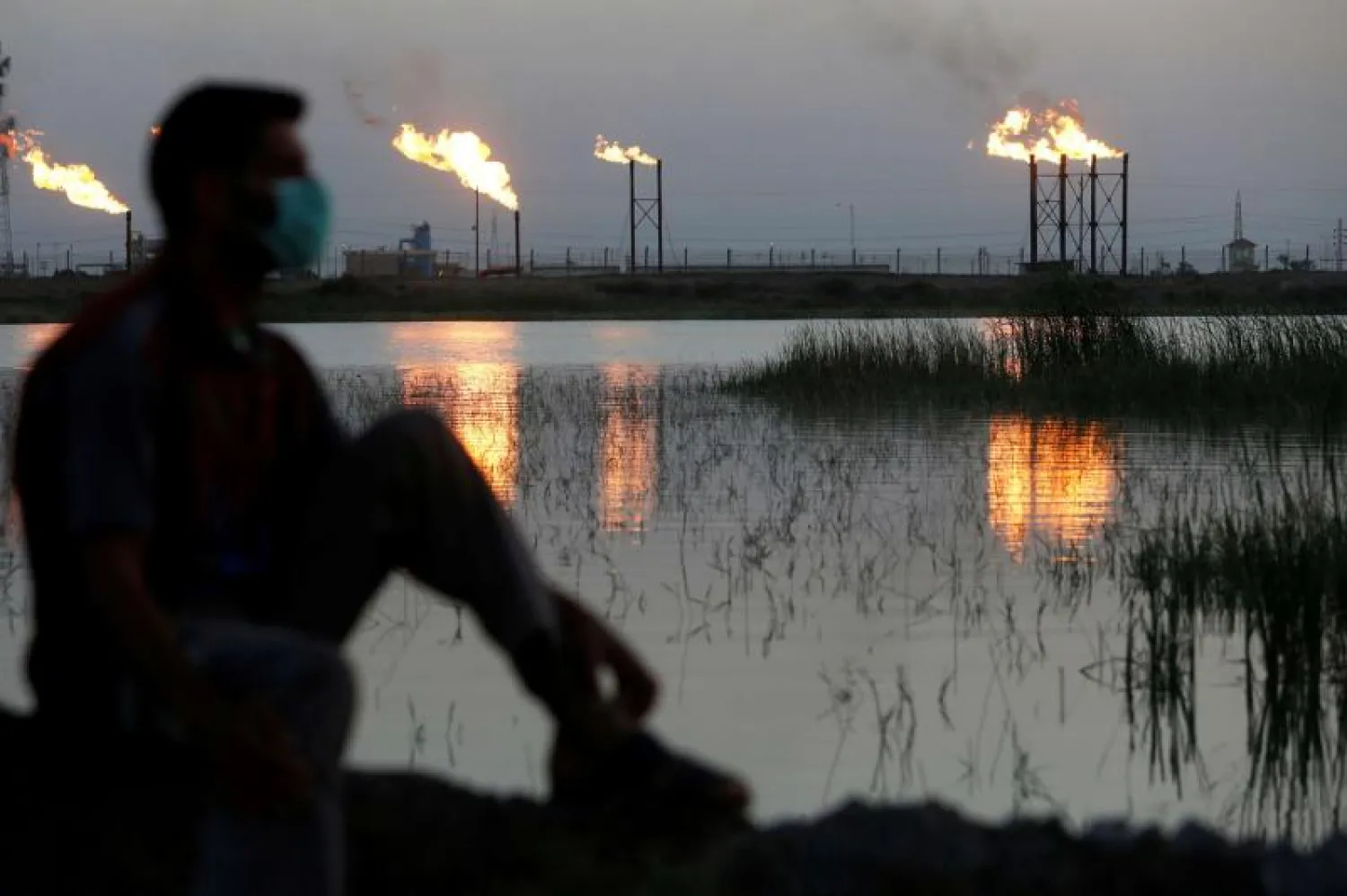

Iraq Resorts to Light Crude Oil to Increase Financial Resources

Flare stacks at Nahr Bin Umar oil field north of Basra, Iraq. (File photo: Reuters)
TT

Iraq Resorts to Light Crude Oil to Increase Financial Resources

Flare stacks at Nahr Bin Umar oil field north of Basra, Iraq. (File photo: Reuters)

Iraqi Oil Minister Ihsan Abdul Jabbar called for maximizing the production of light crude oil to achieve additional financial revenues that support the treasury and the national economy.

Light crude oil is liquid petroleum of low density and flows freely at room temperature.

The American Petroleum Institute (API) classifies light crude oil as having low viscosity, low specific gravity and high gravity due to the presence of a high proportion of light hydrocarbon fractions.

In a press statement, Abdul Jabbar stressed the necessity of expediting projects to improve the specifications of crude oil, given its importance in the global markets.

He explained that the country will benefit from foreign expertise and cooperation to implement the joint goals of boosting national oil and gas industry.

Iraq has a major financial crisis as a result of low oil prices, and the country is moving towards developing refineries to obtain more profits.

Crude oil sales during September reached more than $3 billion in revenues. The average of oil exports in November was 2.613 million barrels per day (bpd), with the majority of exports from the southern fields.

Meanwhile, the Governor of the Central Bank of Iraq (CBI), Mustafa Ghaleb, stated that the drop in crude oil prices and the decision of the Organization of the Petroleum Exporting Countries (OPEC) and its allies to reduce production rates led to a decrease in Iraq's oil revenues.

Last month, Ghaleb said the decline in crude oil revenues lead to a decrease in dollars sold by the Ministry of Finance to the Central Bank in exchange for the Iraqi dinar.

The governor explained that most of the current spending will turn into a consumer demand that ultimately represents a demand for the dollar.

The Central Bank will try to meet the demand to finance imports, however, foreign reserves are expected to witness a decline in addition to a drop in oil revenues if the current situation persists.



Oil Rises as Risks of Prolonged Mideast Conflict Fan Supply Worries

A man rides a bicycle in front of abandoned oil wells in Maracaibo lake, Zulia state, Venezuela on September 7, 2026. (Photo by John Chacَn / AFP)
TT

Oil Rises as Risks of Prolonged Mideast Conflict Fan Supply Worries

A man rides a bicycle in front of abandoned oil wells in Maracaibo lake, Zulia state, Venezuela on September 7, 2026. (Photo by John Chacَn / AFP)

Oil prices extended gains to multi-week highs on Tuesday as risks of a prolonged conflict in the Middle East grew after Iran threatened to retaliate against any new US attacks on its assets, heightening worries over supply disruption.

Brent crude futures were up $1.25, or 1.3%, to $98.25 a barrel by 0630 GMT. US West Texas Intermediate crude was at $93.70 a barrel, up $2.22, or 2.4%, Reuters reported.

Brent earlier rose to as much as $98.79 a barrel, its highest since July 24, while WTI reached $94.21 a barrel, its highest since June 8.

Following ⁠Monday's Labor Day ⁠holiday in the US, WTI was playing catch-up to Brent, which absorbed the weekend's escalation a day earlier, said Suvro Sarkar, head of energy research at DBS Bank.

"Overall, we believe the recent uptick in hostilities between the US and Iran has the potential to materially change markets' reading of oil price related risks not only for the rest of 2026, but well into 2027 now," he said.

Iran threatened the ⁠US with "economic warfare" and said it fired an advanced missile at US warships.

On Saturday, US forces had struck three Iranian oil tankers, including one near Kharg Island, Iran's main oil export hub, according to US Central Command. The attacks followed strikes by Iran's Revolutionary Guards on US warships operating in the region.

Shipping traffic through the Strait of Hormuz also slowed at the start of this week, after Iran threatened on Monday to retaliate for any new US attacks.

Meanwhile, Goldman Sachs raised its Brent and WTI price forecasts by $5 to $85 and $80, respectively, for December 2026 and to $80 and $75, respectively, for 2027, reflecting its new assumption that Middle East shipping disruptions continue into 2027.


Global Diesel Supply to Stay Tight Through Winter, Industry Execs Say

Diesel prices are displayed at a gas station as prices hit a record high in the US, Friday, Sept. 4, 2026 in Minneapolis. (AP Photo/Ellen Schmidt)
TT

Global Diesel Supply to Stay Tight Through Winter, Industry Execs Say

Diesel prices are displayed at a gas station as prices hit a record high in the US, Friday, Sept. 4, 2026 in Minneapolis. (AP Photo/Ellen Schmidt)

Global diesel supply will remain tight due to a lack of spare refining capacity, Russia's ban on exports and the approach of peak winter demand, senior industry executives said on Tuesday.

The wars in Ukraine and Iran have impacted refineries in Russia and the Middle East, pushing diesel margins to record levels in Europe and the US, while reducing crude supplies to Asia.

"There's really a shortage of products because we're missing 2 million barrels a day from Russia, and we're missing nearly 2 million barrels a day ⁠from the Middle ⁠East," Vitol CEO Russell Hardy told the APPEC conference on Tuesday.

According to Reuters, Hardy said crude is in a better supply position than products as the Middle East is exporting about 9 million bpd of crude and 1 million bpd of products.

"We're still not running enough refining capacity to prevent those draws," he ⁠said.

"We keep eating into the surplus that exists around the world, and we're pretty much at the bottom of our stockpiles."

Mark Senn, senior vice president of global trading at Phillips 66, said most US refineries were already running flat out.

"When you're looking forward to a winter season coming where diesel stocks are quite deficit, you're setting up for an environment where that strength could continue in those markets," he added.

US diesel prices jumped to record highs late last week, while the product's ⁠crack spread, ⁠a measure of refining profitability, surged to a record intraday high of $108.02 a barrel on Wednesday.

Vitol's Hardy said high prices and the lack of available fuel supplies are expected to reduce global oil demand by about 1.5 million bpd in 2026 versus 2025.

He added that the gap between China's crude imports in 2025 and 2026 at 5 million to 6 million bpd is unsustainable and he expects the gap to narrow towards the end of the year so China will have sufficient fuel for winter.


Saudi PIF Launches Company to Develop Coastal Destination in Al-Khafji

Aerial view of Al-Khafji Governorate (King Abdulaziz Foundation)
TT

Saudi PIF Launches Company to Develop Coastal Destination in Al-Khafji

Aerial view of Al-Khafji Governorate (King Abdulaziz Foundation)

Saudi Arabia's Public Investment Fund (PIF) said it has launched a real estate company to create an integrated tourist and residential destination on the Al-Khafji coastline on the Arabian Gulf.

Gulf Coast Development Company will develop the project in partnership with the private sector and local and regional investors, PIF said in a statement on Monday.

The project, spanning around 20 ⁠square kilometers with a 10-km waterfront, is expected to accommodate more than 16,000 housing units alongside hotels and other commercial facilities.

“The Al-Khafji Governorate’s strategic location offers seamless access for residents and visitors from Saudi Arabia, Kuwait, and other Gulf Arab states and will contribute to creating both direct and indirect opportunities for the local community,” said the statement.

“Within its Urban Development and Livability ecosystem, PIF is investing in real estate projects in partnership with the private sector to maximize long-term value realization and advance urban innovation,” it said.

“Projects in this ecosystem will further enhance quality of life, modernize living, and create people-centered and sustainable cities through coordinated investments,” PIF added.

According to the statement, the project’s development will unfold in three phases. The first phase, which is scheduled for completion in 2030, will deliver three neighborhoods and lay the foundation for an integrated tourism-residential community.

"Through its local real estate projects, PIF continues to unlock the potential of strategic sectors, deepen their integration within the six ecosystems outlined in PIF’s 2026 2030 strategy, and strengthen the private sector’s role as an effective partner in economic growth,” said PIF’s Head of Local Real Estate Investments Saad Alkroud.

“The company’s project will generate new opportunities for the region’s residents, upgrade the city’s infrastructure and deepen private sector partnerships that maximize value and deliver sustainable returns,” he added.

PIF’s Urban Development & Livability ecosystem is one of six new ecosystems revealed in PIF’s 2026-2030 strategy.