


Israeli Police Cleared in Shooting of Maimed Palestinian Boy

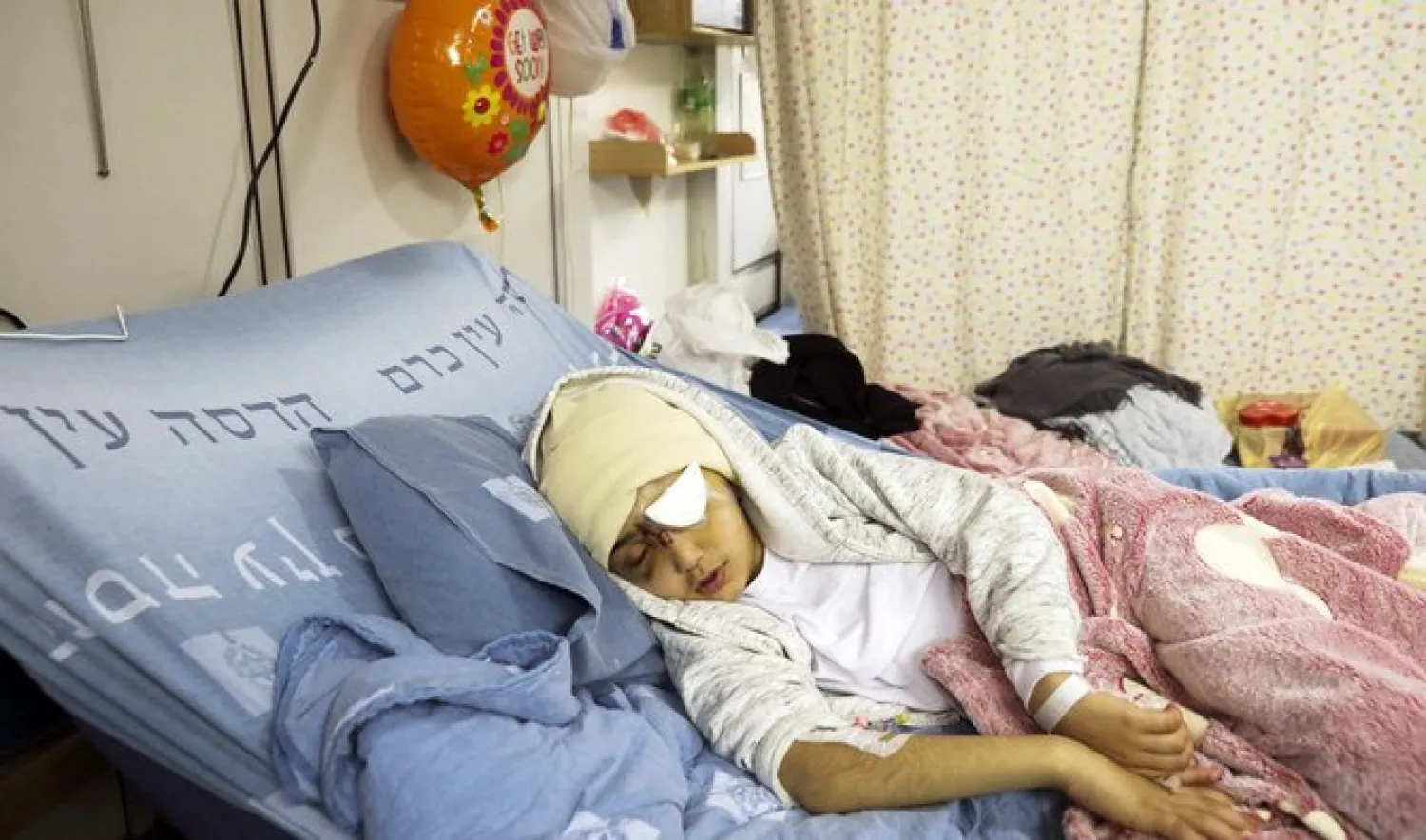
The Palestinian boy Malik Eissa, 9, rests in Hadassa hospital in Jerusalem. (AP)
TT

Israeli Police Cleared in Shooting of Maimed Palestinian Boy

The Palestinian boy Malik Eissa, 9, rests in Hadassa hospital in Jerusalem. (AP)

Israeli authorities have cleared police of any wrongdoing in the case of a nine-year-old boy who lost an eye after apparently being shot in the face by an Israeli officer earlier this year.

Malik Eissa was struck by what appeared to be a sponge-tipped munition last February and lost vision in his left eye. Residents said he had just gotten off a school bus in the Palestinian neighborhood of Issawiya in East Jerusalem when police opened fire.

Police said at the time they had responded to riots in the tense neighborhood and used what they call nonlethal weapons.

In a statement sent to The Associated Press on Saturday, the Israeli Justice Ministry said its unit for internal police investigations concluded that while the incident was “sad,” there were insufficient grounds for prosecution after interviewing witnesses and reviewing video footage and other evidence.

It said police were conducting an arrest operation at the time and were attacked by a group of stone throwers.

It also said that medical experts could not determine whether the boy had been struck by a bullet or a stone. It said, however, that the investigations unit ordered a review of operational conduct, including its use of sponge-tipped bullets in civilian areas.

Malik’s father, Wael Issa, told AP that his family had been the victim of injustice twice — first when the boy was shot and now with the investigation being closed.

“When my son was shot, the members of the investigative unit came to the hospital. They were about to cry. They told me, ‘Don’t worry, those responsible for shooting him will be held accountable,’” he said on Sunday.

“But 10 months after investigating, they decided to close the file.”

He said the boy suffers from constant headaches and psychological problems and has not returned to school because of repeated surgeries and embarrassment about his appearance.

He said his son finally agreed to return to school two weeks ago after receiving a glass eye but stopped going after a couple of days because of an embarrassing incident.

“The eye fell out in front of the students. He feels terrible,” he said. “Frankly speaking I don’t believe I will ever get justice in this system.”

Palestinians and Israeli human rights groups have long accused Israel of whitewashing wrongdoing by its security forces.

B’tselem, Israel’s leading human rights group, said the case “exemplifies whitewashing at work.”

“Every individual case is isolated to a series of technical details, as though this was a singular incident, rather than an open fire policy,” it said.

It accused police of operating within “an oppressed civilian population to enforce an occupation and annexation,” leading to civilian casualties and impunity for those who harm them.

Issawiya is part of East Jerusalem, which Israel captured in the 1967 Middle East war along with the West Bank and the Gaza Strip, territories the Palestinians want for a future state.

Israel later annexed East Jerusalem in a step that is not internationally recognized and views all of the city as its capital. The Palestinians claim East Jerusalem as their future capital.

Issawiya has been the site of frequent police raids that often ignite demonstrations or clashes. Police blame the violence on local youths, whom they accuse of throwing stones and firebombs at patrol vehicles.


Moving ISIS Prisoners from Syria to Iraq Came at the Request of Baghdad, Officials Say

Local youth play atop of a damaged armored vehicle belonging to the Syrian Democratic Forces (SDF) at the site of clashes with Syrian government forces in the village of al-Hol in northeastern Syria’s Hasakeh province, Syria, Wednesday, Jan. 21, 2026. (AP Photo/Ghaith Alsayed)
TT

Moving ISIS Prisoners from Syria to Iraq Came at the Request of Baghdad, Officials Say

Local youth play atop of a damaged armored vehicle belonging to the Syrian Democratic Forces (SDF) at the site of clashes with Syrian government forces in the village of al-Hol in northeastern Syria’s Hasakeh province, Syria, Wednesday, Jan. 21, 2026. (AP Photo/Ghaith Alsayed)

The decision to move prisoners of the ISIS group from northeast Syria to detention centers in Iraq came after a request by officials in Baghdad that was welcomed by the US-led coalition and the Syrian government, officials said Thursday.

American and Iraqi officials told The Associated Press about the Iraqi request, a day after the US military said that it started transferring some of the 9,000 ISIS detainees held in more than a dozen detention centers in northeast Syria controlled by the Kurdish-led Syrian Democratic Forces, or SDF, in northeast Syria.

The move to start transferring the detainees came after Syrian government forces took control of the sprawling al-Hol camp — which houses thousands of mostly women and children — from the SDF, which withdrew as part of a ceasefire. Troops on Monday seized a prison in the northeastern town of Shaddadeh, where some ISIS detainees escaped and many were recaptured, state media reported.

The SDF said Thursday that government forces shelled al-Aqtan prison near the northern city of Raqqa with heavy weapons, while simultaneously imposing a siege around the prison using tanks and deployed fighters.

Al-Aqtan prison, where some ISIS prisoners are held, was surrounded by government forces earlier this week and negotiations were ongoing on the future of the detention facility.

With the push by government forces into northeast Syria along the border with Iraq, there have been concerns in Baghdad that some of the detainees might become danger to Iraq’s security, if they manage to flee from the detention centers amid the chaos.

An Iraqi security official said that the decision to transfer the prisoners from Syria to Iraq was an Iraqi decision, welcomed by the US-led coalition and the Syrian government. The official added that it was in Iraq’s security interest to detain them in Iraqi prisons rather than leaving them in Syria.

Also Thursday, a senior US military official confirmed to the AP that Iraq “offered proactively” to take the ISIS prisoners rather than the US requesting it of them.

Both the Iraqi and US officials spoke on condition of anonymity because they weren't authorized to comment publicly.

Over the past several years, the SDF has handed over to Iraqi authorities foreign fighters, including French citizens, who were put on trial and received sentences.

The SDF still controls more than a dozen detention facilities holding around 9,000 ISIS members, but is slated to hand the prisons over to government control under a peace process that also is supposed to eventually merge the SDF with government forces.

US Central Command said that the first transfer on Wednesday involved 150 ISIS members, who were taken from Syria’s northeastern province of Hassakeh to “secure locations” in Iraq. The statement said that up to 7,000 detainees could be transferred to Iraqi-controlled facilities.

ISIS declared a caliphate in 2014 in large parts of Syria and Iraq, attracting large numbers of fighters from around the world. The group was defeated in Iraq in 2017, and in Syria two years later, but its sleeper cells still carry out deadly attacks in both countries. The SDF played a major role in defeating ISIS.


Yemen: Coalition Steps Up Engagement with Aden’s Civil Society

Coalition to Restore Legitimacy oversees the normalization of life and improvement of services in Aden (Government Media) 
TT

Yemen: Coalition Steps Up Engagement with Aden’s Civil Society

Coalition to Restore Legitimacy oversees the normalization of life and improvement of services in Aden (Government Media) 

Amid rapidly evolving developments on the ground led by the leadership of the Coalition Forces to Restore Legitimacy in Yemen, efforts are continuing to normalize life in Aden, the country’s temporary capital, within a comprehensive vision aimed at restoring the city’s civil character and strengthening the role of the state and its service and security institutions.

Major General Falah Al-Shahrani, adviser to the Coalition Forces to Restore Legitimacy in Yemen, has intensified meetings with representatives of civil sectors, activists, and media professionals, seeking to build broad partnerships with Aden’s community and expand participation in shaping and implementing a plan to restore the city’s civil identity after years of conflict.

Alongside the daily follow-up of plans to remove military camps from Aden and restructure and integrate security units, the adviser to the joint forces is giving particular priority to basic services—especially electricity and water—viewed as a practical gateway to restoring public trust and improving living standards.

Al-Shahrani has also been holding regular meetings with journalists, activists, and community figures, listening to their views on the challenges facing the city and the aspirations of its residents in this new phase. Many hope this stage will restore Aden’s economic, cultural, and social standing as one of the oldest cities that embodied values of coexistence and openness.

Participants in these meetings stressed the importance of granting Aden’s residents a greater and more meaningful role in decision-making, noting that they had suffered marginalization in previous periods and that any successful plan to restore the city’s civil character must begin with their inclusion as direct stakeholders.

They also emphasized the need to give top priority to the education sector, describing it as the cornerstone of reconstruction and sustainable development and the primary foundation for rebuilding civic awareness and entrenching a culture of the rule of law.

Participants further called for directing support toward sustainable projects, foremost among them the rehabilitation of buildings damaged by the Houthi invasion of the city in 2015, given the direct impact of such projects on residents’ lives in terms of housing, services, and economic activity.

They noted that discussions with Al-Shahrani were marked by seriousness and transparency, reflecting the Coalition leadership’s determination to listen directly to public concerns beyond rigid official frameworks.

They affirmed that they sensed a genuine commitment and a clear vision to rebuild what the war had destroyed in Aden and other liberated provinces, in parallel with efforts to consolidate security and stability.


US Transfers ISIS Detainees from Syria to Iraq

 US soldiers at a military base north of Baghdad (Reuters – archive photo) 
 US soldiers at a military base north of Baghdad (Reuters – archive photo) 
TT

US Transfers ISIS Detainees from Syria to Iraq

 US soldiers at a military base north of Baghdad (Reuters – archive photo) 
 US soldiers at a military base north of Baghdad (Reuters – archive photo) 

US Central Command has launched a new operation to transfer ISIS detainees from northeastern Syria to Iraq, aiming to ensure that they remain in secure detention facilities and to reduce the risk of instability.

The operation began with the transfer of 150 ISIS militants from a detention facility in Hasakah, Syria, to a secure site in Iraq. US officials say the number of detainees moved from Syria to Iraqi-controlled prisons could eventually reach about 7,000.

Admiral Brad Cooper, the head of US Central Command, said: “We are closely coordinating with regional partners, including the Iraqi government, and we sincerely appreciate their role in ensuring the enduring defeat of ISIS.

“Facilitating the orderly and secure transfer of ISIS detainees is critical to preventing a breakout that would pose a direct threat to the United States and regional security.”

According to Reuters, the move follows the rapid collapse of the Kurdish-led Syrian Democratic Forces in northeastern Syria, which raised doubts about the security of roughly a dozen prisons and detention camps previously guarded by the group.

US officials also discussed the situation with Syrian President Ahmed al-Sharaa, focusing on ongoing tensions in Syria, the need for government forces to respect ceasefire arrangements with the Syrian Democratic Forces, and support for the coordinated transfer of ISIS detainees to Iraq.

The US side outlined plans to relocate thousands of detainees in a controlled manner and urged all parties to avoid actions that could disrupt the process.

An Iraqi official told Asharq Al-Awsat that the transfer would help ease growing concerns about possible escapes. He added that holding the detainees in prisons supervised by the Iraqi government, in direct coordination with the United States, would significantly reduce the chances of ISIS rebuilding its capabilities.

Syrian media reported that security forces recently arrested 90 group members who had escaped from al-Shaddadi prison south of Hasakah. The Syrian army later announced it had taken control of the city, imposed a curfew, and launched operations to secure the area and capture fugitives.

Recent government advances, combined with what appears to be a reduction in US support for the SDF, mark the most significant shift in territorial control since the fall of Bashar al-Assad 13 months ago.

The United States said this week that the main objectives of its partnership with the SDF have largely been achieved after years of fighting ISIS.