

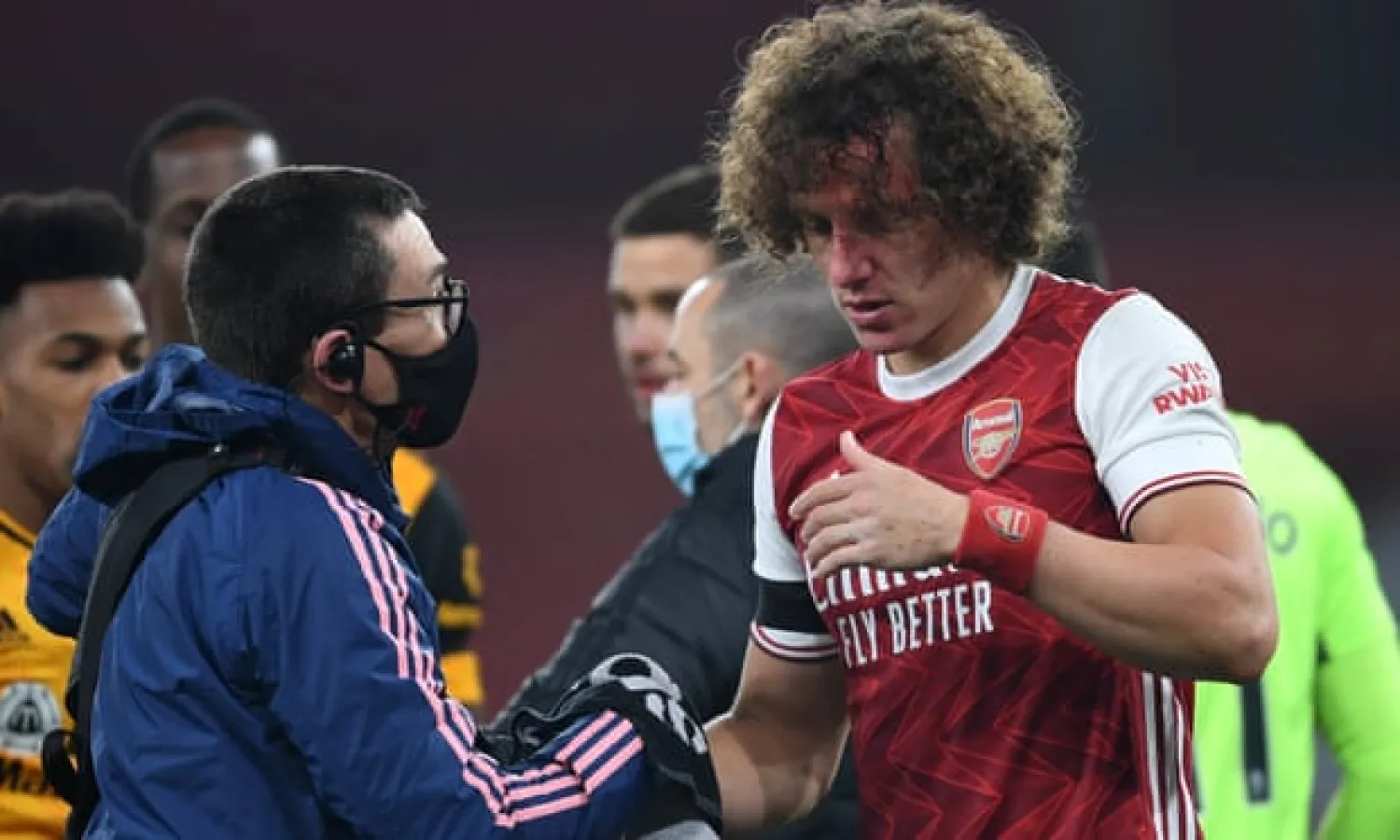

Football Needs to Catch Up and Get Its House in Order Over Concussion

Arsenal’s David Luiz is treated after Sunday’s sickening clash of heads with Wolves’ Raúl Jiménez, who has now been diagnosed with a fractured skull. Photograph: David Price/Arsenal FC/Getty Images
TT

Football Needs to Catch Up and Get Its House in Order Over Concussion

Arsenal’s David Luiz is treated after Sunday’s sickening clash of heads with Wolves’ Raúl Jiménez, who has now been diagnosed with a fractured skull. Photograph: David Price/Arsenal FC/Getty Images

For too long football has played tiki-taka with the issue of concussion, rather than tackling it head on. It has been passed around from committee to committee, governing body to governing body, without the authorities facing up to its pernicious threat. Perhaps the recent deaths of Jack Charlton and Nobby Stiles will sharpen the focus.

What happened at the Emirates on Sunday certainly should. It was jolting enough to witness Wolves’ Raúl Jiménez receiving oxygen and leaving on a stretcher with a fractured skull following a clash of heads with David Luiz. It was almost as worrying when the Arsenal man got up and carried on for another 40 minutes, despite blood oozing through his head bandages.

True, David Luiz passed all the required medical assessments. And the Premier League emphasizes that doctors have a long list of clues they use to detect concussion, ranging from a “dazed, blank or vacant look” on a player’s face to asking questions such as: “What team did you play last week?” Gone are the days when a dose of smelling salts was applied to the nostrils before the player was shunted back into action.

Even so, was it an unnecessary risk? Scientists have long since established that concussion symptoms do not always show up immediately after a head impact and that playing on can damage recovery. One study in the journal Pediatrics followed 69 high‑school athletes who sustained head injuries in American football, ice hockey, soccer, and volleyball and found that those who stayed on the field took twice as long to recover (44 days compared with 22 days).

There also remains a wearing sense that football is lagging behind both rugby codes as well cricket, the NFL, and horse racing when it comes to head impacts. As Alan Shearer put it on Match of the Day 2: “We are talking about life and death.”

He added: “Football needs to get real, it needs to wake up, it needs to get serious. Not next year, next month, now. It is not acceptable, it has been going too far too long.”

In rugby union, it used to be regarded as a badge of honor to battle on, no matter how groggy the brain or bloodied the shirt. Attitudes have changed. Incidents such as Wales’s George North appearing to be concussed twice in a Six Nations match focused minds – as did the year‑on‑year rise in the reported incidents of concussion in the Premiership from 2009-10 onwards.

Nowadays if there is any suspicion of a concussion then a player is removed from the pitch for a head injury assessment, which takes 10 minutes. If a player fails any of the cognitive tests, which are measured against a pre-season baseline, they are removed from play. The rules have also been changed in an attempt to make the game safer, particularly when it comes to tackling.

Rugby remains dangerous. Last year, a study in the British Journal of Sports Medicine found that on average, a professional rugby union player is more likely than not to sustain a concussion after 25 matches. But at least there is a sense of the authorities recognizing the seriousness of the problem and trying to do something about it.

Cricket’s attitude to concussion also changed in 2014 after the Australia batsman Phil Hughes died after being struck on the back of the head. Concussion substitutes are now allowed – which enabled Australia’s Steve Smith to be replaced mid-match in last year’s Ashes Test at Lord’s after he was struck on the neck by a Jofra Archer bouncer.

Horse racing has more concussions than any other sport, with an average of 25 per 1,000 hours in jumping and 17 in Flat races, but the British Horseracing Authority insists they have been “well ahead of the game” in recognizing the dangers thanks to its former doctor, Michael Turner, a world authority on concussion.

Since 2018 any jockey who is involved in a fall is immediately assessed by a Scat5 test and often again 25-30 minutes later, even if they are asymptomatic. “If they fail the test they are stood down for a minimum of six days,” says Robin Mounsey of the BHA. “Any rider with concussion shouldn’t be driving so they will also be helped to get home. If it is a severe case of concussion, they will be sent to hospital.”

The riders also do a two-yearly CogSport test to set a baseline and then to pick up any concerning shifts.

Football finally looks to be getting its act together with Lukas Brud, the chief executive of the International Football Association Board, telling the Guardian that new protocols, allowing additional substitutions if a player suffers a head injury, are likely to be passed on 16 December and trialed “as soon as possible” next year.

It is a start. But there is still a sense the game is skirting around the issue. That is despite a major Glasgow University finding last year that former professional footballers are three and a half times more likely to suffer from dementia than the general population. Another study, by scientists at Purdue in Indiana, showed when teenage girls head a football regularly there is a risk of low‑level brain injuries, which in some cases last for four or five months before the brain looks normal on MRI scans.

Perhaps the lack of X-rated collisions compared with other sports led football’s authorities to relax for too long. Thankfully attitudes are now changing. But with Watford’s Troy Deeney claiming on Monday that players know best when it comes to head injuries there is still some way to go.

(The Guardian)


Hospital: Vonn Had Surgery on Broken Leg from Olympics Crash

This handout video grab from IOC/OBS shows US Lindsey Vonn crashing during the women's downhill event at the Milano Cortina 2026 Winter Olympic Games on February 8, 2026. (Photo by Handout / various sources / AFP)
TT

Hospital: Vonn Had Surgery on Broken Leg from Olympics Crash

This handout video grab from IOC/OBS shows US Lindsey Vonn crashing during the women's downhill event at the Milano Cortina 2026 Winter Olympic Games on February 8, 2026. (Photo by Handout / various sources / AFP)

Lindsey Vonn had surgery on a fracture of her left leg following the American's heavy fall in the Winter Olympics downhill, the hospital said in a statement given to Italian media on Sunday.

"In the afternoon, (Vonn) underwent orthopedic surgery to stabilize a fracture of the left leg," the Ca' Foncello hospital in Treviso said.

Vonn, 41, was flown to Treviso after she was strapped into a medical stretcher and winched off the sunlit Olimpia delle Tofane piste in Cortina d'Ampezzo.

Vonn, whose battle to reach the start line despite the serious injury to her left knee dominated the opening days of the Milano Cortina Olympics, saw her unlikely quest halted in screaming agony on the snow.

Wearing bib number 13 and with a brace on the left knee she ⁠injured in a crash at Crans Montana on January 30, Vonn looked pumped up at the start gate.

She tapped her ski poles before setting off in typically aggressive fashion down one of her favorite pistes on a mountain that has rewarded her in the past.

The 2010 gold medalist, the second most successful female World Cup skier of all time with 84 wins, appeared to clip the fourth gate with her shoulder, losing control and being launched into the air.

She then barreled off the course at high speed before coming to rest in a crumpled heap.

Vonn could be heard screaming on television coverage as fans and teammates gasped in horror before a shocked hush fell on the packed finish area.

She was quickly surrounded by several medics and officials before a yellow Falco 2 ⁠Alpine rescue helicopter arrived and winched her away on an orange stretcher.


Meloni Condemns 'Enemies of Italy' after Clashes in Olympics Host City Milan

Demonstrators hold smoke flares during a protest against the environmental, economic and social impact of the Milano-Cortina 2026 Winter Olympics in Milan, Italy, February 7, 2026. REUTERS/Kevin Coombs
TT

Meloni Condemns 'Enemies of Italy' after Clashes in Olympics Host City Milan

Demonstrators hold smoke flares during a protest against the environmental, economic and social impact of the Milano-Cortina 2026 Winter Olympics in Milan, Italy, February 7, 2026. REUTERS/Kevin Coombs

Italian Prime Minister Giorgia Meloni has condemned anti-Olympics protesters as "enemies of Italy" after violence on the fringes of a demonstration in Milan on Saturday night and sabotage attacks on the national rail network.

The incidents happened on the first full day of competition in the Winter Games that Milan, Italy's financial capital, is hosting with the Alpine town of Cortina d'Ampezzo.

Meloni praised the thousands of Italians who she said were working to make the Games run smoothly and present a positive face of Italy.

"Then ⁠there are those who are enemies of Italy and Italians, demonstrating 'against the Olympics' and ensuring that these images are broadcast on television screens around the world. After others cut the railway cables to prevent trains from departing," she wrote on Instagram on Sunday.

A group of around 100 protesters ⁠threw firecrackers, smoke bombs and bottles at police after breaking away from the main body of a demonstration in Milan.

An estimated 10,000 people had taken to the city's streets in a protest over housing costs and environmental concerns linked to the Games.

Police used water cannon to restore order and detained six people.

Also on Saturday, authorities said saboteurs had damaged rail infrastructure near the northern Italian city of Bologna, disrupting train journeys.

Police reported three separate ⁠incidents at different locations, which caused delays of up to 2-1/2 hours for high-speed, Intercity and regional services.

No one has claimed responsibility for the damage.

"Once again, solidarity with the police, the city of Milan, and all those who will see their work undermined by these gangs of criminals," added Meloni, who heads a right-wing coalition.

The Italian police have been given new arrest powers after violence last weekend at a protest by the hard-left in the city of Turin, in which more than 100 police officers were injured.


Liverpool New Signing Jacquet Suffers 'Serious' Injury

Soccer Football - Ligue 1 - RC Lens v Stade Rennes - Stade Bollaert-Delelis, Lens, France - February 7, 2026  Stade Rennes' Jeremy Jacquet in action REUTERS/Benoit Tessier
Soccer Football - Ligue 1 - RC Lens v Stade Rennes - Stade Bollaert-Delelis, Lens, France - February 7, 2026 Stade Rennes' Jeremy Jacquet in action REUTERS/Benoit Tessier
TT

Liverpool New Signing Jacquet Suffers 'Serious' Injury

Soccer Football - Ligue 1 - RC Lens v Stade Rennes - Stade Bollaert-Delelis, Lens, France - February 7, 2026  Stade Rennes' Jeremy Jacquet in action REUTERS/Benoit Tessier
Soccer Football - Ligue 1 - RC Lens v Stade Rennes - Stade Bollaert-Delelis, Lens, France - February 7, 2026 Stade Rennes' Jeremy Jacquet in action REUTERS/Benoit Tessier

Liverpool's new signing Jeremy Jacquet suffered a "serious" shoulder injury while playing for Rennes in their 3-1 Ligue 1 defeat at RC Lens on Saturday, casting doubt over the defender’s availability ahead of his summer move to Anfield.

Jacquet fell awkwardly in the second half of the ⁠French league match and appeared in agony as he left the pitch.

"For Jeremy, it's his shoulder, and for Abdelhamid (Ait Boudlal, another Rennes player injured in the ⁠same match) it's muscular," Rennes head coach Habib Beye told reporters after the match.

"We'll have time to see, but it's definitely quite serious for both of them."
Liverpool agreed a 60-million-pound ($80-million) deal for Jacquet on Monday, but the 20-year-old defender will stay with ⁠the French club until the end of the season.

Liverpool, provisionally sixth in the Premier League table, will face Manchester City on Sunday with four defenders - Giovanni Leoni, Joe Gomez, Jeremie Frimpong and Conor Bradley - sidelined due to injuries.
