


Iran Moving Key Facility at Nuclear Site Underground, Report Shows

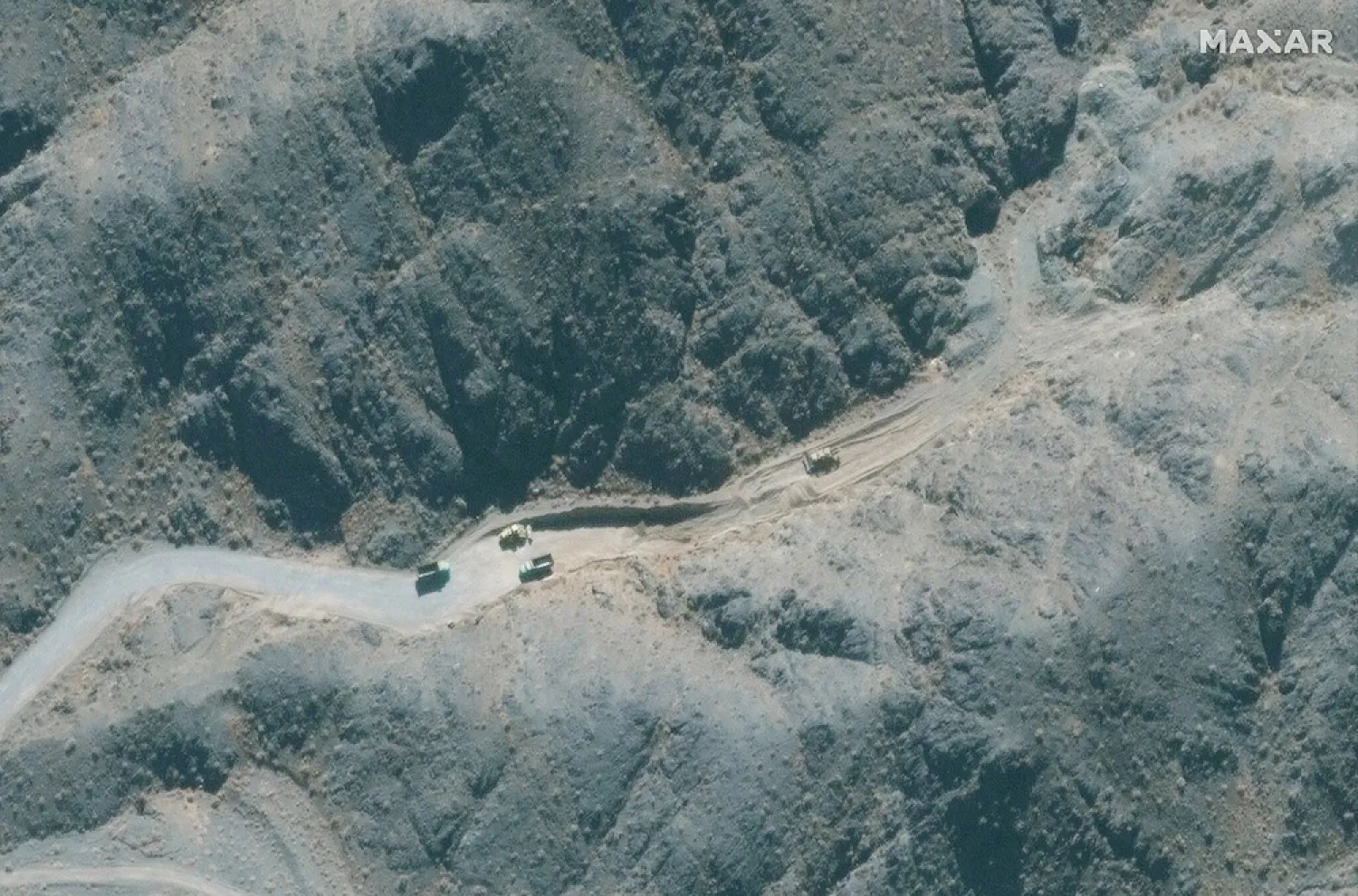
Road work and earth-moving vehicles outside a future tunnel entrance. Oct. 21, 2020. (Maxar Technologies)
TT

Iran Moving Key Facility at Nuclear Site Underground, Report Shows

Road work and earth-moving vehicles outside a future tunnel entrance. Oct. 21, 2020. (Maxar Technologies)

In July, an explosion rocked a key Iranian nuclear facility. Iran called it sabotage and vowed to rebuild a destroyed building underground. Iran is now turning that promise into a reality, new satellite images show, reported the New York Times.

The mysterious July explosion that destroyed a centrifuge assembly hall at Iran’s main nuclear fuel enrichment facility in Natanz was deemed by the Iranian authorities to be enemy sabotage, and provoked a defiant response: The wrecked building would be rebuilt in “the heart of the mountains,” the head of Iran’s Atomic Energy Organization said.

Progress on that pledge, which could shield the facility from an aerial assault or other threats, has been unclear to outside observers. But new satellite imagery is now shedding light on the Iranian plans.

The Visual Investigations team of The New York Times has tracked construction at the site using the new imagery. For the first time, new tunnel entrances for underground construction are visible under a ridge in the mountain foothills south of the Natanz facility, about 140 miles south of Tehran.

The Times worked with Jeffrey Lewis, an arms control expert at the Middlebury Institute of International Studies at Monterey in California, to interpret the new image.

“The new facility is likely to be a far more secure location for centrifuge assembly — it is located far from a road and the ridge offers significant overburden that would protect the facility from air attack,” Lewis stated in written comments.

The July explosion was not the only recent incident that appeared to have exposed major gaps in Iran’s security of its nuclear program, which the country insists is limited to peaceful purposes. In late November, a brazen daylight attack killed Iran’s top nuclear scientist, Mohsen Fakhrizadeh.

Iran has blamed Israel and the United States for the Natanz explosion and Fakhrizadeh’s assassination, which were both considered serious setbacks to Iran’s nuclear program.

Lewis described the clues that underground construction was underway at the site in Natanz.

“There are what appear to be two tunnel entrances on either side of a large ridge, with a pile of spoil from excavation nearby. The space between the two entrances is large enough to accommodate a facility about the same size as the centrifuge assembly building that was destroyed this summer and that Iran indicated it was rebuilding in the mountains.”

Looking at satellite images taken over several months allows for tracking changes. Even something as simple and inconspicuous as a pile of dirt is a clue.

“The major clue is the pile of spoil from the excavation that was not present in July,” Lewis said. “Iran also regraded a pair of roads on each side of the ridge leading to what appear to be tunnel entrances.”

Allison Puccioni, an imagery analyst affiliated with the Center for International Security and Cooperation at Stanford University, pointed out other telltale signs of excavations near the debris pile.

In comments provided to the Times, Puccioni said that between the debris pile and excavation site, the imagery showed “trails of excavated earth, lighter in color than the existing hard-packed road.”

A flurry of activity in Natanz captured by satellites in recent months includes the building of new roads and additional excavations, which started after the explosion.

Researchers from AllSource Analysis and the Institute for Science and International Security have previously identified the area and said that additional tunnels are being constructed, suggesting work on an even larger underground complex is underway.

The destroyed building was built in 2012 and had been used to assemble centrifuges, the machines that enrich uranium needed for peaceful purposes — and when enriched to higher levels, for bombs. The 2015 nuclear agreement between Iran and world powers halted high level enrichment, but Iran started amassing enriched uranium again after President Trump left the accord two years ago.

After the July explosion, the International Atomic Energy Agency, which monitors Iran’s compliance with the accord, confirmed that there had been no nuclear materials at that specific building.

In response to Fakhrizadeh’s assassination, Iran enacted a law last week to immediately ramp up uranium enrichment and bar international inspectors by February if US sanctions are not lifted. The law also calls for the installment of advanced centrifuges at its nuclear facilities, including in Natanz.

The New York Times


Suspected Militants Kill 2, Including a Police Officer Guarding Polio Team in Northwestern Pakistan

A health worker marks a child’s finger after administering a polio vaccination in Hyderabad, Pakistan, 15 December 2025. EPA/NADEEM KHAWAR
TT

Suspected Militants Kill 2, Including a Police Officer Guarding Polio Team in Northwestern Pakistan

A health worker marks a child’s finger after administering a polio vaccination in Hyderabad, Pakistan, 15 December 2025. EPA/NADEEM KHAWAR

Suspected militants opened fire on a police officer guarding a team of polio workers in northwestern Pakistan on Tuesday, killing the officer and a passerby before fleeing, police said.
No polio worker was harmed in the attack that occurred in Bajaur, a district of Khyber Pakhtunkhwa province bordering Afghanistan, according to local police chief Samad Khan, The Associated Press said.
No group immediately claimed responsibility for the attack, but suspicion is likely to fall on the Pakistani Taliban and other militant groups blamed by the government for similar attacks in the region and elsewhere in the country.
The shooting came a day after Pakistan launched a weeklong nationwide vaccination campaign aimed at immunizing 45 million children. According to the World Health Organization, Pakistan and Afghanistan remain the only two countries where polio has not been eradicated.
Prime Minister Shehbaz Sharif condemned the attack in a statement and vowed strong action against those responsible.
Pakistan has reported 30 polio cases since January, down from 74 during the same period last year, according to a statement from the government-run Polio Eradication Initiative.
Pakistan regularly launches campaigns against polio despite attacks on the workers and police assigned to the inoculation drives. Militants falsely claim the vaccination campaigns are a Western conspiracy to sterilize children.
More than 200 polio workers and police assigned to protect them have been killed in Pakistan since the 1990s, according to health and security officials.


Kremlin Says Christmas Ceasefire Proposed by Ukraine Depends on Reaching Peace Deal

In this pool photograph distributed by the Russian state agency Sputnik, Kremlin spokesman Dmitry Peskov attends a meeting of Russia's President with Iranian President in Ashgabat on December 12, 2025. (Photo by Alexander KAZAKOV / POOL / AFP)
TT

Kremlin Says Christmas Ceasefire Proposed by Ukraine Depends on Reaching Peace Deal

In this pool photograph distributed by the Russian state agency Sputnik, Kremlin spokesman Dmitry Peskov attends a meeting of Russia's President with Iranian President in Ashgabat on December 12, 2025. (Photo by Alexander KAZAKOV / POOL / AFP)

The Kremlin said on Tuesday that a Christmas truce that Ukraine has proposed would depend on whether a peace deal is reached or not.

Russia does not want a ceasefire that would allow Kyiv to prepare for further fighting, Kremlin spokesman Dmitry Peskov said.

He added that Moscow had not yet seen details of proposals on NATO-style security guarantees for Ukraine that US and European officials said Washington has offered to provide, according to Reuters.


Zelenskyy Says Peace Proposals to End War in Ukraine Could Be Presented to Russia within Days 

Ukraine's President Volodymyr Zelenskyy listens during a press conference with German Chancellor Friedrich Merz at the Chancellery in Berlin, Germany, Monday, Dec. 15, 2025. (AP)
TT

Zelenskyy Says Peace Proposals to End War in Ukraine Could Be Presented to Russia within Days 

Ukraine's President Volodymyr Zelenskyy listens during a press conference with German Chancellor Friedrich Merz at the Chancellery in Berlin, Germany, Monday, Dec. 15, 2025. (AP)

Ukrainian President Volodymyr Zelenskyy says proposals negotiated with US officials on a peace deal to end his country’s nearly four-year war with Russia could be finalized within days, after which American envoys will present them to the Kremlin before further possible meetings in the United States next weekend.

Zelenskyy told reporters late Monday that a draft peace plan discussed with the US during talks in Berlin earlier in the day is “very workable.” He cautioned, however, that some key issues — notably what happens to Ukrainian territory occupied by invading Russian forces — remain unresolved.

US-led peace efforts appear to be picking up momentum. But Russian President Vladimir Putin may balk at some of the proposals thrashed out by officials from Washington, Kyiv and Western Europe, including postwar security guarantees for Ukraine.

American officials on Monday said there's consensus from Ukraine and Europe on about 90% of the US-authored peace plan. US President Donald Trump said: “I think we’re closer now than we have been, ever” to a peace settlement.

Plenty of potential pitfalls remain, however.

Zelenskyy reiterated that Kyiv rules out recognizing Moscow’s control over any part of the Donbas, an economically important region in eastern Ukraine made up of Luhansk and Donetsk. Russia's army doesn’t fully control either.

“The Americans are trying to find a compromise,” Zelenskyy said, before visiting the Netherlands on Tuesday. “They are proposing a ‘free economic zone’ (in the Donbas). And I want to stress once again: a ‘free economic zone’ does not mean under the control of the Russian Federation.”

The land issue remains one of the most difficult obstacles to a comprehensive agreement.

Putin wants all the areas in four key regions that his forces have seized, as well as the Crimean Peninsula, which Moscow illegally annexed in 2014, to be recognized as Russian territory.

Zelenskyy warned that if Putin rejects diplomatic efforts, Ukraine expects increased Western pressure on Moscow, including tougher sanctions and additional military support for defense. Kyiv would seek enhanced air defense systems and long-range weapons if diplomacy collapses, he said.

Ukraine and the US are preparing up to five documents related to the peace framework, several of them focused on security, Zelenskyy said.

He was upbeat about the progress in the Berlin talks.

“Overall, there was a demonstration of unity,” Zelenskyy said. “It was truly positive in the sense that it reflected the unity of the US, Europe, and Ukraine.”
