
'Narrow Path' to Brexit Trade Deal Visible, Next Few Days Critical

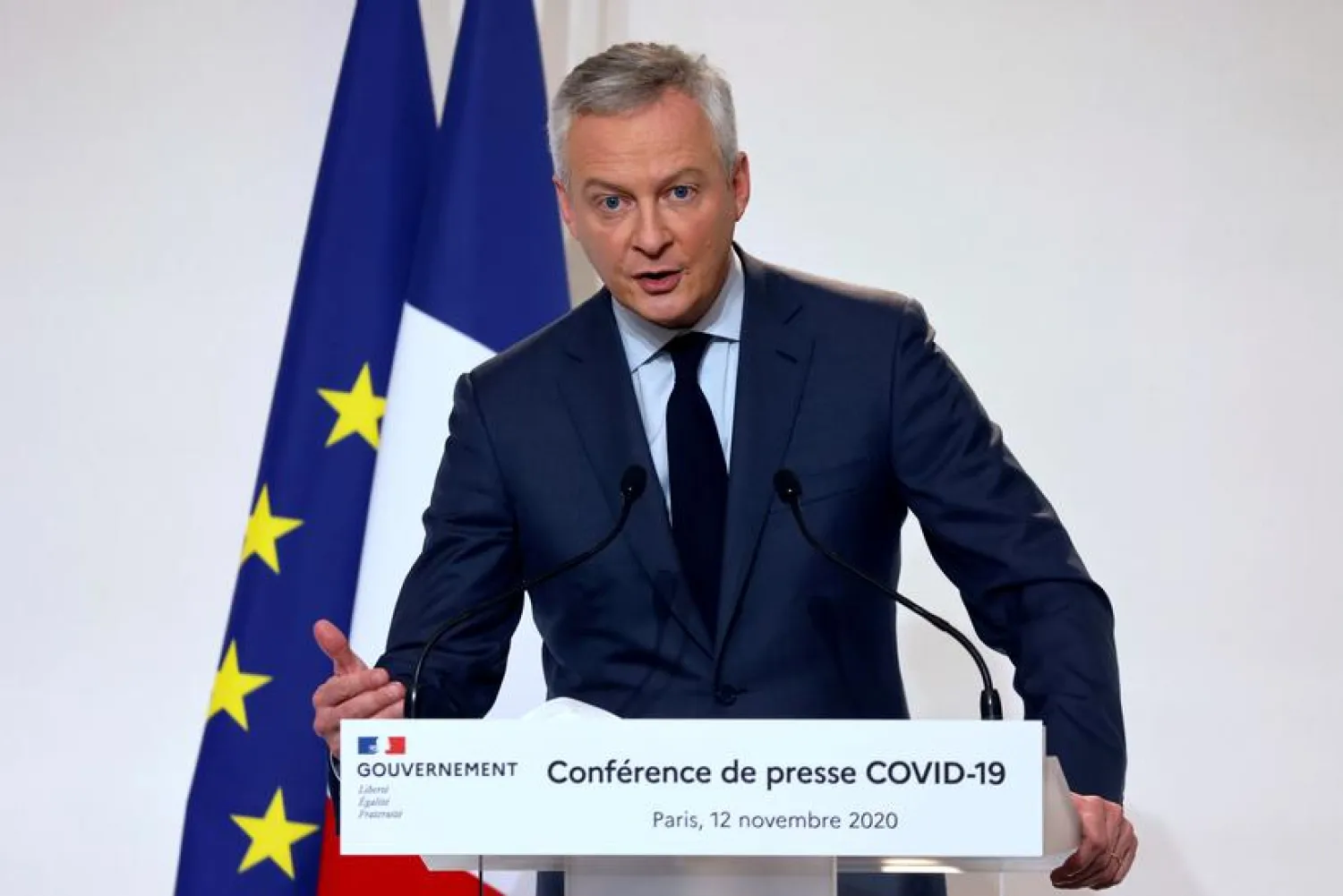
French Economy and Finance Minister Bruno Le Maire speaks during a news conference on the country's COVID-19 situation at the French Health Ministry in Paris, France November 12, 2020. Ludovic Marin/File Photo
TT

'Narrow Path' to Brexit Trade Deal Visible, Next Few Days Critical

French Economy and Finance Minister Bruno Le Maire speaks during a news conference on the country's COVID-19 situation at the French Health Ministry in Paris, France November 12, 2020. Ludovic Marin/File Photo

European Union Brexit negotiator Michel Barnier said on Monday that sealing a trade pact with Britain was still possible before the country's final break with the 27-nation bloc on Dec. 31 but the next few days of negotiations would be critical.

A senior EU diplomat who attended a closed-door briefing by Barnier on the state of play in Brussels said the tortuous trade talks could collapse but for now "the patient is still alive".

"There might now be a narrow path to an agreement visible - if negotiators can clear the remaining hurdles in the next few days," another EU diplomat said, adding that success depends on London accepting "inherent trade-offs" for a fair deal.

Despite missing multiple deadlines, Britain and the EU agreed on Sunday to "go the extra mile" to try to break deadlocks on access to UK fishing waters for EU trawlers and corporate fair play rules in order to avert a turbulent split in trading ties at the end of the month.

"It is our responsibility to give the talks every chance of success," Barnier said in a tweet after his meeting with EU national envoys, adding "the next few days are important" if a trade deal is to be in place for Jan. 1.

Going into the meeting, he told reporters that differences over free and fair competition and access to markets and fishing waters still stood in the way of an agreement.

"And it's on these points that we haven't found the right balance with the British. So we keep working," he said.

The estranged allies are racing to seal a new partnership deal to carry on trading freely and govern ties from energy to transport beyond Dec. 31, when Britain leaves the EU's single market and customs union after Brexit.

Senior EU diplomats, who spoke under condition of anonymity after taking part in Barnier's closed-door briefing, said the negotiator relayed some limited progress on how to settle any future trade disputes but was "guarded" on prospects for a deal.

The sides remained at odds over state aid provisions and have moved further apart again on fisheries, with the EU rejecting UK's proposal for a three-year transition period from 2021 on access to British waters, they said.

"Patient still alive...but keep the undertaker on speed dial," said one diplomat on how the talks were going.

Britons voted to leave the world's largest trading bloc in a national referendum in 2016, and pro-Brexit politicians had claimed on several occasions that reaching a deal would be easy.

While gaps have been narrowing after seven months of talks, it was not clear if Britain and the EU would be able to clinch an agreement with less than three weeks left, or face economic damage from a no-deal from Jan.1.

That would harm an estimated trillion dollars worth of annual trade, send shockwaves through markets, snarl borders and sow chaos in supply chains across Europe just as the continent struggles with economic havoc wrought by the COVID-19 pandemic.

"FOLLY"

French Finance Minister Bruno Le Maire said on Monday Britain has the most to lose from Brexit.

"The British people will be the biggest losers from Brexit," he said, calling Brexit "a political, economic and historical folly".

In London, British business secretary Alok Sharma said the EU and the United Kingdom were still apart but Prime Minister Boris Johnson did not want to walk away yet.

"People expect us, businesses expect us in the UK to go the extra mile and that's precisely what we're doing," he told Sky.

Sharma also said British shoppers worried about a failure to secure a trade deal should not stockpile food and he was confident food supplies would be maintained.

The British Retail Consortium said retailers were doing everything they could to prepare for all eventualities on Jan. 1 - increasing their stocks of tins, toilet rolls, and other longer-life products so there would be sufficient supply of essential products. It also warned of higher prices without a deal.

Iran’s Nuclear Chief Stresses His Country’s Need for Nuclear Industry

Iranian President Masoud Pezeshkian, second left, and the Atomic Energy Organization of Iran chief Mohammad Eslami, second right, are seen during the "National Day of Nuclear Technology," in Tehran, Iran, April 9, 2025. (Iranian Presidency/AFP)
TT

Iran’s Nuclear Chief Stresses His Country’s Need for Nuclear Industry

Iranian President Masoud Pezeshkian, second left, and the Atomic Energy Organization of Iran chief Mohammad Eslami, second right, are seen during the "National Day of Nuclear Technology," in Tehran, Iran, April 9, 2025. (Iranian Presidency/AFP)

Iran’s growing need for clean and sustainable energy has made nuclear development an “unquestionable necessity”, the head of the country’s Atomic Energy Organization (AEOI) said on Monday, the Tasnim new agency reported.

Nuclear chief Mohammad Eslami said assassinations and military attacks carried by Iran’s enemies has failed to destroy the country's nuclear industry. “They have to get rid of this illusion,” he noted.

Speaking at Student Day commemorations in Tehran, Eslami noted the National Security Strategy approved by US President Donald Trump.

“Besides the emphasis on progress in various fields, the strategy mainly stresses technology development. Therefore, the US policy is based on power and the creation of a broad global rule led by the US, or the America First concept,” he said.

He accused Washington of using sanctions and political pressure as a tool to subjugate any country not serving such a policy, similar to what is now happening in Venezuela.

“(US Secretary of State Marco) Rubio said that Iran has no right to possess nuclear power, which means that the issue is not related to Tehran’s producing of a nuclear bomb,” he noted.

Eslami, who also acts as Vice-President, highlighted significant progress in the construction of the second and third units of the Bushehr nuclear power plant.

He said more than 6,000 people are now working on the plant’s new units. The first unit alone has delivered “72 billion kilowatt hours of electricity” to the national grid and has a minimum operational lifespan of 50 years, he added.

Eslami said the current world order is plagued by “the law of the jungle and double standards,” but noted that the International Atomic Energy Agency (IAEA) remains an institution under the United Nations, making it essential for Iran “to prevent accusations of deviation from regulations by adhering to the frameworks.”

“Iran has one problem with the IAEA: the political pressure exerted by the US, the E3 countries and the Zionist entity,” he added

“The accusation that they have been making against our industry for over 25 years is that we are pursuing military action and that we are not transparent,” Eslami said, adding that Iran has engaged in nuclear talks for 25 years before it signed the nuclear deal in 2015.

Eslami stressed that his country’s nuclear policies are run by an experienced system, not by one person. “Iran has an interest to follow such system until all sanctions are lifted. We are working to resolve this problem,” he said.


SEA Games to Open in Thailand with Tightened Security

Security was heightened at the Southeast Asian Games after Thailand-Cambodia border clashes reignited. Chanakarn Laosarakham / AFP
TT

SEA Games to Open in Thailand with Tightened Security

Security was heightened at the Southeast Asian Games after Thailand-Cambodia border clashes reignited. Chanakarn Laosarakham / AFP

The Southeast Asian Games officially open in Bangkok on Tuesday with security for athletes tightened due to fresh border clashes between Thailand and Cambodia.

The SEA Games run until December 20 in Bangkok and the nearby coastal province of Chonburi, with thousands of athletes from 11 southeast Asian countries competing in events ranging from football and fencing to skateboarding, sailing and combat sports, reported AFP.

They include world-class performers such as Olympic weightlifting gold medallists Hidilyn Diaz of the Philippines and Rizki Juniansyah of Indonesia, and Thailand's badminton silver medallist Kunlavut Vitidsarn.

The Thai King and Queen are scheduled to open the Games ceremony at the Rajamangala National Stadium in Bangkok Tuesday evening, with a performance South Korea–trained Thai artist BamBam.

Far from the competition, renewed combat this week over a long-standing border dispute between Thailand and Cambodia has killed six Cambodian civilians and three Thai soldiers, and wounded more than 20 others.

Citing safety concerns, Cambodia last month withdrew about half of its athletes, pulling out of eight events including football, wrestling, judo and karate.

Thailand's deputy Prime Minister Thammanat Prompao said Tuesday that Thailand will "ensure the highest level of security" for Cambodian at athletes during the ongoing border tensions.

Security personnel will be deployed to guarantee their safety, he said, though specific operational details were not disclosed.

Thailand is hosting the SEA Games, which take place every two years, for the first time since 2007. They were first held in Bangkok in 1959.

The SEA Games are known for inclusion of non-Olympic sports from the region such sepak takraw, foot volleyball played with a rattan ball and pencak silat, a martial art popular in Indonesia.


2025 Will Be World’s Second or Third-Hottest Year on Record, EU Scientists Say

Last year was the planet's hottest on record. (AFP)
TT

2025 Will Be World’s Second or Third-Hottest Year on Record, EU Scientists Say

Last year was the planet's hottest on record. (AFP)

This year is set to be the world's second or third-warmest on record, potentially surpassed only by 2024's record-breaking heat, the European Union's Copernicus Climate Change Service (C3S) said on Tuesday.

The data is the latest from C3S following last month's COP30 climate summit, where governments failed to agree to substantial new measures to reduce greenhouse gas emissions, reflecting strained geopolitics as the US rolls back its efforts, and some countries seek to weaken CO2-cutting measures.

This year will also likely round out the first three-year period in which the average global temperature exceeded 1.5 degrees Celsius (2.7 degrees Fahrenheit) above the 1850-1900 pre-industrial period, when humans began burning fossil fuels on an industrial scale, C3S said in a monthly bulletin.

"These milestones are not abstract – they reflect the accelerating pace of climate change," said Samantha Burgess, strategic lead for climate at C3S.

Extreme weather continued to hit regions around the globe this year. Typhoon Kalmaegi killed more than 200 people in the Philippines last month. Spain suffered its worst wildfires for three decades because of weather conditions that scientists confirmed were made more likely by climate change.

Last year was the planet's hottest on record.

While natural weather patterns mean temperatures fluctuate year to year, scientists have documented a clear warming trend in global temperatures over time, and confirmed that the main cause of this warming is greenhouse gas emissions from burning fossil fuels.

The last 10 years have been the 10 warmest years since records began, the World Meteorological Organization said earlier this year.

The global threshold of 1.5 Celsius is the limit of warming which countries vowed under the 2015 Paris climate agreement to try to prevent, to avoid the worst consequences of warming.

The world has not yet technically breached that target - which refers to an average global temperature of 1.5 Celsius over decades. But the UN said this year that the 1.5 Celsius goal can no longer realistically be met and urged governments to cut CO2 emissions faster, to limit overshooting the target.

C3S's records go back to 1940, and are cross-checked with global temperature records going back to 1850.