

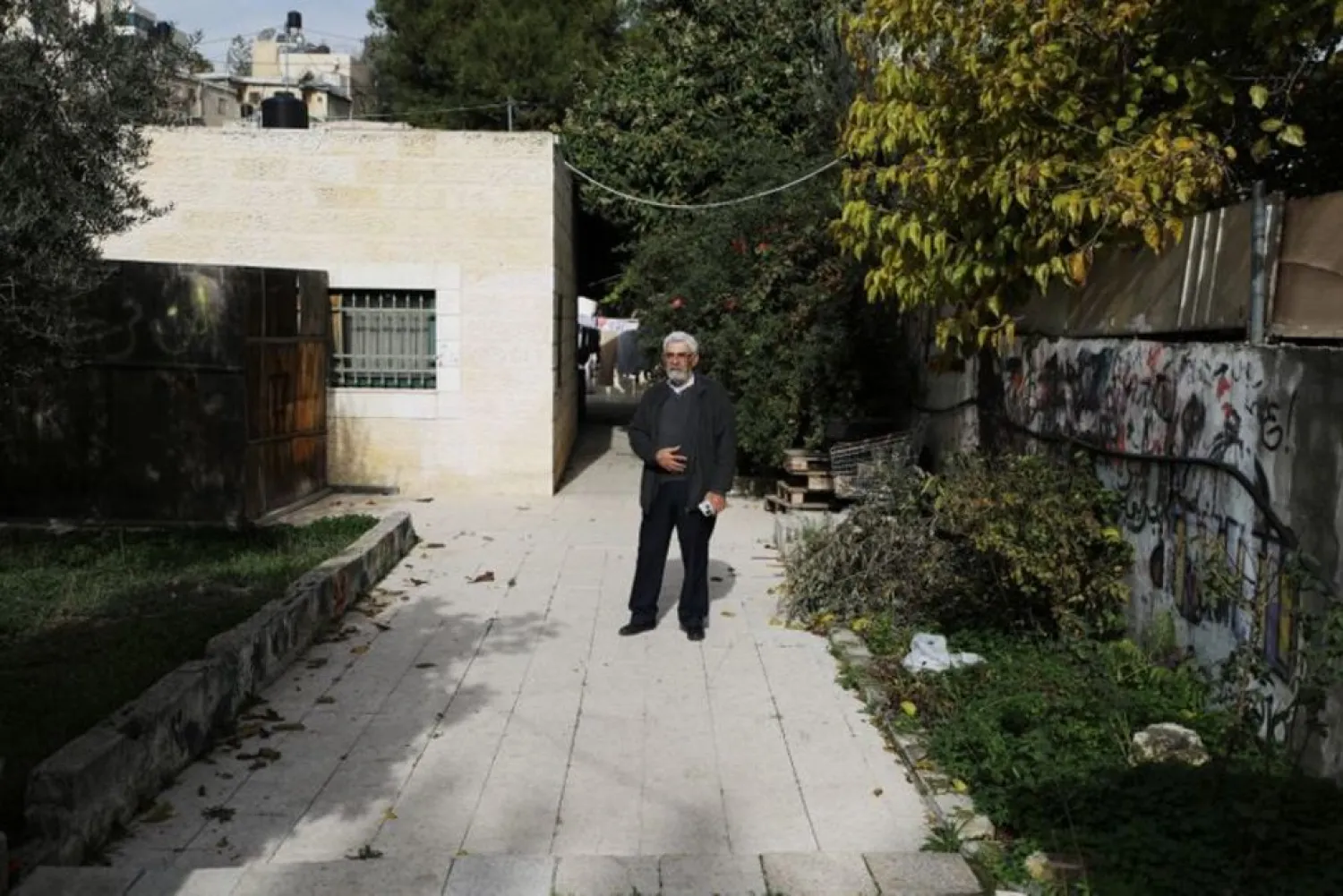

After 60 Years, East Jerusalem Palestinians Face Eviction Under Israeli Settler Rulings

Palestinian Nabil Al-Kurd stands outside his home in east Jerusalem December 14, 2020. Picture taken December 14, 2020. REUTERS/Ammar Awad
TT

After 60 Years, East Jerusalem Palestinians Face Eviction Under Israeli Settler Rulings

Palestinian Nabil Al-Kurd stands outside his home in east Jerusalem December 14, 2020. Picture taken December 14, 2020. REUTERS/Ammar Awad

For Nabil al-Kurd, being forced out of the East Jerusalem home he has lived in since the 1950s would be a fate worse than death.

But the 76-year-old and his wife and children are among dozens of Palestinians under threat of eviction from two districts of the disputed city, after an Israeli court ruled their properties are built on land belonging to Jewish settlers.

"This is my motherland. All my memories are in this house," Kurd told Reuters. "I won't leave unless it is to the cemetery."

The ownership claims against him and others in Sheikh Jarrah and a second neighborhood, Batan al-Hawa, are a focal point of settler development plans in East Jerusalem, captured by Israel in a war in 1967.

Kurd was ordered evicted in October, within 30 days.

He has appealed to the Jerusalem District court, though Hagit Ofran, project coordinator for Israeli anti-settlement group Peace Now, says he has little chance of overturning the ruling.

That same court has this year upheld several settler claims, based on 19th- and early 20th-century documents, drawing censure from the European Union, whose representative in Jerusalem says 77 Palestinians are at risk of forced transfer.

CITY AT THE HEART OF CONFLICT

The status of Jerusalem, a city holy to Jews, Muslims, and Christians, is at the heart of the Israeli-Palestinian conflict.

Palestinians want the capital of their would-be state to be East Jerusalem, and most countries regard settlements that Israel has built there as illegal.

Israel disputes this, citing biblical and historical links to the territory, as well as security needs and legal arguments.

Many of the Palestinians facing eviction were refugees like Kurd or their descendants, who came to the area more than half a century ago, Peace Now said.

The settlers in Kurd's case bought the land from two Jewish associations that claimed to have purchased it at the end of the 19th century, the group said.

A lawyer who represented the settlers claiming Kurd's property declined to speak with Reuters.

Peace Now says some 14 families have been evicted from Batan al-Hawa since 2015 and 16 from Sheikh Jarrah since the late 1990s in such cases.

Evictions are typically stayed while appeals are heard, and some of the residents have appealed their cases to Israel's Supreme Court, but Kurd's family is taking no chances.

"My family has prepared luggage of the important things we need so that if they come in any second, we will be ready," said daughter Muna al-Kurd.

."..We have a camera at the house, four cameras that show the street, and dad stays up until two to three in the morning just watching if they are coming to evacuate us."



Syria to Start Currency Swap on January 1st, Central Bank Governor Says

Syrian pounds are pictured inside an exchange currency shop in Azaz, Syria February 3, 2020. Picture taken February 3, 2020. REUTERS/Khalil Ashawi/File Photo
TT

Syria to Start Currency Swap on January 1st, Central Bank Governor Says

Syrian pounds are pictured inside an exchange currency shop in Azaz, Syria February 3, 2020. Picture taken February 3, 2020. REUTERS/Khalil Ashawi/File Photo

Syria will start swapping old banknotes for new ones under a ​plan to replace Assad-era notes starting from January 1, 2026, Central Bank Governor Abdelkader Husrieh said on Thursday.

Husrieh announced the introduction of the new Syrian currency, saying the decree "sets January ‌1, 2026, ‌as the start date ‌for ⁠the ​exchange ‌process". Sources familiar with the matter told Reuters in August that the country will issue new banknotes, removing two zeros from its currency in an attempt to restore ⁠public confidence in the severely devalued pound.

The ‌step is intended ‍to strengthen ‍the Syrian pound after its purchasing ‍power collapsed to record lows following a 14-year conflict that ended with President Bashar al-Assad's ouster in December.

Husrieh ​said the operation will take place through a smooth and orderly ⁠swap - a move bankers hope will ease fears that the new currency could fuel inflation and further erode the purchasing power of Syrians already reeling from high prices.

He added that a press conference will soon outline the exact regulations and mechanisms.


Türkiye Begins Black Box Analysis of Jet Crash That Killed Libyan Military Chief and 7 Others

Libyan national flags fly at half-mast in Tripoli on December 24, 2025, after the head of Libya's armed forces and his four aides died in a plane crash in Türkiye. (AFP)
TT

Türkiye Begins Black Box Analysis of Jet Crash That Killed Libyan Military Chief and 7 Others

Libyan national flags fly at half-mast in Tripoli on December 24, 2025, after the head of Libya's armed forces and his four aides died in a plane crash in Türkiye. (AFP)

The technical analysis of the recovered black boxes from a jet crash that killed eight people, including western Libya’s military chief, began as the investigation proceeded in cooperation with Libyan authorities, the Turkish Ministry of Defense said Thursday.

The private jet with Gen. Muhammad Ali Ahmad al-Haddad, four other military officials and three crew members crashed on Tuesday after taking off from Türkiye’s capital, Ankara, killing everyone on board. Libyan officials said the cause of the crash was a technical malfunction on the plane.

The high-level Libyan delegation was on its way back to Tripoli after holding defense talks in Ankara aimed at boosting military cooperation between the two countries.

The wreckage was scattered across an area covering 3 square kilometers (more than a square mile), complicating recovery efforts, according to the Turkish Interior Minister Ali Yerlikaya.

A 22-person delegation, including five family members, arrived from Libya early on Wednesday to assist in the investigation.


Lebanese President: We are Determined to Hold Parliamentary Elections on Time

President Joseph Aoun between Prime Minister Nawaf Salam and Speaker Nabih Berri (Lebanese Presidency file photo)
TT

Lebanese President: We are Determined to Hold Parliamentary Elections on Time

President Joseph Aoun between Prime Minister Nawaf Salam and Speaker Nabih Berri (Lebanese Presidency file photo)

Lebanese President Joseph Aoun reiterated on Thursday that the country’s parliamentary elections are a constitutional obligation that must be carried out on time.

Lebanon’s state-run National News Agency quoted Aoun as saying that he, alongside Prime Minister Nawaf Salam and Parliament Speaker Nabih Berri, is determined to hold the elections on schedule.

Aoun also emphasized that diplomatic efforts have continued unabated to keep the specter of war at bay, noting that "things are heading in a positive direction".

The agency also cited Berri reaffirming that the elections will take place as planned, with "no delays, no extensions".

The Lebanese parliamentary elections are scheduled for May next year.