

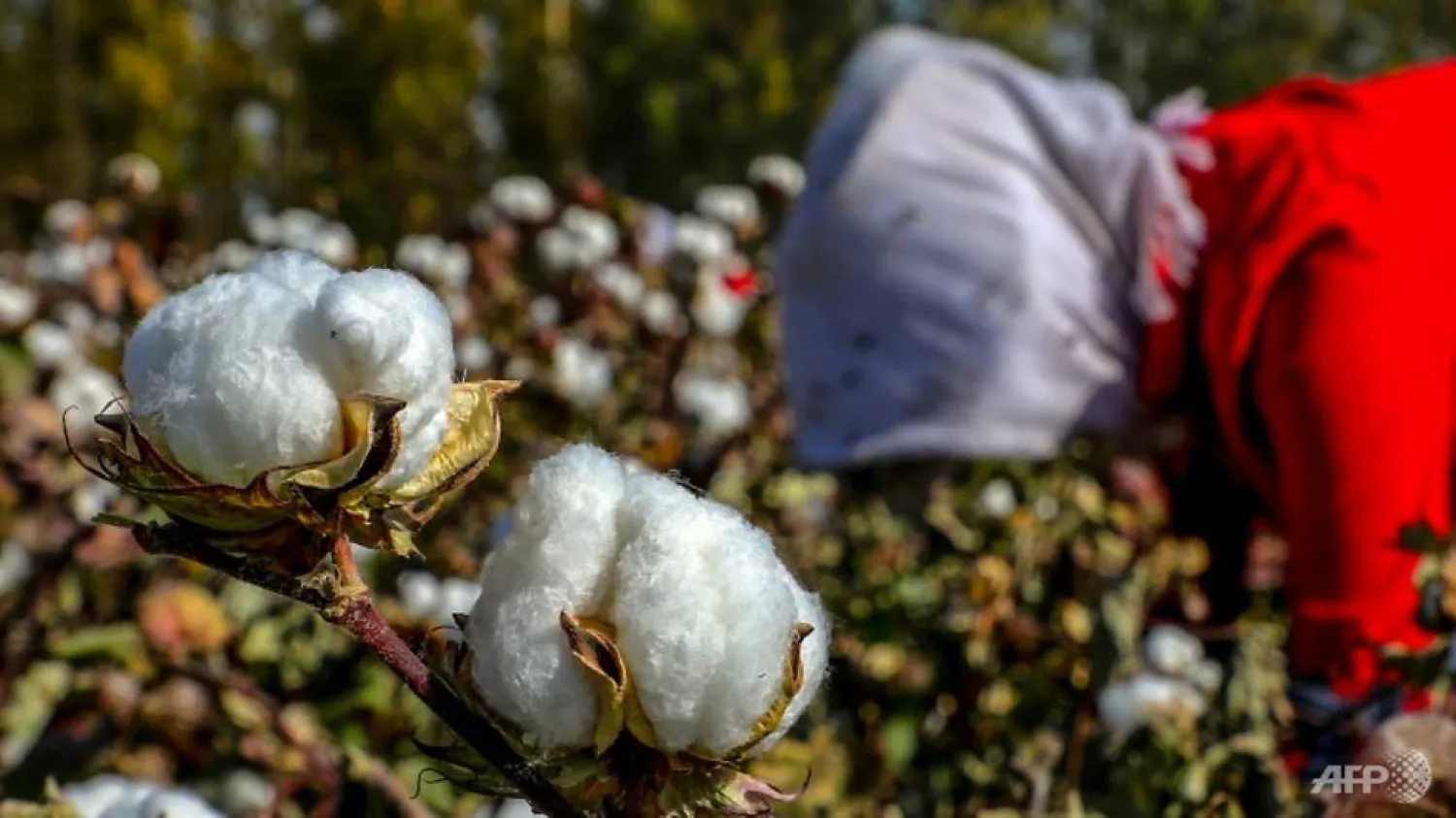

Over 570,000 Uighurs Involved in China Cotton Coerced Labor: Report

Xinjiang is a global hub for the crop, producing over 20 percent of the world's cotton |AFP
TT

Over 570,000 Uighurs Involved in China Cotton Coerced Labor: Report

Xinjiang is a global hub for the crop, producing over 20 percent of the world's cotton |AFP

Hundreds of thousands of ethnic minority laborers in China's northwestern Xinjiang region are being forced to pick cotton through a coercive state-run scheme, a report has said.

The research published Monday by Washington-based think tank the Center for Global Policy is likely to heap more pressure on global brands such as Nike, Gap, and Adidas, which have been accused of using Uighur forced labor in their textile supply chains.

Rights activists have said Xinjiang is home to a vast network of extrajudicial internment camps that have imprisoned at least one million people, which China has defended as vocational training centers to counter extremism.

The report -- which referenced online government documents -- said the total number involved in three majority-Uighur regions exceeds a 2018 estimate of 517,000 people forced to pick cotton as part of the scheme by hundreds of thousands.

Researchers warned of the "potentially drastic consequences" for global cotton supply chains, with Xinjiang producing more than 20 percent of the world's cotton and around a fifth of the yarn used in the United States coming from the region.

The BBC reported that it had asked 30 major international brands if they intended to continue sourcing products from China as a result of the findings -- of those that replied, only four said they had a strict policy of demanding that items sourced from anywhere in China do not use raw cotton from Xinjiang.

Beijing said that all detainees have "graduated" from the centers, but reports have suggested that many former inmates have been transferred to low-skilled manufacturing factory jobs, often linked to the camps.

But the think tank report said labor transfer scheme participants were heavily surveilled by police, with point-to-point transfers, "military-style management" and ideological training, citing government documents.

"It is clear that labor transfers for cotton-picking involve a very high risk of forced labor," Adrian Zenz, who uncovered the documents, wrote in the report.

"Some minorities may exhibit a degree of consent in relation to this process, and they may benefit financially. However... it is impossible to define where coercion ends and where local consent may begin."

- 'Anti-China research organization' -

The report also says there is a strong ideological incentive to enforce the scheme, as the boost in rural incomes allows officials to hit state-mandated poverty alleviation targets.

China has strongly denied allegations of forced labor involving Uighurs in Xinjiang and says training programs, work schemes, and better education have helped stamp out extremism in the region.

When asked about the report on Tuesday, Beijing said workers "of all ethnicities in Xinjiang sign labor contracts with enterprises based on their own voluntary choice of occupation."

Foreign ministry spokesman Wang Wenbin also attacked the report's author Zenz, saying he was the "backbone of an anti-China research organization set up under the manipulation of the US intelligence agency, which mainly fabricates rumors against China and defames China."

Earlier this month, the US banned imports of cotton produced by the Xinjiang Production and Construction Corps, a major paramilitary entity, which covers about a third of the crop produced in the entire region.

Another proposed bill banning all imports from Xinjiang has yet to pass the US Senate.


Russia: Man Suspected of Shooting Top General Detained in Dubai

An investigator works outside a residential building where the assassination attempt on Russian Lieutenant General Vladimir Alexeyev took place in Moscow, Russia February 6, 2026. REUTERS/Anastasia Barashkova
TT

Russia: Man Suspected of Shooting Top General Detained in Dubai

An investigator works outside a residential building where the assassination attempt on Russian Lieutenant General Vladimir Alexeyev took place in Moscow, Russia February 6, 2026. REUTERS/Anastasia Barashkova

Russia's Federal Security Service (FSB) said on Sunday that the man suspected of shooting top Russian military intelligence officer Vladimir Alexeyev in Moscow has been detained in Dubai and handed over to Russia.

Lieutenant General Vladimir Alexeyev, deputy head of the GRU, ⁠Russia's military intelligence arm, was shot several times in an apartment block in Moscow on Friday, investigators said. He underwent surgery after the shooting, Russian media ⁠said.

The FSB said a Russian citizen named Lyubomir Korba was detained in Dubai on suspicion of carrying out the shooting.

Russian Foreign Minister Sergei Lavrov accused Ukraine of being behind the assassination attempt, which he said was designed to sabotage peace talks. ⁠Ukraine said it had nothing to do with the shooting.

Alexeyev's boss, Admiral Igor Kostyukov, the head of the GRU, has been leading Russia's delegation in negotiations with Ukraine in Abu Dhabi on security-related aspects of a potential peace deal.


Factory Explosion Kills 8 in Northern China

Employees work on an electric vehicle (EV) production line at the Volkswagen Anhui factory in Hefei, Anhui province, China, February 4, 2026. REUTERS/Florence Lo
TT

Factory Explosion Kills 8 in Northern China

Employees work on an electric vehicle (EV) production line at the Volkswagen Anhui factory in Hefei, Anhui province, China, February 4, 2026. REUTERS/Florence Lo

An explosion at a biotech factory in northern China has killed eight people, Chinese state media reported Sunday, increasing the total number of fatalities by one.

State news agency Xinhua had previously reported that seven people died and one person was missing after the Saturday morning explosion at the Jiapeng biotech company in Shanxi province, citing local authorities.

Later, Xinhua said eight were dead, adding that the firm's legal representative had been taken into custody.

The company is located in Shanyin County, about 400 kilometers west of Beijing, AFP reported.

Xinhua said clean-up operations were ongoing, noting that reporters observed dark yellow smoke emanating from the site of the explosion.

Authorities have established a team to investigate the cause of the blast, the report added.

Industrial accidents are common in China due to lax safety standards.
In late January, an explosion at a steel factory in the neighboring province of Inner Mongolia left at least nine people dead.


Iran Warns Will Not Give Up Enrichment Despite US War Threat

Traffic moves through a street in Tehran on February 7, 2026. (Photo by ATTA KENARE / AFP)
TT

Iran Warns Will Not Give Up Enrichment Despite US War Threat

Traffic moves through a street in Tehran on February 7, 2026. (Photo by ATTA KENARE / AFP)

Iran will never surrender the right to enrich uranium, even if war "is imposed on us,” its foreign minister said Sunday, defying pressure from Washington.

"Iran has paid a very heavy price for its peaceful nuclear program and for uranium enrichment," Abbas Araghchi told a forum in Tehran.

"Why do we insist so much on enrichment and refuse to give it up even if a war is imposed on us? Because no one has the right to dictate our behavior," he said, two days after he met US envoy Steve Witkoff in Oman.

The foreign minister also declared that his country was not intimidated by the US naval deployment in the Gulf.

"Their military deployment in the region does not scare us," Araghchi said.
