

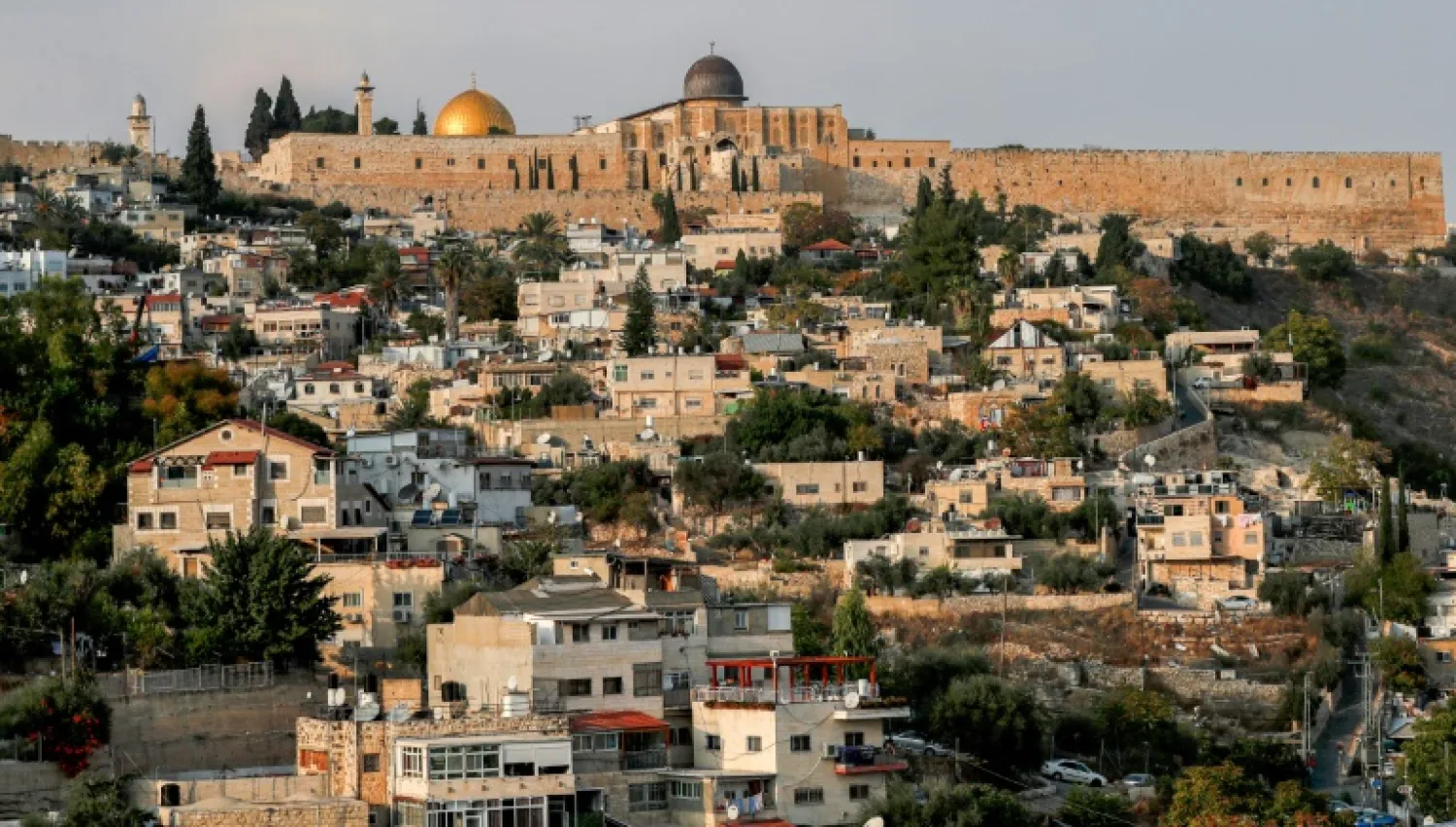

In East Jerusalem, a Battle Over 'Every Inch' of Land

The predominantly Arab neighborhood of Silwan, outside the Old City in Israeli-annexed east Jerusalem | AFP
TT

In East Jerusalem, a Battle Over 'Every Inch' of Land

The predominantly Arab neighborhood of Silwan, outside the Old City in Israeli-annexed east Jerusalem | AFP

The television in Zuheir Rajabi's lounge does not show films or the news: the only footage projected on its huge flat screen is from 10 surveillance cameras installed around his modest east Jerusalem home.

Rajabi lives in Silwan, a poor neighbourhood just outside the Old City in Israeli-annexed east Jerusalem, made up of dusty trash-strewn alleys, with electrical cables dangling low off their poles.

The moustached 49-year-old Palestinian told AFP that the surveillance footage offers him a sense of protection in case Jewish settlers harass him or clashes with Israeli police erupt again outside his door.

"This piece of paper proves my father bought this land from a Palestinian in 1966," Rajabi said, waving an Arabic document from the Jordanian authorities who controlled east Jerusalem until 1967, when Israel seized it in the Six Day War.

"But the Israeli courts don't want to hear about it," the father of four said with a grunt, seated in his living room with its orange and grey walls.

Rajabi has been locked in a five-year legal battle with three Israelis -- Yitzhak Ralbag, Avraham Sheferman and Mordechai Zarbiv -- who represent a trust registered in the name of Rabbi Moshe Benvenisti that claims ownership of the land where his home sits.

The Benvenisti trustees have cited 19th-century documents from the Ottoman Empire, which controlled Jerusalem before the British mandate era began in 1920, showing that Silwan land was owned by the trust.

The trust rented plots to Yemeni Jews, who lived in the area until they were forced out by Arab riots in 1929 and 1936.

In 1970, Israel passed a law allowing Jews to reclaim property they had lost in or before 1948, the year of Israel's creation which also saw authority over east Jerusalem pass from British to Jordanian control.

In cases where former east Jerusalem Jewish landowners or their heirs were unavailable, Israel granted administration of the land rights to a government entity called the General Custodian.

In 2001, the General Custodian declared the Benvenisti trust the rightful owner of two plots in Silwan, including one that Rajabi calls home.

Rajabi, who heads the local branch of a Palestinian community organisation that runs recreational activities, is due to face Ralbag, Sheferman and Zarbiv in court again on December 22.

As with most homes in Silwan, the Al-Aqsa Mosque and the southern Old City Wall can be seen from Rajabi's house, which has been extended over the years from its original two rooms.

He claims he has been offered a substantial cash payout to leave the property, where he has lived since the late 1960s.

He also told AFP that the Israeli state had "offered to build us a home in other areas of east Jerusalem, and we refused".

Rajabi's case is not unique in the Silwan neighborhood.

Like all of east Jerusalem, it is considered occupied Palestinian territory by much of the international community. Israel's annexation of east Jerusalem has not been recognized by most nations.

In the 1980s, settlers began moving into Silwan, which sits on land where -- according to Jewish tradition -- King David established his capital some 3,000 years ago, making the area hallowed ground in Jewish history.

There are now several hundred settlers in Silwan, living among some 50,000 Palestinians.

The area's Jewish homes are recognizable by Israeli flags flying on their roofs and modern facilities like a fully-enclosed basketball court that poorer Palestinian residents would struggle to afford.

Although not all cases are documented, anti-occupation group Peace Now says that 700 Palestinians in east Jerusalem are threatened with eviction.

Settler expansion in the area does not appear to be simply the result of individual families seeking to live in what Jews call the City of David.

Critics of Silwan's settler movement allege that it is backed by a spectacularly well-funded campaign aimed at transferring Palestinian-owned land to Jews.

- 'Ideological real estate' -

A thick binder planted on Rajabi's dining room table documents an Israeli legal process he blasts as biased against Palestinians.

"It's a political issue and all the branches of the Israeli government are conspiring together," he said.

Israeli anti-occupation groups claim the Benvenisti trustees are agents of the well-funded settler organization Ateret Cohanim, which states its mission is making "Jewish life flourish in Jerusalem."

A 1992 report by Israel's then Labour-led coalition government found that collaboration between the General Custodian and groups like Ateret Cohanim was plagued by "conflicts of interest."

The report made recommendations to address those conflicts, which activists say have been ignored.

Ateret Cohanim rejects any suggestion that it is working to force out Palestinians.

The group is simply focused on one particular type of transaction, its head Daniel Luria told AFP.

"We're doing ideological real estate. We're not forcing anyone to sell, we're not doing door knocking (but) if an Arab wants to sell, we're not going to say we're not interested," Luria said.

It is taboo among Palestinians to sell to settlers.

But the head of Peace Now, Hagit Ofran, said that for Palestinians in east Jerusalem "it is very, very hard to compete with the endless budget of groups like Ateret Cohanim" or the hardline settler organization Elad.

Pro-settler groups are ready to give "millions for a small piece of land", nearly impossible sums for Palestinians to pay, she told AFP.

According to a September investigation by the BBC, Russian oligarch and Chelsea football club owner Roman Abramovich controls companies that have donated an estimated $100 million to Elad.

Abramovich -- who was granted Israeli citizenship in 2018 -- has not publicly discussed his reported contributions and Elad declined to comment on its donors.

While the Palestinians are financially overmatched, they are not fighting alone.

Turkey's international development agency (TIKA) has, according to its website, "restored numerous local homes and shops in an effort to ease the hardships faced by east Jerusalem's Muslim community as a result of Israel's ongoing policy of Judaization."

- Battle for 'every inch' -

Abdelhalim Shaloudi received an eviction order at his 70-square-meter (750-square-foot) Silwan home in 2003.

"I don't sleep at night anymore," the father of four told AFP.

Shaloudi said the lawyers recommended by the Palestinian Authority -- based in Ramallah in the occupied West Bank -- cannot match the high-priced settler legal effort in Israeli courts.

But for now, he has no option but to wait it out and hope.

One organisation attempting a grassroots push-back against settlers is the Wadi Hilweh Information Center-Silwan, founded by Jawad Siam.

Its offices are just a few metres away from the City of David's archaeological centre, a site controlled by Elad that packed the area with tourists before the coronavirus pandemic.

"I created this centre to keep the name 'Silwan' alive," Siam told AFP.

"We are trying to adopt the same (real-estate) strategy as them," he said, meaning steering Palestinians to fill vacancies in Silwan immediately, in the hope of limiting places for settler expansion.

"But we are no match," he conceded. "They track us down on every inch, on every empty square of land."

- Never 'give up' -

Settlers generally reject the premise that Jews have taken control of land that historically belonged to Palestinians.

Disputes over historical or even ancient land claims are perpetual features of the Israeli-Palestinian conflict.

But history aside, it is not clear that the modern settler strategy of expanding the Jewish presence in east Jerusalem at the expense of Palestinians is destined to succeed.

Daniel Seidemann, a lawyer who founded the Israeli anti-occupation group Ir Amim, highlighted what he termed the legal strategy's moral bankruptcy.

He noted that the 1970 law only applies to Jews making land claims in east Jerusalem.

It does not offer any recourse to Palestinians who may have lost land, notably those who lost their homes in west Jerusalem upon the creation of Israel and the conflict that followed.

He also emphasized that much of the world regards east Jerusalem as occupied.

Under international law, "the transfer of a civilian population of the occupier and the displacement of the occupied is illegal," he said.

Bar-Ilan University political scientist Menachem Klein noted that despite the inferior services and poor infrastructure, Palestinians remain committed to east Jerusalem.

Their insistence that the area be the capital of their future state is unwavering, he said.

Israelis may want Palestinians "to leave the city," but that wish ignores the fact that Jerusalem is part of the Palestinian "identity", Klein said.

"This is their city."

And Rajabi made clear he is not going anywhere.

"I'm going to defend myself until the last possible moment. I cannot imagine for a second anyone else living in the house," he said.

"I would rather die here than give up."


Lebanon PM Pledges Reconstruction on Visit to Ruined Border Towns

This handout picture released by the Lebanese Government Press Office shows Lebanon's Prime Minister Nawaf Salam being showered with confetti as he is received by locals during a tour in the heavily-damaged southern village of Dhayra near the border with Israel on February 7, 2026. (Lebanese Government Press Office / AFP)
TT

Lebanon PM Pledges Reconstruction on Visit to Ruined Border Towns

This handout picture released by the Lebanese Government Press Office shows Lebanon's Prime Minister Nawaf Salam being showered with confetti as he is received by locals during a tour in the heavily-damaged southern village of Dhayra near the border with Israel on February 7, 2026. (Lebanese Government Press Office / AFP)

Lebanese Prime Minister Nawaf Salam visited heavily damaged towns near the Israeli border on Saturday, pledging reconstruction.

It was his first trip to the southern border area since the army said it finished disarming Hezbollah there, in January.

Swathes of south Lebanon's border areas remain in ruins and largely deserted more than a year after a US-brokered November 2024 ceasefire sought to end hostilities between Israel and the Iran-backed group.

Lebanon's government has committed to disarming Hezbollah, and the army last month said it had completed the first phase of its plan to do so, covering the area between the Litani River and the Israeli border about 30 kilometers (20 miles) further south.

Visiting Tayr Harfa, around three kilometers from the border, and nearby Yarine, Salam said frontier towns and villages had suffered "a true catastrophe".

He vowed authorities would begin key projects including restoring roads, communications networks and water in the two towns.

Locals gathered on the rubble of buildings to greet Salam and the delegation of accompanying officials in nearby Dhayra, some waving Lebanese flags.

In a meeting in Bint Jbeil, further east, with officials including lawmakers from Hezbollah and its ally the Amal movement, Salam said authorities would "rehabilitate 32 kilometers of roads, reconnect the severed communications network, repair water infrastructure" and power lines in the district.

Last year, the World Bank announced it had approved $250 million to support Lebanon's post-war reconstruction, after estimating that it would cost around $11 billion in total.

Salam said funds including from the World Bank would be used for the reconstruction and rehabilitation projects.

The second phase of the government's disarmament plan for Hezbollah concerns the area between the Litani and the Awali rivers, around 40 kilometers south of Beirut.

Israel, which accuses Hezbollah of rearming, has criticized the army's progress as insufficient, while Hezbollah has rejected calls to surrender its weapons.

Despite the truce, Israel has kept up regular strikes on what it usually says are Hezbollah targets and maintains troops in five south Lebanon areas.

Lebanese officials have accused Israel of seeking to prevent reconstruction in the heavily damaged south with repeated strikes on bulldozers, excavators and prefabricated houses.

Visiting French Foreign Minister Jean-Noel Barrot on Friday said the reform of Lebanon's banking system needed to precede international funding for reconstruction efforts.

The French diplomat met Lebanon's army chief Rodolphe Haykal on Saturday, the military said.


Over 2,200 ISIS Detainees Transferred to Iraq from Syria, Says Iraqi Official

 One of the American buses transporting ISIS fighters, according to a security source from the Syrian Democratic Forces, heads from Syria towards Iraq, in Qamishli, Syria, February 7, 2026. (Reuters)
One of the American buses transporting ISIS fighters, according to a security source from the Syrian Democratic Forces, heads from Syria towards Iraq, in Qamishli, Syria, February 7, 2026. (Reuters)
TT

Over 2,200 ISIS Detainees Transferred to Iraq from Syria, Says Iraqi Official

 One of the American buses transporting ISIS fighters, according to a security source from the Syrian Democratic Forces, heads from Syria towards Iraq, in Qamishli, Syria, February 7, 2026. (Reuters)
One of the American buses transporting ISIS fighters, according to a security source from the Syrian Democratic Forces, heads from Syria towards Iraq, in Qamishli, Syria, February 7, 2026. (Reuters)

Iraq has so far received 2,225 ISIS group detainees, whom the US military began transferring from Syria last month, an Iraqi official told AFP on Saturday.

They are among up to 7,000 ISIS detainees whose transfer from Syria to Iraq the US Central Command (CENTCOM) announced last month, in a move it said was aimed at "ensuring that the terrorists remain in secure detention facilities".

Previously, they had been held in prisons and camps administered by the Kurdish-led Syrian Democratic Forces (SDF) in northeast Syria.

The announcement of the transfer plan last month came after US envoy to Syria Tom Barrack declared that the SDF's role in confronting ISIS had come to an end.

Saad Maan, head of the security information cell attached to the Iraqi prime minister's office, told AFP on Saturday that "Iraq has received 2,225 terrorists from the Syrian side by land and air, in coordination with the international coalition", which Washington has led since 2014 to fight IS.

He said they are being held in "strict, regular detention centers".

A Kurdish military source confirmed to AFP the "continued transfer of ISIS detainees from Syria to Iraq under the protection of the international coalition".

On Saturday, an AFP photographer near the Kurdish-majority city of Qamishli in northeastern Syria saw a US military convoy and 11 buses with tinted windows.

- Iraq calls for repatriation -

ISIS seized swathes of northern and western Iraq starting in 2014, until Iraqi forces, backed by the international coalition, managed to defeat it in 2017.

Iraq is still recovering from the severe abuses committed by the extremists.

In recent years, Iraqi courts have issued death and life sentences against those convicted of terrorism offences.

Thousands of Iraqis and foreign nationals convicted of membership in the group are incarcerated in Iraqi prisons.

On Monday, the Iraqi judiciary announced it had begun investigative procedures involving 1,387 detainees it received as part of the US military's operation.

In a statement to the Iraqi News Agency on Saturday, Maan said "the established principle is to try all those involved in crimes against Iraqis and those belonging to the terrorist ISIS organization before the competent Iraqi courts".

Among the detainees being transferred to Iraq are Syrians, Iraqis, Europeans and holders of other nationalities, according to Iraqi security sources.

Iraq is calling on the concerned countries to repatriate their citizens and ensure their prosecution.

Maan noted that "the process of handing over the terrorists to their countries will begin once the legal requirements are completed".


Drone Attack by RSF in Sudan Kills 24, Including 8 Children, Doctors’ Group Says

Displaced Sudanese wait to receive humanitarian aid at the Abu al-Naga displacement camp in the Gedaref State, some 420km east of the capital Khartoum on February 6, 2026. (AFP)
TT

Drone Attack by RSF in Sudan Kills 24, Including 8 Children, Doctors’ Group Says

Displaced Sudanese wait to receive humanitarian aid at the Abu al-Naga displacement camp in the Gedaref State, some 420km east of the capital Khartoum on February 6, 2026. (AFP)

A drone attack by a notorious paramilitary group hit a vehicle carrying displaced families in central Sudan Saturday, killing at least 24 people, including eight children, a doctors’ group said.

The attack by the Rapid Support Forces occurred close to the city of Rahad in North Kordofan province, said the Sudan Doctors Network, which tracks the country’s ongoing war.

The vehicle transported displaced people who fled fighting in the Dubeiker area of North Kordofan, the doctors’ group said in a statement. Among the dead children were two infants, the group said.

The doctors’ group urged the international community and rights organizations to “take immediate action to protect civilians and hold the RSF leadership directly accountable for these violations.”

There was no immediate comment from the RSF, which has been at war against the Sudanese military for control of the country for about three years.

Sudan plunged into chaos in April 2023 when a power struggle between the military and the RSF exploded into open fighting in the capital, Khartoum, and elsewhere in the country.

The devastating war has killed more than 40,000 people, according to UN figures, but aid groups say that is an undercount and the true number could be many times higher.

It created the world’s largest humanitarian crisis with over 14 million people forced to flee their homes. It fueled disease outbreaks and pushed parts of the country into famine.
