Sarraj Orders Reorganization of Special Deterrence Force Away From Bashagha

The head of the Libyan Government of National Accord (GNA) Fayez Al-Sarraj talking to GNA Interior Minister Fathi Bashagha in Tripoli | Getty Images
TT

Sarraj Orders Reorganization of Special Deterrence Force Away From Bashagha

The head of the Libyan Government of National Accord (GNA) Fayez Al-Sarraj talking to GNA Interior Minister Fathi Bashagha in Tripoli | Getty Images

Conflict within Libya’s Tripoli-based Government of National Accord (GNA) has taken a new course after its head, Fayez Al-Sarraj, ordered the reorganization of the Special Deterrence Force away from the Interior Ministry.

The move removes the Force’s subordination to Interior Minister Fathi Bashagha.

On another note, the head of Egypt's General Intelligence Service (GIS) Abbas Kamel conveyed during a surprise visit to the Libyan city of Benghazi on Saturday a message of support from President Abdel-Fattah El-Sisi to the Libyan people on various military and political levels.

During his visit, Kamel met with the commander of the Libyan National Army (LNA) Khalifa Haftar and the head of the Libyan House of Representatives Aguila Saleh.

A number of issues of concern were discussed. This came within the framework of the Egyptian role in support of stabilizing the situation in Libya and preserving its capabilities and gains, a GIS statement said.

In Kamel and Haftar’s meeting, the statement said, emphasis was placed on the Egyptian efforts and moves in support of the outcomes of the 5+5 Military Commission meetings, which resulted in delaying the ceasefire and taking a number of measures that have contributed to stabilizing the military and security situation throughout Libya.

The 5+5 Joint Military Commission, which brings together five military officials from the eastern and western camps in the Libyan conflict, is one of the three tracks of the settlement process that emerged during the Berlin Conference on Libya in mid-January. It was subsequently adopted by the UN Security Council.

Moreover, Kamel met with Saleh along with a number of MPs, where he emphasized that Egypt “supports all tracks of a comprehensive settlement of the Libyan crisis” in coordination with the United Nations (UN) and the international community.

The head of Egypt’s GIS also discussed the latest developments in the political situation, as well as ways to advance and develop Egyptian-Libyan relations at all levels during the coming period, the statement noted.


Roadside Bomb Kills Iraqi Army Brigadier, Soldier Near Kirkuk

The Iraqi army during operations against ISIS (Ministry of Defense)
TT

Roadside Bomb Kills Iraqi Army Brigadier, Soldier Near Kirkuk

The Iraqi army during operations against ISIS (Ministry of Defense)

A roadside bomb targeting an Iraqi army vehicle killed an Iraqi army brigadier and a soldier near the northern city of Kirkuk on Wednesday, the military said, in the second attack on Iraqi security forces in the area this month.

The bomb struck an army patrol conducting a search operation at an ISIS hideout that Iraqi warplanes had targeted a day earlier, about 80 km (50 miles) south of Kirkuk, according to a military statement.

The attack, which wounded two other soldiers, follows an October 5 assault claimed by ISIS militants southwest of Kirkuk, in which one federal policeman was killed and four others wounded when gunmen armed with machineguns and sniper rifles attacked a federal police position.

The latest incident occurred just weeks after US forces completed their withdrawal from Iraq on September 30, ending their military mission in the country.

Iraqi officials have said ISIS retains sleeper cells capable of carrying out hit-and-run attacks, raising concerns that the militants could seek to exploit security gaps despite continued Iraqi counter-insurgency operations.


Colombia Opens Embassy in Jerusalem, Restores Free Trade Deal with Israel

FILE - Colombian President Abelardo De La Espriella speaks during a bilateral agreements signing ceremony with US Secretary of State Marco Rubio in Barranquilla, Colombia, on Sept. 8, 2026. (AP Photo/Fernando Vergara, Pool, File)
TT

Colombia Opens Embassy in Jerusalem, Restores Free Trade Deal with Israel

FILE - Colombian President Abelardo De La Espriella speaks during a bilateral agreements signing ceremony with US Secretary of State Marco Rubio in Barranquilla, Colombia, on Sept. 8, 2026. (AP Photo/Fernando Vergara, Pool, File)

Colombia opened its embassy in Jerusalem on Wednesday, becoming the 10th country to do so, as new President Abelardo de la Espriella reversed his predecessor's break with Israel by also restoring a free trade agreement between the two countries.

Most countries maintain their embassies to Israel in Tel Aviv. Israel regards Jerusalem as its capital, while Palestinians seek East Jerusalem as the capital of a future independent state. The city's ⁠status remains one ⁠of the most contentious issues in the Israeli-Palestinian conflict.

Former Colombian President Gustavo Petro in May 2024 broke diplomatic relations with Israel over its actions in Gaza and had heavily criticized Prime Minister Benjamin Netanyahu.

Petro ⁠had closed Colombia's embassy in Tel Aviv and recalled its ambassador, a move Israel said was antisemitic and a reward for Hamas militants.

Right-winger de la Espriella became president in August.

On Tuesday, the free trade agreement that was terminated by Petro was reinstated.

Israel's Foreign Minister Gideon Saar said: "In just two months, we have reversed most of the ⁠negative ⁠consequences of the Petro administration for Israel-Colombia relations and have even broken new ground ... I thank ... Abelardo de la Espriella for his determination to bring Israel-Colombia relations to an all-time high.”

Colombian Minister of Foreign Affairs Omar Bula Escobar attended the opening of the embassy in Jerusalem.

Several countries have relocated their embassies to Jerusalem since the United States did so in 2018. Among them are Guatemala, Honduras, Paraguay and Somaliland.


Barrack, al-Zaidi Discuss Iraq’s Difficult Path to Stability

US envoy to Iraq Tom Barrack speaks to the media at United Nations headquarters in New York on September 24, 2026 (Reuters)
TT

Barrack, al-Zaidi Discuss Iraq’s Difficult Path to Stability

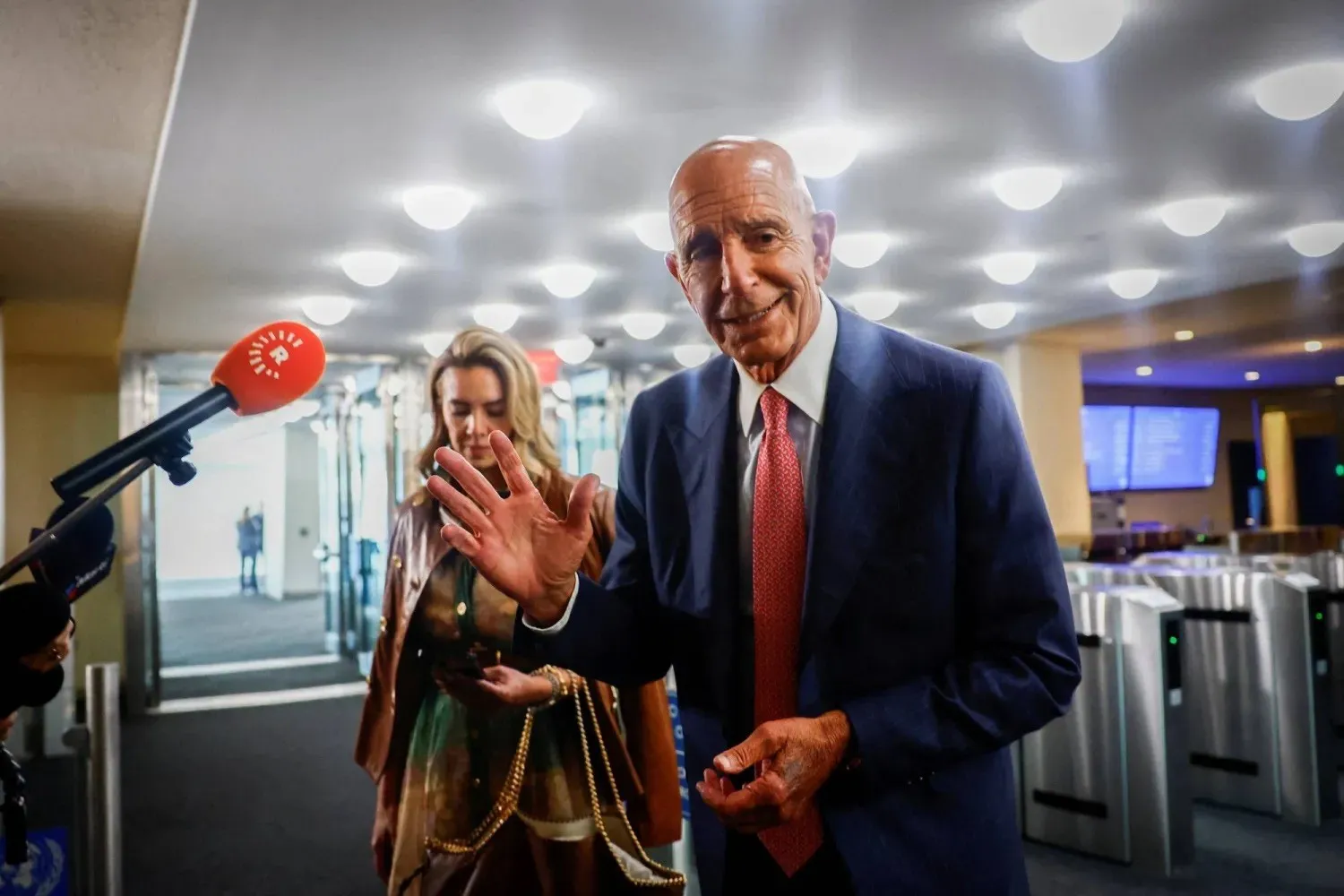
US envoy to Iraq Tom Barrack speaks to the media at United Nations headquarters in New York on September 24, 2026 (Reuters)

Iraqi sources have indicated that the issue of weapons held by armed factions was likely among the topics discussed in Baghdad between Iraq’s prime minister, head of the judiciary and US envoy Tom Barrack, who spoke of the “hard road toward” towards achieving stability in the region.

Prime Minister Ali al-Zaidi received Barrack on Monday evening, nearly two weeks after the withdrawal of the US-led international coalition forces from Iraqi territory.

According to observers, the withdrawal could prompt Washington and Baghdad to discuss post-pullout arrangements, particularly amid regional tensions and the possibility of renewed conflict between Washington and Tehran.

The Iraqi Prime Minister’s Office said the meeting between al-Zaidi and Barrack addressed “bilateral relations between Iraq and the United States and ways to strengthen cooperation in various fields.”

They also discussed “the latest developments in the region and efforts to support regional security and stability in a manner that serves the common interests of both countries and eases regional tensions and conflicts.”

The US envoy praised al-Zaidi’s leadership in a post on X.

"Stability is not inherited; it is built by leaders who choose the hard road. Iraq's security and prosperity are the region's. Grateful for his leadership and partnership,” Barrack said.

The envoy’s visit to Baghdad came amid a shift in relations between Baghdad and Washington following the end of the international coalition’s military mission in Iraq late September. The relationship is now expected to transition toward a political and economic partnership, alongside continued security cooperation between the two countries.

Barrack highlighted this shift during a meeting with US Embassy Chargé d’Affaires in Iraq Steve Fagin, saying that US-Iraqi relations are moving from a security-based partnership toward a broader relationship centered on economic cooperation and mutual interests.

Barrack had met Foreign Minister Fuad Hussein in Istanbul on Saturday, where they discussed “bilateral relations between Iraq and the US ... in light of the end of the international coalition forces’ mission in Iraq, as well as prospects for cooperation between the two countries in the coming period,” according to an Iraqi Foreign Ministry statement.

Barrack added that the meeting addressed developments in the region, ongoing conflicts and their implications for security and stability in Iraq and other countries in the region, as well as Iraq’s financial and economic situation and developments related to the Iraqi dinar’s exchange rate.

The US envoy also met in Baghdad with Supreme Judicial Council President Faik Zaidan. According to a statement by the council, the two sides “discussed ideas related to developing relations between the two countries in the legal and judicial fields.”

An official source close to the Coordination Framework alliance did not rule out the possibility that “the visit is an attempt to support al-Zaidi’s government, which is facing intense pressure at this stage, particularly following the decision to devalue the Iraqi dinar.”

Several lawmakers have recently raised the possibility of withdrawing confidence from al-Zaidi and bringing down his government in an attempt to absorb public anger following market turmoil and a sharp rise in the prices of goods and basic commodities after the dinar’s devaluation.

The source told Asharq Al-Awsat that he believed “Washington has come to realize that Iran and its allies in Iraq are seeking to challenge it by pressuring al-Zaidi with the threat of a no-confidence vote. Barrack’s presence may be intended to renew confidence in al-Zaidi’s government, whose leadership has previously been praised by senior US officials, including President Trump.”

The source also did not rule out the possibility that the US official would discuss the issue of weapons held by armed factions, given the importance Washington attaches to the matter.

Bringing all arms under state control is one of the key issues in Iraqi-US talks. During a meeting in Baghdad last June, al-Zaidi and Barrack stressed the importance of completing efforts to end the presence of armed formations operating outside state authority and strengthening Iraqi sovereignty.

Aqil Abbas, a researcher specializing in US affairs, highlighted the significance of Barrack’s meeting with Zaidan, saying that “the US-Iraqi understanding is based on the judiciary serving as the spearhead in efforts to dismantle armed factions, paving the way for the executive authorities to resolve this issue.”

Abbas told Asharq Al-Awsat that Iraqi authorities would likely resort to the judiciary after exhausting negotiations with armed factions and efforts to reach a consensual political solution. This, he said, confirmed that the US strategy remained focused on addressing armed factions through Iraqi institutions.

“The decisive factor in the weapons issue is the firmness of the government and judiciary, as well as the willingness shown by the Coordination Framework forces to deal with this issue,” Abbas said.

He cautioned, however, that “Iraq’s shifting sands may dash Tom Barrack’s hopes. Without a firm US position encompassing Iraq as a whole, we will not see the armed factions disarmed anytime soon.”