


Lebanon Arrests 8 After Refugee Camp Set Ablaze

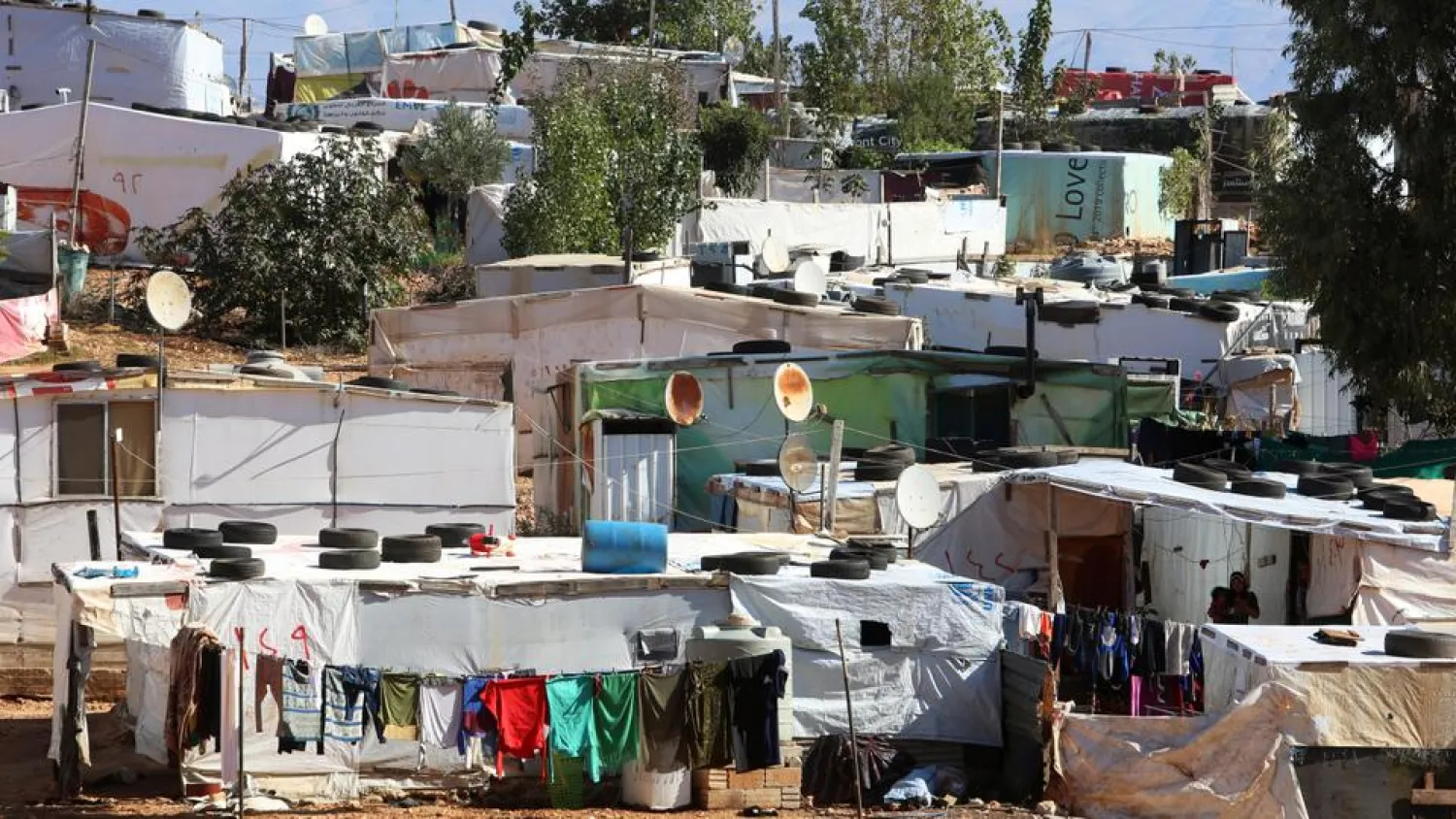
Clothes are hung up to dry at a Syrian refugee camp in Marjayoun, southern Lebanon November 24, 2020. (Reuters)
TT

Lebanon Arrests 8 After Refugee Camp Set Ablaze

Clothes are hung up to dry at a Syrian refugee camp in Marjayoun, southern Lebanon November 24, 2020. (Reuters)

Lebanon's army said Sunday it had arrested eight people after a dispute led a group of Lebanese nationals to set fire to an informal refugee settlement in the country's north.

The army said it "arrested two Lebanese nationals and six Syrians over a personal dispute... between a number of Lebanese men and Syrian workers," according to a statement.

"The Lebanese men fired bullets in the air and torched the tents of Syrian refugees," it added, without elaborating on the cause of the altercation.

The fire on Saturday night tore through the tented shelters of some 75 families near the town of Bhanine in the north Lebanon Miniyeh region, leaving only a charred wasteland.

The camp's more than 370 residents were forced to flee, according to the United Nations refugee agency, UNHCR, and at least four people were taken to hospital for injuries.

On Sunday, the Syrian Ministry of Foreign Affairs issued a statement calling on “the competent Lebanese judiciary and relevant authorities to assume their responsibilities in providing protection and care for the displaced Syrians."

It expressed deep regret over the fire that broke out in the Syrian refugee camp in the Miniyeh district. The statement was published by the official Syrian News Agency (SANA), quoting an official source in the Syrian Ministry of Foreign Affairs.

Damascus renewed the call on the Syrian citizens, “who were forced to leave the country by the unjust war on Syria, to return to their homeland.”

The statement added that the Syrian government “is making all efforts to facilitate this return and provide them with the requirements of decent living in their cities and villages, based on the available capabilities.”

Dozens of refugees returned Sunday to the remains of the camp to try to salvage anything that might have survived the blaze.

"I came back to check on belongings inside our small tent only to discover that we no longer own anything," said Amira Issa, a 45-year-old mother of five who fled Syria eight years ago.

"We lost everything in one moment," she told AFP, sobbing.

The fire sparked an outpouring of sympathy on social media from Lebanese, who condemned what they called a racist attack.

Syria's foreign ministry expressed "deep regret" over the incident and called on "Syrians forced to leave their country by an unjust war to return" home.

UNHCR said most camp residents have found temporary shelter.

"They have relocated to nearby informal settlements... or were taken in by area residents," said UNHCR spokesman Khaled Kabbara.

"We saw a remarkable level of solidarity from the Lebanese community offering vacant shelters, including hospitals and schools."

Lebanon says it hosts some 1.5 million Syrians, including around one million registered as refugees with the United Nations.

Authorities have called on refugees to return to Syria even though rights groups warn that the war-torn country is not yet safe.

In November, around 270 Syrian refugee families fled the northern Lebanese town of Bsharre after a Syrian national was accused of shooting dead a Lebanese resident, sparking widespread tension and hostility.



Lebanon Condemns ‘Systematic’ Israeli Destruction in South

A photograph taken from the southern Lebanese village of Chaqra shows an Israeli flag fluttering over the burnt fields of the border village of Mais al-Jabal, burnt during Israeli military operations on August 11, 2026. (AFP)
TT

Lebanon Condemns ‘Systematic’ Israeli Destruction in South

A photograph taken from the southern Lebanese village of Chaqra shows an Israeli flag fluttering over the burnt fields of the border village of Mais al-Jabal, burnt during Israeli military operations on August 11, 2026. (AFP)

Lebanese Prime Minister Nawaf Salam on Wednesday condemned Israel's "systematic destruction" in the country's south as a violation of international law, as Israel's defense minister said its military was "destroying all the houses" there.

Salam said Israeli "attacks, incursions, demolitions and the systematic destruction of homes", infrastructure, government buildings and places of worship "represent a serious violation of the principles and rules of international law and international humanitarian law".

Claiming that villages and towns "are entirely 'military facilities' does not stand up to any logic and cannot be used as an excuse for destroying them, displacing their inhabitants and preventing them from returning," he said in a statement.

Israel's Defense Minister Israel Katz visited southern Lebanon on Wednesday, vowing to keep troops in a so-called "security zone" there and saying the Israeli military was "destroying the underground infrastructure" in the area and "destroying all the houses".

Hezbollah drew Lebanon into the Middle East war in March by attacking Israel, which responded with heavy airstrikes and a ground invasion that Lebanese authorities say have killed more than 4,300 people.

A framework deal reached in late June between Lebanon and Israel involves the disarmament of the Iran-backed group, a gradual withdrawal of Israeli forces from south Lebanon and the deployment of the Lebanese army to the region, starting in "pilot zones".

While violence has significantly decreased since the signing of a US-Iran memorandum of understanding in June and the Lebanon-Israel deal, Lebanon still reports intermittent Israeli strikes and ongoing demolitions.

Lebanon's state-run National News Agency (NNA) on Wednesday said Israeli troops carried out detonations in southern villages including in Zawtar al-Shariqyeh, which abuts one of the "pilot zones".

Lebanon's army said Israel had blown up "the municipal building in Zawtar al-Shariqyeh" as well as "a public school, a health clinic, a children's nursery and a number of homes".

Also on Wednesday, Lebanon's army chief Rodolphe Haykal met visiting US General Joseph Clearfield, who heads a coordination group involved with the June agreement.

The pair discussed "developments in the south and security arrangements" relating to the deal, the Lebanese military said, as well as "the difficulties the army faces in carrying out its missions, primarily due to the continuing attacks, bulldozing and destruction by the Israeli occupation".

President Joseph Aoun also met Clearfield, his office said, and discussed the implementation of the framework deal.

Israel and Lebanon are to hold an eighth round of US-sponsored negotiations next month, in Rome.


Israeli Settlers Keep Up Siege of Palestinian Homes Despite Army Intervention

Israeli settlers besiege a Palestinian home for the fourth consecutive day in the town of Qusra, south of Nablus, 12 August 2026. (EPA)
TT

Israeli Settlers Keep Up Siege of Palestinian Homes Despite Army Intervention

Israeli settlers besiege a Palestinian home for the fourth consecutive day in the town of Qusra, south of Nablus, 12 August 2026. (EPA)

The Israeli military failed in an attempt on Wednesday to remove occupied West Bank settlers who for days have blockaded Palestinian homes, an eyewitness and an AFP photographer reported.

The siege began on Sunday, when a group of settlers set up a makeshift tent near houses in the Palestinian village of Qusra, just south of Nablus, blocking essential supplies from entering.

"We have received no food and no medicine," Qusai Abu Rida, a Palestinian trapped inside one of the houses, told AFP by telephone, adding that he had only managed to secure electricity thanks to solar panels.

The Israeli military condemned the settlers' actions and declared the area a "closed military zone", before on Wednesday morning removing the tent where the settlers had been staying.

Security forces "are working to evacuate the civilians who were staying there," the military said in a statement.

By mid-afternoon, an AFP photographer at the scene said the military had left and the tent had been removed, but that the settlers were still at the site.

Abu Rida confirmed the situation remained unchanged, with the settlers still in possession of chairs and blankets.

"The army has withdrawn, and so far we are still besieged, with the settlers at our doorstep," he told AFP.

Violence by Israeli settlers towards Palestinians in the West Bank has persisted for years, often with little or no legal consequence, but recent months have seen a surge in attacks.

Israel has occupied the West Bank since 1967.

More than 500,000 Israelis live in settlements in the Palestinian territory, which are illegal under international law, among some three million Palestinians.

The Israeli military said Tuesday it had received several reports of settlers entering and taking control of Palestinian homes and land in the area.

"This is illegal, reprehensible and unacceptable activity that harms the residents of the areas and disrupts their daily lives," it said.

It also said that disciplinary action would be taken against security personnel who had been filmed at the site days earlier.

According to an AFP tally based on data from the Palestinian health ministry, Israeli soldiers or settlers have killed at least 1,097 Palestinians, including both gunmen and civilians, since the start of the Gaza war in October 2023.

Israeli figures show at least 48 Israelis, including civilians and security personnel, have been killed in Palestinian attacks or during Israeli military operations during the same period.


Syria Receives First Shipments at Pier Previously Used by Russia

A drone view shows a vessel at Berth NO. 4, which was handed over by Russian forces to the Syrian government, at the port of Tartus in Tartus, Syria, August 12, 2026. (Reuters)
TT

Syria Receives First Shipments at Pier Previously Used by Russia

A drone view shows a vessel at Berth NO. 4, which was handed over by Russian forces to the Syrian government, at the port of Tartus in Tartus, Syria, August 12, 2026. (Reuters)

Syria received its first shipments of wheat and cement materials this week at a berth previously used by Russian forces, according to officials at the Tartus port, where Reuters reporters saw Russian forces packing up materials and moving out of parts of the pier.

Both shipments arrived on Tuesday, two days after Damascus announced it had reached an agreement with Moscow on the future of Russian bases at Tartus and the Hmeimim airport, ‌both in Syria's northwestern ‌coastal regions.

Syria's foreign ministry said the deal would ‌see ⁠Syria take over management ⁠of civilian facilities, including Hmeimim airport and the commercial berth at Tartus port, and that military facilities would be repurposed as joint training facilities.

"We began operating berth 4 yesterday after taking it over from the Operations Department. Work commenced immediately with the reception of two vessels in succession," Youssef Arnous, the head of Tartus port's operations and investment department, told Reuters on Wednesday.

He said that specific berth could ⁠accommodate up to three vessels simultaneously and that storage yards ‌directly opposite the pier could reduce vessel ‌waiting time during anchorage.

LSEG data showed that both vessels had come from Turkish ports, but ‌it was not immediately clear where they had originated.

Reuters reporters at the ‌port on Wednesday saw Russian forces moving out of a building near the pier and relocating material to another military facility nearby.

It was not immediately clear how many Russian forces remain at Tartus or in Hmeimim. A Syrian source familiar with the arrangement ‌said some Russian military forces would stay in Syria as part of the deal.

The future of the bases ⁠became uncertain after ⁠Russian ally Bashar al-Assad fled the country in 2024. The memorandum followed 18 months of intensive negotiations.

Russia's foreign ministry said on Tuesday that it saw the deal as "an important step aimed at further improving bilateral cooperation in the military sphere".

Russia has long viewed its naval and air bases in Syria as a key source of geopolitical clout in the Middle East and power projection across the Mediterranean and into Africa.

The Tartus facility is Russia's only Mediterranean repair and replenishment hub, and Moscow has used Syria as a staging post to fly its military contractors in and out of Africa.

Reuters reported in July that parts of the fourth berth in Tartus that had been used by Russia's military would be transformed into a commercial and logistics hub.