

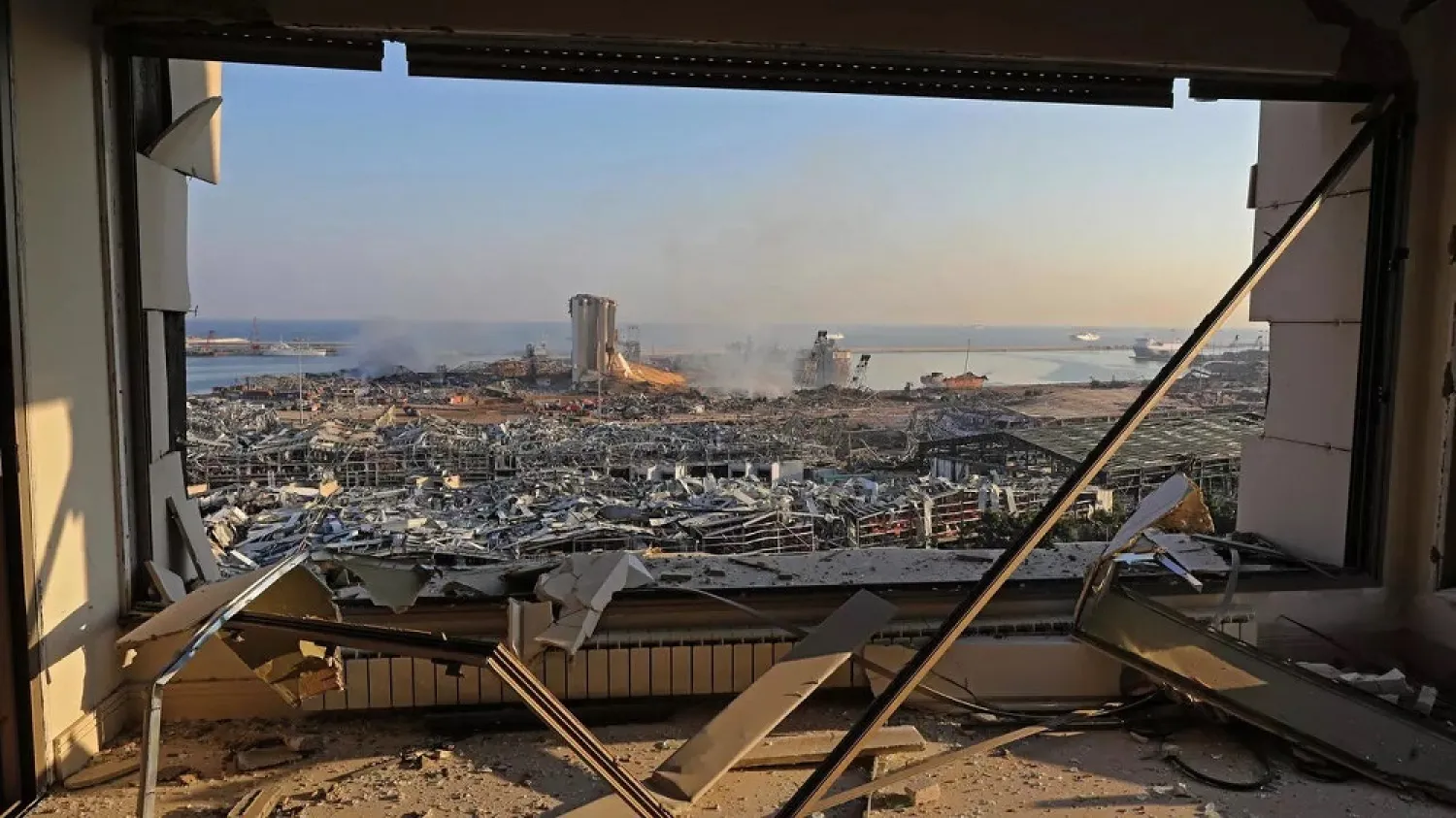

FBI Found Beirut Port Blast Caused by 500 Tons of Fertilizer, Says PM

A massive explosion at the Beirut port on August 4 killed more than 200 people and laid waste to large swathes of the Lebanese capital. (AFP)
TT

FBI Found Beirut Port Blast Caused by 500 Tons of Fertilizer, Says PM

A massive explosion at the Beirut port on August 4 killed more than 200 people and laid waste to large swathes of the Lebanese capital. (AFP)

Lebanon's outgoing premier Hassan Diab said Tuesday that an FBI investigation into an August 4 explosion at the Beirut port found it was caused by 500 tons of ammonium nitrate.

The prime minister, who resigned in the wake of the blast that killed more than 200 people, had previously said that more than 2,700 tons of ammonium nitrate fertilizer had been stored haphazardly at a port warehouse for years.

But a report by the US domestic intelligence agency, which aided Lebanon in the probe, said that less than a quarter of that amount had exploded, Diab told reporters during a briefing.

"The FBI report revealed that the amount that exploded is only 500 tons," he said. "Where did the (other) 2,200 tons go?" he asked.

The FBI has not made its findings public. AFP could not independently verify the contents of the FBI report.

Nearly five months after the blast, little light has been shed on the circumstances that led to Lebanon's worst peacetime disaster, which is widely blamed on decades of negligence and corruption by the country's ruling elite.

The slow pace of the investigation has sparked outrage at home and fueled distrust among international donors, whose support is much needed if Lebanon is to stand a chance of surviving its deepest economic crisis in decades.

Lead investigative judge Fadi Sawwan this month charged Diab and three former ministers over the explosion in the first set of indictments against politicians.

He charged them with "negligence and causing death to hundreds and injuries to thousands more" in the first such official indictment against a prime minister in office in Lebanese history.

The blast probe has since been suspended after two of the charged ministers called on Sawwan to be replaced. Lebanon's top Court of Cassation must rule on their request before investigations proceed.

The investigation had led to the arrest of at least 25 suspects, including the chief of the port and its customs director, but not a single politician.

‘Diabolical’ move

Diab said he was shocked to learn he was being charged with negligence over the explosion, saying he did his utmost duty during his brief tenure, during which he learned about dangerous chemicals stored at the port.

In an interview with The Associated Press, Diab described being singled out and charged while others knew more, calling it “diabolical.” He insisted the investigating judge must go through parliament to question him further, now that he has been charged.

The charges caused a political storm in Lebanon and Diab and other ministers refused to appear before the judge for questioning as defendants, calling the charges politically motivated and selective.

“Questioning me is not an issue, he (the judge) is welcome to do it. But being charged is a whole different ball game,” Diab said.

The challenge to Sawwan’s summoning is rooted in disparate interpretations over who has the authority to question ministers and heads of governments. According to Lebanon’s constitution, a separate council made up of judges and politicians and set up by parliament is entrusted with trying ministers and premiers for crimes of high treason, dereliction of duty and breach of the constitution — a body that has never been activated by parliament.

The move by Sawwan to exercise his discretion in accusing government officials came after he sent a letter and documents to parliament last month, informing lawmakers of serious suspicions relating to government officials and asking them to investigate. The lawmakers responded by saying that the material they received did not point to any professional wrongdoing.

On Tuesday, Diab — who voluntarily gave an affidavit to Sawwan in September — challenged him to present any evidence that incriminates him to parliament.

Diab said he first found out about the potentially dangerous material at the port from an adviser who had heard about it at an informal dinner on June 3. He said that two hours later received a different set of information, after which he requested a detailed file be presented to him within two days.

Diab said it took more than a month and a half to complete the file. The first letter he officially received was on July 22 and he immediately acted on it with the concerned authorities and scheduled a visit to the port. But he said he canceled after being told the stored chemicals were fertilizers. Ammonium nitrate is highly explosive when it decomposes but is predominantly used in agriculture as a high-nitrogen fertilizer.

“I respect the judicial system but I also respect the constitution, which is above all. And as such, if you want to charge me, send your files to the parliament and I can be charged there,” Diab said. He said he did not know why he was singled out among former prime ministers who spent more years in office, calling it “mind boggling” and “diabolical.”

“Somebody that has come and fought corruption from Day 1 ... somebody that is independent like me, with clean hands like me, I don’t know why they’re targeting me this way,” he said.

A former professor at the American University of Beirut, Diab was named prime minister a year ago after receiving the support of the Hezbollah group and its allies. He resigned in the wake of the Aug. 4 blast but remains in his post in a caretaker capacity, as Lebanese officials have failed to agree on a new cabinet.

Diab urged the judge to focus on why the ship carrying the ammonium nitrate was allowed entry into Lebanon in the first place and who allowed it to stay there for six years.

Diab, in the interview, called on Lebanese politicians to urgently form a new government to put the brakes on the country's economic and financial meltdown, which has been made worse by the explosion.

“They (politicians) are still behaving as if there’s no problem in the country. ... We’re in a disaster. It doesn’t matter who takes which ministry, we have to all work together and forget political disputes," he said.

Diab said he hopes that a new US administration headed by President-elect Joe Biden will help “stir things up” and help move the country positively toward forming a government.


Rescue Teams Search for Survivors in Building Collapse that Killed at Least 2 in Northern Lebanon

A Lebanese flag is pictured, in the aftermath of a massive explosion, in Beirut's damaged port area, Lebanon August 17, 2020. REUTERS/Hannah McKay
TT

Rescue Teams Search for Survivors in Building Collapse that Killed at Least 2 in Northern Lebanon

A Lebanese flag is pictured, in the aftermath of a massive explosion, in Beirut's damaged port area, Lebanon August 17, 2020. REUTERS/Hannah McKay

At least two people were killed and four rescued from the rubble of a multistory apartment building that collapsed Sunday in the city of Tripoli in northern Lebanon, state media reported.

Rescue teams were continuing to dig through the rubble. It was not immediately clear how many people were in the building when it fell.

The bodies pulled out were of a child and a woman, the state-run National News Agency reported.

Dozens of people crowded around the site of the crater left by the collapsed building, with some shooting in the air.

The building was in the neighborhood of Bab Tabbaneh, one of the poorest areas in Lebanon’s second largest city, where residents have long complained of government neglect and shoddy infrastructure. Building collapses are not uncommon in Tripoli due to poor building standards, according to The AP news.

Lebanon’s Health Ministry announced that those injured in the collapse would receive treatment at the state’s expense.

The national syndicate for property owners in a statement called the collapse the result of “blatant negligence and shortcomings of the Lebanese state toward the safety of citizens and their housing security,” and said it is “not an isolated incident.”

The syndicate called for the government to launch a comprehensive national survey of buildings at risk of collapse.


Israel to Take More West Bank Powers and Relax Settler Land Buys

A view of Israeli settlement of Maale Adumim, in the West Bank, Sunday, June 18, 2023. (AP)
TT

Israel to Take More West Bank Powers and Relax Settler Land Buys

A view of Israeli settlement of Maale Adumim, in the West Bank, Sunday, June 18, 2023. (AP)

Israel's security cabinet approved a series of steps on Sunday that would make it easier for settlers in the occupied West Bank to buy land while granting Israeli authorities more enforcement powers over Palestinians, Israeli media reported.

The West Bank is among the territories that the Palestinians seek for a future independent state. Much of it is under Israeli military control, with limited Palestinian self-rule in some areas run by the Western-backed Palestinian Authority (PA).

Citing statements by Finance Minister Bezalel Smotrich and Defense Minister Israel Katz, Israeli news sites Ynet and Haaretz said the measures included scrapping decades-old regulations that prevent Jewish private citizens buying land in the West Bank, The AP news reported.

They were also reported to include allowing Israeli authorities to administer some religious sites, and expand supervision and enforcement in areas under PA administration in matters of environmental hazards, water offences and damage to archaeological sites.

Palestinian President Mahmoud Abbas said the new measures were dangerous, illegal and tantamount to de-facto annexation.

The Israeli ministers did not immediately respond to requests for comment.

The new measures come three days before Prime Minister Benjamin Netanyahu is scheduled to meet in Washington with US President Donald Trump.

Trump has ruled out Israeli annexation of the West Bank but his administration has not sought to curb Israel's accelerated settlement building, which the Palestinians say denies them a potential state by eating away at its territory.

Netanyahu, who is facing an election later this year, deems the establishment of any Palestinian state a security threat.

His ruling coalition includes many pro-settler members who want Israel to annex the West Bank, land captured in the 1967 Middle East war to which Israel cites biblical and historical ties.

The United Nations' highest court said in a non-binding advisory opinion in 2024 that Israel's occupation of Palestinian territories and settlements there is illegal and should be ended as soon as possible. Israel disputes this view.


Arab League Condemns Attack on Aid Convoys in Sudan

A general view shows the opening session of the meeting of Arab foreign ministers at the Arab League Headquarters (Reuters)
TT

Arab League Condemns Attack on Aid Convoys in Sudan

A general view shows the opening session of the meeting of Arab foreign ministers at the Arab League Headquarters (Reuters)

Arab League Secretary-General Ahmed Aboul Gheit strongly condemned the attack by the Rapid Support Forces on humanitarian aid convoys and relief workers in North Kordofan State, Sudan.

In a statement reported by SPA, secretary-general's spokesperson Jamal Rushdi quoted Aboul Gheit as saying the attack constitutes a war crime under international humanitarian law, which prohibits the deliberate targeting of civilians and depriving them of their means of survival.

Aboul Gheit stressed the need to hold those responsible accountable, end impunity, and ensure the full protection of civilians, humanitarian workers, and relief facilities in Sudan.