

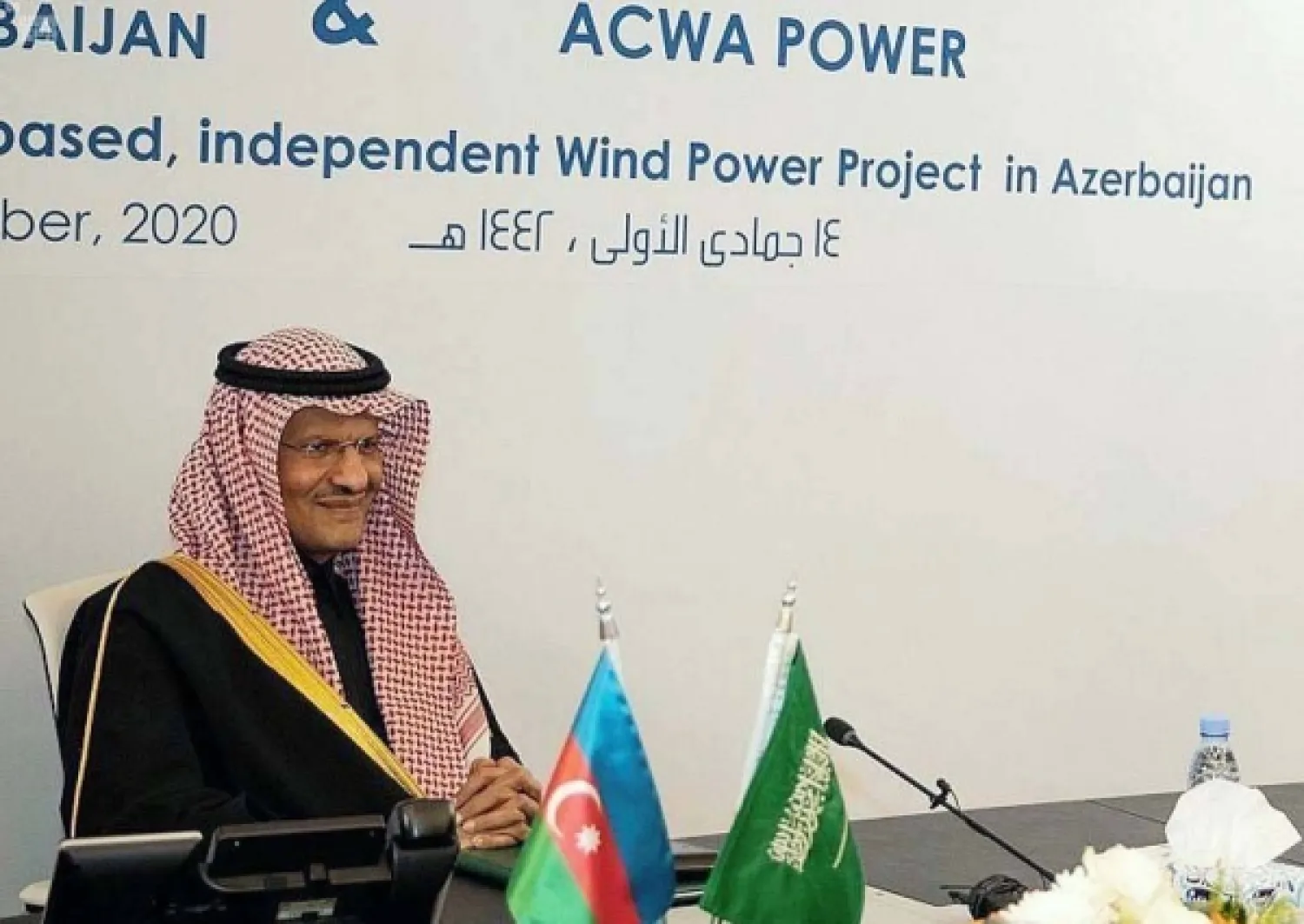

ACWA Power Signs Deals for First Wind Project in Azerbaijan

Saudi Minister of Energy Prince Abdulaziz Bin Salman. - SPA
TT

ACWA Power Signs Deals for First Wind Project in Azerbaijan

Saudi Minister of Energy Prince Abdulaziz Bin Salman. - SPA

Following the signing of the implementation agreement for the $300 million Independent Power Project in January 2020, ACWA Power Tuesday executed the official agreements for the 240 MW wind power project that will be located in the Absheron and Khizi regions.

The virtual signing ceremony was attended by Minister of Energy Prince Abdulaziz Bin Salman, Azerbaijan Minister of Energy Parviz Shahbazov and Balababa Rzayev, president of Azerenerji OJSC, and Mohammad Abunayyan, chairman of ACWA Power.

Key agreements signed by ACWA Power, a leading Saudi developer, investor and operator of power generation and water desalination plants in high growth markets, included the signing of the Investment Agreement with the government of the Republic of Azerbaijan, represented by the Ministry of Energy.

ACWA Power also signed the Power Purchase Agreement and Transmission Connection Agreement with Azerenerji OJSC, the national electrical power company and off-taker for the project, state news agency SPA reported.

Though Azerbaijan has relied largely on natural gas to meet its energy needs, the focus is now on diversification and boosting of alternative energy resources. Renewables offer the most prominent solution to meeting Azerbaijan’s ambitious climate targets.

The country has committed to reducing its greenhouse gas (GHG) emissions by 35% by 2030, under the Paris Agreement, which emphasizes the use of alternative and renewable energy sources to achieve this target.

With its excellent wind resources, Azerbaijan’s move towards effectively harnessing wind as a sustainable energy source is being fast tracked by key public private partnerships.

As the first foreign investment based independent wind power project in Azerbaijan structured as a public-private partnership, the plant will contribute to reach Azerbaijan’s target of 30% of renewable energy capacity by 2030.

Once complete, it will power 300,000 households and 400,000 tons of emissions will also be offset each year, supporting the country’s green ambitions.

Speaking to the Saudi Press Agency, Prince Abdulaziz said: “The Kingdom of Saudi Arabia and Azerbaijan enjoy long-term diplomatic and economic relations, and cooperation between the two countries has been strengthened recently through their participation in OPEC+.

“Azerbaijan, along with other member countries played an important role in promoting stability in global oil markets. We appreciate Azerbaijan's efforts to fulfil its obligations under the Declaration of Cooperation, and the high level of compliance it has achieved.”

He also expressed his confidence in the role that ACWA Power will play in promoting and expanding the cooperation between the Kingdom of Saudi Arabia and the Republic of Azerbaijan, and in supporting the efforts of the Azerbaijani government to meet its national needs of electric energy feasibly, economically and in adherence to international standards.

For his part, Shahbazov said: “The signing of Agreements and implementation of the Project is an indication of the confidence in the business climate in Azerbaijan and will mark a next stage of economic cooperation between our countries.

“I am confident that after ‘ACWA Power’ - other companies from Saudi Arabia will follow suit and will invest in Azerbaijan."

“Concerning the importance of this project for Azerbaijan, I would like to stress that in addition to being first ever foreign investment based IPP, the wind power station annually will help to generate 1 billion KWh electricity, saving up to 220 million cubic meters of gas, cutting down on 400,000 tons of emissions annually, create new jobs and new production and service areas.”

As a renewable energy leader, ACWA Power’s global expertise in delivering transformative solutions at an affordable cost, will strongly support Azerbaijan in realizing its renewable energy development goals.

Abunayyan also said: “The signing of three key agreements today is a significant milestone and a strong step towards unlocking the renewable energy potential of the Republic of Azerbaijan."

“ACWA Power is honored to partner with the Ministry of Energy, in Azerbaijan and the national electric power company Azerenerji OJSC to develop the first foreign investment based independent wind power plant.”

“I express my sincere thanks to Prince Abdulaziz Bin Salman, Saudi Minister of Energy, for his guidance and presence and patronage of this signing ceremony with the Azerbaijani Ministry of Energy,” Abunayyan added.

Abunayyan also reaffirmed that the agreements signed Tuesday will contribute to Azerbaijan’s ongoing efforts to deploy renewable energy and provide a better future for upcoming generations.

Rzayev said: “According to the contracts to be signed, connecting the 240 MW power plant to be built by the company to the grid and purchasing the power to be generated by the plant will be performed by Azerenerji OJSC.

“The implementation of this project will stimulate the development of our national economy, play an important role in ensuring the energy sustainability in our country, allow for saving the gas, which is our natural resource, and have a positive impact on the environment.”

Notably, ACWA Power remains focused on extending its leadership in high-growth markets through operational excellence and technological expertise, delivering power and desalinated water reliably and responsibly to communities across the globe.



How 2025 Decisions Redrew the Future of Riyadh’s Real Estate Market

Construction is seen at a real estate project in Riyadh. (SPA)
TT

How 2025 Decisions Redrew the Future of Riyadh’s Real Estate Market

Construction is seen at a real estate project in Riyadh. (SPA)

The Saudi capital underwent an unprecedented structural shift in its real estate market in 2025, driven by a forward-looking agenda led by Prince Mohammed bin Salman, Crown Prince and Prime Minister. Far from incremental regulation, the year’s measures amounted to a deep corrective overhaul aimed at dismantling long-standing distortions, breaking land hoarding, expanding affordable housing supply, and firmly rebalancing landlord-tenant relations.

Together, the decisions ended years of speculation fueled by artificial scarcity and pushed the market toward maturity, one grounded in real demand, fair pricing, and transparency.

Observers dubbed 2025 a “white revolution” for Saudi real estate. The reforms severed the link between property and short-term speculation, restoring housing as a sustainable residential and investment product. Below is a detailed outline of the most significant of these historic decisions:

1- Unlocking land, boosting supply

In March, authorities lifted restrictions on sale, subdivision, development permits, and planning approvals for 81 million square meters north of Riyadh. A similar decision in October freed another 33.24 million square meters to the west.

The Royal Commission for Riyadh City was also mandated to deliver 10,000 - 40,000 fully serviced plots annually at subsidized prices capped at SAR 1,500 per square meter, curbing price manipulation and offering real alternatives for citizens.

2- Rent controls and contractual fairness

To stabilize households and businesses, the government froze annual rent increases for residential and commercial leases in Riyadh for five years starting in September. Enforced through the upgraded “Ejar” platform, the move halted arbitrary hikes while aligning growth with residents’ quality of life.

3- Tougher fees

An improved White Land Tax took effect in August, extending beyond vacant plots to include unoccupied built properties. Annual fees rose to as much as 10% of land value for parcels of 5,000 square meters or more within urban limits, raising the cost of land hoarding and incentivizing prompt development.

4- Investment openness and digital governance

A revised foreign ownership regime allowed non-Saudis - individuals and companies - to own property in designated zones under strict criteria, injecting international liquidity. Transparency was reinforced by the launch of the “Real Estate Balance” platform, providing real-time price indicators based on actual transactions and curbing phantom pricing.

5- Quality and urban standards

Policy shifted from quantity to quality with mandatory application of the Saudi Building Code and sustainability standards for all new developments, ensuring long-term operational value and preventing low-quality sprawl.

Structural shift

Sector specialists told Asharq Al-Awsat the measures represent a qualitative leap in market management, moving Riyadh from a scarcity and speculation-led cycle to a balanced market governed by genuine demand, efficient land use, disciplined contracts, and transparent indicators.

Khaled Al-Mobid, CEO of Menassat Realty Co., said the reforms were timely and corrective after years of rapid price escalation. He noted early positives: slowing price growth, a return to realistic negotiations, increased supply in some districts, and better-quality offerings focused on intrinsic value rather than quick appreciation.

Abdullah Al-Moussa, a real estate expert and broker, described the steps as addressing root causes, not symptoms.

He observed a behavioral shift, especially in northern Riyadh, from “hold and wait” to reassessment, alongside calmer price momentum, renewed interest in actual development, and clearer rental dynamics.

Saqr Al-Zahrani, another market expert, told Asharq Al-Awsat that the reforms tackled structural imbalances by breaking artificial scarcity created by undeveloped land banks.

Opening vast tracts north and west and introducing market-wide indicators restored “organized abundance,” aligning prices with real demand and purchasing power without heavy-handed intervention, he remarked.

He added that recent months have seen weaker demand for raw land and stalled auctions, contrasted with rising interest in off-plan sales and partnerships with developers.

Banks, too, have reprioritized toward projects with operational viability, lifting overall supply quality despite a temporary slowdown in some transactions.

Consumers, meanwhile, are showing greater patience and interest in self-build options, signaling a maturing market awareness.

Outlook

Experts expect the effects to continue through 2027, delivering broad price stability with limited corrections in overheated locations rather than sharp declines.

Homeownership, especially among young buyers, is projected to rise as capital shifts from land speculation to long-term development.

The 2025 decisions were not short-term fixes but the launch of a new social and economic trajectory for Riyadh’s property market, redefining real estate as a housing service and value-adding investment, not a speculative vessel.

As Riyadh advances toward becoming one of the world’s ten largest city economies, its real estate reset offers a model for aligning regulation with quality of life, transparency, and sustainable growth.


Deal to Export Oil from Kurdish Region to Continue with No Issues, Kurdish Rudaw Reports

A staff at an oilfield holds the flag of Kurdistan. (X)
TT

Deal to Export Oil from Kurdish Region to Continue with No Issues, Kurdish Rudaw Reports

A staff at an oilfield holds the flag of Kurdistan. (X)

Kurdistan broadcaster Rudaw quoted the ​vice president of Iraq's state oil company SOMO as saying ‌on Saturday that ‌the ‌oil ⁠export ​deal ‌between Baghdad and Erbil is set to be renewed with ⁠out issues, Reuters reported.

In September, ‌Iraq restarted ‍the ‍export of ‍oil from its Kurdish region to Türkiye after ​an interruption of more ⁠than two years following a deal between Baghdad and the Kurdish regional government.


Musk Wins Appeal that Restores 2018 Tesla Pay Deal Now Worth about $139 Billion

FILE PHOTO: Elon Musk attends the Breakthrough Prize awards in Los Angeles, California, U.S., April 13, 2024. REUTERS/Mario Anzuoni/File Photo
TT

Musk Wins Appeal that Restores 2018 Tesla Pay Deal Now Worth about $139 Billion

FILE PHOTO: Elon Musk attends the Breakthrough Prize awards in Los Angeles, California, U.S., April 13, 2024. REUTERS/Mario Anzuoni/File Photo

Elon Musk's 2018 pay package from Tesla, once worth $56 billion, was restored by the Delaware ​Supreme Court on Friday, nearly two years after a lower court struck down the compensation deal as "unfathomable." The ruling overturns a decision that had prompted a furious backlash from Musk and damaged Delaware's business-friendly reputation. It assures Musk greater control over the company, which he has said is his main concern, even after shareholders recently approved a new pay package that could be worth $878 billion if Tesla meets certain targets, Reuters reported.

The Supreme Court said a 2024 ruling that rescinded the pay package had been improper and inequitable to Musk. The remedy of total rescission "leaves Musk uncompensated for his time and efforts over a period of six years," the 49-page ruling issued on Friday stated.

The 2018 pay package is now worth about $139 billion based on the price of Tesla's stock at the close of trading on Friday. "For ‌Elon, this is ‌a win because he gets control faster," said Gene Munster, managing partner at Tesla ‌investor ⁠Deepwater ​Asset Management.

If Musk ‌exercises all the stock options from the 2018 package, his stake in Tesla would grow from about 12.4% to 18.1% of an expanded share base. The company is issuing shares tied to his new pay package, although he must earn them by hitting performance goals.

Tesla shares were up less than 1% in after-hours trading following the ruling.

Tesla did not immediately respond to a request for comment. Musk posted on X that he was "vindicated." Lawyers who challenged the pay package said in a statement that they were considering their next steps and were "proud to have participated in the historic verdict below, calling to account the Tesla board and its largest stockholder for their breaches of fiduciary duty." The pay package was by ⁠far the largest ever until Tesla shareholders approved the new pay plan in November. If Tesla’s appeal had failed, it could have triggered a $26 billion hit to profit over two ‌years to account for the replacement stock-compensation package it had promised Musk – at ‍today’s much higher stock price.

The 2018 pay deal provided Musk options ‍to acquire about 304 million Tesla shares at a deeply discounted price if the company hit various milestones, which it did. ‍The options represent around 9% of Tesla's outstanding stock. Musk never collected his stock options because soon after shareholders approved the 2018 compensation, the board was sued by Richard Tornetta, an investor with nine Tesla shares.

UNFRIENDLY TO BUSINESS?

In 2024, after a five-day trial, Delaware Judge Kathaleen McCormick concluded that Tesla's directors were conflicted and key facts were hidden from shareholders when they voted to approve the plan. She ordered that the 2018 plan be rescinded.

Musk ​accused Delaware judges of being activists who are hostile to tech founders and he urged businesses to follow Tesla and reincorporate elsewhere. Dropbox, Roblox, Trade Desk and Coinbase were among the handful of large companies that moved ⁠their legal homes to Nevada or Texas. However, Delaware remains by far the most popular legal home for U.S. public companies.

Tesla's board had warned that Musk, the world's richest person who also leads the SpaceX rocket venture and artificial intelligence startup xAI, could leave the electric car company if he did not get the pay he wanted and an increase in his voting power. The Delaware Supreme Court may have been reluctant to annul Musk's pay package because shareholders had overwhelmingly voted in favor of it, said Brian Dunn, director of the Institute for Compensation Studies at Cornell University’s School of Industrial and Labor Relations. "I think that there's some belief that maybe the courts shouldn't get between the shareholders and the decisions that they make," said Dunn. Shareholders approved the new pay package in November and Tesla has taken steps to reduce the risk that a shareholder could tie up the 2025 package in the courts.

The Austin-based company is now incorporated in Texas, which allows Tesla to require that any investor or group of investors must own 3% of the company stock before suing for an alleged corporate law violation. A ‌stake of that size would be worth around $30 billion and Musk is the only individual with that much stock.