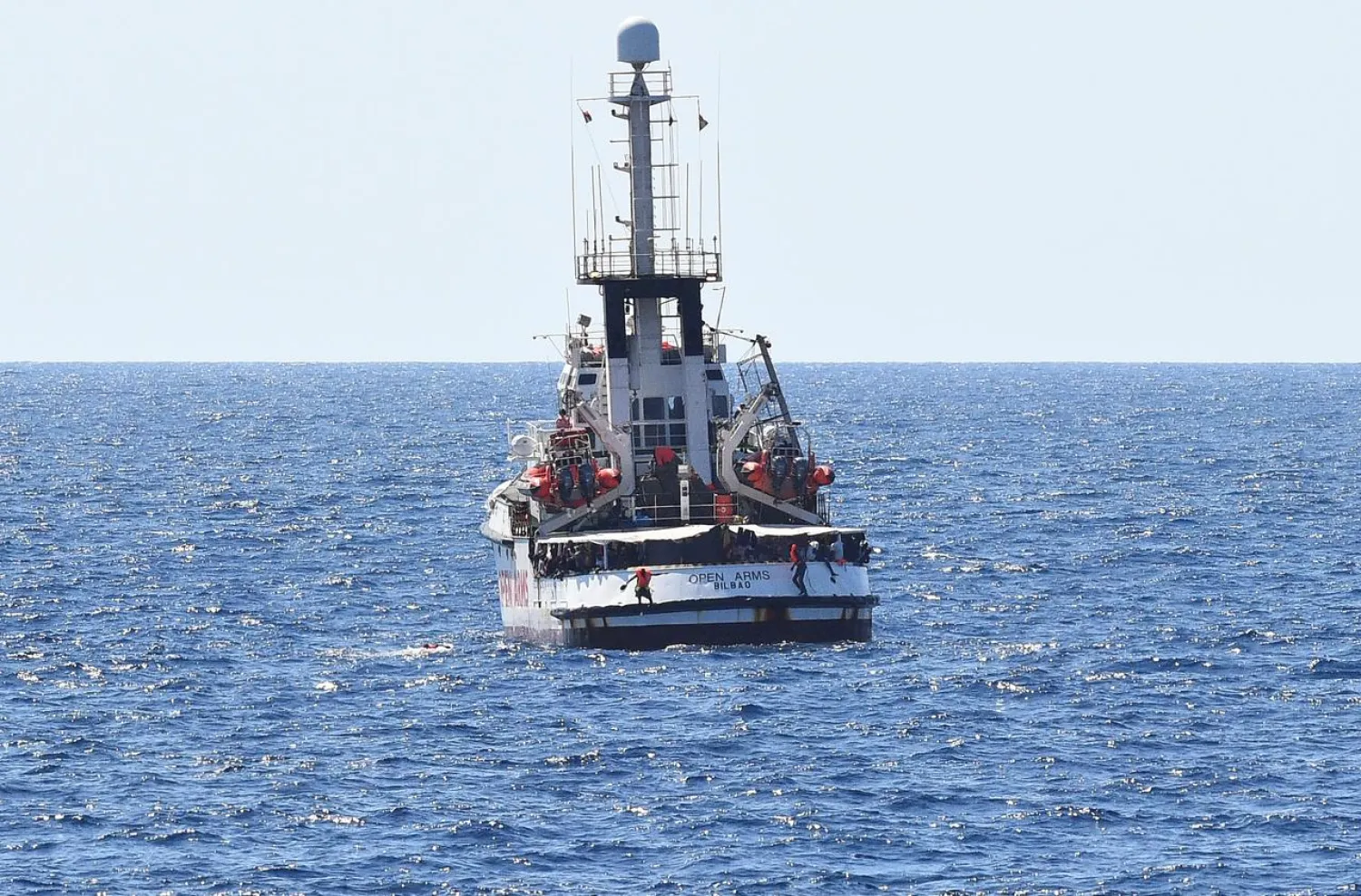
Boat Seeks Mediterranean Port of Safety for Migrants

Migrants jump off the Spanish rescue ship Open Arms, close to the Italian shore in Lampedusa, Italy August 20, 2019. REUTERS/Guglielmo Mangiapane
TT

Boat Seeks Mediterranean Port of Safety for Migrants

Migrants jump off the Spanish rescue ship Open Arms, close to the Italian shore in Lampedusa, Italy August 20, 2019. REUTERS/Guglielmo Mangiapane

A Spanish-flagged humanitarian ship on Sunday was seeking a port of safety for 265 migrants its crew rescued from the Mediterranean Sea in the last few days.

The Open Arms charity tweeted that its vessel on Saturday had safely brought aboard 96 migrants who had been adrift in a wooden boat with without life vests in international waters. It said the passengers, most of them from Eritrea, included two women and 17 minors and were suffering from hypothermia.

In a separate operation two days before that rescue, Open Arms took aboard 169 migrants, who had departed Libyan shores, where many human traffickers are based.

The traffickers launch vessels, many of them flimsy rubber dinghies or rickety fishing boats, crowded with migrants who hope to reach European shores to seek asylum.

Italy and fellow EU nation Malta have often refused docking permission to the humanitarian rescue boats, contending that most migrants want to reach jobs or relatives in northern Europe. Italian and Maltese government authorities have insisted other European nations do their share.


Iran Goes on Offensive as Diplomacy with US Stalls

Vessels near the Strait of Hormuz, as seen from Musandam, Oman, August 17, 2026. REUTERS/Stringer
TT

Iran Goes on Offensive as Diplomacy with US Stalls

Vessels near the Strait of Hormuz, as seen from Musandam, Oman, August 17, 2026. REUTERS/Stringer

Six months into its war with the United States, Iran's military has begun signaling a shift from retaliation to offence, which analysts say could reflect Tehran's belief it holds leverage to advance its demands and break the stalemate.

Since US-Israeli strikes launched the war on February 28, Tehran has largely portrayed its strikes against the United States, Israel and Gulf countries as revenge for attacks on the Iranian republic.

Now, Iranian officials are openly talking about giving offensive operations a greater priority while keeping control over the strategic Strait of Hormuz, a key source of leverage against Washington that has disrupted a vital global energy route and driven up energy prices.

Iran's supreme leader Mojtaba Khamenei outlined that approach in a reshuffle of top military commanders earlier this month, calling for "strengthening maximum deterrence and preparing to conduct large-scale offensive operations against the enemy".

Last week, a deputy commander of Iran's Revolutionary Guards indicated that Tehran was revising its military doctrine to give "offensive operations" strategic priority.

Analyst Sina Toossi of the Center for International Policy believes the shift to offensive operations does not mean Tehran was "adopting a doctrine of preventive war".

Rather, he said, Tehran appears to have concluded that "if confrontation becomes unavoidable, Iran should escalate earlier and more forcefully rather than wait for the United States or Israel to define the terms of the conflict".

Ahmad Zeidabadi, a Tehran-based international relations expert, believes the shift reflects Tehran's assessment of Washington's intentions.

"The Islamic Republic believes the United States has likely ruled out war and now seeks to perpetuate the status quo including the US naval blockade and the economic pressure," he told AFP.

- Iran's calculus -

Diplomatic efforts with the US remain stalled, especially since a June 17 truce collapsed and the US reimposed oil sanctions and the blockade on Iranian ports.

"Iranians believe that diplomacy is doomed to fail in the current climate and that the Americans will not accept their terms," said Zeidabadi.

"Consequently, they may feel compelled to resort to offensive action to force the US to accept Iranian conditions ... and to initiate a new round of negotiations."

Iran suffered heavy losses in the initial bombardment campaign, including the killing of supreme leader Ali Khamenei and senior military commanders, as well as extensive material and economic damage.

But the political system has remained intact, and intense bombardment eventually subsided following an April 8 ceasefire, apart from sporadic exchanges of fire, particularly in and around Hormuz.

The war has since spread across the region to include disruption of shipping in the Red Sea's Bab al-Mandab strait.

"Tehran increasingly believes that American military superiority does not give Washington escalation dominance," said Toossi.

The Strait of Hormuz has become central to that calculus, with Tehran requiring vessels to seek permission and to pay service fees to transit -- a move strongly opposed by Washington and regional countries.

Reopening the strait has become a US priority.

US Vice President JD Vance said last week that "goal number one" was keeping energy prices low for Americans, while preventing Tehran from acquiring a nuclear weapon ranked second.

A June 17 memorandum of understanding between Tehran and Washington that outlined terms for a truce was a far cry from US President Donald Trump's initial call for Iran's "unconditional surrender".

That truce later collapsed over disagreements primarily over the management of the Hormuz but Iranian officials still tout it as evidence of "victory".

"I can state with conviction that we have won this war in the true sense of the word, both militarily and politically," top negotiator Mohammad Bagher Ghalibaf said in a speech last week, while describing the deal as a source of "pride and victory".

- Risk of miscalculation -

An Iranian attack in late July on a US air base and a command center in Jordan has been portrayed on Iranian media as an example of that "preemptive" approach.

For Hossein Kanani-Moghadam, an international relations expert and former general in the Revolutionary Guards, the new strategy could take other forms.

"Such operations could encompass a combination of cyber warfare, psychological warfare, intelligence operations, and economic warfare," he said.

But Tehran's calculus comes with serious risks.

"If this threat is serious ... the outcome of this scenario would be catastrophic for Iran and the region," said Zeidabadi.

Toossi also believes that the strategy "means future crises could escalate much faster".

The broader danger, according to Toossi, is what he described as "reciprocal deterrence trap" with each side responding to the other's attempts to strengthen deterrence as evidence it must escalate further.

"That is a much more unstable strategic environment, even if neither side actually wants another major war," he said.


Visiting Iraq, Iran’s Parliament Speaker Hails ‘New Order’ in the Region

 Iran's Parliament Speaker Mohammad Bagher Ghalibaf (C) speaks during a press conference at the site where Qassem Soleimani, commander of the Quds Force of Iran's Revolutionary Guards Corps (IRGC), was killed by a US airstrike in 2020, near the airport, upon his arrival in Baghdad on August 19, 2026. (AFP)
Iran's Parliament Speaker Mohammad Bagher Ghalibaf (C) speaks during a press conference at the site where Qassem Soleimani, commander of the Quds Force of Iran's Revolutionary Guards Corps (IRGC), was killed by a US airstrike in 2020, near the airport, upon his arrival in Baghdad on August 19, 2026. (AFP)
TT

Visiting Iraq, Iran’s Parliament Speaker Hails ‘New Order’ in the Region

 Iran's Parliament Speaker Mohammad Bagher Ghalibaf (C) speaks during a press conference at the site where Qassem Soleimani, commander of the Quds Force of Iran's Revolutionary Guards Corps (IRGC), was killed by a US airstrike in 2020, near the airport, upon his arrival in Baghdad on August 19, 2026. (AFP)
Iran's Parliament Speaker Mohammad Bagher Ghalibaf (C) speaks during a press conference at the site where Qassem Soleimani, commander of the Quds Force of Iran's Revolutionary Guards Corps (IRGC), was killed by a US airstrike in 2020, near the airport, upon his arrival in Baghdad on August 19, 2026. (AFP)

Iran's parliament speaker Mohammad Bagher Ghalibaf on Wednesday stressed the importance of strengthening the "new order" in the region, on the first stop in a three-day visit to Iraq.

Ghalibaf's trip comes at a time when Iraq is facing American pressure to disarm factions close to Tehran, which wields significant political influence in Iraq.

Prime Minister Ali al-Zaidi, who took office three months ago with US backing, has pledged to restrict weapons to the control of the state.

Speaking from the site near Baghdad airport where Iranian Revolutionary Guards Quds Force commander general Qassem Soleimani was killed in a 2020 US strike, Ghalibaf said: "Our trip to Iraq today is aimed at strengthening the new order in the region and accelerating the strengthening of cooperation between all countries in the region without foreign interference."

"Resistance in Iraq is... one of the elements of this country's power. Today, resistance has gone beyond the borders of Iran and Iraq... and has become global," he added.

Ghalibaf is scheduled to meet al-Zaidi later on Wednesday and then hold a meeting with the Coordination Framework, the largest bloc in parliament, made up of Shiite parties with varying degrees of proximity to Tehran.

Iraq has been pulled into the Middle East war, with pro-Iran factions have launching attacks on US interests, which Washington has responded to with deadly strikes. Iran has also shelled positions belonging to Iranian Kurdish opposition groups.

Iraq is facing mounting challenges in maintaining a balance between Iran and the United States, and since the US invasion in 2003 it has been an arena of rivalry between the two powers.

Al-Zaidi has given the armed factions -- some of which belong to the Iran’s so-called “Axis of Resistance” -- until September 30 to hand over their weapons to the state, coinciding with the scheduled end of the mission of the US-led coalition against the ISIS group.

Some of the most powerful factions, however, and those closest to Iran, refuse to cooperate.

On Thursday, Ghalibaf will head to the city of Karbala where he will take part in ceremonies marking 40 days since the funeral of former Iranian supreme leader Ali Khamenei, who was killed in US-Israeli strikes on February 28.


North Korea Leader’s Sister Says ‘Unaware’ of Reported Kim-Trump Communication

Kim Yo Jong, the sister of North Korea's leader Kim Jong Un, speaks at the National Emergency Prevention General Meeting in Pyongyang, North Korea. (KCNA via KNS/AFP via Getty Images file)
TT

North Korea Leader’s Sister Says ‘Unaware’ of Reported Kim-Trump Communication

Kim Yo Jong, the sister of North Korea's leader Kim Jong Un, speaks at the National Emergency Prevention General Meeting in Pyongyang, North Korea. (KCNA via KNS/AFP via Getty Images file)

The powerful sister of Kim Jong Un said Wednesday she was "unaware" of reported communication between her brother and Donald Trump, after the US president hinted at contact with the North Korean leader, but said ties between the two remained "excellent".

Kim Yo Jong's statement came hours after Washington and Seoul announced their annual exercises would end about a week earlier than planned following an order from Trump to scale them back.

Trump said on Sunday that he had told the Pentagon to curtail the annual Ulchi Freedom Shield exercises -- a day before they started -- citing his "good relationship" with North Korean leader Kim Jong Un.

Asked on Monday whether Kim had responded to his requests for a conversation, Trump said: "Yeah, he has."

But Kim's sister, Kim Yo Jong, said Wednesday she was unaware of any such contact between her brother and Trump.

"Regarding the recent news from Washington about communication between the leaders of North Korea and the United States, I am completely unaware of it," she said in a statement.

"It is likely the only matter concerning our top leadership's foreign policy that I am unaware of."

Kim Yo Jong nevertheless said her brother still had "good memories and feelings" about Trump and that the relationship between the two leaders remains "excellent".

Earlier Wednesday, Seoul's military said the drills would wrap up on Friday, not on August 27 as originally planned.

"We have decided to adjust the UFS exercise period to run from the 17th to the 21st," South Korea's Joint Chiefs of Staff said in a statement.

The decision was made "at the suggestion of the US side", it added.

The Pentagon said the "substantially reduced" drills would "preserve essential readiness and... (cause) no degradation to US training objectives".

The exercises are designed to prepare for a possible attack by North Korea.

They were understood to consist of two phases: the first, focused on defending against potential North Korean threats, was due to run until Friday; and the second, focused on a counteroffensive, from August 24 to 27.

The second phase is now understood to have been scrapped.

Kim Yo Jong, however, dismissed the reduction, saying: "We do not consider it worth commenting on and find it completely uninteresting."

She said reducing the scale or duration of the exercise did not change their "provocative and aggressive" character.

Nuclear-armed North Korea has long voiced outrage at the exercises, considering them dress rehearsals for an invasion.

Wednesday's early morning commentary by the state-run Korean Central News Agency said they pose "the most immediate and open threat" to North Korea and "regional security".

That commentary did not mention Trump's order or his desire to resume talks with Kim, with whom he has hinted at being in contact.

- 'Much safer' -

In the initial announcement on his Truth Social platform, Trump described the drills as unfriendly towards a country that had been respectful to him.

South Korea's Foreign Minister Cho Hyun told lawmakers on Wednesday that Seoul had not been informed in advance of Trump's plan to downsize them.

"Neither our government nor US government officials knew in advance what President Trump revealed via Truth Social," Cho said.

Trump has insisted that he is making the situation "much safer" through his ties with Kim.

"There has been persistent speculation that Washington could seek renewed talks with Pyongyang ahead of the November US midterm elections," Yang Moo-jin, former president of the University of North Korean Studies, told AFP.

"For Trump, a meeting with... Kim Jong Un could offer a chance to secure a foreign-policy legacy."

The Wall Street Journal reported on Tuesday, citing unnamed US officials, that Trump is pushing aides to set up a meeting with Kim as soon as this autumn.

"Reducing exercises could have a positive impact on the possibility of US-North Korea dialogue," Park Won-gon, a professor at Ewha Womans University, told AFP.

"The suspension of joint exercises has always been a prerequisite for North Korea to engage in dialogue with the US," he added.

Trump and Kim met three times in his first spell in the White House, but they have not held talks during his second term.

The United States stations about 28,500 troops in South Korea to bolster the country's defenses, a legacy of the 1950-53 Korean War that ended with an armistice rather than a peace treaty.

Trump has repeatedly criticized longstanding US alliances, casting doubt on Washington's commitment to security in East Asia and alarming regional partners.