


Niger Museum Is Eclectic National 'Mirror'

Dino delight: Niger's national museum specializes in paleontology, history, and art -- and also boasts a zoo | AFP
TT

Niger Museum Is Eclectic National 'Mirror'

Dino delight: Niger's national museum specializes in paleontology, history, and art -- and also boasts a zoo | AFP

There can be few museums in the world to rival the National Museum of Niger.

It has displays covering art, history, dinosaurs, nuclear energy, craftwork, and music as well as live animals, for it is also a zoo.

Its clientele is similarly diverse, encompassing visitors who have trekked to the capital Niamey from across the country, school groups, well-heeled foreign tourists, and street urchins.

The cultural gem of the world's poorest country, the 24-hectare (59-acre) museum survives on a budget that for rich counterparts is the equivalent to money found down the back of the sofa.

Yet it charges a rock-bottom entrance fee -- around 10 US cents -- so that even the most impoverished can walk in and have access to exceptional things... including wild animals. "Fauna and culture," as the museum says.

"It's Niger's mirror, its social and cultural reflection," said its director, Haladou Mamane, proudly ticking off its strengths in culture, history, archaeology, paleontology... not forgetting the zoo section, "part of a multi-disciplinary tradition."

"Here, every Nigerien, regardless of their background, can gain insights about the country," said Mamane, noting that many people in Niger have never been to school.

Hot and arid, located in the heart of the Sahel, Niger ranks the lowest among 189 countries on the UN's Human Development Index. Per capita income is just $1,040 (855 euros) per year -- just over $2.5 per day, according to the World Bank.

Adding to the burden is a crippling jihadist insurgency. Two, in fact -- one coming from the southeast, from Nigeria, and one from the southwest, from Mali.

The state provides the museum with an annual subsidy of 327 million CFA francs ($610,000 or 500,000 euros), and income from the meager entrance fee of 50 CFA francs covers just about a third of costs.

- Street kids' museum -

Before the pandemic, it received more than 100,000 visitors per year, many of them so-called talibe children.

These are children who are unique to West Africa -- their parents hand them to a type of Islamic school, where they are supposed to learn the Koran.

But they typically spend their days begging in the dusty streets with a metal receptacle strung around their neck, and many find the museum is a wonderful escape.

One such was 12-year-old Ismael Mariama, who after playing on the slides and seesaws watched a large lion taking an afternoon nap.

"I came to see the animals. I paid 50 francs," he said, clad in worn, grubby clothes.

"I came from Yantala," a rundown district in northwestern Niamey, "to come and see the animals, the monkey, the lions, the crocodiles," he said.

"I've seen everything," said the lad, before putting his hand between the bars of a cage to give a biscuit to the monkeys.

He added that he had been to the museum's section on Nigerien craftwork and was interested in the leather shoes.

Mamane said he was especially proud of the craftwork area -- a place that provides a shop window for sculptors, painters, potters, and leatherworkers, who can sell what they produce.

The artisans come from all over this ethnically diverse country -- a sign of "national unity," said Mamane.

"It's a bit hard with the coronavirus, but the museum is a good thing for us," said Ali Abdoulaye, a leatherworker.

"These days, artisans are losing out to cheaper Chinese products -- but you buy a (Chinese) handbag, and it falls apart after a couple of days."

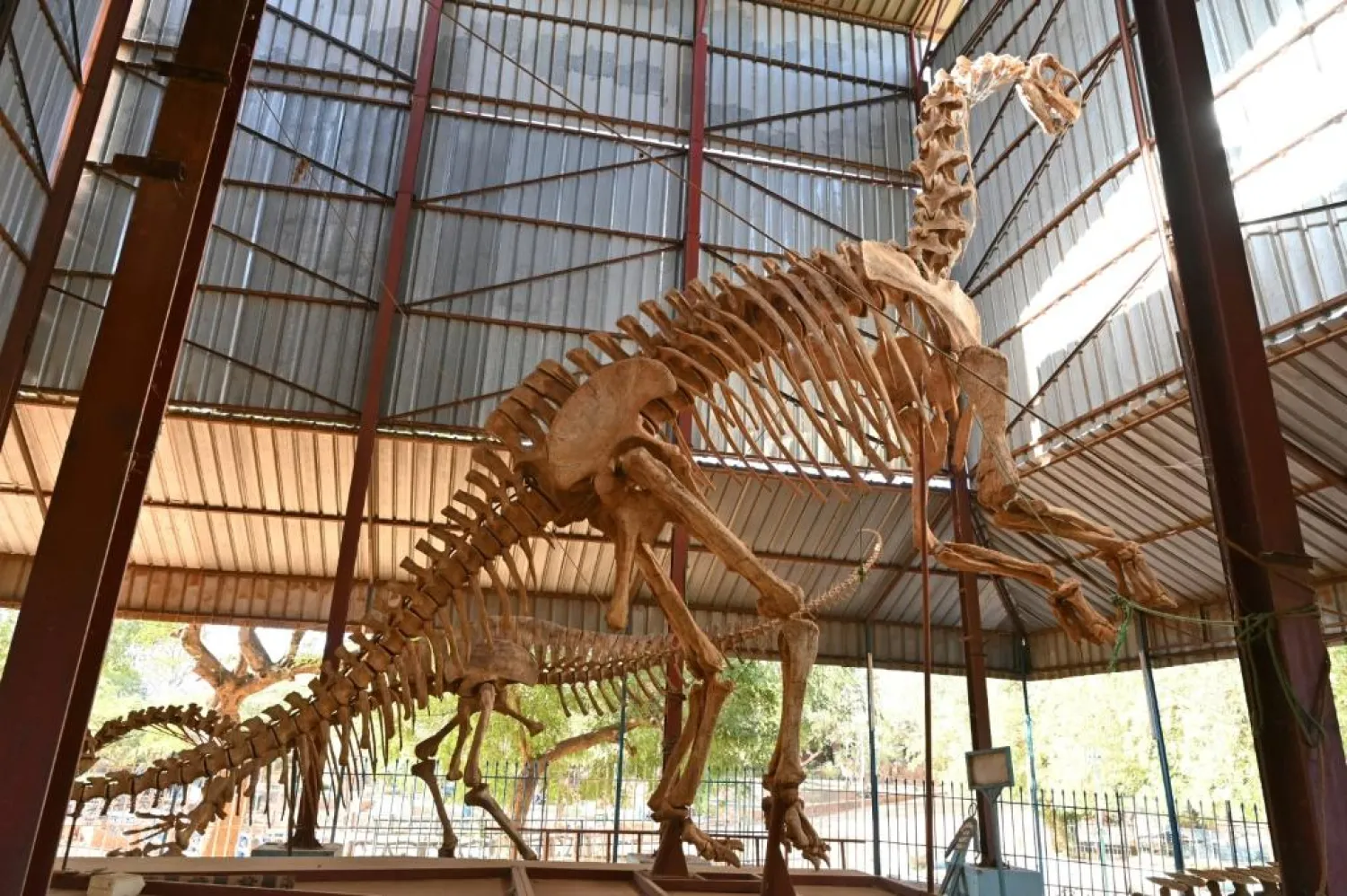
A few meters (yards) from the museum's main hall is a star attraction -- the skeletal remains of three monsters from the Age of the Dinosaurs.

They include Sarcosuchus imperator, an 11m (36-feet) -long crocodile, whose fossil was discovered in the Agadez region by a French paleontologist, Philippe Taquet.

- Makeover -

The museum, founded just before Niger gained independence from France in 1960, is planning on a refurbishment and an expansion next year with the help of international donations.

As in many museums around the world, it looks to sponsors for exhibitions.

A show on uranium, Niger's outstanding mineral wealth, is funded by the French company Orano, previously Areva, whose subsidiaries operate two mines in the south of the country.

Next to it is an exhibition on oil, which has recently been discovered in Niger. The display, which includes an enormous model of a refinery in Zinder, southern Niger, has been funded by the China National Petroleum Corporation (CNPC).

The museum promises that once the building work is complete, the 111 species in the zoo will enjoy "improved living conditions".




2025 Was UK's Hottest and Sunniest Year on Record

FILE PHOTO: A woman shields herself from sun with an umbrella at Westminster Bridge in London, Britain, June 21, 2025. REUTERS/Isabel Infantes/File Photo
TT

2025 Was UK's Hottest and Sunniest Year on Record

FILE PHOTO: A woman shields herself from sun with an umbrella at Westminster Bridge in London, Britain, June 21, 2025. REUTERS/Isabel Infantes/File Photo

Last year was Britain's hottest and sunniest on record, the national weather service confirmed on Friday, calling it a "clear demonstration" of the impacts of climate change.

"2025 now joins 2022 and 2023 in the top three warmest years since 1884," the Met Office said in a statement, noting the United Kingdom's mean temperature through last year was 10.09 degrees Celsius.

"This is an increasingly clear demonstration of the impacts of climate change on UK temperatures," it added.

"It is also only the second year in this series where the UK's annual mean temperature has exceeded 10.0C."

The previous record of 10.03C was set in 2022, AFP reported.

It means four of the UK's last five years now appear in the top five warmest years since 1884, and all of the top ten hottest years will now have occurred in the last two decades.

The Met Office had already announced last month that 2025 was the country's sunniest year since that record series began in 1910.

The UK -- which comprises England, Scotland, Wales and Northern Ireland -- saw 1648.5 hours of sunshine, 61.4 hours more than the previous record set in 2003.

An "exceptional" amount of sunshine during the spring followed by long spells of clear skies during the summer helped set the record, the Met Office has noted.

Mark McCarthy, its head of climate attribution, said the "very warm" year was "in line with expected consequences of human-induced climate change".

"Although it doesn't mean every year will be the warmest on record, it is clear from our weather observations and climate models that human-induced global warming is impacting the UK's climate," he added.


A Building Under Construction Collapses in Nairobi, Leaving an Unknown Number of People Trapped

Members of The Disaster Response Battalion (DRB) of the Kenya Defense Forces (KDF) gather at the site of a 16-storey building under construction that collapsed, as search and rescue operations begin with possible casualties still unconfirmed, in the South C neighborhood of Nairobi, on January 2, 2026. (AFP)
TT

A Building Under Construction Collapses in Nairobi, Leaving an Unknown Number of People Trapped

Members of The Disaster Response Battalion (DRB) of the Kenya Defense Forces (KDF) gather at the site of a 16-storey building under construction that collapsed, as search and rescue operations begin with possible casualties still unconfirmed, in the South C neighborhood of Nairobi, on January 2, 2026. (AFP)

A multi-story building under construction in the Kenyan capital, Nairobi, collapsed Friday, leaving an unknown number of people trapped.

Rescue workers are digging through the rubble. The building was in an area of Nairobi known as South C, according to the Kenya Red Cross, and local media say it was a 16-story structure.

“A multi-agency response team is on site managing the situation,” the Kenya Red Cross said in a statement.

There was no immediate comment from authorities on the likely cause of the collapse or the number of victims. The toll is not expected to be high, The Associated Press said.

Building collapses are common in Nairobi, where housing is in high demand and unscrupulous developers often bypass regulations or simply violate building codes.

After eight buildings collapsed and killed 15 people in Kenya in 2015, the presidency ordered an audit of buildings across the country to see if they were up to code. The National Construction Authority found that 58% of the buildings in Nairobi were unfit for habitation.


Digital Age Brings Denmark’s 400-Year-Run Postal Service to Historic End

Mailboxes have been removed from all around Denmark. (EPA-EFE/Shutterstock)
TT

Digital Age Brings Denmark’s 400-Year-Run Postal Service to Historic End

Mailboxes have been removed from all around Denmark. (EPA-EFE/Shutterstock)

Beside the railroad tracks of Copenhagen’s train station, right in the heart of the Danish capital, stands a red-brick building with an ornate façade and a copper-clad cupola still turning green over time.

When it opened in 1912 as the Central Post Building, its grandeur echoed the booming postal and telegraph services that crisscrossed Denmark, connecting Danes to one another.

A little over a century later and that building, now a luxury hotel, presides over a city, and a country, where the postal service no longer delivers letters, according to CNN.

Denmark’s state-run postal service, PostNord, will deliver its last ever letter on Tuesday, as the digital age brings its 400-year-run to an end. This makes Denmark the first country in the world to decide that physical mail is no longer either essential or economically viable.

Denmark’s postal service delivered more than 90% fewer letters in 2024 than in 2000. The US Postal Service delivered 50% less mail in 2024 than in 2006.
And as our correspondence has moved largely online – transfiguring into WhatsApp messages, video calls, or just an exchange of memes – our communication and language have changed accordingly.

Letters themselves “will change status” too, often coming to represent more intimate messages than their digital counterparts, said Dirk van Miert, a professor at the Huygens Institute in the Netherlands who specializes in early modern knowledge networks.

The knowledge networks that letters facilitated for centuries are “only expanding” in their online form, expediting both access to that knowledge as well as the rise of disinformation, he told CNN.

PostNord has been removing the 1,500 mailboxes scattered across Denmark since June. When it sold them off to raise money for charity on December 10, hundreds of thousands of Danes tried to buy one.

For each mailbox, they paid either 2,000 ($315) or 1,500 ($236) Danish krone, depending on how worn they were.

Instead of posting letters, Danes will now have to drop them off at kiosks in shops, from where they will be couriered by private company DAO to both domestic and international addresses. PostNord will continue delivering parcels, however, as online shopping remains ever popular.

Denmark is one of the world’s most digital nations; even its public sector utilizes several online portals, minimizing any physical government correspondence and making it much less reliant on postal services than many other countries.

Still, the need for physical correspondence continues around the world, even if it is diminished.

Almost 2.6 billion people remain offline, according to the UN-affiliated Universal Postal Union, and many more “lack meaningful connectivity,” thanks to inadequate devices, poor coverage and limited digital skills. Rural communities, women and those living in poverty are among the worst affected, it added.

And even in countries like Denmark, some groups who are more reliant on postal services, like older people, may be adversely affected by the changes, advocacy groups say.

“It’s very easy for us to access our mail on the phone or a website... but we forgot to give the same possibilities to those who are not digital,” said Marlene Rishoej Cordes, a spokesperson for the DaneAge Association, which advocates for older people.

The letter has undergone transformations before, in both medium and style. “It changed formats from papyrus or wax tablets... then paper later on, vellum in the Middle Ages, and now we have electronic devices,” said Van Miert.

In the 17th century, following the traditions laid down by great philosopher-letter-writers, like Cicero and Erasmus, students were taught “how to write a proper letter, a letter of consolation, praise or congratulations,” he added. “For a diplomatic letter, a wholly different style was required than for a personal, or what they called a familiar, letter.”

Letters have come to represent an “element of nostalgia” and a permanence that technology cannot match, Nicole Ellison, a professor at the University of Michigan specializing in computer-mediated communication, told CNN.

Still, like the students who altered their letter-writing styles according to different contexts, digital communication has evolved to compensate for some of the personal touches and emotional cues a handwritten letter can convey.

Nonetheless, the demise of the letter is already sparking nostalgia in Denmark.

“Look closely at the picture here,” one Danish user on X said, alongside a photo of a mailbox. “Now in 5 years I will be able to explain to a 5-year-old what a mailbox was in the old days.”