


Return With Confidence: Using Tech to Create Safe Offices, Post-Pandemic

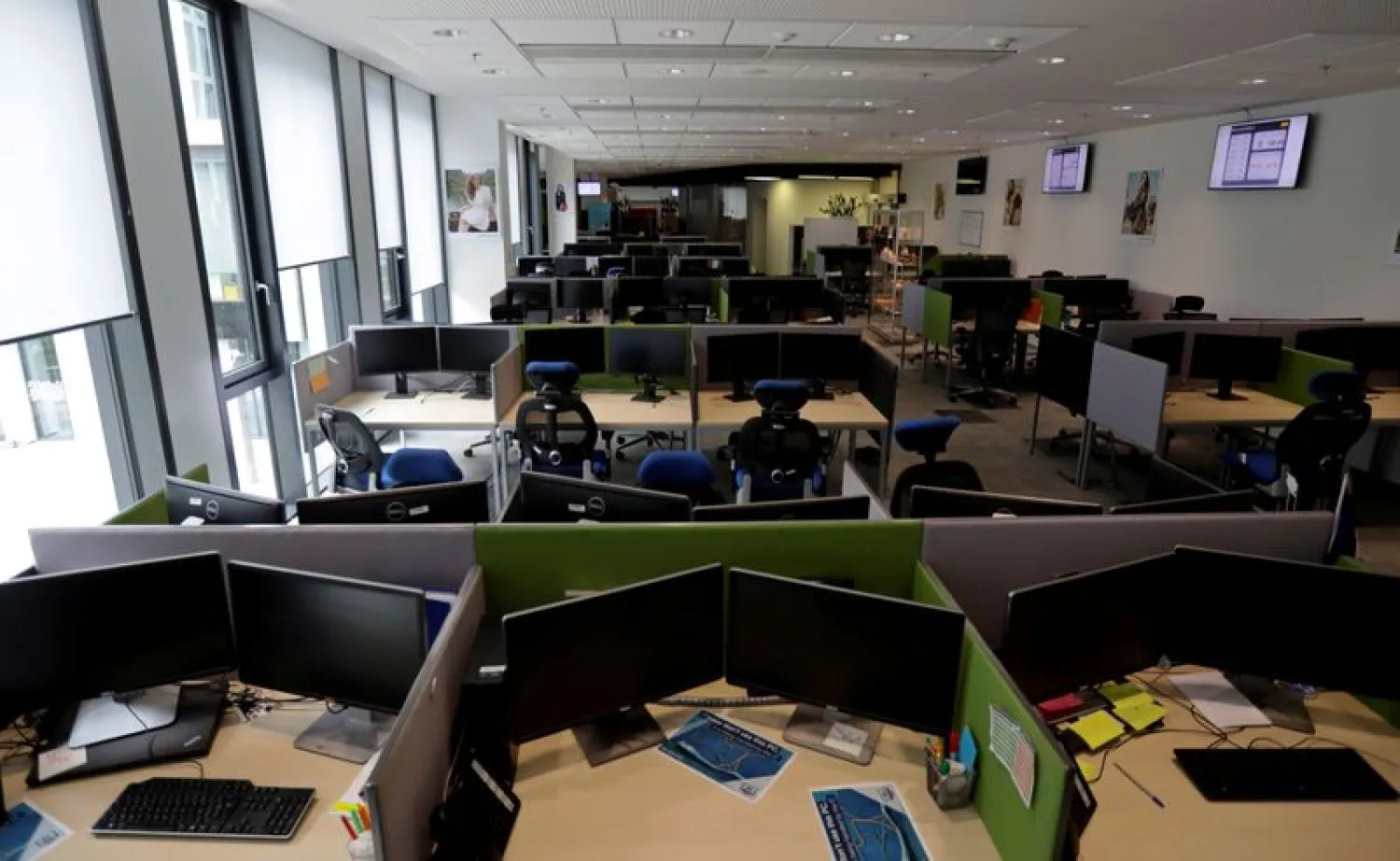
Open office workspace is seen in an empty office in Prague | Photo: REUTERS
TT

Return With Confidence: Using Tech to Create Safe Offices, Post-Pandemic

Open office workspace is seen in an empty office in Prague | Photo: REUTERS

How can technology help companies worldwide return to work safely when lockdown ends?

At Siemens, Ruth Gratzke is overseeing a "Return with Confidence" campaign to create safe and healthy indoor office environments.

"It addresses everything from elevators where you don´t have to touch the buttons, touchless interactions throughout the building, or management of meeting rooms and desks around social distancing," said Gratzke, who is president of Siemens Smart Infrastructure, US, a unit of Siemens AG. "It´s about using creative and new technologies, looking at what´s available in tech, and giving people the confidence to return to the office."

Gratzke, 49, talked to Reuters about the future of the office as well as leadership lessons she learned during the pandemic. Edited excerpts are below.

Q. What do you think our future work offices will look like?

A. The days of the good old cube format where everybody is sitting piled on top of each other are over. If people sit near one another again, there may be Plexiglass barriers around us.

And while people always say, "Yeah, we´re going to collaborate in these great beautiful meeting rooms," people have learned to effectively communicate with each other via video.

Q. What impact has the pandemic had on leadership?

A. It´s shifted a lot more focus to our people. They are really the ones who have carried us through this pandemic and we´ve had to think a lot about, "How do I take care of these human beings and keep them safe, engaged, and motivated?"

Our Mexico operations lost a handful of employees. We had to look at "how can we help their families through this dire time?" We´re taking care of our employees in ways I never had to before.

Q. What is your biggest work-life challenge now?

A. Being a home educator while being president. My son is nine years old. He is in public school, and he went virtual in March.

I was used to going to work in the morning and not thinking about my family until I came back at night. Homeschooling was incredibly stressful and trying to balance both was crazy.

But constantly juggling both made me a lot more patient with myself. If I have a video call in my home office, and my little guy barges in here because he couldn't solve a math problem, a year ago I would have killed myself over embarrassment. Now it´s like, "Hey, that´s OK. It´s part of life."

Q. How are you managing burnout?

A. I´ve been working a lot more, longer hours, and I´m a lot more exhausted. My days are more packed and dense.

I´m a runner, so I get up at five in the morning and go pound the pavement for an hour. There´s something wonderful about just taking your music and going running in the dark. It cleanses my brain. Now, if I skip a run, I can feel my stress go up immediately.

Q. What advice do you have for someone just starting out right now?

A. For people that are trying to get into the job market, I am really impressed with young talent who go on LinkedIn and are ruthless. They find a way to connect. They are not scared of approaching someone with a big title.

I have the highest respect for someone who dares to do that. That takes confidence. I really encourage you to use the tools you have today and don´t be afraid to be aggressive.

Q. Is there a business book you often recommend?

A. "The Other Kind of Smart" by Harvey Deutschendorf. At some point in my career, I received feedback that I was too assertive, and I needed to focus more on being in tune with people around me.

This book showed me that strengthening the side of EQ, the ability to listen, the ability to read the signs around you are equally important as having a brilliant mind or being a great engineer.




AI No Better Than Other Methods for Patients Seeking Medical Advice, Study Shows

AI (Artificial Intelligence) letters and a robot hand are placed on a computer motherboard in this illustration created on June 23, 2023. (Reuters)
TT

AI No Better Than Other Methods for Patients Seeking Medical Advice, Study Shows

AI (Artificial Intelligence) letters and a robot hand are placed on a computer motherboard in this illustration created on June 23, 2023. (Reuters)

Asking AI about medical symptoms does not help patients make better decisions about their health than other methods, such as a standard internet search, according to a new study published in Nature Medicine.

The authors said the study was important as people were increasingly turning to AI and chatbots for advice on their health, but without evidence that this was necessarily the best and safest approach.

Researchers led by the University of Oxford’s Internet Institute worked alongside a group of doctors to draw up 10 different medical scenarios, ranging from a common cold to a life-threatening hemorrhage causing bleeding on the brain.

When tested without human participants, three large-language models – Open AI's Chat GPT-4o, ‌Meta's Llama ‌3 and Cohere's Command R+ – identified the conditions in ‌94.9% ⁠of cases, ‌and chose the correct course of action, like calling an ambulance or going to the doctor, in an average of 56.3% of cases. The companies did not respond to requests for comment.

'HUGE GAP' BETWEEN AI'S POTENTIAL AND ACTUAL PERFORMANCE

The researchers then recruited 1,298 participants in Britain to either use AI, or their usual resources like an internet search, or their experience, or the National Health Service website to ⁠investigate the symptoms and decide their next step.

When the participants did this, relevant conditions were identified in ‌less than 34.5% of cases, and the right ‍course of action was given in ‍less than 44.2%, no better than the control group using more traditional ‍tools.

Adam Mahdi, co-author of the paper and associate professor at Oxford, said the study showed the “huge gap” between the potential of AI and the pitfalls when it was used by people.

“The knowledge may be in those bots; however, this knowledge doesn’t always translate when interacting with humans,” he said, meaning that more work was needed to identify why this was happening.

HUMANS OFTEN GIVING INCOMPLETE INFORMATION

The ⁠team studied around 30 of the interactions in detail, and concluded that often humans were providing incomplete or wrong information, but the LLMs were also sometimes generating misleading or incorrect responses.

For example, one patient reporting the symptoms of a subarachnoid hemorrhage – a life-threatening condition causing bleeding on the brain – was correctly told by AI to go to hospital after describing a stiff neck, light sensitivity and the "worst headache ever". The other described the same symptoms but a "terrible" headache, and was told to lie down in a darkened room.

The team now plans a similar study in different countries and languages, and over time, to test if that impacts AI’s performance.

The ‌study was supported by the data company Prolific, the German non-profit Dieter Schwarz Stiftung, and the UK and US governments.


Meta Criticizes EU Antitrust Move Against WhatsApp Block on AI Rivals

(FILES) This illustration photograph taken on December 1, 2025, shows the logo of WhatsApp displayed on a smartphone's screen, in Frankfurt am Main, western Germany. (Photo by Kirill KUDRYAVTSEV / AFP)
TT

Meta Criticizes EU Antitrust Move Against WhatsApp Block on AI Rivals

(FILES) This illustration photograph taken on December 1, 2025, shows the logo of WhatsApp displayed on a smartphone's screen, in Frankfurt am Main, western Germany. (Photo by Kirill KUDRYAVTSEV / AFP)

Meta Platforms on Monday criticized EU regulators after they charged the US tech giant with breaching antitrust rules and threaten to halt its block on ⁠AI rivals on its messaging service WhatsApp.

"The facts are that there is no reason for ⁠the EU to intervene in the WhatsApp Business API. There are many AI options and people can use them from app stores, operating systems, devices, websites, and ⁠industry partnerships," a Meta spokesperson said in an email.

"The Commission's logic incorrectly assumes the WhatsApp Business API is a key distribution channel for these chatbots."


Chinese Robot Makers Ready for Lunar New Year Entertainment Spotlight

A folk performer breathes fire during a performance ahead of Lunar New Year celebrations in a village in Huai'an, in China's eastern Jiangsu Province on February 7, 2026. (AFP)
TT

Chinese Robot Makers Ready for Lunar New Year Entertainment Spotlight

A folk performer breathes fire during a performance ahead of Lunar New Year celebrations in a village in Huai'an, in China's eastern Jiangsu Province on February 7, 2026. (AFP)

In China, humanoid robots are serving as Lunar New Year entertainment, with their manufacturers pitching their song-and-dance skills to the general public as well as potential customers, investors and government officials.

On Sunday, Shanghai-based robotics start-up Agibot live-streamed an almost hour-long variety show featuring its robots dancing, performing acrobatics and magic, lip-syncing ballads and performing in comedy sketches. Other Agibot humanoid robots waved from an audience section.

An estimated 1.4 million people watched on the Chinese streaming platform Douyin. Agibot, which called the promotional stunt "the world's first robot-powered gala," did not have an immediate estimate for total viewership.

The ‌show ran a ‌week ahead of China's annual Spring Festival gala ‌to ⁠be aired ‌by state television, an event that has become an important - if unlikely - venue for Chinese robot makers to show off their success.

A squad of 16 full-size humanoids from Unitree joined human dancers in performing at China Central Television's 2025 gala, drawing stunned accolades from millions of viewers.

Less than three weeks later, Unitree's founder was invited to a high-profile symposium chaired by Chinese President Xi Jinping. The Hangzhou-based robotics ⁠firm has since been preparing for a potential initial public offering.

This year's CCTV gala will include ‌participation by four humanoid robot startups, Unitree, Galbot, Noetix ‍and MagicLab, the companies and broadcaster ‍have said.

Agibot's gala employed over 200 robots. It was streamed on social ‍media platforms RedNote, Sina Weibo, TikTok and its Chinese version Douyin. Chinese-language television networks HTTV and iCiTi TV also broadcast the performance.

"When robots begin to understand Lunar New Year and begin to have a sense of humor, the human-computer interaction may come faster than we think," Ma Hongyun, a photographer and writer with 4.8 million followers on Weibo, said in a post.

Agibot, which says ⁠its humanoid robots are designed for a range of applications, including in education, entertainment and factories, plans to launch an initial public offering in Hong Kong, Reuters has reported.

State-run Securities Times said Agibot had opted out of the CCTV gala in order to focus spending on research and development. The company did not respond to a request for comment.

The company demonstrated two of its robots to Xi during a visit in April last year.

US billionaire Elon Musk, who has pivoted automaker Tesla toward a focus on artificial intelligence and the Optimus humanoid robot, has said the only competitive threat he faces in robotics is from Chinese firms.