


Vaccine Skepticism Hurts East European Anti-Virus Efforts

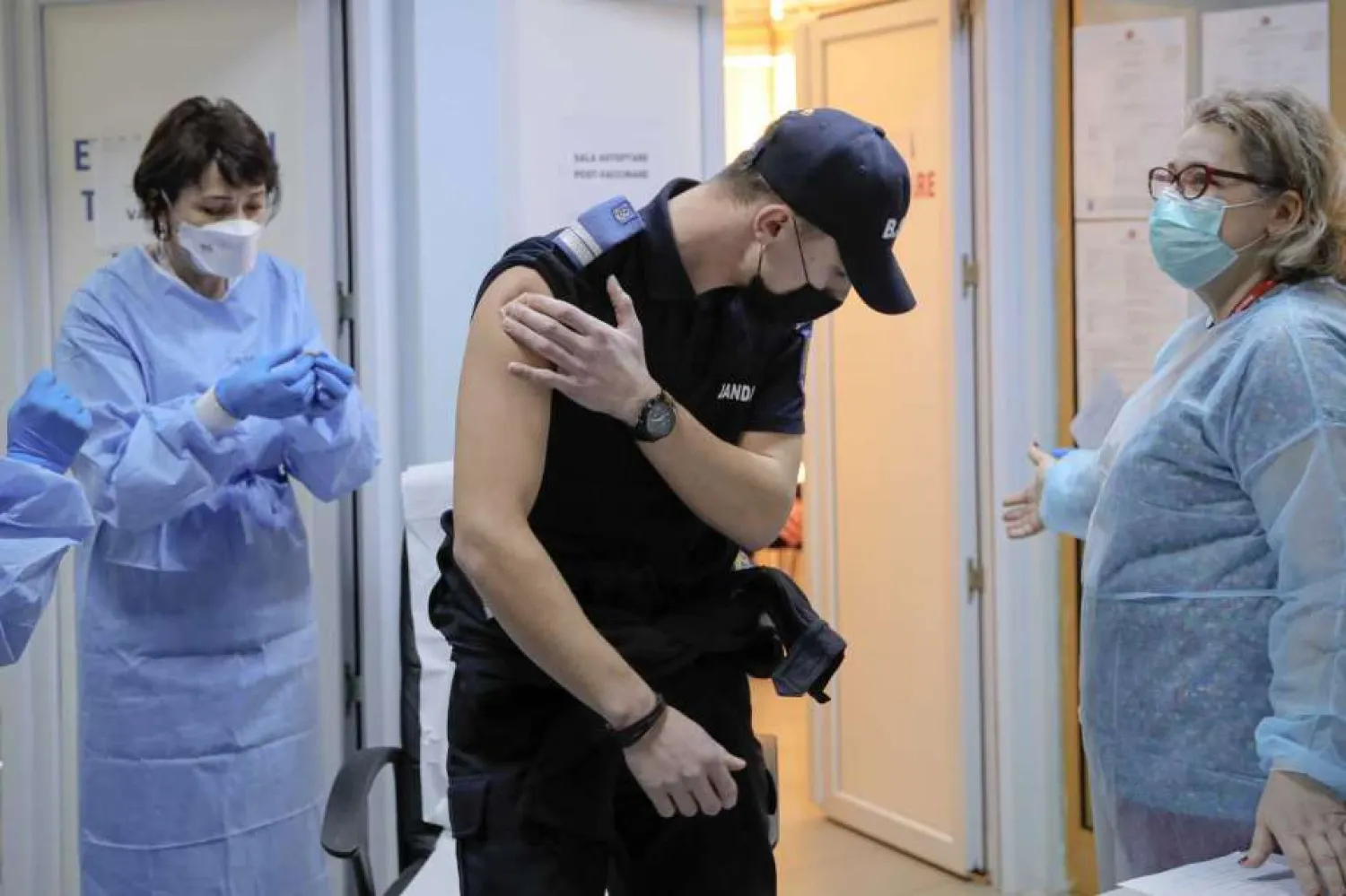
In this photo taken on Friday, Jan. 15, 2021, A Romanian gendarme leaves after getting a COVID-19 vaccine at a hospital in Bucharest, Romania. (AP Photo/Vadim Ghirda)
TT

Vaccine Skepticism Hurts East European Anti-Virus Efforts

In this photo taken on Friday, Jan. 15, 2021, A Romanian gendarme leaves after getting a COVID-19 vaccine at a hospital in Bucharest, Romania. (AP Photo/Vadim Ghirda)

Vaccines from the West, Russia, or China? Or none at all? That dilemma faces nations in southeastern Europe, where coronavirus vaccination campaigns are off to a slow start - overshadowed by heated political debates and conspiracy theories.

In countries like the Czech Republic, Serbia, Bosnia, Romania, and Bulgaria, vaccine skeptics have included former presidents and even some doctors. Serbian tennis champion Novak Djokovic was among those who said he did not want to be forced to get inoculated.

False beliefs that the coronavirus is a hoax or that vaccines would inject microchips into people have spread in the countries that were formerly under harsh Communist rule. Those who once routinely underwent mass inoculations are deeply split over whether to get the vaccines at all.

"There is a direct link between support for conspiracy theories and skepticism toward vaccination," a recent Balkan study warned. "A majority across the region does not plan to take the vaccine, a ratio considerably lower than elsewhere in Europe, where a majority favors taking the vaccine."

Only about 200,000 people applied for the vaccine in Serbia, a country of 7 million, in the days after authorities opened the procedure. By contrast, 1 million Serbians signed up for 100 euros ($120) on the first day the government offered the pandemic aid.

Hoping to encourage vaccinations, Serbian officials have gotten their shots on TV. Yet they themselves have been split over whether to get the Western-made Pfizer-BioNTech vaccine or Russia´s Sputnik V, more divisions in a country that is formally seeking European Union membership but where many favor closer ties with Moscow.

Serbian President Aleksandar Vucic on Saturday greeted a shipment of 1 million doses of the Chinese Sinopharm vaccine, saying he will receive a shot to show that it is safe.

"Serbs prefer the Russian vaccine," read a recent headline of the Informer, a pro-government tabloid, as officials announced that 38% of those who have applied to take the shots favor the Russian vaccine, while 31% want the Pfizer-BioNTech version - a rough division among pro-Russians and pro-Westerners in Serbia.

In neighboring Bosnia, a war-torn country that remains ethnically divided among Serbs, Bosniaks, and Croats, politics also are a factor, as the Serb-run half appeared set to opt for the Russian vaccine, while the Bosniak-Croat part likely will turn to the Western ones.

Sasa Milovanovic, a 57-year-old real estate agent from Belgrade, sees all vaccines as part of the "global manipulation" of the pandemic.

"People are locked up, they have no lives any longer and live in a state of hysteria and fear," he said.

Djokovic has said he was against being forced to take a coronavirus vaccine in order to travel and compete but was keeping his mind open. The top-ranked tennis player and his wife tested positive in June after a series of exhibition matches with zero social distancing that he organized in the Balkans. They and their foundation have donated 1 million euros ($1.1 million) to buy ventilators and other medical equipment for hospitals in Serbia.

Serbian Health Ministry official Mirsad Djerlek has described the vaccine response as "satisfactory," but cautioned on the state-run RTS broadcaster that "people in rural areas usually believe in conspiracy theories, and that is why we should talk to them and explain that the vaccine is the only way out in this situation."

A study by the Balkans in Europe Policy Advisory Group, published before the regional vaccination campaign started in December, concluded that virus conspiracy theories are believed by nearly 80% of citizens of the Western Balkan countries striving to join the EU. About half of them will refuse to get vaccinated, it said.

Baseless theories allege the virus isn´t real or that it´s a bioweapon created by the US or its adversaries. Another popular falsehood holds that Microsoft founder Bill Gates is using COVID-19 vaccines to implant microchips in the planet's 7 billion people.

A low level of information about the virus and vaccines, distrust in governments, and repeated assertions by authorities that their countries are besieged by foreigners help explain the high prevalence of such beliefs, according to the Balkans think tank.

Similar trends have been seen even in some eastern European Union countries.

In Bulgaria, widespread conspiracy theories hampered past efforts to deal with a measles outbreak. Surveys there suggested distrust of vaccines remains high even as coronavirus cases keep rising. A recent Gallup International poll found that 30% of respondents want to get vaccinated, 46% will refuse and 24% are undecided.

Bulgarian doctors have tried to change attitudes. Dr. Stefan Konstantinov, a former health minister, joked that people should be told neighboring Greece would close resorts to tourists who don't get vaccinated, because "this would guarantee that some 70% of the population would rush to get a jab."

In the Czech Republic, where surveys show some 40% reject vaccination, protesters at a big rally against government virus restrictions in Prague demanded that vaccinations not be mandatory. Former President Vaclav Klaus, a fierce critic of the government's pandemic response, told the crowd that vaccines are not a solution.

"They say that everything will be solved by a miracle vaccine," said the 79-year-old Klaus, who insists that people should get exposed to the virus to gain immunity, which experts reject. "We have to say loud and clear that there´s no such a thing. ... I am not going to get vaccinated."

Populist authorities in Hungary have taken a hard line against virus misinformation, but rejection of vaccines is still projected at about 30%. Parliament passed emergency powers in March that allows authorities to prosecute anyone deemed to be "inhibiting the successful defense" against the virus, including "fearmongering" or spreading false news. At least two people who criticized the government's response to the pandemic on social media were arrested, but neither was formally charged.

Romanian Health Minister Vlad Voiculescu said he is relying on family doctors to "inform, schedule and monitor people after the vaccine" and that his ministry will offer bonuses to medical workers based on the number of people they get onboard. Asked if such incentives would fuel anti-vaccination propaganda, Voiculescu said: "I am interested more by the doctors´ view on the matter than I am about the anti-vaxxers."

Dr. Ivica Jeremic, who has worked with virus patients in Serbia since March and tested positive himself in November, hopes vaccination programs will gain speed once people overcome their fear of the unknown.

"People will realize the vaccine is the only way to return to normal life," he said.


Top Trump Iran Negotiator Says Visits US Aircraft Carrier in Middle East

US Special Envoy Steve Witkoff delivers a press conference upon the signing of the declaration on deploying post-ceasefire force in Ukraine, during the so-called "Coalition of the Willing" summit, at the Elysee Palace in Paris, France, January 6, 2026. (Reuters)
TT

Top Trump Iran Negotiator Says Visits US Aircraft Carrier in Middle East

US Special Envoy Steve Witkoff delivers a press conference upon the signing of the declaration on deploying post-ceasefire force in Ukraine, during the so-called "Coalition of the Willing" summit, at the Elysee Palace in Paris, France, January 6, 2026. (Reuters)

US President Donald Trump's lead Iran negotiator Steve Witkoff on Saturday said he visited the USS Abraham Lincoln aircraft carrier currently in the Arabian Sea, with Washington and Tehran due to hold further talks soon.

"Today, Adm. Brad Cooper, Commander of US Naval Forces Central Command, Jared Kushner, and I met with the brave sailors and Marines aboard the USS Abraham Lincoln, her strike group, and Carrier Air Wing 9 who are keeping us safe and upholding President Trump's message of peace through strength," said Witkoff in a social media post.

Iranian Foreign Minister Abbas Araghchi said on Saturday he hoped talks with the United States would resume soon, while reiterating Tehran's red lines and warning against any American attack.


Israel’s Netanyahu Expected to Meet Trump in US on Wednesday and Discuss Iran

Israeli Prime Minister Benjamin Netanyahu delivers a speech during a special session to mark the 77th anniversary of the Knesset's establishment and the 60th anniversary of the dedication of the current building at the Knesset, the Israeli parliament, in Jerusalem, 02 February 2026. (EPA)
TT

Israel’s Netanyahu Expected to Meet Trump in US on Wednesday and Discuss Iran

Israeli Prime Minister Benjamin Netanyahu delivers a speech during a special session to mark the 77th anniversary of the Knesset's establishment and the 60th anniversary of the dedication of the current building at the Knesset, the Israeli parliament, in Jerusalem, 02 February 2026. (EPA)

Israeli Prime Minister Benjamin Netanyahu is expected to meet US President Donald Trump on Wednesday in Washington, where they will discuss negotiations with Iran, Netanyahu's office said on Saturday.

Iranian and US officials held indirect nuclear ‌talks in the ‌Omani capital ‌Muscat ⁠on Friday. ‌Both sides said more talks were expected to be held again soon.

A regional diplomat briefed by Tehran on the talks told Reuters Iran insisted ⁠on its "right to enrich uranium" ‌during the negotiations with ‍the US, ‍and that Tehran's missile capabilities ‍were not raised in the discussions.

Iranian officials have ruled out putting Iran's missiles - one of the largest such arsenals in the region - up ⁠for discussion, and have said Tehran wants recognition of its right to enrich uranium.

"The Prime Minister believes that any negotiations must include limiting ballistic missiles and halting support for the Iranian axis," Netanyahu's office said in a ‌statement.


Italy FM Rules Out Joining Trump’s ‘Board of Peace’

Italy's Minister for Foreign Affairs Antonio Tajani speaks to the press during the EPP Leaders’ meeting, in Zagreb, Croatia, 30 January 2026. (EPA)
TT

Italy FM Rules Out Joining Trump’s ‘Board of Peace’

Italy's Minister for Foreign Affairs Antonio Tajani speaks to the press during the EPP Leaders’ meeting, in Zagreb, Croatia, 30 January 2026. (EPA)

Italy will not take part in US President Donald Trump's "Board of Peace", Italian Foreign Minister Antonio Tajani said Saturday, citing "insurmountable" constitutional issues.

Trump launched his "Board of Peace" at the World Economic Forum in Davos in January and some 19 countries have signed its founding charter.

But Italy's constitution bars the country from joining an organization led by a single foreign leader.

Prime Minister Giorgia Meloni, a Trump ally, last month noted "constitutional problems" with joining, but suggested Trump could perhaps reopen the framework "to meet the needs not only of Italy, but also of other European countries".

Tajani appeared Saturday to rule that out.

"We cannot participate in the Board of Peace because there is a constitutional limit," he told the ANSA news agency.

"This is insurmountable from a legal standpoint," he said, the day after meeting US Secretary of State Marco Rubio and US Vice President JD Vance at the Olympics in Milan.

Although originally meant to oversee Gaza's rebuilding, the board's charter does not limit its role to the Palestinian territory and appears to want to rival the United Nations.
