

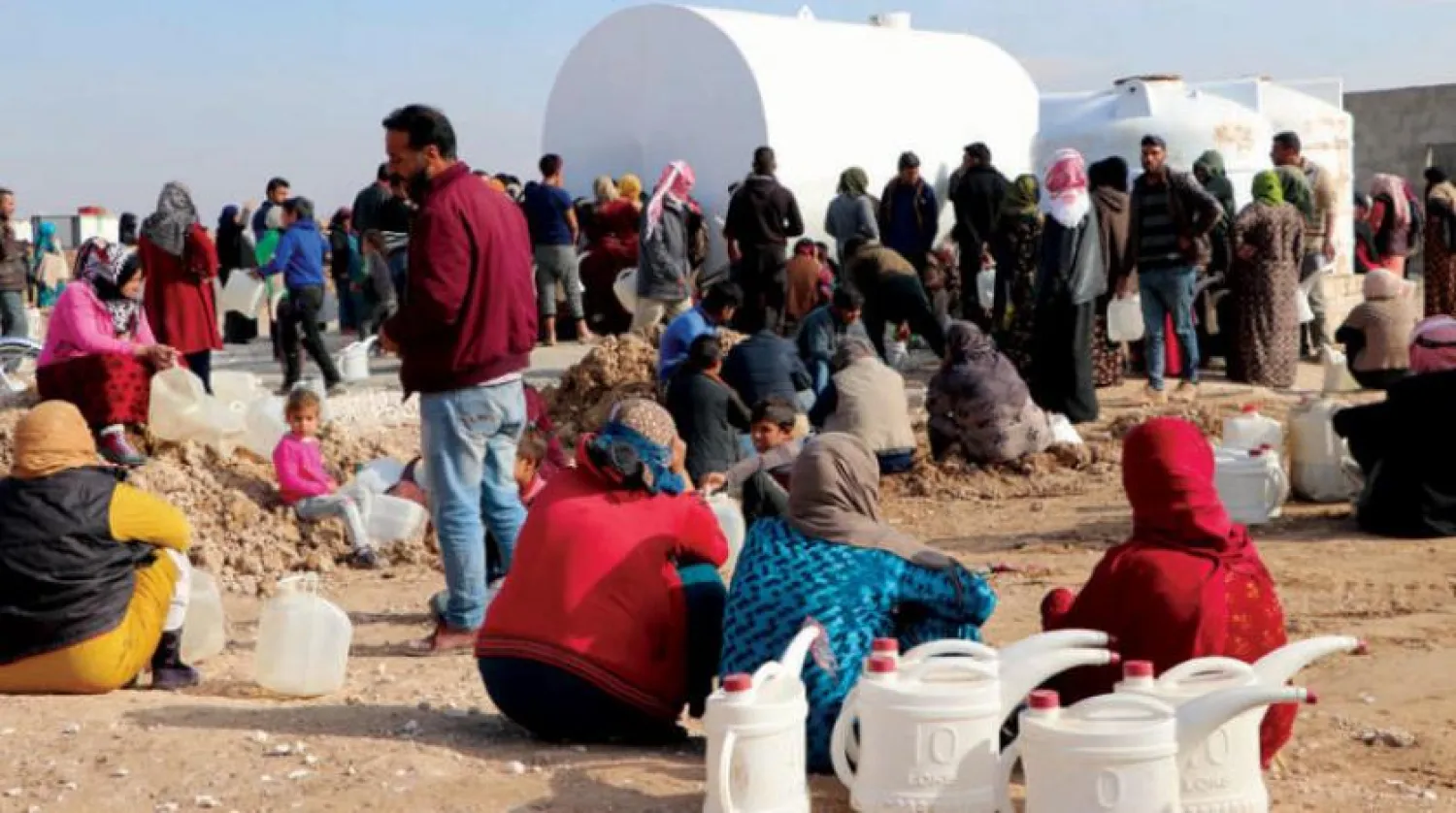

A Million Syrians Face Disaster from Turkey’s ‘Water War’

Syrians at a displacement camp in al-Hasakeh. (Asharq Al-Awsat)
TT

A Million Syrians Face Disaster from Turkey’s ‘Water War’

Syrians at a displacement camp in al-Hasakeh. (Asharq Al-Awsat)

Syria’s al-Hasakeh region is again suffering from a water shortage after Turkish forces stopped operations at the Allouk pumping water station on Saturday.

The disruption sparked a wave of popular outrage with rallies, organized by regime loyalists, taking to the streets.

Local sources said Turkey had stopped operations at the station on Saturday and prevented workers from entering it.

Allouk is the only source of drinking water for around a million people living in al-Hasakeh in northeastern Syria.

Operations there have frequently come to a halt due to Turkish shelling and power cuts.

The station had only resumed operating on December 17 after weeks of closure.

People took to the streets on Monday to protest the latest shut down. They condemned Turkish forces and their affiliated Syrian factions for cutting drinking water supplies to vast regions in northeastern Syria.

They also seized the opportunity to express their frustration with the predominantly Kurdish Syrian Democratic Forces (SDF). They demanded that the forces lift the siege on neighborhoods and areas held by the regime.

January has seen a wave of arrests between the Kurdish Asayish security forces and regime forces in the cities of al-Hasakeh and al-Qamishli, stoking tensions between the SDF and Damascus.

The shut down of the Allouk station will leave a million people and residents of displacement camps facing a catastrophe over their deprivation from drinking water.

The station is the main water supply to al-Hasakeh city and the surrounding areas, as well as three displacement camps, including al-Hol, which alone is home to 62,000 people. The other camps are Washokani with 12,000 refugees and al-Areesha with 13,000.

The International Committee for the Red Cross had last year expressed its concern over the repeated disruptions of water supplies in al-Hasakeh and the dire situation has been compounded with the outbreak of the novel coronavirus.



EU Condemns Israel's West Bank Control Measures

The Israeli settlement of Har Homa, seen from the West Bank city of Bethlehem, Tuesday, Dec. 17, 2024. (AP)
TT

EU Condemns Israel's West Bank Control Measures

The Israeli settlement of Har Homa, seen from the West Bank city of Bethlehem, Tuesday, Dec. 17, 2024. (AP)

The European Union on Monday condemned new Israeli measures to tighten control of the West Bank and pave the way for more settlements in the occupied Palestinian territory, AFP reported.

"The European Union condemns recent decisions by Israel's security cabinet to expand Israeli control in the West Bank. This move is another step in the wrong direction," EU spokesman Anouar El Anouni told journalists.


Atrocities in Sudan's El-Fasher Were 'Preventable Human Rights Catastrophe'

Sudanese displaced people who left El Fasher after its fall, sit in the shade in Tawila at the Rwanda camp reception point on December 17, 2025. (Photo by AFP)
TT

Atrocities in Sudan's El-Fasher Were 'Preventable Human Rights Catastrophe'

Sudanese displaced people who left El Fasher after its fall, sit in the shade in Tawila at the Rwanda camp reception point on December 17, 2025. (Photo by AFP)

The atrocities unleashed on El-Fasher in Sudan's Darfur region last October were a "preventable human rights catastrophe", the United Nations said Monday, warning they now risked being repeated in the neighbouring Kordofan region.


"My office sounded the alarm about the risk of mass atrocities in the besieged city of El-Fasher for more than a year ... but our warnings were ignored," UN rights chief Volker Turk told the Human Rights Council in Geneva.


He added that he was now "extremely concerned that these violations and abuses may be repeated in the Kordofan region".


Arab League Condemns Israel's Decisions to Alter Legal, Administrative Status of West Bank

A general view shows the opening session of the meeting of Arab foreign ministers at the Arab League Headquarters (Reuters)
TT

Arab League Condemns Israel's Decisions to Alter Legal, Administrative Status of West Bank

A general view shows the opening session of the meeting of Arab foreign ministers at the Arab League Headquarters (Reuters)

The General Secretariat of the Arab League strongly condemned decisions by Israeli occupation authorities to impose fundamental changes on the legal and administrative status of the occupied Palestinian territories, particularly in the West Bank, describing them as a dangerous escalation and a flagrant violation of international law, international legitimacy resolutions, and signed agreements, SPA reported.

In a statement, the Arab League said the measures include facilitating the confiscation of private Palestinian property and transferring planning and licensing authorities in the city of Hebron and the area surrounding the Ibrahimi Mosque to occupation authorities.

It warned of the serious repercussions of these actions on the rights of the Palestinian people and on Islamic and Christian holy sites.

The statement reaffirmed the Arab League’s firm support for the legitimate rights of the Palestinian people, foremost among them the establishment of their independent state on the June 4, 1967 borders, with East Jerusalem as its capital.