


Brazilian Football Has a Racism Problem – From Grassroots to the Elite

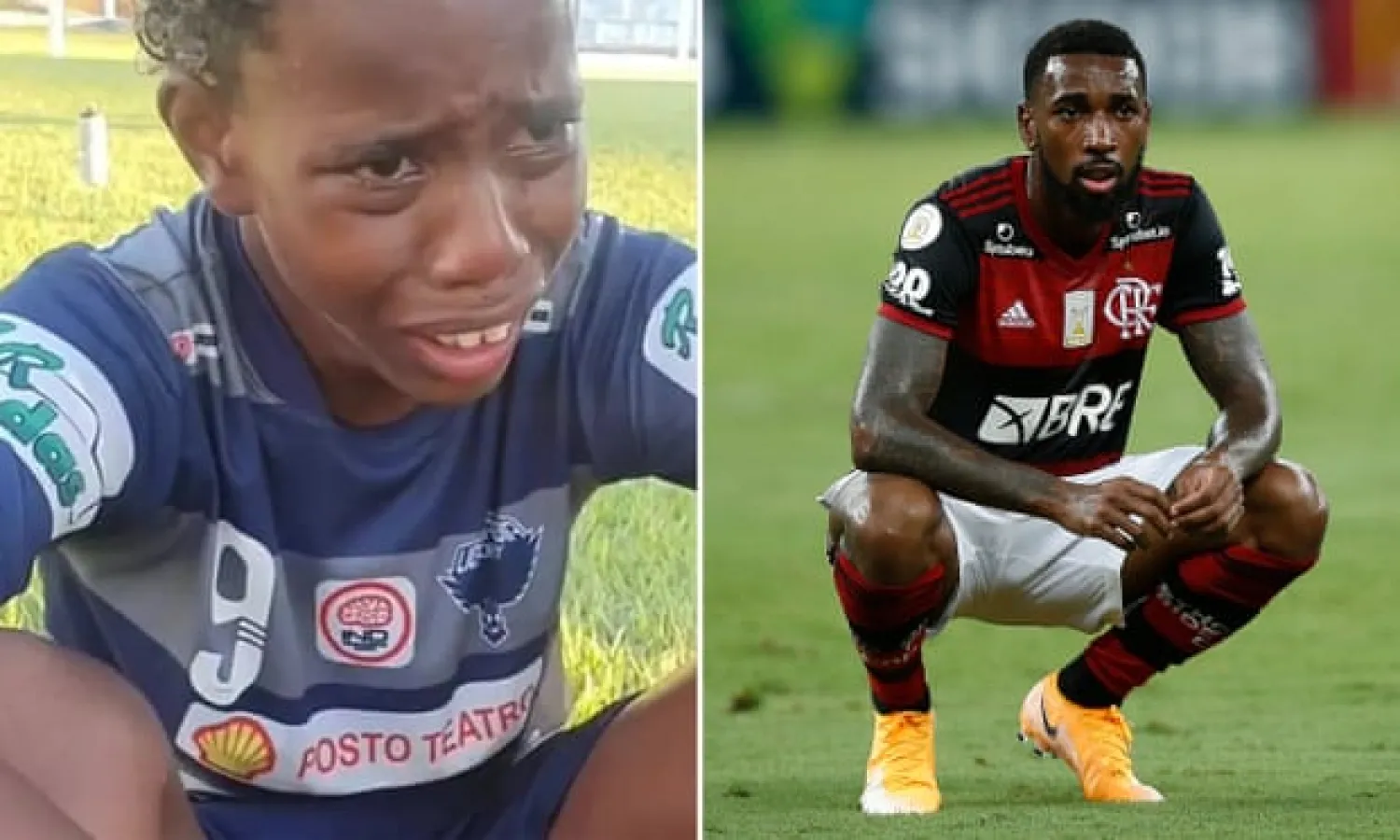
Luiz Eduardo and Gerson both accused opponents of using racist language in recent weeks. Composite: Getty
TT

Brazilian Football Has a Racism Problem – From Grassroots to the Elite

Luiz Eduardo and Gerson both accused opponents of using racist language in recent weeks. Composite: Getty

Black people in Brazil are beaten to death in supermarkets on Black Consciousness Day, routinely harassed and brutalized by the police, and even cropped out of marketing photos for private schools so only their white peers are shown. The football field is usually one of the few places where black Brazilians are not subjected to prejudice and racism, a stage that provides a form of escapism from the harsh realities of everyday life. Yet two incidents over Christmas showed that the game is far from immune to racism, either at the grassroots level or the professional ranks.

First, a clip of an 11-year-old boy Luiz Eduardo went viral. At the conclusion of a match in Caldas Novas, in the rural state of Goiás, the youngster was left distraught and in tears after the opposition’s coach repeatedly told his players to “close down the preto”, which is a highly offensive racial slur in Portuguese. Corinthians wore Luiz Eduardo’s name on their shirts in solidarity in their game against Goiás a few days later and he received videos of support from players such as Gabriel Jesus and Neymar. Santos, the club that nurtured Neymar, have even offered him trials.

In a land home to one of the world’s most racially unequal societies, where public education is poor, access to private schooling is expensive and the minimum wage is miserly, football stereotypically offers one of the few avenues to a better life for young black kids and their families, making professional employment in the industry the dream of millions. Yet, as shown during a fiery clash between Flamengo and Bahia in December, escaping poverty does not mean players are free from discrimination.

During a tussle in a keenly contested league game, the Flamengo midfielder Gerson says he was told to “shut your mouth, negro” by the Bahia player Juan Pablo Ramírez. Speaking after the game, Gerson said: “I have played many games as a professional and I’ve never said anything because I had never suffered prejudice. But after conceding one of the goals, Ramírez started arguing with Bruno Henrique and I went to talk to him and he told me: ‘Shut your mouth, black.’ He has to learn to respect people.”

Various high profile players commented on the incident, with Everton striker Richarlison, who played alongside Gerson for various Brazil youth teams, telling his former teammate on Twitter: “They won’t shut us up. We will scream louder and louder! We are together brother! Burn the racists!”

After the game, the Bahia manager Mano Menezes argued with Gerson on the side of the pitch and accused him of “malandragem”, a form of rogue trickery that could be translated as shithousing. Menezes – who had a stint as the Brazil manager a decade ago in which he led his country to the Olympic final at London 2012 – was effectively suggesting that Gerson had only accused Ramírez of racism to gain an advantage in a tight game.

The furor has been hugely embarrassing for Bahia, who have proudly cultivated a reputation as one of Brazil’s most progressive clubs on issues such as racism and homophobia. Amid the fallout after the final whistle, the club announced that they had suspended Ramírez and dismissed Menezes. The club said they had sacked their manager because of the team’s poor form – their 4-3 defeat to Flamengo left them 16th in the Brasileirão table – but his remarks seem to have played their part.

“His attitude certainly weighed heavily on Bahia to take the decision to fire him on the same day,” says Brazilian football journalist Breiller Pires. However, Pires points out that not every club would have acted so quickly or decisively in punishing their staff. “Were it another club, we would have probably seen different conduct. Bahia have been a pioneer in creating a core of affirmative actions and carrying out major social actions, which has contributed to the club adopting a zero tolerance attitude towards the case in removing the player and avoiding blaming the victim.”

“Despite this, they still need to improve on their progressive fronts. Replacing Roger Machado, a black and socially engaged coach, with Mano was a mistake. The club left social responsibility in the background and looked only at the sporting side of things. And, due to the sullying of their image due to this case, they have paid dearly for it. Bahia must make their players and employees more aware of their stance, by showing them the importance of demonstrating anti-racist attitudes and that racism will never be tolerated by the club and its fans.”

Gerson has made his complaints to the police official and Ramírez has subsequently offered an apology in a video posted by the club on its social media channels. Although he maintains that he did not tell Gerson to shut his mouth, did not say anything racist and might have been misunderstood.

Bahia hired a language specialist, who concluded that there had been no wrongdoing on the part of their player. He has since been reinstated to the team. The club say they will take steps to prevent further incidents, including writing “anti-racist, xenophobic and homophobic” clauses in their players’ contracts and putting players through structural racism immersion courses in pre-season. They have also proposed an anti-discriminatory protocol for matches and supported the idea for a national anti-racism in football day in Brazil.

Dani Alves, who started his career at Bahia, played for Menezes in the Brazil team and is now back in Brasileiro at São Paulo FC, has been critical of the punishments given to Menezes and Ramírez. “It seems a shame to me that we have evolved in so many banal things, but in the things that we really should have evolved, we have been getting more stupid,” he wrote on Instagram. “As long as there is no severe punishment, it will never end.”

Pires agrees, saying: “Dismissal is little for what Mano did. The coach’s conduct was reprehensible. A football professional cannot behave like him in the face of a report of racism, in blaming and discrediting the victim. It was the most shameful episode of his career.”

Pires says the cases of both Luiz Eduardo and Gerson “are reflections of the structural racism of society, which still marginalizes black people, as happened with João Alberto at the Carrefour supermarket on Black Consciousness Day. In football, there is an even greater tolerance for racism. Racist offenses are seen as part of the ‘sporting culture’ – something evident when Mano Menezes treats an accusation of racism as a footballing provocation. The absence of black people in commanding positions – such as coaches, directors and club presidents – is normalized, even though football is full of black idols and great athletes. The lack of representation in the sport’s most powerful roles is one of the reasons why racist offenses generally go unpunished, and why victims are blamed.”

(The Guardian)


We Will Know How Good We Are After Group Stage, Says Germany Captain Kimmich

Joshua Kimmich of Team Germany talks to the media during a press conference at Donovan L. Nicol Hall of Excellence at Winston-Salem State University on June 16, 2026 in Winston-Salem, North Carolina. (Getty Images/AFP)
TT

We Will Know How Good We Are After Group Stage, Says Germany Captain Kimmich

Joshua Kimmich of Team Germany talks to the media during a press conference at Donovan L. Nicol Hall of Excellence at Winston-Salem State University on June 16, 2026 in Winston-Salem, North Carolina. (Getty Images/AFP)

Germany's seven-goal rout of ‌Curacao for their World Cup opener has triggered a wave of enthusiasm among success-starved fans, but captain Joshua Kimmich said on Tuesday the team needed their next two group matches to see exactly where they stand.

The Germans thrashed Curacao 7-1 on Sunday to take control of Group E. They play Ivory Coast, also on three points following their 1-0 win over Ecuador, on Saturday before completing their group matches against Ecuador next week.

"It was an expected win for us but the way it happened was very dominant," Kimmich told a press conference. "But ‌we have seen ‌that to win by such a score is ‌not ⁠expected (in this tournament)." ⁠

While the four-time champions easily won their opener against the World Cup newcomers from the Caribbean, European champions Spain stumbled to a 0-0 draw against minnows Cape Verde and Saudi Arabia also snatched a draw against Uruguay.

Germany are desperate to restore their international reputation after suffering shock first-round exits in the previous two World Cups in 2018 and ⁠2022. They are now on a 10-game winning streak, ‌but Kimmich said the team would ‌have a much better picture of their chances in the tournament after the ‌group stage.

"Both teams (Ivory Coast and Ecuador) are physically very strong and ‌they can deal well with the conditions," Kimmich said.

"We played the first game against an opponent who is certainly not world class. Now come some challenges where we can see where we stand. We have great qualities to ‌hurt opponents. We need to work on stability, reduce the goals we concede, even against a small ⁠opponent."

While the ⁠Germans want to gradually hit top form at the right time after more than a decade of failing to make any impact on the international stage, Kimmich warned they needed to be more consistent in their game.

Former Germany coach Joachim Loew, who led them to their last World Cup title in 2014, told a sports show back in Germany that while the team had a lot of quality it was still lacking the necessary stability to win the title.

"Let's play the next two matches and then all the experts can better evaluate where we stand," Kimmich said. "We have now won 10 games in a row. I have the feeling that we are on a good path."


Serena Williams to Play Doubles with Sister Venus at Wimbledon

FILE -Venus Williams, left, and sister Serena talk together, during their Women's Doubles match against Irina Spirlea and Caroline Vis, at Wimbledon, July 4, 2000. (AP Photo/Alastair Grant, File)
TT

Serena Williams to Play Doubles with Sister Venus at Wimbledon

FILE -Venus Williams, left, and sister Serena talk together, during their Women's Doubles match against Irina Spirlea and Caroline Vis, at Wimbledon, July 4, 2000. (AP Photo/Alastair Grant, File)

Serena Williams will play at Wimbledon for the first time since 2022 after the American legend was given a wildcard to play the doubles event with her sister Venus on Tuesday.

Williams made a sensational return to tennis last week when she won her first-round doubles match at Queen's Club with partner Victoria Mboko.

The 44-year-old had not played professional tennis for four years after saying she was "evolving away" from the sport following the 2022 US Open.

But the 23-time Grand Slam singles champion was keen to play in front of her two young daughters and made the shock announcement of her return just prior to the Wimbledon warm-up event at Queen's.

Williams was unable to play more than one match at Queen's after Mboko pulled out with an injury, but she is due to continue her remarkable comeback in the Berlin Open doubles alongside Karolina Muchova this week.

The Williams sisters are six-time doubles champions at Wimbledon, winning their last title on their most recent appearance together a decade ago.

Following speculation that Serena would be tempted to play in the singles at Wimbledon, which starts on June 29, the American was absent from the list of wildcard entries into that part of the tournament.

After so long away, she had no ranking to secure automatic entry into tournaments, leaving her to rely on wildcards.

There is still one singles wildcard place for Wimbledon to be announced.


Gazans Displaced by War Watch World Cup from the Ruins

 Palestinian football fans watch 2026 World Cup matches at a cafe in Gaza City, June 11, 2026. (Reuters)
Palestinian football fans watch 2026 World Cup matches at a cafe in Gaza City, June 11, 2026. (Reuters)
TT

Gazans Displaced by War Watch World Cup from the Ruins

 Palestinian football fans watch 2026 World Cup matches at a cafe in Gaza City, June 11, 2026. (Reuters)
Palestinian football fans watch 2026 World Cup matches at a cafe in Gaza City, June 11, 2026. (Reuters)

Fadi Al-Arawi, a footballer in the Gaza Strip Premier League, hasn't been able to take the pitch since pro sports were suspended with the outbreak of war more than two years ago. Like most Gazans, he no longer even has a home where he can watch the World Cup on TV.

As Saturday's match between Qatar and Switzerland was about to get under way, he wore his old Gaza Sports Club professional uniform and medals he had picked up at international competitions.

He hovered in the darkness over a flickering laptop, trying to get an internet signal to watch the match with a group of friends in a room in a school converted into a shelter for Gazans displaced by ‌Israel's military campaign.

"See, ‌this is the internet, it's starting to cut out and ‌the ⁠match hasn't even ⁠started yet," Al-Arawi, 38, told Reuters in Khan Younis as Israeli drones hummed overhead. "Can you hear the drones? We might live or die, we might be bombed."

Much of Gaza was destroyed and its infrastructure heavily damaged during Israel's two-year military assault in the territory, launched after the October 2023 Hamas attacks.

Despite an October 2025 truce, Israel has continued to carry out attacks in Gaza, and Hamas has so far rebuffed calls to lay down its ⁠arms in exchange for Israel withdrawing its troops.

'DESPITE EVERYTHING, WE WILL ‌WATCH THE MATCHES'

Nearly the entire population of more ‌than 2 million Palestinians lives in a narrow strip of Hamas-controlled territory along the coast, mainly ‌in tents and damaged buildings.

Alaa Babli, who runs the Royal Cafe in Gaza City, ‌installed two alternative power lines and a backup battery to ensure late-night matches can still be screened once fuel-powered generators shut down after midnight.

Hani Abu Rizq, who came to watch a match beneath flags of Egypt and Morocco hanging on the cafe wall, said Gazans are never free ‌of fear when out in public.

"The cafe could be targeted," he said. "Something next to me could be targeted and I ⁠could lose my life... ⁠But despite everything we are suffering, we are continuing, and we will watch the matches."

The Palestinian Football Association says 1,000 athletes were among the 73,000 Palestinians killed by Israel in the war since 2023, from children and amateurs in all sports to referees and professionals.

Israel has also destroyed around 285 sports facilities — some completely bulldozed, others bombed. Israeli forces converted stadiums into detention camps, some of which became notorious for allegations of mistreatment of prisoners there, which Israel denies.

The enclave's flagship Al-Yarmouk Stadium in Gaza City, where Al-Arawi and other professionals once played in front of thousands of spectators, is now a tent city for displaced families.

"Since the Israeli war of extermination in 2023, Palestinian sports have been a primary target of the Israeli military machine," said Mustafa Siam of the Palestinian Football Association.
