


Empty Seas: Oceanic Shark Populations Dropped 71% since 1970

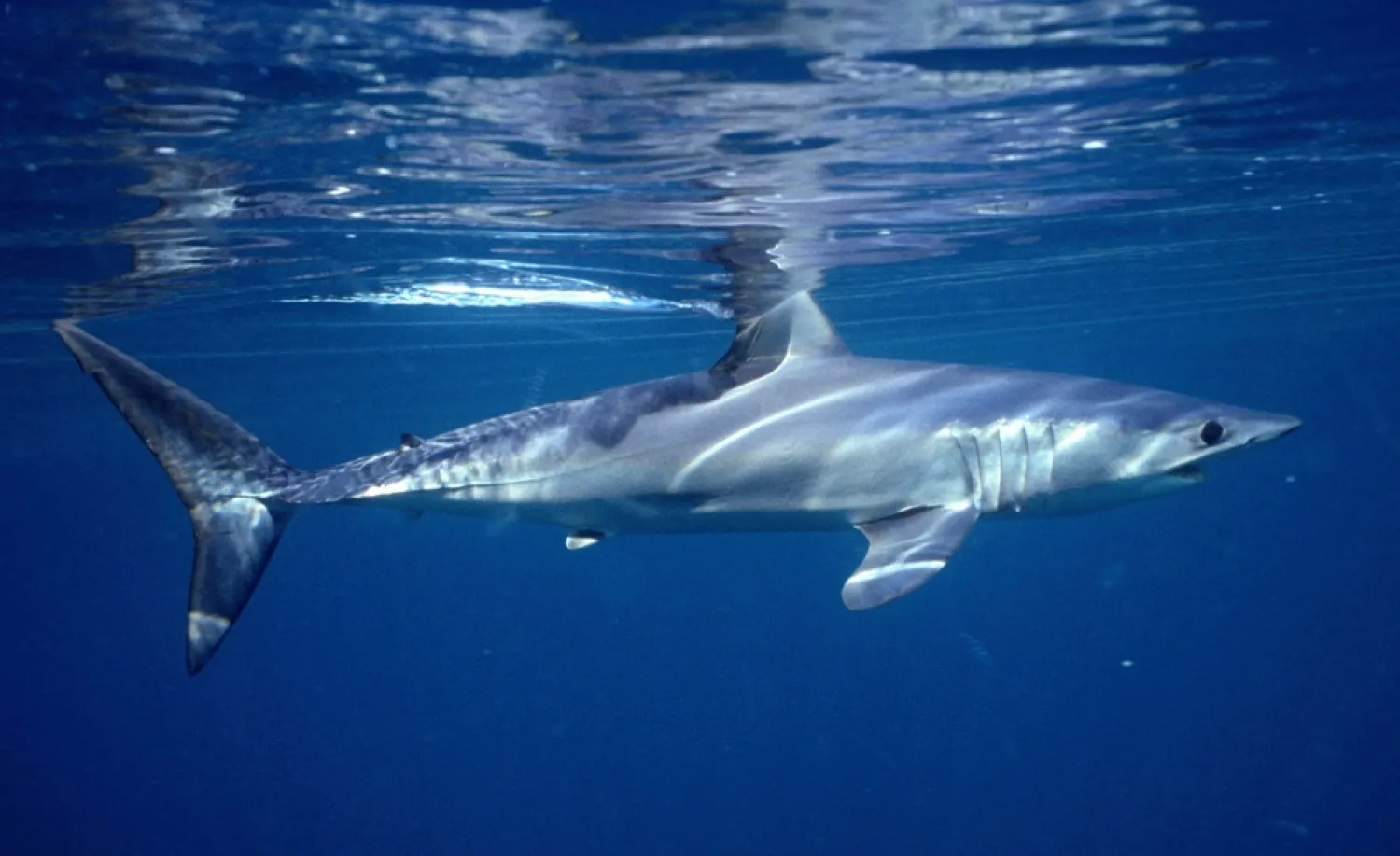
This undated photo provided by Dr. Greg Skomal in January 2021 shows a shortfin mako shark. (AP)
TT

Empty Seas: Oceanic Shark Populations Dropped 71% since 1970

This undated photo provided by Dr. Greg Skomal in January 2021 shows a shortfin mako shark. (AP)

When marine biologist Stuart Sandin talks about sharks, it sounds like he’s describing Jedis of the ocean. “They are terrific predators, fast swimmers and they have amazing senses — they can detect any disturbance in the ocean from great distance,” such as smells or tiny changes in water currents.

Their ability to quickly sense anything outside the norm in their environment helps them find prey in the vastness of the open ocean. But it also makes them especially vulnerable in the face of increased international fishing pressure, as global fishing fleets have doubled since 1950.

“You drop a fishing line in the open ocean, and often it’s sharks that are there first — whether or not they’re the primary target,” said Sandin, who works at the Scripps Institution of Oceanography.

Scientists have known for decades that individual shark species are declining, but a new study drawing on 57 global datasets underscores just how dramatically worldwide populations have collapsed in the past half century.

Globally, the abundance of oceanic sharks and rays dropped more than 70% between 1970 and 2018, according to a study published Wednesday in the journal Nature.

And 24 of the 31 species of sharks and rays are threatened with extinction, while three species — oceanic whitetip sharks, scalloped hammerhead sharks and great hammerhead sharks — are considered critically endangered.

“The last 50 years have been pretty devastating for global shark populations,” said Nathan Pacoureau, a biologist at Simon Fraser University in Canada and a co-author of the study.

Sometimes sharks are intentionally caught by fishing fleets, but more often they are reeled in incidentally as “bycatch,” in the course of fishing for other species such as tuna and swordfish.

Sharks and rays are both fish with skeletons made of cartilage, not bone. In contrast to most other kinds of fish, they generally take several years to reach sexual maturity, and they produce fewer offspring.

“In terms of timing, they reproduce more like mammals – and that makes them especially vulnerable,” said Pacoureau. “Their populations cannot replenish as quickly as many other kinds of fish.”

The number of fishing vessels trolling the open ocean has risen steeply since the 1950s, as engine power expanded ships' range. And while climate change and pollution also imperil shark survival, increased fishing pressure is the greatest threat for every oceanic shark species.

“When you remove top predators of the ocean, it impacts every part of the marine food web,” said Stuart Pimm, an ecologist at Duke University, who was not involved in the study. “Sharks are like the lions, tigers and bears of the ocean world, and they help keep the rest of the ecosystem in balance.”



Spain and Portugal Continue to Battle Storm Leonardo as New Storm Approaches

 A mountain landslide blocks railway tracks during heavy rains, as storm Leonardo hits parts of Spain, in Benaojan, Spain, February 6, 2026. (Reuters)
A mountain landslide blocks railway tracks during heavy rains, as storm Leonardo hits parts of Spain, in Benaojan, Spain, February 6, 2026. (Reuters)
TT

Spain and Portugal Continue to Battle Storm Leonardo as New Storm Approaches

 A mountain landslide blocks railway tracks during heavy rains, as storm Leonardo hits parts of Spain, in Benaojan, Spain, February 6, 2026. (Reuters)
A mountain landslide blocks railway tracks during heavy rains, as storm Leonardo hits parts of Spain, in Benaojan, Spain, February 6, 2026. (Reuters)

Storm Leonardo continued to batter the Iberian Peninsula on Friday, bringing floods and putting rivers at risk of bursting their banks while thousands of people were evacuated from their homes in Spain and Portugal.

In southern Spain's Andalusia region, some 7,000 people have had to leave their homes due to successive storms.

Among them were around 1,500 people ordered to evacuate the mountain village of Grazalema, where Andalusia's regional leader Juan Manuel Moreno warned that aquifers were "full to the brim with water,” and at risk of collapsing.

“It's raining on already saturated ground. The land is unable to drain," Moreno said. “We urge extreme caution. This is not over.”

Spanish police said Friday they had found a body located 1,000 meters (about 0.6 miles) away from where a woman had disappeared Wednesday after she fell into a river in Malaga province while trying to rescue her dog. Police said they had not yet identified the body, but believed it belonged to the 45-year-old woman.

Another storm front, Marta, was expected to arrive Saturday, with Spain's weather agency AEMET saying it would bring even more rain and heavy winds, including to areas already drenched by Storm Leonardo.

Marta is expected to affect Portugal, too.

Of particular concern was southern Spain's Guadalquivir River, which flows through Córdoba and Seville and eventually into the Atlantic Ocean, and whose water levels have dramatically risen in recent days.

Additional rain Saturday could leave many more homes at risk in Córdoba, local authorities warned.

In Portugal, parts of Alcacer do Sal were submerged after the Sado River overflowed, forcing residents to leave the city located 90 kilometers (about 56 miles) south of Lisbon.

Alerts were issued also for regions near the Tagus River due to rising water levels.

A separate storm in late January left a trail of destruction in Portugal, killing several people, according to Portuguese authorities.


AROYA Cruises Debuts Arabian Gulf Voyages for 2026

AROYA offers a curated experience featuring culturally inspired entertainment and diverse dining options - SPA
TT

AROYA Cruises Debuts Arabian Gulf Voyages for 2026

AROYA offers a curated experience featuring culturally inspired entertainment and diverse dining options - SPA

AROYA Cruises, a subsidiary of the PIF-owned Cruise Saudi, has officially launched its inaugural season in the Arabian Gulf.

Running from February 21 to May 8, the season marks a milestone in regional tourism by blending authentic Saudi hospitality with international maritime standards, SPA reported.

AROYA offers a curated experience featuring culturally inspired entertainment and diverse dining options.

The season is designed to provide guests with a dynamic way to explore the Gulf, setting a new benchmark for luxury travel that reflects the Kingdom's heritage on a global stage.


Snowstorm Brings Much of Denmark to a Halt

A car drives in heavy snow at Store Heddinge in South Zealand, Denmark, 05 February 2026.  EPA/Mads Claus Rasmussen
A car drives in heavy snow at Store Heddinge in South Zealand, Denmark, 05 February 2026. EPA/Mads Claus Rasmussen
TT

Snowstorm Brings Much of Denmark to a Halt

A car drives in heavy snow at Store Heddinge in South Zealand, Denmark, 05 February 2026.  EPA/Mads Claus Rasmussen
A car drives in heavy snow at Store Heddinge in South Zealand, Denmark, 05 February 2026. EPA/Mads Claus Rasmussen

Denmark authorities halted public transport, closed schools and cancelled flights on Friday as heavy snowfall blanketed much of the country.

The Nordic country's meteorological institute DMI warned that heavy snow would likely continue until Friday evening in the east, where the capital Copenhagen is located.

Police said people should avoid going outdoors unless necessary and stay indoors in the capital and the surrounding region.

Copenhagen's airport cancelled flights to Paris and Berlin and warned of "delay and cancellation risks because of snowy conditions." Many schools were closed.

In the second-largest city of Aarhus, bus services were cancelled.