Iran Produces Uranium Metal, IAEA Says, in Latest Breach of Deal

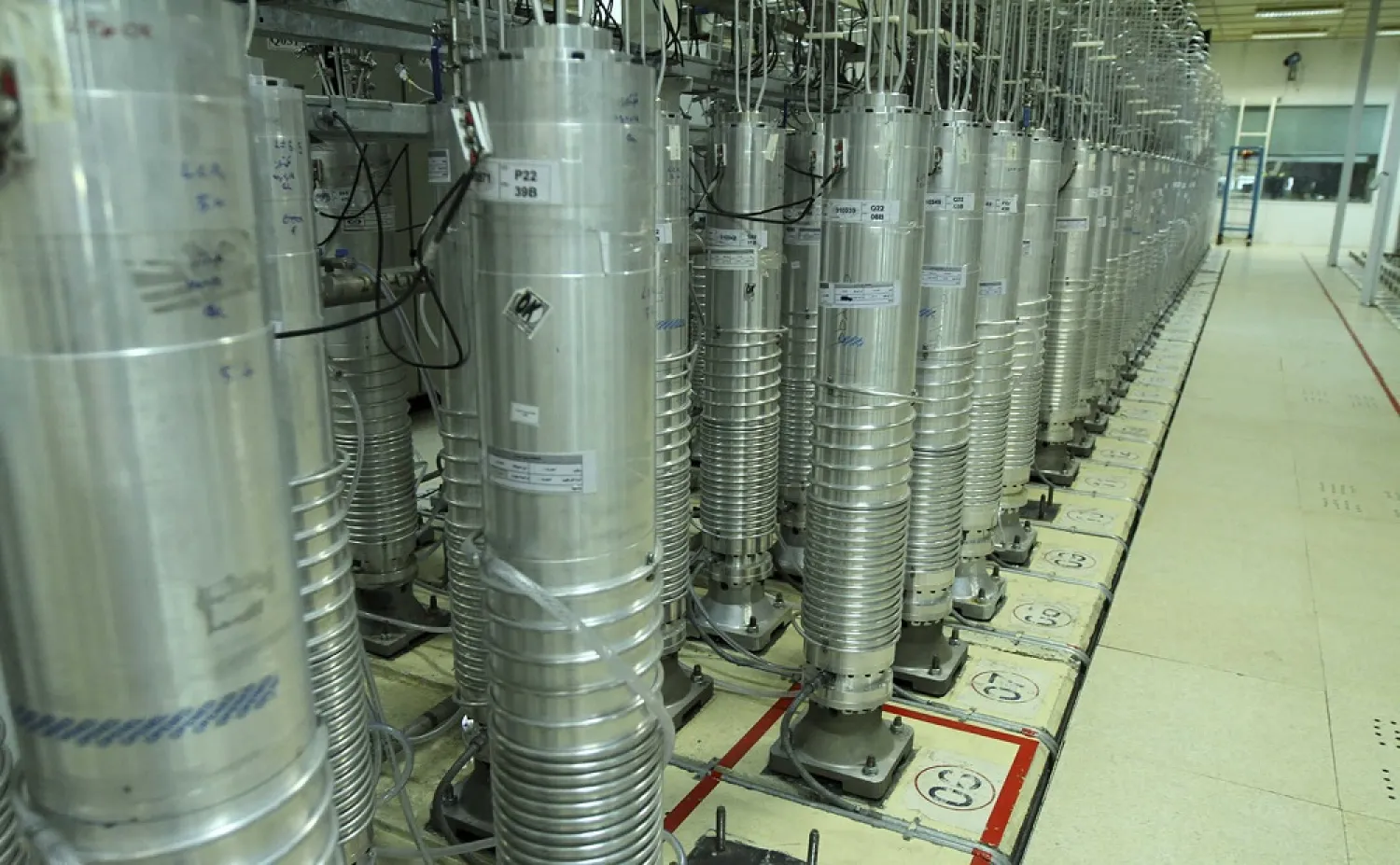
This photo released Nov. 5, 2019, by the Atomic Energy Organization of Iran shows centrifuge machines at the Natanz uranium enrichment facility in central Iran. (AP)
TT

Iran Produces Uranium Metal, IAEA Says, in Latest Breach of Deal

This photo released Nov. 5, 2019, by the Atomic Energy Organization of Iran shows centrifuge machines at the Natanz uranium enrichment facility in central Iran. (AP)

Iran has carried out its plan to produce uranium metal, the UN atomic watchdog confirmed on Wednesday, despite Western powers having warned Iran that would breach their 2015 nuclear deal as uranium metal can be used to make the core of an atom bomb.

Iran began breaching its nuclear deal with major powers step by step in 2019 in response to US President Donald Trump’s withdrawal from the deal the previous year and Washington’s reimposition of sanctions on Tehran.

Iran has in recent months accelerated those breaches of the deal’s restrictions on its atomic activities, potentially complicating efforts to bring the United States back into the deal under President Joe Biden.

A law passed in response to the killing of its top nuclear scientist in November, which Tehran blames on its foe Israel, called for steps including opening a uranium metal plant. Iran told the International Atomic Energy Agency in December it planned to produce uranium metal fuel for a research reactor.

“Director General Rafael Mariano Grossi today informed IAEA Member States about recent developments regarding Iran’s R&D activities on uranium metal production as part of its stated aim to produce fuel for the Tehran Research Reactor,” the IAEA said in a statement.

Wednesday’s report, seen by Reuters, and a previous one said that Iran planned to carry out research on uranium metal using natural uranium before moving on to uranium metal enriched to 20%, the level it is enriching uranium to now, short of the 90% that is weapons grade.

“The Agency on 8 February verified 3.6 gram of uranium metal at Iran’s Fuel Plate Fabrication Plant (FPFP) in Esfahan,” the IAEA statement added.

France, Britain and Germany, all parties to the deal, last month said they were “deeply concerned” and that Iran’s uranium metal production had no civilian credibility but potentially serious military implications.

The 2015 deal’s central aim was to extend the time Iran would need to produce enough fissile material for a nuclear bomb to at least a year from roughly 2-3 months. Iran, however, denies ever pursuing nuclear weapons and says it only wants to use nuclear energy for peaceful purposes.

US intelligence agencies and the IAEA believe Iran had a secret, coordinated nuclear weapons program that it halted in 2003.


UN to Debate Rules for ‘Killer Robots’

Activists from the Campaign to Stop Killer Robots, a coalition of non-governmental organizations opposing lethal autonomous weapons or so-called "killer robots", stage a protest at Brandenburg Gate in Berlin, Germany, March, 21, 2019. (Reuters)
TT

UN to Debate Rules for ‘Killer Robots’

Activists from the Campaign to Stop Killer Robots, a coalition of non-governmental organizations opposing lethal autonomous weapons or so-called "killer robots", stage a protest at Brandenburg Gate in Berlin, Germany, March, 21, 2019. (Reuters)

Countries will debate whether to start talks on binding rules for autonomous weapons systems -- dubbed "killer robots" by critics -- at the UN from Monday, as concerns grow about their increasing use on the battlefield.

Warfare is undergoing a radical transformation as armies seek to capitalize on the boom in artificial intelligence to boost their fighting abilities by identifying and striking targets more quickly and more accurately.

But a chorus of voices, from campaigners to UN chief Antonio Guterres and Pope Leo XIV, have warned against the dangers of handing the power of life and death to fully autonomous machines.

"The need to regulate autonomous weapons has taken on new urgency" with developments in artificial intelligence, said Laurent Gisel, head of the Weapons and Conduct of Hostilities Unit at the International Committee of the Red Cross (ICRC).

Russia has reportedly used fully autonomous drones to deadly effect in its war on Ukraine, while Ukraine's own defense industry is pushing to develop autonomous "drone swarms".

Human Rights Watch said the meeting in Geneva this week of the UN's Review Conference of the Convention on Conventional Weapons (CCW) would leave civilians "dangerously exposed" if it failed to act decisively.

The meeting will bring together 128 countries to decide whether to open negotiations on legally binding rules.

- 'Carefully cultivated ambiguity' -

But while many states are in favor of tighter rules, as with other advanced military capabilities such as nuclear weapons, countries that have acquired the technology are reluctant to have their hands tied.

At the UN General Assembly last month, 163 states adopted a resolution calling for negotiations on rules governing autonomous weapons.

Five countries voted against -- the United States, Russia, Belarus, Israel and North Korea, which last week boasted of a new AI-enabled torpedo system.

Nine abstained, including Iran and China, which has maintained a "carefully cultivated ambiguity", said Laure de Roucy-Rochegonde of the French Institute of International Relations.

Washington has proposed a five-year process to develop a non-binding instrument, while NGOs and the ICRC are advocating for a one-year timeline.

In 2023, Guterres and ICRC President Mirjana Spoljaric Egger called on states to ban autonomous weapons before 2026.

The ICRC is calling for a ban on two categories of autonomous weapons: so-called "unpredictable autonomous weapons" and those designed or used to directly target humans.

Given the opposition from leading international powers, observers say it looks unlikely agreement will be reached this week to start talks on binding rules.


2 Planes Collide on the Ground in Miami, Only Minor Injuries Reported

FILE - Vehicles drive past the entrance to Miami International Airport in Miami May 12, 2020, (AP Photo/Wilfredo Lee, File)
TT

2 Planes Collide on the Ground in Miami, Only Minor Injuries Reported

FILE - Vehicles drive past the entrance to Miami International Airport in Miami May 12, 2020, (AP Photo/Wilfredo Lee, File)

Federal aviation safety officials on Sunday were investigating a minor collision between two planes at a taxiway intersection at Miami International Airport, where one aircraft's wingtip struck the nose of another, authorities said. Two people reported minor injuries.

The accident happened at about 9 p.m. Saturday and involved a Copa Airlines Boeing 737 passenger aircraft with 172 people aboard and a UPS Boeing 767 cargo plane, according to the National Transportation Safety Board and Copa Airlines. The wing of the Copa flight and the nose of the UPS plane collided, the NTSB said.

Photos taken at the scene show the UPS plane nose with a horizontal gash on one side and a larger hole in the middle, The Associated Press reported.

On audio recorded by ATC.com, a pilot on the UPS plane told air traffic control that he went too far at the intersection and his plane was clipped by the Copa flight. Air traffic control told the UPS pilot that he was supposed to yield to the Copa aircraft.

The NTSB said it was gathering information and may provide an update on Sunday.

The Copa plane had just arrived from Panama City and the UPS plane was headed to Bogota, Colombia, officials said.

In a statement on social media, Copa called the collision minor and said two of its passengers were treated at the scene for minor injuries.

UPS said it was working with authorities to determine what happened.

“We cannot speculate on the details of the incident,” UPS said in a statement.

“The National Transportation Safety Board is responsible for investigating incidents like this and will control the flow of information.”

The mishap came two months after an Amazon cargo plane careened off a runway at Miami International and smashed into a van carrying workers for a company that cleans airplanes, killing five people.


Nearly 1,500 Migrants Arrive in Canary Islands in One Day

Rescued migrants disembark from a Spanish Maritime Rescue Service vessel with assistance from emergency workers and Civil Guard officers at the port of La Restinga in El Pinar on the island of El Hierro, Canary Islands, Spain, 14 November 2026. EPA/GELMERT FINOL
TT

Nearly 1,500 Migrants Arrive in Canary Islands in One Day

Rescued migrants disembark from a Spanish Maritime Rescue Service vessel with assistance from emergency workers and Civil Guard officers at the port of La Restinga in El Pinar on the island of El Hierro, Canary Islands, Spain, 14 November 2026. EPA/GELMERT FINOL

Almost 1,500 migrants arrived in Spain's Canary Islands on Saturday, the highest number in a single day since 2020, the EFE news agency reported on Sunday, citing the maritime rescue service.

A total of 1,488 people in 14 boats were rescued by the Spanish coastguard, EFE reported, continuing a surge of arrivals from West African countries to the Spanish archipelago since October.

The previous one-day record was the 1,461 people rescued in waters off the Canary Islands on November 7, 2020, maritime rescue services said ⁠on Sunday, according to Reuters.

While migrant ⁠arrivals have declined so far this year compared with the same period last year, the sharp increase last month placed additional pressure on reception and emergency services on some of the Canary Islands, particularly the smaller and less densely populated ones.

One boat on ⁠Saturday was carrying 240 people, including 12 women and 36 children, authorities said. The rescued migrants were taken to El Hierro, one of the smallest Canary Islands. Most of the people were from Senegal, Gambia and Guinea Conakry.

Twelve boats arrived in El Hierro, plus one in Gran Canaria and another in Tenerife.

Spain's Territorial Policy Minister Angel Victor Torres will visit El Hierro on Sunday to discuss the surge in migrant arrivals.

The Atlantic ⁠route ⁠from West Africa to the Canary Islands is one of the world's deadliest migration crossings. Thousands of migrants attempt the journey each year in overcrowded boats, seeking to reach Spanish territory despite rough seas, strong currents and long distances.

Arrivals tend to pick up in the autumn months, when sea conditions along the route are generally calmer and more favorable for crossings.

Migrant arrivals to the Canary Islands between January and October 31 were down 5.5% from the same period last year, government data show.