

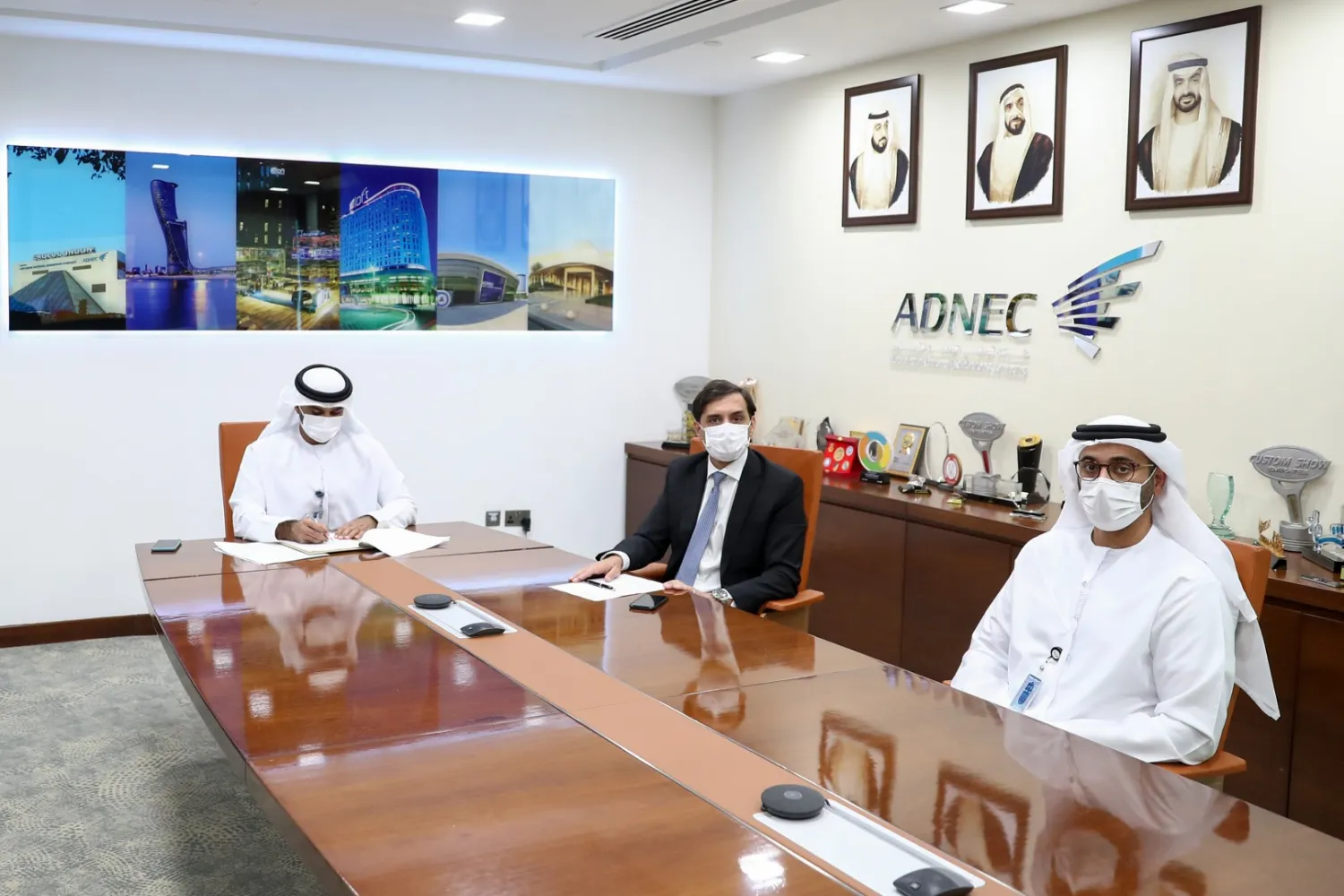

ADNEC, Expo Tel Aviv Sign Strategic MoU to Increase Business Opportunities

Part of the virtual signing ceremony between (ADNEC) and Expo Tel Aviv - WAM
TT

ADNEC, Expo Tel Aviv Sign Strategic MoU to Increase Business Opportunities

Part of the virtual signing ceremony between (ADNEC) and Expo Tel Aviv - WAM

Abu Dhabi National Exhibitions Company (ADNEC) and Expo Tel Aviv, Israel’s leading exhibition center, said will partner towards fostering further collaboration and cooperation in the regional business tourism sector.

The Memorandum of Understanding (MoU) will forge a relationship between the leading exhibition centers, enhancing their respective new business pipelines and increasing opportunities for collaboration at both venues.

The MoU demonstrates the wider spirit of cooperation between the United Arab Emirates and Israel. The agreement took place at a virtual signing ceremony between Humaid Matar Al Dhaheri, Managing Director and Group CEO of ADNEC, and Tamir Dayan, CEO of Expo Tel Aviv, state news agency WAM reported.

Commenting on the agreement, Humaid Al Dhaheri said: "Our relationship with Expo Tel Aviv will enable the wider growth of the business tourism sector in the UAE and wider region, which ADNEC consistently seeks to promote. This strategic partnership showcases ADNEC’s efforts in fostering intraregional cooperation and will offer new developments for the transfer of knowledge to local audiences."

"Through this partnership, we aim to foster innovation and business opportunities between our two nations."

For his part, Tamir Dayan said: "The Abu Dhabi National Exhibitions Company and Expo Tel Aviv provide models for regional leadership in the business tourism sector. Our mutual expertise in the design, delivery, and execution of world-class events makes us natural partners. Israel and The Emirates will probably be the first countries in the world to be vaccinated against the corona virus and lead the exhibitions industry forward and now through this MoU, we are aiming to foster our cooperation, providing further opportunities for the transfer of knowledge and expertise between our two entities."

"My colleagues and I look forward to working with our Emirati partners in identifying and capitalizing on new opportunities for the Middle East’s business tourism sector, and welcoming new visitors from the UAE and beyond in Tel Aviv."

ADNEC is committed to fostering regional collaboration in the business tourism and events sector, as witnessed by the range of agreements and partnerships that have been signed with other countries in the Middle East.

ADNEC continues to focus on fostering greater outreach opportunities with event organizers and associations in Israel, following the historic signing of the Abraham Accords in 2020, which provided new opportunities for pan-regional collaboration and cooperation.



Saudi Vision 2030 Exhibition at LEAP 2026 Highlights Transformation Journey

The Saudi Vision 2030 exhibition, participating in LEAP 2026, offers visitors an immersive experience showcasing the transformations the vision has led since its launch in 2016. (SPA)
TT

Saudi Vision 2030 Exhibition at LEAP 2026 Highlights Transformation Journey

The Saudi Vision 2030 exhibition, participating in LEAP 2026, offers visitors an immersive experience showcasing the transformations the vision has led since its launch in 2016. (SPA)

The Saudi Vision 2030 exhibition, participating in LEAP 2026, offers visitors an immersive experience showcasing the transformations the vision has led since its launch in 2016, the Saudi Press Agency reported on Thursday.

The exhibition tells the story of one of the Kingdom of Saudi Arabia’s greatest transformation success stories, whose impact has extended across vital and development sectors in various regions of Saudi Arabia.

Presented in both Arabic and English, the exhibition offers visitors a comprehensive tour across five sections.

The journey begins with the vision story section, which provides a concise and comprehensive overview of the vision, why it was launched, its foundations, its three pillars, the strategic objectives derived from them, and the tools used to implement them.

The exhibition also takes visitors through the vision’s stages and journey from 2016 to the present, following the completion of its first 10 years and its entry in 2026 into its third phase, extending through 2030.

This phase focuses on maintaining implementation momentum and consolidating the gains of transformation to ensure its impact continues beyond 2030.

The following section highlights the economic, social, and development transformations Saudi Arabia has witnessed over these years, including employment, housing, economic diversification, investment, and quality of life.

An interactive screen tracks progress across more than 13 performance indicators directly linked to the strategic objectives of Saudi Vision 2030, enabling visitors to review the indicators’ performance based on the latest data and statistics. This reflects the mechanisms used to measure progress, monitor achievements, and assess their impact.

The visitor journey concludes with stories of people, indicators, and achievements, highlighting a national transformation whose impact has extended to citizens, places, and sectors.


SABIC, Lenovo Sign MoU to Explore Cooperation Opportunities

The MoU was signed on the sidelines of LEAP 2026 in Riyadh. (SABIC)
TT

SABIC, Lenovo Sign MoU to Explore Cooperation Opportunities

The MoU was signed on the sidelines of LEAP 2026 in Riyadh. (SABIC)

Saudi Basic Industries Corporation (SABIC) signed a memorandum of understanding (MoU) with global technology company Lenovo on the sidelines of LEAP 2026 in Riyadh, reported the Saudi Press Agency on Wednesday. The agreement aims to explore strategic cooperation opportunities that support innovation in the industrial sector.

The MoU reflects the two companies' commitment to supporting Saudi Arabia's transformation into a global hub for innovation and advanced industries. It establishes a framework to identify areas of cooperation and leverage their expertise to develop advanced industries and innovative technological capabilities in Saudi Arabia and beyond.

Through the cooperation, SABIC and Lenovo will explore opportunities to combine their expertise and capabilities in areas that support industrial development, knowledge transfer, and technological advancement.

Lenovo continues to expand its presence in Saudi Arabia after opening its regional headquarters in Riyadh earlier this year, with plans to establish research and development and manufacturing facilities. The investments aim to strengthen local capabilities, advance knowledge transfer and research, and develop Saudi talent in engineering, advanced manufacturing, and emerging technologies.


Austria Seeking Digital Partnerships, Joint Investments with Saudi Arabia

Austrian State Secretary at the Federal Chancellery for Digital Affairs, Constitution and Public Service Alexander Pröll, LL.M., and Saudi Minister of Communications and Information Technology Abdullah Alswaha at LEAP 2026 in Riyadh. (Asharq Al-Awsat)
TT

Austria Seeking Digital Partnerships, Joint Investments with Saudi Arabia

Austrian State Secretary at the Federal Chancellery for Digital Affairs, Constitution and Public Service Alexander Pröll, LL.M., and Saudi Minister of Communications and Information Technology Abdullah Alswaha at LEAP 2026 in Riyadh. (Asharq Al-Awsat)

Saudi-Austrian relations are heading toward a new phase that transcends political and diplomatic cooperation into viable commercial and research partnerships, as well as executable digital projects. This shift places an increasing focus on artificial intelligence, digital government, secure and sovereign digital infrastructure, applied research, and industrial technology.

Austrian State Secretary at the Federal Chancellery for Digital Affairs, Constitution and Public Service Alexander Pröll, LL.M., told Asharq Al-Awsat that his country was seeking “to help translate the political relationship into concrete business and research partnerships”.

Pröll is in Saudi Arabia to take in the LEAP 2026 conference in Riyadh.

“Meeting directly with Saudi ministers gives us the chance to talk frankly about where our two digital agendas overlap and where we can genuinely work together,” he added.

He hoped that the relationships built this week turn into real projects over the coming months.

Austrian State Secretary at the Federal Chancellery for Digital Affairs, Constitution and Public Service Alexander Pröll during a dialogue session at LEAP 2026. (Asharq Al-Awsat)

Saudi-Austrian relations

Pröll said: “Saudi Arabia and Austria have a long-standing and friendly relationship, and I see real momentum building specifically in the digital and technology space.”

“Both our countries are pursuing ambitious, government-led digital transformation agendas - Vision 2030 on the Saudi side, and on ours a clear push toward digital sovereignty, from our Public AI Initiative and our Chatbot ‘ida’ for the federal administration, GovGPT, to our digital identity system, ID Austria,” he went on to say.

“That gives us a genuinely shared language: both countries understand digitalization not just as a technology question, but as a question of capability, resilience and sovereignty.”

The delegation at LEAP 2026 “brings together such a broad Austrian delegation - our national research institution, our federal infrastructure and telecom regulatory bodies, and leading companies in cloud infrastructure and engineering technology - is itself a sign of how seriously we take this partnership,” he noted.

LEAP: From dialogue to projects

Commenting on LEAP, Pröll said: “It is one of the very few platforms where you can have serious conversations with governments, researchers and industry from across the world in the space of a few days.”

“My first objective is to present Austria's approach to digital sovereignty and responsible AI to an international audience - what we have built with GovGPT, our Public AI initiatives, and our push for a European approach to digital infrastructure - and to learn from what Saudi Arabia has achieved at a pace and scale that few countries can match,” he stressed.

“We have brought the heads of our national research institution, our federal real estate and infrastructure company, our telecoms and media regulator, and companies active in cloud and data infrastructure and in engineering and mobility technology. My objective is to open doors for them - to introduce them to the right Saudi counterparts, in government and in industry, and to help translate the political relationship into concrete business and research partnerships,” he said.

AI’s ‘immediate potential’

Pröll said AI is probably the area where he sees the most “immediate potential”.

“Digital government is a good example: we have built GovGPT as a tool to make our public administration more efficient and more accessible, and Saudi Arabia has invested heavily in digitizing government services at scale - there is a lot we can learn from each other on implementation, on user adoption, on what actually works,” he stated.

“On data infrastructure, Austria is investing significantly in expanding our own sovereign compute capacity, and Saudi Arabia is building some of the most ambitious digital infrastructure projects in the world. That is an area where I would like to explore how Austrian expertise - in engineering, in energy-efficient and secure infrastructure - can be part of that story,” he told Asharq Al-Awsat.

Austrian State Secretary at the Federal Chancellery for Digital Affairs, Constitution and Public Service Alexander Pröll during a dialogue session at LEAP 2026. (Asharq Al-Awsat)

AI governance

Pröll raised the question of responsible and trustworthy AI. “I've argued, including at the UN Global Dialogue on AI Governance, for a binding international framework for AI governance,” he said.

“I don't see that as a brake on innovation. I see trust as a precondition for AI to be adopted at scale, by citizens and by businesses,” he continued.

“I would like Saudi Arabia and Austria to be part of that conversation together, alongside our work on AI research through institutions, like our Austrian Institute of Technology,” he stressed.

Partnerships and investment

Pröll said that opportunities for Saudi and Austrian companies are not limited to exchanging expertise, but extend to joint research and development, projects, and direct investments.

“Each of the organizations travelling with me brings something specific to the table. Our national research institution works on applied AI, data infrastructure and technology research, and is a natural partner for joint R&D with Saudi research institutions and universities,” he went on to say.

“Our federal real estate company manages public infrastructure at national scale and has real expertise to offer on developing the physical infrastructure that digital and data projects need. Our telecoms and broadcasting regulator can offer a regulatory dialogue on everything from spectrum to platform governance, which becomes more important as both our digital sectors grow,” he noted.”

“We have a company specializing in cloud and data center infrastructure that is actively looking at international markets, and a global engineering technology company with deep expertise in powertrain, mobility and simulation technology that is highly relevant to Saudi Arabia's industrial diversification and mobility ambitions,” he added.

Pröll said: “My hope is that this visit is the start - that these meetings lead to concrete pilot projects, business partnerships, and where it makes sense, direct investment in both directions.”

“I see Austrian companies as reliable, high-quality partners for the technology ambitions of Vision 2030, and I hope Saudi partners will see the same potential we do.”

Austrian State Secretary at the Federal Chancellery for Digital Affairs, Constitution and Public Service Alexander Pröll at LEAP 2026. (Asharq Al-Awsat)

Beyond AI

Pröll added that technological cooperation between Austria and Saudi Arabia does not stop at artificial intelligence, pointing to significant potential in quantum technologies and quantum communications.

“Austria has a strong research base in quantum computing and quantum communication, and this is a field where early cooperation between countries can shape the next decade of technological competitiveness,” he explained.

Cybersecurity is another: as our societies digitize, protecting that infrastructure becomes as important as building it, and it's an area where regulatory and technical cooperation go hand in hand,” he revealed.

He also pointed to mobility and engineering technology, “where Austrian companies are global leaders in powertrain development, simulation and testing - directly relevant to Saudi Arabia's ambitions in advanced manufacturing and future mobility.”

Beyond LEAP

Pröll stressed that the most critical step following the Riyadh visit is to ensure that the momentum does not stall once the conference concludes.

“I would like to see this visit translate into a structured, ongoing dialogue - regular contact between our ministries and agencies, and a clear framework for cooperation that the companies and institutions in this delegation can build on,” he said.

“Concretely, I would welcome the chance to follow up with a Saudi delegation visiting Austria, so our partners can see firsthand what we have built and continue these conversations on our home ground,” he remarked.

“What matters most to me is that the relationships built this week don't stay at the level of good intentions, but turn into real projects - in research, in infrastructure, in AI governance - over the coming months,” he added.