

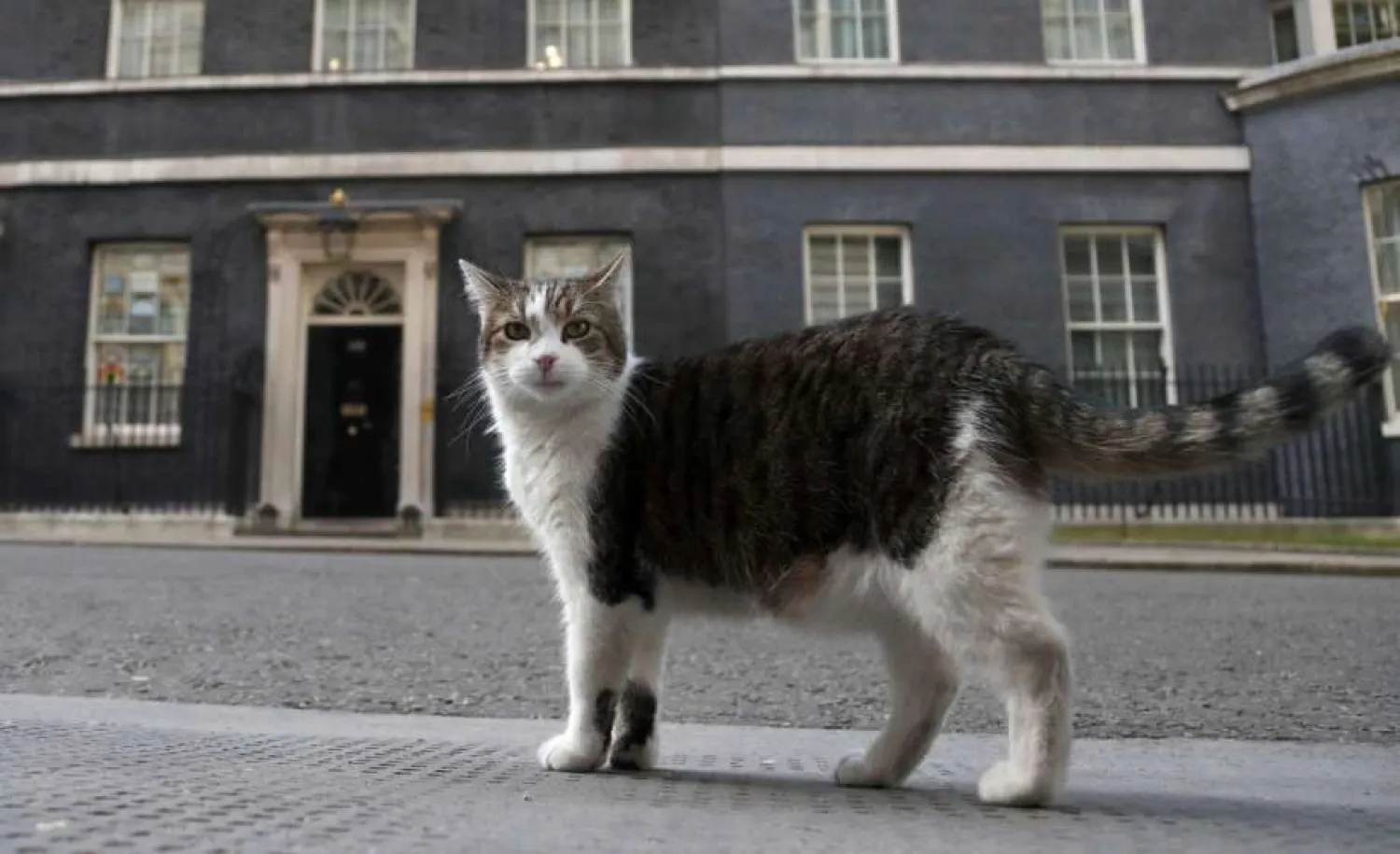

UK's Chief Mouser Celebrates 10 Years on the Prowl

In this Thursday, May 21, 2020 file photo, Larry, the official 10 Downing Street cat walks outside 10 Downing Street before the nationwide Clap for Carers to recognize and support National Health Service (NHS) workers and carers fighting the coronavirus pandemic, in London. Monday, Feb. 15, 2021 marks the 10th anniversary of rescue cat Larry becoming Chief Mouser to the Cabinet Office in a bid to deal with a rat problem at 10 Downing Street. (AP Photo/Frank Augstein, file)
TT

UK's Chief Mouser Celebrates 10 Years on the Prowl

In this Thursday, May 21, 2020 file photo, Larry, the official 10 Downing Street cat walks outside 10 Downing Street before the nationwide Clap for Carers to recognize and support National Health Service (NHS) workers and carers fighting the coronavirus pandemic, in London. Monday, Feb. 15, 2021 marks the 10th anniversary of rescue cat Larry becoming Chief Mouser to the Cabinet Office in a bid to deal with a rat problem at 10 Downing Street. (AP Photo/Frank Augstein, file)

Larry the cat, a four-legged inhabitant of London´s 10 Downing St., is marking a decade as Britain´s mouse-catcher in chief on Monday.

The tabby cat was recruited by then-Prime Minister David Cameron to deal with a pack of rats seen scuttling close to the British leader´s official residence, and entered Downing Street on Feb. 15, 2011.

The former stray, adopted from London´s Battersea Dogs and Cats Home, was given the title Chief Mouser to the Cabinet Office, an unofficial pest control post. He was the first cat to hold the rat-catching portfolio since the retirement of Humphrey in 1997, and has loyally served three prime ministers.

But it seems like yesterday that Larry was just another cat - as opposed to a media superstar - said Lindsey Quinlan, the head of cattery of Battersea.

"Throughout his time at Number 10, Larry has proven himself to not only be a brilliant ambassador for Battersea but also demonstrated to millions of people around the world how incredible rescue cats are,´´ she said. "His rags to riches tale is yet more proof of why all animals deserve a second chance - one minute they may be an overlooked stray on the streets, the next they could become one of the nation´s beloved political figures, with fans around the world."

Larry, who has met a number of world leaders, has been largely unfriendly to men but took a liking to former US President Barack Obama. When former President Donald Trump visited in 2019, Larry took a nap under his car.

His grip on the public imagination is clear - and political leaders know better than to ignore that popularity. The tomcat was a sentimental topic of conversation in Cameron´s final appearance in Parliament as prime minister when he said he wanted to quash a rumor that - perish the thought - he didn´t like Larry.

And just to prove it, he whipped out evidence: a picture of Larry lying on his lap.

"He belongs to the house and the staff love him very much - as do I," he said at the time, explaining why he wasn't taking Larry with him after leaving office.

After the December 2019 election, rumors swirled that Larry might be headed for retirement with the news that the new prime minister, Boris Johnson, was a dog man. However, despite the prime minister moving Jack Russell cross Dilyn into Downing Street, Larry remained in office.

Reports of his rodent-killing abilities vary. Larry became known for his occasional scraps with neighboring cats -- especially Palmerston, chief mouser to the Foreign Office across the street -- and fondness for sleep. Palmerston has retired to the country, so things have been a bit quieter of late.

These days Larry, now 14, is often seen by photographers patrolling his turf. Visitors to the building can sometimes find him napping on a ledge above a radiator or sleeping on a floor, where dignitaries occasionally have to step over him.

At the heart of government, he specializes in power naps.


Why Do Some Tropical Butterflies Live 25 Times Longer Than Their Relatives?

A Heliconius melpomene butterfly feeds on pollen. (Nature Communications)
TT

Why Do Some Tropical Butterflies Live 25 Times Longer Than Their Relatives?

A Heliconius melpomene butterfly feeds on pollen. (Nature Communications)

Most butterflies have short lifespans, fluttering between colorful flowers for a few weeks before dying, but a few rare exceptions have stumped scientists. Now, some long-lived tropical butterfly species are shedding light on the secrets of longevity.

Butterflies belonging to the Heliconius genus, which inhabit the tropical rainforests of South and Central America, have lifespans that vary wildly. The Dione juno butterfly lives for 14 days after reaching adulthood, while Heliconius hewitsoni lives for 348 days — nearly 25 times longer.

Other Heliconius species also have impressively lengthy lives, enduring between 106 to 277 days, according to a study on the phenomenon published Tuesday in the journal Nature Communications.

Some scientists have speculated that Heliconius’ extended adulthood is due to the insects consuming an enhanced diet, rather than relying purely on carbohydrates like other butterflies.

But the exact reasons behind this unexpected longevity have been unclear, which is what inspired Dr. Jessica Foley, the study’s lead author and a postdoctoral scholar at Tufts University’s Jean Mayer USDA Human Nutrition Research Center on Aging in Boston, to take an in-depth look at the intriguing butterfly genus.

“We see vast differences in lifespan across the animal kingdom — adult mayflies famously live only for a day, whereas some whales and sharks can live for hundreds of years,” Foley wrote in an email.

“I’m interested in the evolutionary basis of these kinds of lifespan differences because they might hold insights relevant for healthy ageing in humans,” she added.

Foley and her colleagues discovered that while nutrition has its part to play, some Heliconius have also evolved an anti-aging mechanism the researchers are still unraveling — and how it could be a model for understanding human longevity.

The new research shows that Heliconius can be a potential model insect group for studying increased longevity, including adaptations that could slow aging and have potential applicability to humans, said Dr. Jaret C Daniels, curator and interim associate director for the McGuire Center for Lepidoptera and Biodiversity at the Florida Museum of Natural History. Daniels was not involved in the study.

“This study reinforces the utility of many insect groups and important model organisms for various fields of research,” Daniels said in an email.

“Since many insects are often overlooked or underappreciated by humans, studies like this can help change that perspective,” Daniels added.


22 Saudi Universities Recognized in QS World University Rankings 2027

File photo of the Saudi flag/AAWSAT
TT

22 Saudi Universities Recognized in QS World University Rankings 2027

File photo of the Saudi flag/AAWSAT

Twenty-two Saudi universities have been recognized among the world's leading higher education institutions in the QS World University Rankings 2027, the Saudi Press Agency reported on Tuesday.

King Fahd University of Petroleum and Minerals topped the list of Saudi universities, ranking 63rd globally and securing a place among the world's top 100 universities. King Saud University ranked 107th globally, followed by King Abdulaziz University in 200th place, Prince Mohammad Bin Fahd University in 421st place, and Imam Abdulrahman Bin Faisal University in 474th place.

The rankings also included several other Saudi universities with a global presence, including Prince Sultan University, King Khalid University, King Faisal University, Umm Al-Qura University, Qassim University, Imam Mohammad Ibn Saud Islamic University, Alfaisal University, Princess Nourah bint Abdulrahman University, Taif University, Effat University, Majmaah University, the Islamic University of Madinah, Northern Borders University, University of Hail, University of Tabuk, and Taibah University.

The continued progress reflects advancements made by Saudi universities in education, scientific research, and innovation. It also highlights the Kingdom's growing presence in global higher education and supports Saudi Vision 2030's goal of building a competitive, knowledge-based economy driven by innovation and academic excellence.


Plan to Sell Artifacts from Titanic Faces US Government Opposition

FILE - The Titanic leaves Southampton, England, April 10, 1912, on her maiden voyage. (AP Photo, File)
TT

Plan to Sell Artifacts from Titanic Faces US Government Opposition

FILE - The Titanic leaves Southampton, England, April 10, 1912, on her maiden voyage. (AP Photo, File)

A plan to auction more than 100 artifacts salvaged from the wreckage of the Titanic — including personal belongings, currency, kitchen items and decor — is facing pushback from the US government, according to newly unsealed court documents.

RMS Titanic Inc., the company that owns exclusive salvage rights to the famous wreck in the North Atlantic, wants to sell the artifacts for the first time despite previous agreements to only display them at museums and traveling exhibitions.

Georgia-based RMS Titanic proposed auctioning the artifacts and displaying them on a global tour in four cities, although those locations haven't been publicly revealed. Court documents filed in the US referenced the company's plan to sell artifacts including a bronze cherub, a necklace of gold nuggets and a heart-shaped pendant.

The National Oceanic and Atmospheric Administration represents US interests and oversight in the wreck site. The agency contends such a sale would violate RMS Titanic's legal obligations to the site, according to documents a judge ordered unsealed earlier this month.

In arguing that the auction should be prohibited, the government wrote that the company “does not seek the Court’s approval, does not believe that approval is required, and asserts that it is not restricted in its ability to sell” the artifacts.

Representatives for RMS Titanic did not respond to The Associated Press requests for comment Monday. Its attorneys previously said in a federal court filing that the proposed auction arrangement wouldn’t violate existing court orders and agreements about the artifacts.

This is the latest attempt to sell Titanic artifacts Since 1987, salvage operations have retrieved thousands of items and even chunks of the Titanic’s hull. RMS Titanic makes money by exhibiting them.

Over the decades, the company has tried to sell artifacts to fund future explorations and as it faced financial trouble. But those efforts were roundly opposed by US courts along with preservation groups and relatives of the victims. Some of the salvaged items belonged to passengers aboard the ship.

However, items saved by survivors or plucked from the water by rescuers can be sold and often fetch big sums. A life jacket worn by a passenger went for just over $900,000 in April, while a gold pocket watch given to the ship captain who rescued the survivors was sold for nearly $2 million in 2024.

Auctioneers say the unending fascination with the Titanic — which sank in 1912 after hitting an iceberg on its maiden voyage from Europe to New York, killing more than 1,500 people — and the rarity of artifacts adds up to high demand and exorbitant prices.

A trans-Atlantic dispute over the artifacts RMS Titanic wants to auction some of the first artifacts salvaged from the wreck. Those items were taken to France, which awarded ownership of them to the salvager. French oceanographic institute IFREMER partnered with Woods Hole Oceanographic Institution on the discovery of the wreck.

The rest of the collection was retrieved during subsequent expeditions, and the salvage claim was made in a US District Court in Norfolk, Virginia.

NOAA argues that all of the roughly 5,000 items — regardless of whether they were claimed in France or the US — must remain in one collection based on conditions set by the US court. NOAA also maintains on its website that a French court’s conditions required that the artifacts not be sold individually and be kept together as a single collection.

The company has argued, among other things, that the US court lacks jurisdiction over the items claimed in France.

Representatives for the French government did not respond to requests for comment late Monday.

Pieces of history for all to see Some undersea explorers have pushed back at the idea of selling Titanic artifacts, which they argue should be displayed in the public interest.

“I don’t have a problem with people recovering artifacts from the Titanic as long as it’s done careful, with proper archaeological techniques,” said Greg Stone, a veteran ocean explorer and ocean scientist. “I’d feel better if it was a nonprofit enterprise.”

Richard Daynard, a law professor at Northeastern University School of Law in Boston who specializes in public interest advocacy, said rules on the display and sale of Titanic artifacts are intended to preserve the wreckage for the benefit of the public, and so it can't be “picked up by billionaires for further display of their wealth and power.”

“If it’s something where someone can walk through their house and say ‘Yes, I bought this for $5 million and it’s original from the Titanic,’ that’s not a good thing,” he said.
