

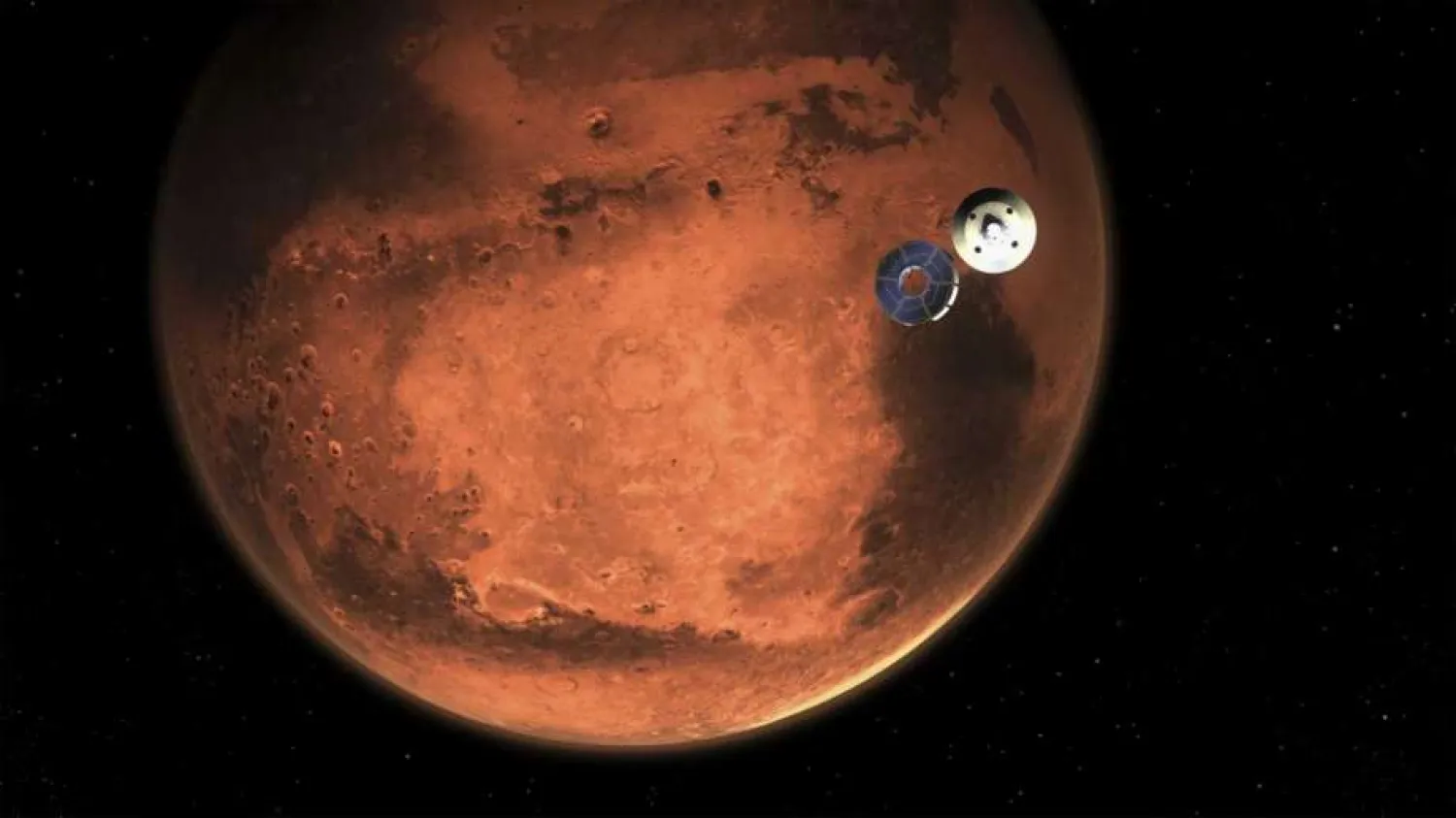

NASA Rover Streaks Toward a Landing on Mars

In this illustration made available by NASA, the Perseverance rover casts off its spacecraft's cruise stage, minutes before entering the Martian atmosphere. (NASA/JPL-Caltech via AP)
TT

NASA Rover Streaks Toward a Landing on Mars

In this illustration made available by NASA, the Perseverance rover casts off its spacecraft's cruise stage, minutes before entering the Martian atmosphere. (NASA/JPL-Caltech via AP)

A NASA rover streaked toward a landing on Mars on Thursday in the riskiest step yet in an epic quest to bring back rocks that could answer whether life ever existed on the red planet.

Ground controllers at the space agency's Jet Propulsion Laboratory in Pasadena, California, settled in nervously for the descent of Perseverance to the surface of Mars, long a deathtrap for incoming spacecraft. It takes a nail-biting 11 1/2 minutes for a signal that would confirm success to reach Earth.

The landing of the six-wheeled vehicle would mark the third visit to Mars in just over a week. Two spacecraft from the United Arab Emirates and China swung into orbit around the planet on successive days last week.

All three missions lifted off in July to take advantage of the close alignment of Earth and Mars, traveling some 300 million miles in nearly seven months.

Perseverance, the biggest, most advanced rover ever sent by NASA, stood to become the ninth spacecraft to successfully land on Mars, every one of them from the U.S.

The car-size, plutonium-powered rover was aiming for NASA´s smallest and trickiest target yet: a 5--by-4-mile strip on an ancient river delta full of pits, cliffs and fields of rock.

Scientists believe that if life ever flourished on Mars, it would have happened 3 billion to 4 billion years ago, when water still flowed on the planet.

Percy, as it is nicknamed, was designed to drill down with its 7-foot (2-meter) arm and collect rock samples that might hold signs of bygone microscopic life. The plan called for three to four dozen chalk-size samples to be sealed in tubes and set aside on Mars to be retrieved by a fetch rover and brought homeward by another rocket ship, with the goal of getting them back to Earth as early as 2031.

Scientists hope to answer one of the central questions of theology, philosophy and space exploration.

"Are we alone in this sort of vast cosmic desert, just flying through space, or is life much more common? Does it just emerge whenever and wherever the conditions are ripe?" said deputy project scientist Ken Williford. "Big, basic questions, and we don´t know the answers yet. So we´re really on the verge of being able to potentially answer these enormous questions."

China´s spacecraft includes a smaller rover that also will be seeking evidence of life - if it makes it safely down from orbit in May or June.

Perseverance's descent has been described by NASA as "seven minutes of terror," in which flight controllers can only watch helplessly. The preprogrammed spacecraft was designed to hit the Martian atmosphere at 12,100 mph (19,500 kph), then use a parachute to slow it down and a rocket-steered platform known as a sky crane to lower the rover the rest of the way to the surface.

Mars has proved a treacherous place: In the span of less than three months in 1999, a U.S. spacecraft was destroyed upon entering orbit because engineers mixed up metric and English units, and an American lander crashed on Mars after its engines cut out prematurely.

NASA is teaming up with the European Space Agency to bring the rocks home. Perseverance´s mission alone costs nearly $3 billion.

The only way to confirm - or rule out - signs of past life is to analyze the samples in the world´s best labs. Instruments small enough to be sent to Mars wouldn´t have the necessary precision.

"The Mars sample return project is probably the most challenging thing we´ve ever attempted within NASA," said planetary science director Lori Glaze, "and we don´t do any of these things alone."



Somalia Welcomes Its First Bowling Alley as the Middle Class and Diaspora Returnees Grow

 People bowl at the Feynuus Bowling Center in Mogadishu, Somalia, on Jan. 15, 2026. (AP)
People bowl at the Feynuus Bowling Center in Mogadishu, Somalia, on Jan. 15, 2026. (AP)
TT

Somalia Welcomes Its First Bowling Alley as the Middle Class and Diaspora Returnees Grow

 People bowl at the Feynuus Bowling Center in Mogadishu, Somalia, on Jan. 15, 2026. (AP)
People bowl at the Feynuus Bowling Center in Mogadishu, Somalia, on Jan. 15, 2026. (AP)

In a city long defined by conflict, Somalia ’s capital of Mogadishu now echoes with the crash of pins at the country's first modern bowling alley.

It's the latest sign of revival in the once-thriving Indian Ocean port shaped by 35 years of civil war and militant bombings. Millions of people were forced to flee what became one of the world’s most dangerous cities. Those who remained avoided public spaces as the al-Qaeda-linked group al-Shabab waged an insurgency against the Somali state.

In recent years, improved security measures against al-Shabab, an expanded government presence and growing private investment have allowed daily life to re-emerge. Cafes line newly reopened streets, beaches draw evening crowds and traffic congestion, once unimaginable, now clogs key intersections.

The Feynuus Bowling Center opened last year and draws many locals and Somalis returning from the diaspora, who bring investment and business ideas after years of sending billions of dollars in remittances from abroad.

On a recent evening, young Somalis gathered in groups, laughing and filming each other on their phones while music played. Many from the diaspora are visiting Mogadishu for the first time in years, or the first time ever.

“I couldn’t believe Mogadishu has this place,” said Hudoon Abdi, a Somali-Canadian on holiday, as she prepared to take her turn to bowl.

“I’m enjoying it. Mogadishu is actually safe,” she said, urging others to visit.

Mogadishu remains vulnerable to militant attacks, however, with security measures like checkpoints and heavily guarded zones part of daily life. Non-Somalis remain largely confined to a compound at the international airport.

But residents say the ability to gather for recreation signals an important psychological shift. Such venues provide a welcoming environment for a younger generation eager for safe spaces to socialize.

Abukar Hajji returned from the United Kingdom on holiday after many years away and found the difference between what he imagined and what he experienced eye-opening.

“When I was flying from the UK, I believed it was a scary place, like a war-torn country,” he said. “Everyone told me, ‘Good luck,’ but when I came and saw it with my own eyes, I didn’t want to leave.”

Sadaq Abdurahman, the manager of the bowling center, said the idea for the business emerged from a growing demand among young people for recreational facilities.

“It has created employment opportunities for at least 40 youths,” he said.

According to the Somali National Bureau of Statistics, Somalia’s unemployment rate stands at 21.4%.

The bowling alley has private security guards, bag checks and surveillance cameras, reflecting the precautions common at public venues in Mogadishu.

Urban planners and economists say businesses like the bowling alley signal a broader shift in Mogadishu’s recovery, as private sector growth increasingly complements international aid and government-led rebuilding efforts.

Ahmed Khadar Abdi Jama, a lecturer in economics at the University of Somalia, said innovative businesses are responding to the needs of diaspora returnees and the growing middle class, “which in turn adds to the expected increase in Somalia’s GDP.”

Outside the bowling alley, traffic hummed and neon signs flickered, other reminders of Mogadishu’s fragile transformation.


Benefit of Taking Magnesium Does Not Get Enough Attention

Nutrition experts recommended trying to get more of magnesium in our diet from food first (Harvard University)
TT

Benefit of Taking Magnesium Does Not Get Enough Attention

Nutrition experts recommended trying to get more of magnesium in our diet from food first (Harvard University)

Nutrition experts revealed that magnesium is often not given the same attention as other vitamins and minerals, although it plays a pivotal role in supporting the overall health of our body, especially improving blood sugar management and supporting neuro-psychological balance.

According to the US National Institutes of Health (NIH), magnesium is an abundant mineral in our body and it’s naturally present in many foods.

The mineral is required in more than 300 different reactions in our body, including those that regulate muscle and nerve function, blood sugar levels, and blood pressure.

“Magnesium plays a role in how our body handles sugar,” Scott Keatley, RD, co-owner of Keatley Medical Nutrition Therapy told Prevention magazine.

“It helps with the action of insulin, the hormone that controls blood sugar levels.” When you have enough magnesium in your body, insulin can work better and your body can manage blood sugar more effectively, Keatley said.

Also, stress can cause our body to use more magnesium than usual, which can limit our body’s ability to do other tasks with the nutrient, Keatley said.

“In addition, magnesium can help reduce the release of stress hormones like cortisol,” he said. “It’s like a natural chill pill that can help keep our body’s stress response in check.”

Magnesium helps regulate brain function and mood. It plays a role in releasing and using neurotransmitters, which are chemicals in our brain that affect our mood and emotions.

The mineral may help improve bone density and decrease fracture risk.
“Magnesium is stored in bones and is an important part of bone health,” said Deborah Cohen, DCN, an associate professor in the department of clinical and preventive nutrition sciences at Rutgers University School of Health Professions.

At baseline, magnesium can help to relax and widen your blood vessels, Keatley said. “This makes it easier for blood to flow and can help lower blood pressure,” he added. “It’s like making the highways wider so that traffic can move more smoothly.”

A 2025 review in hypertension found that magnesium seems to be beneficial for lowering blood pressure in people with high blood pressure and magnesium deficiency, but larger studies are needed.

There are a lot of foods that are high in magnesium. Nutrition experts recommended trying to get more of the nutrient in our diet from food first.

These are the most magnesium-rich foods, according to the NIH are: Pumpkin seeds, Chia seeds, almonds, spinach, cashews, peanuts, shredded wheat, soymilk, black beans, edamame, peanut butter, potato with skin, brown rice and plain yogurt.


SpaceX Prioritizes Lunar 'Self-growing City' over Mars Project

FILE - A SpaceX logo is displayed on a building, May 26, 2020, at the Kennedy Space Center in Cape Canaveral, Fla. (AP Photo/David J. Phillip, File)
TT

SpaceX Prioritizes Lunar 'Self-growing City' over Mars Project

FILE - A SpaceX logo is displayed on a building, May 26, 2020, at the Kennedy Space Center in Cape Canaveral, Fla. (AP Photo/David J. Phillip, File)

Elon Musk said on Sunday that SpaceX has shifted its focus to building a "self-growing city" on the moon, which could be achieved in less than 10 years.

SpaceX still intends to start on Musk's long-held ambition of a city on Mars within five to seven years, he wrote on his X social media platform, "but the overriding priority is securing the future of civilization and the Moon is faster."

Musk's comments echo a Wall Street Journal report on Friday, stating that SpaceX has told investors it would prioritize going to the moon and attempt a trip to Mars ⁠at a later time, targeting March 2027 for an uncrewed lunar landing.

As recently as last year, Musk said that he aimed to send an uncrewed mission to Mars by the end of 2026.

The US faces intense competition from China in the race to return humans to the moon this decade. Humans have not visited the lunar surface since the Apollo 17 mission in 1972. Less than a week ago, Musk announced that SpaceX ⁠acquired the artificial intelligence company he also leads, xAI, in a deal that values the rocket and satellite company at $1 trillion and the artificial intelligence outfit at $250 billion.

Proponents of the move view it as a way for SpaceX to bolster its plans for space-based data centers, which Musk sees as more energy efficient than terrestrial facilities as the demand for compute power soars with AI development.

SpaceX is hoping a public offering later this year could raise as much as $50 billion, which could make it the largest public offering in history.

On Monday, Musk said in response to a user on X that NASA will constitute less than 5% of SpaceX's revenue this year. SpaceX is ⁠a core contractor in NASA's Artemis moon program with a $4 billion contract to land astronauts on the lunar surface using Starship.

"Vast majority of SpaceX revenue is the commercial Starlink system," Musk added.

Earlier on Sunday, Musk shared the company's first Super Bowl ad, promoting its Starlink Wi-Fi service.

Even as Musk reorients SpaceX, he is also pushing his publicly traded company, Tesla, in a new direction.

After virtually building the global electric vehicles market, Tesla is now planning to spend $20 billion this year as part of an effort to pivot to autonomous driving and robots.

To speed up the shift, Musk said last month Tesla is ending production of two car models at its California factory to make room for manufacturing its Optimus humanoid robots.