

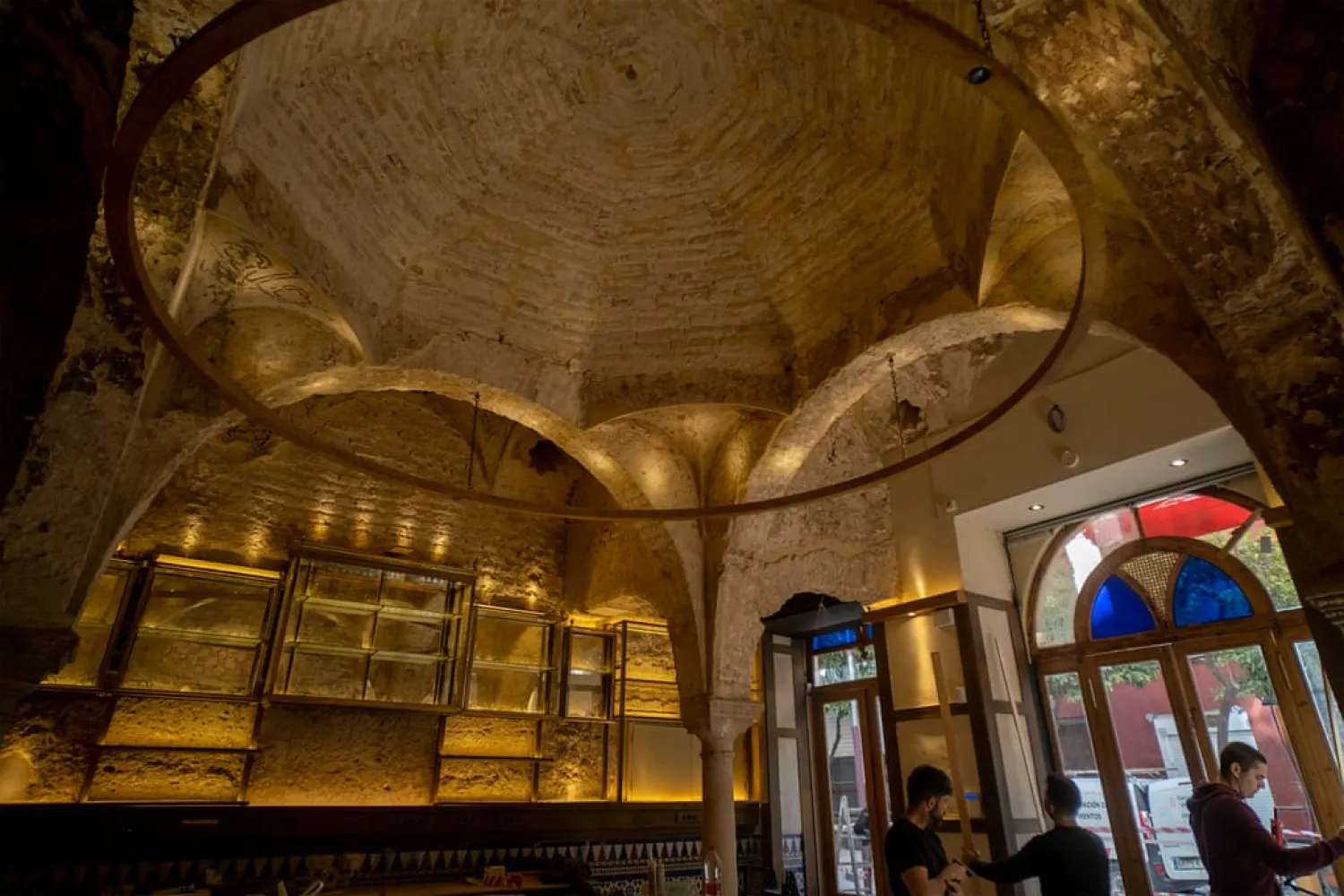

Islamic 12th-Century Bathhouse Uncovered in Seville Tapas Bar

The bathhouse was discovered in a popular tapas bar in the heart of Seville. (El Pais)
TT

Islamic 12th-Century Bathhouse Uncovered in Seville Tapas Bar

The bathhouse was discovered in a popular tapas bar in the heart of Seville. (El Pais)

A magnificently decorated 12th-century Islamic bathhouse, replete with dazzling geometric motifs and skylights in the form of eight-pointed stars, has emerged, a little improbably, from the walls and vaulted ceilings of a popular tapas bar in the heart of the southern Spanish city of Seville.

Last summer, the owners of the Cervercería Giralda – which has been operating near Seville’s cathedral since 1923 – decided to take advantage of local roadworks and the coronavirus pandemic to set about a long-delayed renovation, reported the Guardian on Thursday.

Although local legend and the odd historical document had suggested the site may once have been an ancient hammam, most people had assumed the Giralda’s retro look was down to the neomudéjar, or Islamic revival style, in which the architect Vicente Traver built the bar and hotel above it in the early 1920s.

“There was talk that there were baths here, but not all the historians were convinced and some thought it was all much later,” said Antonio Castro, one of the Giralda’s four co-owners. “We were doing some works and got an archaeologist in, and that’s how the baths were discovered.”

The archaeologist, Álvaro Jiménez, knew of the rumors. But, like many others, he had always imagined them to be fanciful. One day last July, however, the team were gently chipping their way through the plaster that covered the ceiling when they uncovered a skylight in the form of an eight-pointed star.

“As soon as we saw one of the skylights, we knew what it was; it just couldn’t have been anything but a baths,” said Jiménez. “We just had to follow the pattern of the skylights.”

Their explorations soon uncovered an exquisite piece of design dating back to the 12th century when the Almohad caliphate ruled much of what are now Spain and Portugal as well as a large swath of north Africa.

“Decoratively speaking, these baths have the largest amount of preserved decoration of any of the known baths on the Iberian Peninsula,” said the archaeologist.

“Absolutely everything here is decorated, and, luckily, it’s survived. The background is white lime mortar engraved with geometric lines, circles and squares. On top of that you have red ochre paintings of eight-pointed stars and eight-petalled multifoil rosettes. Those two designs alternate and entwine and adapt to the different geometric shapes of the skylight holes.”

While a lot of whitewash still needs to be cleaned to disclose the red paint beneath, the hammam-cum-bar has now been conserved and repaired and the Giralda is due to open once again in two or three weeks.

Jiménez, who described the “kind of a fateful alignment of different things”, said the baths and the bar have “been reborn and become something wonderful; it was the right people, the right time, and a bit of luck”.

Castro and his partners are looking forward to a new chapter in the Giralda’s long history. But they are also toasting the foresight of Vicente Traver.

“This was a pretty well-known bar before, but now people will be able to come in and have a drink in a bar that’s also a 12th-century hammam,” said Castro. “It’s a good thing that the architect back in the 1920s respected the baths – others might have chucked everything out, so we’re grateful to him.”



iRead Marathon Records over 6.5 Million Pages Read

Participants agreed that the number of pages read was not merely a numerical milestone - SPA
TT

iRead Marathon Records over 6.5 Million Pages Read

Participants agreed that the number of pages read was not merely a numerical milestone - SPA

The fifth edition of the iRead Marathon achieved a remarkable milestone, surpassing 6.5 million pages read over three consecutive days, in a cultural setting that reaffirmed reading as a collective practice with impact beyond the moment.

Hosted at the Library of the King Abdulaziz Center for World Culture (Ithra) and held in parallel with 52 libraries across 13 Arab countries, including digital libraries participating for the first time, the marathon reflected the transformation of libraries into open, inclusive spaces that transcend physical boundaries and accommodate diverse readers and formats.

Participants agreed that the number of pages read was not merely a numerical milestone, but a reflection of growing engagement and a deepening belief in reading as a daily, shared activity accessible to all, free from elitism or narrow specialization.

Pages were read in multiple languages and formats, united by a common conviction that reading remains a powerful way to build genuine connections and foster knowledge-based bonds across geographically distant yet intellectually aligned communities, SPA reported.

The marathon also underscored its humanitarian and environmental dimension, as every 100 pages read is linked to the planting of one tree, translating this edition’s outcome into a pledge of more than 65,000 trees. This simple equation connects knowledge with sustainability, turning reading into a tangible, real-world contribution.

The involvement of digital libraries marked a notable development, expanding access, strengthening engagement, and reinforcing the library’s ability to adapt to technological change without compromising its cultural role. Integrating print and digital reading added a contemporary dimension to the marathon while preserving its core spirit of gathering around the book.

With the conclusion of the iRead Marathon, the experience proved to be more than a temporary event, becoming a cultural moment that raised fundamental questions about reading’s role in shaping awareness and the capacity of cultural initiatives to create lasting impact. Three days confirmed that reading, when practiced collectively, can serve as a meeting point and the start of a longer cultural journey.


Imam Turki bin Abdullah Royal Reserve Launches Fifth Beekeeping Season

Jazan’s Annual Honey Festival - File Photo/SPA
TT

Imam Turki bin Abdullah Royal Reserve Launches Fifth Beekeeping Season

Jazan’s Annual Honey Festival - File Photo/SPA

The Imam Turki bin Abdullah Royal Nature Reserve Development Authority launched the fifth annual beekeeping season for 2026 as part of its programs to empower the local community and regulate beekeeping activities within the reserve.

The launch aligns with the authority's objectives of biodiversity conservation, the promotion of sustainable environmental practices, and the generation of economic returns for beekeepers, SPA reported.

The authority explained that this year’s beekeeping season comprises three main periods associated with spring flowers, acacia, and Sidr, with the start date of each period serving as the official deadline for submitting participation applications.

The authority encouraged all interested beekeepers to review the season details and attend the scheduled virtual meetings to ensure organized participation in accordance with the approved regulations and the specified dates for each season.


Hail Municipality Named Arab Green City For 2024-2025

The achievement establishes Hail as a leading Arab model for sustainable urban development - SPA
TT

Hail Municipality Named Arab Green City For 2024-2025

The achievement establishes Hail as a leading Arab model for sustainable urban development - SPA

The Hail Region Municipality has secured first place in the Arab Green City award for 2024-2025 at the 15th session of the Arab Towns Organization.

This recognition honors the municipality’s commitment to environmental sustainability, the expansion of green spaces, and the implementation of urban practices that elevate the quality of life, SPA reported.

The award follows a series of strategic environmental initiatives, including large-scale afforestation, the modernization of public parks, and the adoption of eco-friendly solutions to enhance the urban landscape and resource efficiency.

By aligning its projects with the sustainability goals of Saudi Vision 2030, the municipality continues to foster a healthy and safe environment for residents and visitors.

This achievement establishes Hail as a leading Arab model for sustainable urban development.