



Mogul vs. Mogul: Australia's Tech Law Pits Murdoch against Zuckerberg

Australia's push to regulate tech giants has become a power struggle between two of the world's most powerful men: Rupert Murdoch and Facebook's Mark Zuckerberg. (AFP)
TT

Mogul vs. Mogul: Australia's Tech Law Pits Murdoch against Zuckerberg

Australia's push to regulate tech giants has become a power struggle between two of the world's most powerful men: Rupert Murdoch and Facebook's Mark Zuckerberg. (AFP)

Australia's push to regulate tech giants has become a power struggle between two of the world's most powerful men, with Rupert Murdoch and Mark Zuckerberg locked in a generational battle for media dominance.

Efforts in Australia to make Google and Facebook pay for news has garnered worldwide attention, creating what some call a defining moment for the web and for journalism, and even a litmus test for democracy.

But beyond the high-sounding rhetoric lies a more base struggle, with the barons of traditional media fighting back against their digital heirs.

Sydney tech billionaire Mike Cannon-Brookes went as far as calling the Australian push to force payments for content a "shakedown".

The landmark legislation may carry the seal of government, but media and political insiders see the fingerprints of Rupert Murdoch's News Corp all over it.

"This has been a passionate cause for our company for well over a decade," said News Corp chief executive Robert Thomson, hailing his boss' "fervent, unstinting support" for the cause.

"For many years, we were accused of tilting at tech windmills, but what was a solitary campaign, a quixotic quest, has become a movement, and both journalism and society will be enhanced."

For decades, the Melbourne-born billionaire behind Fox News, The Sun and Sky News Australia has bestraddled politics in the United States, Britain and Down Under.

Today, he controls roughly two-thirds of daily newspaper circulation in Australia's major cities, with complete monopolies in Brisbane, Adelaide, Hobart and Darwin.

That has prompted critics to paint the 89-year-old in almost cartoonish terms -- as an all-powerful political puppet-master.

While he still wields political power, the rise of Facebook and Google has seriously challenged Murdoch's preeminence -- gouging ad revenues that kept many of his publications in the black.

'Frightened of Murdoch'
At the turn of the millennium, newspapers had 96 percent of Australia's classified revenues. Now, that is down to around 12 percent.

For every $100 spent by Australian advertisers today, $49 goes to Google and $24 to Facebook, according to the country's competition watchdog, which proposed the law in direct response to this duopoly.

"Let's not kid around, this was very deliberately designed to put money in the pockets of a very few specific companies -- News Corp and others," Lucie Krahulcova of advocacy group Digital Rights Watch told AFP.

An initial draft of the law even cut out public broadcaster ABC -- which Murdoch's outlets and Australia's conservative government have long attacked -- from receiving Google and Facebook payments.

Former prime minister Kevin Rudd, an outspoken Murdoch critic, told lawmakers in Canberra on Friday that the proposed laws solved the digital dominance problem "by enhancing the power of the existing monopoly -- that's Murdoch".

"Everyone is frightened of Murdoch," he maintained.

Everyone, it seems, except Facebook CEO Mark Zuckerberg, who made a worldwide splash last week by refusing demands to pay Murdoch's News Corp and other Australian media.

Rather than follow Google and reach agreements to pay for content, Zuckerberg went nuclear, removing news from Australia on the platform and sparking a global backlash.

Enormous political power
The two men were born more than three decades part and come from staggeringly different eras, but both wield enormous political power.

Where Murdoch could hobble governments or torpedo campaigns with a rapier front-page splash, Zuckerberg's platform can change the tenor of a US election campaign.

Like Murdoch, Zuckerberg has come under fierce scrutiny for his influence over society.

It is also not the first time they have tussled.

Murdoch's bid for social media dominance failed spectacularly when MySpace was left in the dust of Zuckerberg's rapidly growing Facebook.

According to reports by tech magazine and website Wired, the pair had a testy exchange in Sun Valley, Idaho in 2016, with Zuckerberg allegedly warned to offer publishers a better deal or expect New Corp to lobby regulators around the world.

Those lobbying efforts are now bearing fruit in Australia, with Google agreeing to pay the company for news in a three-year deal.

The amounts were not disclosed, but similar Google deals with other Australian media groups were said to be worth around US$23 million a year.

Supporters have cheered that as a victory for journalism -- a struggling industry long in decline -- although questions remain about whether the money will be ploughed back into reporting.

With legislation in the works in Canada, Europe and perhaps even the United States, Murdoch's "quixotic quest" against the tech giants is unlikely to stop in Australia.



Meta Criticizes EU Antitrust Move Against WhatsApp Block on AI Rivals

(FILES) This illustration photograph taken on December 1, 2025, shows the logo of WhatsApp displayed on a smartphone's screen, in Frankfurt am Main, western Germany. (Photo by Kirill KUDRYAVTSEV / AFP)
TT

Meta Criticizes EU Antitrust Move Against WhatsApp Block on AI Rivals

(FILES) This illustration photograph taken on December 1, 2025, shows the logo of WhatsApp displayed on a smartphone's screen, in Frankfurt am Main, western Germany. (Photo by Kirill KUDRYAVTSEV / AFP)

Meta Platforms on Monday criticized EU regulators after they charged the US tech giant with breaching antitrust rules and threaten to halt its block on ⁠AI rivals on its messaging service WhatsApp.

"The facts are that there is no reason for ⁠the EU to intervene in the WhatsApp Business API. There are many AI options and people can use them from app stores, operating systems, devices, websites, and ⁠industry partnerships," a Meta spokesperson said in an email.

"The Commission's logic incorrectly assumes the WhatsApp Business API is a key distribution channel for these chatbots."


Chinese Robot Makers Ready for Lunar New Year Entertainment Spotlight

A folk performer breathes fire during a performance ahead of Lunar New Year celebrations in a village in Huai'an, in China's eastern Jiangsu Province on February 7, 2026. (AFP)
TT

Chinese Robot Makers Ready for Lunar New Year Entertainment Spotlight

A folk performer breathes fire during a performance ahead of Lunar New Year celebrations in a village in Huai'an, in China's eastern Jiangsu Province on February 7, 2026. (AFP)

In China, humanoid robots are serving as Lunar New Year entertainment, with their manufacturers pitching their song-and-dance skills to the general public as well as potential customers, investors and government officials.

On Sunday, Shanghai-based robotics start-up Agibot live-streamed an almost hour-long variety show featuring its robots dancing, performing acrobatics and magic, lip-syncing ballads and performing in comedy sketches. Other Agibot humanoid robots waved from an audience section.

An estimated 1.4 million people watched on the Chinese streaming platform Douyin. Agibot, which called the promotional stunt "the world's first robot-powered gala," did not have an immediate estimate for total viewership.

The ‌show ran a ‌week ahead of China's annual Spring Festival gala ‌to ⁠be aired ‌by state television, an event that has become an important - if unlikely - venue for Chinese robot makers to show off their success.

A squad of 16 full-size humanoids from Unitree joined human dancers in performing at China Central Television's 2025 gala, drawing stunned accolades from millions of viewers.

Less than three weeks later, Unitree's founder was invited to a high-profile symposium chaired by Chinese President Xi Jinping. The Hangzhou-based robotics ⁠firm has since been preparing for a potential initial public offering.

This year's CCTV gala will include ‌participation by four humanoid robot startups, Unitree, Galbot, Noetix ‍and MagicLab, the companies and broadcaster ‍have said.

Agibot's gala employed over 200 robots. It was streamed on social ‍media platforms RedNote, Sina Weibo, TikTok and its Chinese version Douyin. Chinese-language television networks HTTV and iCiTi TV also broadcast the performance.

"When robots begin to understand Lunar New Year and begin to have a sense of humor, the human-computer interaction may come faster than we think," Ma Hongyun, a photographer and writer with 4.8 million followers on Weibo, said in a post.

Agibot, which says ⁠its humanoid robots are designed for a range of applications, including in education, entertainment and factories, plans to launch an initial public offering in Hong Kong, Reuters has reported.

State-run Securities Times said Agibot had opted out of the CCTV gala in order to focus spending on research and development. The company did not respond to a request for comment.

The company demonstrated two of its robots to Xi during a visit in April last year.

US billionaire Elon Musk, who has pivoted automaker Tesla toward a focus on artificial intelligence and the Optimus humanoid robot, has said the only competitive threat he faces in robotics is from Chinese firms.


AI to Track Icebergs Adrift at Sea in Boon for Science

© Jonathan NACKSTRAND / AFP
TT

AI to Track Icebergs Adrift at Sea in Boon for Science

© Jonathan NACKSTRAND / AFP

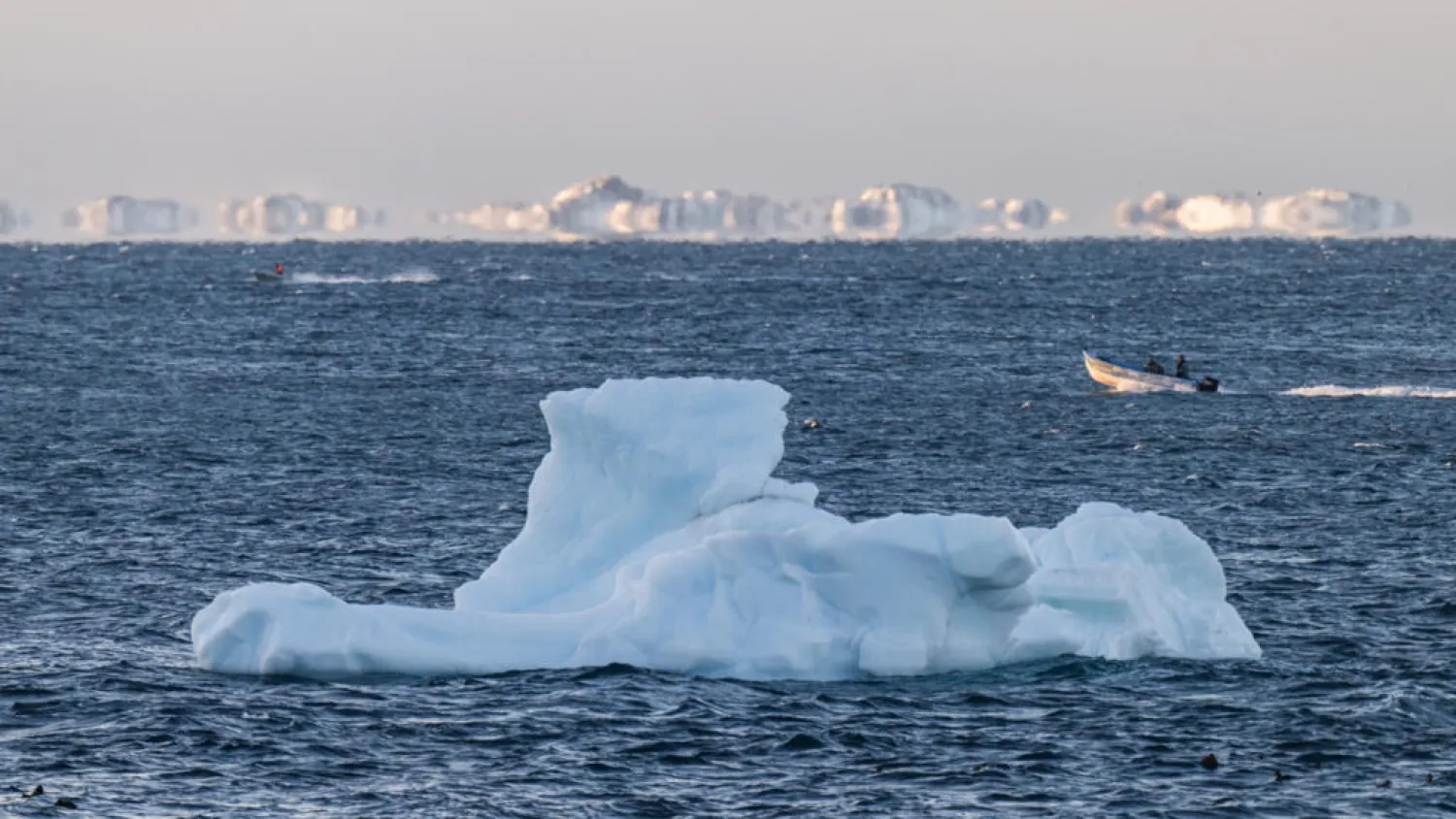
British scientists said Thursday that a world-first AI tool to catalogue and track icebergs as they break apart into smaller chunks could fill a "major blind spot" in predicting climate change.

Icebergs release enormous volumes of freshwater when they melt on the open water, affecting global climate patterns and altering ocean currents and ecosystems, reported AFP.

But scientists have long struggled to keep track of these floating behemoths once they break into thousands of smaller chunks, their fate and impact on the climate largely lost to the seas.

To fill in the gap, the British Antarctic Survey has developed an AI system that automatically identifies and names individual icebergs at birth and tracks their sometimes decades-long journey to a watery grave.

Using satellite images, the tool captures the distinct shape of icebergs as they break off -- or calve -- from glaciers and ice sheets on land.

As they disintegrate over time, the machine performs a giant puzzle problem, linking the smaller "child" fragments back to the "parent" and creating detailed family trees never before possible at this scale.

It represents a huge improvement on existing methods, where scientists pore over satellite images to visually identify and track only the largest icebergs one by one.

The AI system, which was tested using satellite observations over Greenland, provides "vital new information" for scientists and improves predictions about the future climate, said the British Antarctic Survey.

Knowing where these giant slabs of freshwater were melting into the ocean was especially crucial with ice loss expected to increase in a warming world, it added.

"What's exciting is that this finally gives us the observations we've been missing," Ben Evans, a machine learning expert at the British Antarctic Survey, said in a statement.

"We've gone from tracking a few famous icebergs to building full family trees. For the first time, we can see where each fragment came from, where it goes and why that matters for the climate."

This use of AI could also be adapted to aid safe passage for navigators through treacherous polar regions littered by icebergs.

Iceberg calving is a natural process. But scientists say the rate at which they were being lost from Antarctica is increasing, probably because of human-induced climate change.