


UN Says Afghan Civilian Casualties Down by 15% Last Year

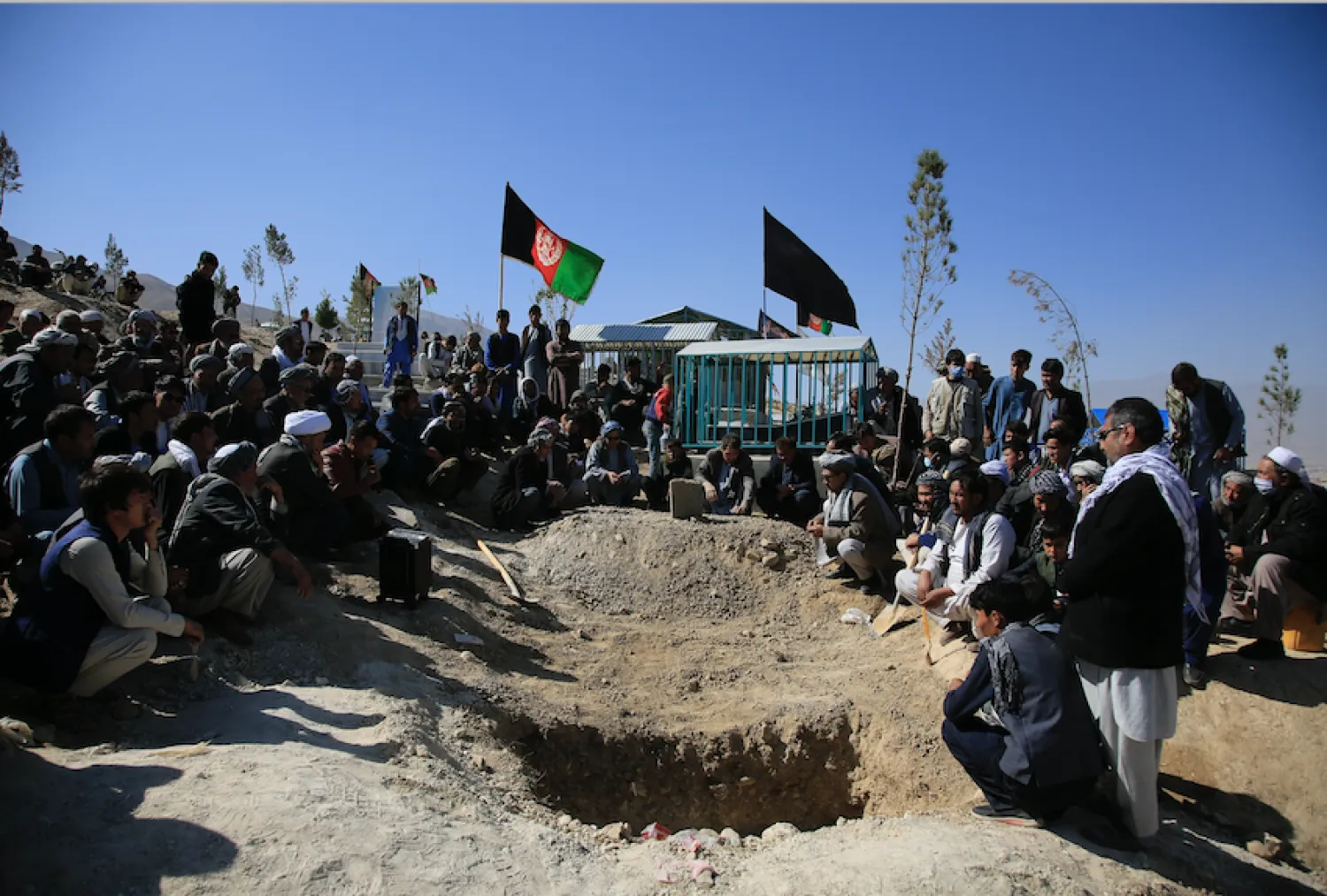
 in this Oct. 25, 2020 file photo, Afghan men bury a victim of a suicide attack that targeted an education center, in Kabul Afghanistan. (AP Photo/Mariam Zuhaib, File)
in this Oct. 25, 2020 file photo, Afghan men bury a victim of a suicide attack that targeted an education center, in Kabul Afghanistan. (AP Photo/Mariam Zuhaib, File)
TT

UN Says Afghan Civilian Casualties Down by 15% Last Year

 in this Oct. 25, 2020 file photo, Afghan men bury a victim of a suicide attack that targeted an education center, in Kabul Afghanistan. (AP Photo/Mariam Zuhaib, File)
in this Oct. 25, 2020 file photo, Afghan men bury a victim of a suicide attack that targeted an education center, in Kabul Afghanistan. (AP Photo/Mariam Zuhaib, File)

The number of civilians killed and wounded in violence across war-weary Afghanistan fell by 15% last year compared to 2019, according to a United Nations report released Tuesday.

The UN Assistance Mission in Afghanistan and the UN Human Rights Office attributed the drop in civilian casualties in part to an apparent tactical change by insurgents to targeted killings, fewer suicide bombings, and a stark drop in casualties attributed to international military forces.

Still, Afghanistan remains among the deadliest places in the world to be a civilian. A distressing feature of the conflict remains the disproportionate impact on Afghan women and children, who make up 43% of all casualties.

The attacks targeting civilians include assaults on members of the judiciary, media, and activists. Also targeted have been religious minorities, especially the Shiite Muslim population, most of whom also belong to the Hazara ethnic group, and the Sikh population.

The overall number of civilian casualties in 2020 of 8,820 - including 3,035 killed and 5,785 others wounded - fell below 10,000 for the first time since 2013. Last year's total was 15% down compared to 2019, the UN said.

Afghanistan has seen a nationwide spike in bombings, targeted killings, and violence on the battlefield as peace negotiations in Qatar between the Taliban and the Afghan government have stalled. It´s been over a month since the sides last met to discuss how to proceed.

Meanwhile, President Joe Biden's administration is reviewing the US-Taliban peace deal that was signed Feb. 29 last year. As part of it, Washington committed to a May 1 withdrawal of all foreign troops from Afghanistan.

Afghanistan peace negotiations between representatives of the Afghan government and the Taliban in Qatar began on Sept. 12 but have failed to alleviate the scale of civilian harm - a key indicator of violence levels. Instead, there was an escalation of violence in the fourth quarter of the year.

For the first time since it began systematic documentation in 2009, UNAMA tallied an increase civilian casualties recorded in the fourth quarter compared with the third quarter. In addition, this period marked a 45% increase in civilian casualties compared to the same three months in 2019, especially from the use of improvised explosive devices and targeted killings.

In October, civilian casualties were the highest of any month in 2020, and in November UNAMA documented the highest number of civilian casualties of any November since it started systematic documentation in 2009. Alongside the overall increase in violence as the year ended, the population was confronted with a spate of targeted killings, referred to by many as "assassinations," of civilians, including media, civil society activists, members of the judiciary, and the civilian government administration, as well as civilian family members of combatants.

"2020 could have been the year of peace in Afghanistan. Instead, thousands of Afghan civilians perished due to the conflict," said Deborah Lyons, the UN's special representative of the secretary-general for Afghanistan. "This important report has the overriding objective of providing the parties responsible with the facts, and recommendations, so they take immediate and concrete steps to protect civilians. I urge them not to squander a single day in taking the urgent steps to avoid more suffering."

The report blamed 62% of casualties on anti-government forces in 2020 with the Taliban responsible for most of them - 46% - and the ISIS group responsible for 8%.

Pro-government forces caused a quarter of all civilian casualties, totaling 2,231, the report said. That includes 841 killed and 1,390 wounded, a decrease of 24% from 2019, with the Afghan national security forces causing most of these - 22% of the total.

While there was an increase in the number of civilian casualties that were unclaimed by any party and for which UNAMA could not attribute responsibility, the report found the Taliban caused 19% fewer civilian casualties than in 2019 and IS caused 45% fewer than the pervious year.

Ground engagements were the leading cause of civilian casualties in 2020. They were responsible for 36% of civilian casualties, a slight increase compared with 2019. Next were suicide and non-suicide attacks using improvised explosive devices, which caused 34.5% of the casualties last year, a 30% decrease. Anti-government forces targeted killings caused 14% of casualties in 2020, up by 45%, and pro-government airstrikes caused 8% of casualties, down 34%.

"Ultimately, the best way to protect civilians is to establish a humanitarian ceasefire," said Lyons, who is also head of UNAMA. "Parties refusing to consider a ceasefire must recognize the devastating consequences of such a posture on the lives of Afghan civilians."



Top Trump Iran Negotiator Says Visits US Aircraft Carrier in Middle East

US Special Envoy Steve Witkoff delivers a press conference upon the signing of the declaration on deploying post-ceasefire force in Ukraine, during the so-called "Coalition of the Willing" summit, at the Elysee Palace in Paris, France, January 6, 2026. (Reuters)
TT

Top Trump Iran Negotiator Says Visits US Aircraft Carrier in Middle East

US Special Envoy Steve Witkoff delivers a press conference upon the signing of the declaration on deploying post-ceasefire force in Ukraine, during the so-called "Coalition of the Willing" summit, at the Elysee Palace in Paris, France, January 6, 2026. (Reuters)

US President Donald Trump's lead Iran negotiator Steve Witkoff on Saturday said he visited the USS Abraham Lincoln aircraft carrier currently in the Arabian Sea, with Washington and Tehran due to hold further talks soon.

"Today, Adm. Brad Cooper, Commander of US Naval Forces Central Command, Jared Kushner, and I met with the brave sailors and Marines aboard the USS Abraham Lincoln, her strike group, and Carrier Air Wing 9 who are keeping us safe and upholding President Trump's message of peace through strength," said Witkoff in a social media post.

Iranian Foreign Minister Abbas Araghchi said on Saturday he hoped talks with the United States would resume soon, while reiterating Tehran's red lines and warning against any American attack.


Israel’s Netanyahu Expected to Meet Trump in US on Wednesday and Discuss Iran

Israeli Prime Minister Benjamin Netanyahu delivers a speech during a special session to mark the 77th anniversary of the Knesset's establishment and the 60th anniversary of the dedication of the current building at the Knesset, the Israeli parliament, in Jerusalem, 02 February 2026. (EPA)
TT

Israel’s Netanyahu Expected to Meet Trump in US on Wednesday and Discuss Iran

Israeli Prime Minister Benjamin Netanyahu delivers a speech during a special session to mark the 77th anniversary of the Knesset's establishment and the 60th anniversary of the dedication of the current building at the Knesset, the Israeli parliament, in Jerusalem, 02 February 2026. (EPA)

Israeli Prime Minister Benjamin Netanyahu is expected to meet US President Donald Trump on Wednesday in Washington, where they will discuss negotiations with Iran, Netanyahu's office said on Saturday.

Iranian and US officials held indirect nuclear ‌talks in the ‌Omani capital ‌Muscat ⁠on Friday. ‌Both sides said more talks were expected to be held again soon.

A regional diplomat briefed by Tehran on the talks told Reuters Iran insisted ⁠on its "right to enrich uranium" ‌during the negotiations with ‍the US, ‍and that Tehran's missile capabilities ‍were not raised in the discussions.

Iranian officials have ruled out putting Iran's missiles - one of the largest such arsenals in the region - up ⁠for discussion, and have said Tehran wants recognition of its right to enrich uranium.

"The Prime Minister believes that any negotiations must include limiting ballistic missiles and halting support for the Iranian axis," Netanyahu's office said in a ‌statement.


Italy FM Rules Out Joining Trump’s ‘Board of Peace’

Italy's Minister for Foreign Affairs Antonio Tajani speaks to the press during the EPP Leaders’ meeting, in Zagreb, Croatia, 30 January 2026. (EPA)
TT

Italy FM Rules Out Joining Trump’s ‘Board of Peace’

Italy's Minister for Foreign Affairs Antonio Tajani speaks to the press during the EPP Leaders’ meeting, in Zagreb, Croatia, 30 January 2026. (EPA)

Italy will not take part in US President Donald Trump's "Board of Peace", Italian Foreign Minister Antonio Tajani said Saturday, citing "insurmountable" constitutional issues.

Trump launched his "Board of Peace" at the World Economic Forum in Davos in January and some 19 countries have signed its founding charter.

But Italy's constitution bars the country from joining an organization led by a single foreign leader.

Prime Minister Giorgia Meloni, a Trump ally, last month noted "constitutional problems" with joining, but suggested Trump could perhaps reopen the framework "to meet the needs not only of Italy, but also of other European countries".

Tajani appeared Saturday to rule that out.

"We cannot participate in the Board of Peace because there is a constitutional limit," he told the ANSA news agency.

"This is insurmountable from a legal standpoint," he said, the day after meeting US Secretary of State Marco Rubio and US Vice President JD Vance at the Olympics in Milan.

Although originally meant to oversee Gaza's rebuilding, the board's charter does not limit its role to the Palestinian territory and appears to want to rival the United Nations.