


US-Israeli Committee Formed to Face Iranian Nuclear Program Issue

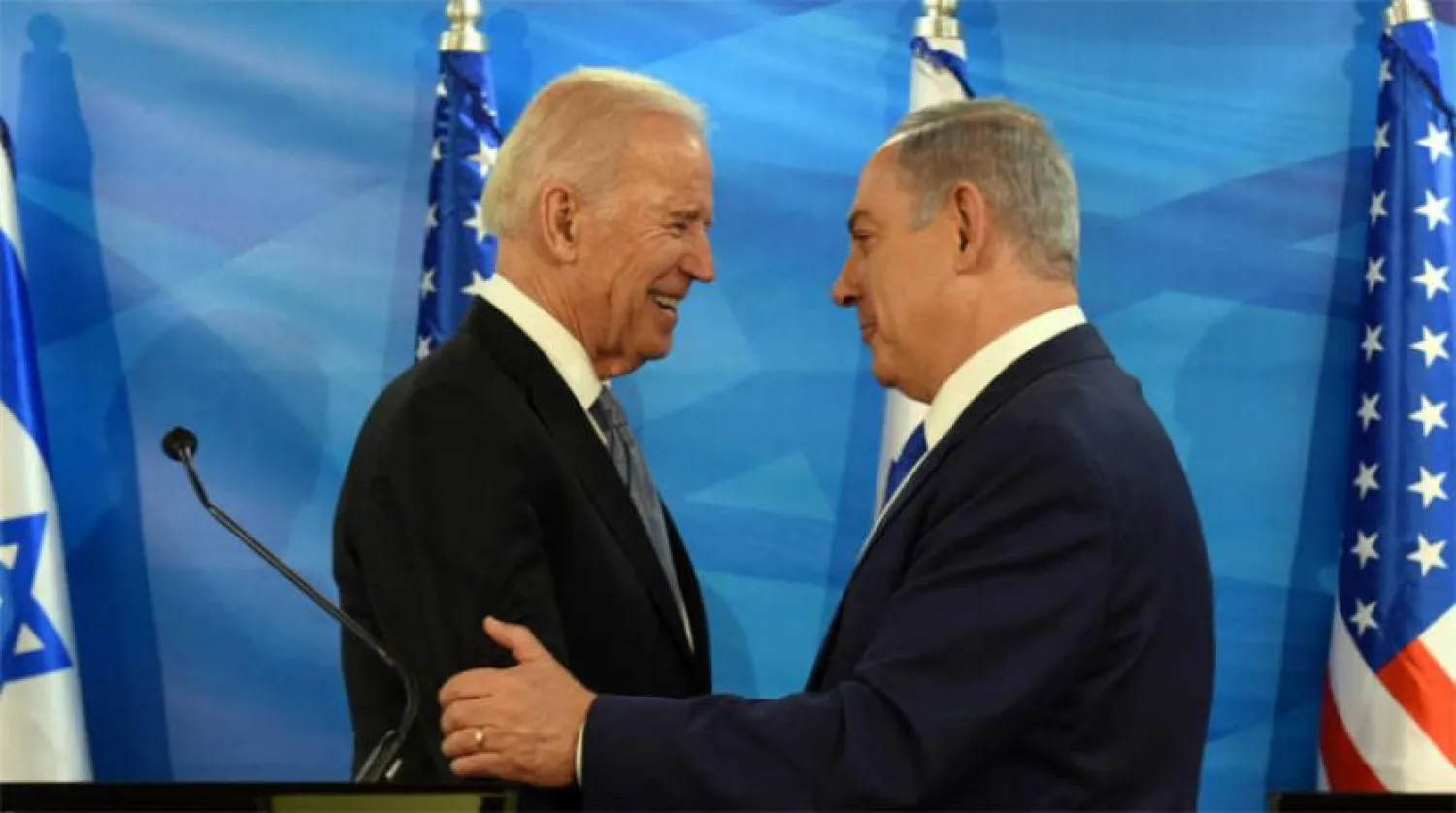
US President Joe Biden and Israeli Prime Minister Benjamin Netanyahu (Archival photo - AFP)
TT

US-Israeli Committee Formed to Face Iranian Nuclear Program Issue

US President Joe Biden and Israeli Prime Minister Benjamin Netanyahu (Archival photo - AFP)

An Israeli-US committee to confront the Iranian nuclear program has been formed and is expected to begin its work soon at the highest national security levels, political and security sources in Tel Aviv revealed on Friday.

Sources pointed to a basic disagreement between US President Joe Biden’s administration and Israeli Prime Minister Benjamin Netanyahu over the Iranian nuclear issue and the US return to the nuclear deal, noting that it requires urgent dialogue and coordination.

Yet, no direct talks have yet taken place between both sides, despite reports about meetings between Israeli and US security officials.

According to Alex Fishman, the military affairs correspondent of Israel’s Yedioth Ahronoth newspaper, a joint committee has already been formed since former President Donald Trump’s administration and is led by heads of both countries’ National Security Councils.

But it has not met recently, and it is expected to resume its work soon to re-coordinate positions on the Iranian nuclear threat, he noted.

Fishman pointed out that “the Americans asked Israel to resume the committee’s meetings.

However, unlike during Trump’s term, the Israeli side is now weak and less capable of influencing US decisions, he said.

Although the new administration focuses on two major issues, namely the economic crisis and the health crisis caused by the coronavirus pandemic, it is aware of the Iranian nuclear program threat, said a senior military official in Tel Aviv.

The administration wants to get rid of this threat and is aware of the importance of relieving its allies in the Middle East who are gravely concerned, he added.

Fishman quoted some officials as saying that there is a serious disagreement between Netanyahu and Biden’s team over dealing with Iran.

Netanyahu wants to resolve the Iranian nuclear complex based on the principle of “everything or nothing,” which means that Tehran be stripped of its nuclear resources that may lead to a military project.

He also links the nuclear issue with two other threats: dismantling the ballistic missile project and halting the positioning scheme in Syria.

“Until achieving both goals, an absolute boycott shall be imposed on it, and the current sanctions against it shall not be eased,” they stressed.

The officials indicated that Netanyahu is very concerned about signals given by Biden’s administration to encourage the regime in Tehran.

They mentioned meetings between US officials and Iranian representatives following an invitation by the European Union, as well as the announcement by Iranian Central Bank of South Korea’s unfreezing of Iranian funds and Iran’s ability to obtain loans from international funds.

These steps would not occur without prior US approval, they stressed.

Meanwhile, officials said that Biden’s administration sees Netanyahu’s stance as “unrealistic” and insists on resuming negotiations to reach a better agreement.



Russia Hits Energy System in Several Regions of Ukraine, Kyiv Says

Local residents gather around a bonfire during an outdoor party to keep warm as many apartments remain without heating in Kyiv on January 18, 2026, amid the Russian invasion of Ukraine. (AFP)
TT

Russia Hits Energy System in Several Regions of Ukraine, Kyiv Says

Local residents gather around a bonfire during an outdoor party to keep warm as many apartments remain without heating in Kyiv on January 18, 2026, amid the Russian invasion of Ukraine. (AFP)

Russia launched a barrage of drone strikes on Ukraine's energy infrastructure overnight on Monday, cutting off power in five regions ​across the country amid freezing temperatures and high demand, Ukrainian officials said.

The Ukrainian air force said that Russian troops had launched 145 drones. Air defense units shot down 126 of them, it said.

"As of this morning, consumers in Sumy, Odesa, Dnipropetrovsk, Kharkiv, and Chernihiv regions are without power," the energy ministry said in a statement. "Emergency repair ‌work is ‌underway if the security situation ‌allows."

In ⁠the ​southern ‌Odesa region, energy and gas infrastructure was damaged, the regional governor said, adding that one person was hurt in the attack.

DTEK, Ukraine's largest private energy company, said its energy facility in Odesa was "substantially" damaged, knocking out power for 30,800 households.

A local power grid company in northern Chernihiv region said that ⁠five important energy facilities were damaged, leaving tens of thousands of consumers ‌without power.

Russia also hit Ukraine's second-largest ‍city of Kharkiv with missiles ‍on Monday morning, significantly damaging a critical infrastructure facility, ‍Mayor Ihor Terekhov said.

Moscow has stepped up a winter campaign of strikes on the Ukrainian energy system, including generation, electricity transmission and gas production facilities, amid freezing temperatures that complicate repair works.

The ​attacks have caused long blackouts.

"Being without electricity for more than 16 hours is awful," Serhii Kovalenko, ⁠CEO of energy distribution company Yasno, said on Facebook late on Sunday. "And it's not because of the energy companies, but because of cynical attacks by the enemy, who is trying to create a humanitarian disaster."

Ukraine declared an energy emergency last week as its grid crumbled due to accumulated wartime damage and a new targeted wave of Russian bombardments.

Energy Minister Denys Shmyhal said on Monday the government would implement projects to improve electricity transmission from the western part ‌of the country to its power-hungry east.


‘Not Right’ for Iran to Attend Davos Summit After Deadly Protests, Say Organizers

Iranian Foreign Minister Abbas Araghchi speaks in a joint press briefing with his Iraqi counterpart Fuad Hussein in Tehran, Iran, Sunday, Jan. 18, 2026. (AP)
TT

‘Not Right’ for Iran to Attend Davos Summit After Deadly Protests, Say Organizers

Iranian Foreign Minister Abbas Araghchi speaks in a joint press briefing with his Iraqi counterpart Fuad Hussein in Tehran, Iran, Sunday, Jan. 18, 2026. (AP)

Iran's foreign minister will not be attending the Davos summit in Switzerland this week, the organizers said Monday, stressing it would not be "right" after the recent deadly crackdown on protesters in Iran.

Abbas Araghchi had been scheduled to speak on Tuesday during the annual gathering of the global elite at the upscale Swiss ski resort town.

But activists have been calling on the World Economic Forum organizers to disinvite him amid what rights groups have called a "massacre" in his country.

"The Iranian Foreign Minister will not be attending Davos," the World Economic Forum said on X.

"Although he was invited last fall, the tragic loss of lives of civilians in Iran over the past few weeks means that it is not right for the Iranian government to be represented at Davos this year," it added.

Demonstrations sparked by anger over economic hardship exploded into protests late December in what has been widely seen as the biggest challenge to the Iranian leadership in recent years.

The rallies subsided after a government crackdown under the cover of a communications blackout that started on January 8.

Norway-based Iran Human Rights says it has verified the deaths of 3,428 protesters killed by security forces, confirming cases through sources within the country's health and medical system, witnesses and independent sources.

The NGO warned that the true toll is likely to be far higher. Media cannot independently confirm the figure and Iranian officials have not given an exact death toll.


Iran to Consider Lifting Internet Ban; State TV Hacked

People walk past a burnt-out building destroyed during public protests in the Iranian capital Tehran on January 19, 26. (AFP)
TT

Iran to Consider Lifting Internet Ban; State TV Hacked

People walk past a burnt-out building destroyed during public protests in the Iranian capital Tehran on January 19, 26. (AFP)

Iran may lift its internet blackout in a few days, a senior parliament member said on Monday, after authorities shut communications while they used massive force to crush protests in the worst domestic unrest since ​the 1979 revolution.

In the latest sign of weakness in the authorities' control, state television appeared to be hacked late on Sunday, briefly showing speeches by US President Donald Trump and the exiled son of Iran's last shah calling on the public to revolt.

Iran's streets have largely been quiet for a week since anti-government protests that began in late December were put down in three days of mass violence.

An ‌Iranian official ‌told Reuters on condition of anonymity that the ‌confirmed ⁠death ​toll ‌was more than 5,000, including 500 members of the security forces, with some of the worst unrest taking place in ethnic Kurdish areas in the northwest. Western-based Iranian rights groups also say thousands were killed.

Opponents accuse the authorities of opening fire on peaceful demonstrators to crush dissent. Iran's clerical rulers say armed crowds egged on by foreign enemies attacked hospitals and mosques.

The death tolls dwarf ⁠those of previous bouts of anti-government unrest put down by the authorities in 2022 and 2009. ‌The violence drew repeated threats from Trump ‍to intervene militarily, although he has backed ‍off since the large-scale killing stopped.

INTERNET TO RETURN WHEN 'CONDITIONS ARE APPROPRIATE'

Ebrahim ‍Azizi, the head of parliament's National Security and Foreign Policy Committee, said top security bodies would decide on restoring internet in the coming days, with service resuming "as soon as security conditions are appropriate".

Another parliament member, hardliner Hamid Rasaei, said authorities should ​have listened to earlier complaints by Supreme Leader Ali Khamenei about "lax cyberspace".

Iranian communications including internet and international phone lines were ⁠largely stopped in the days leading up to the worst unrest. The blackout has since partially eased, allowing accounts of widespread attacks on protesters to emerge.

During Sunday's apparent hack into state television, screens broadcast a segment lasting several minutes with the on-screen headline "the real news of the Iranian national revolution".

It included messages from Reza Pahlavi, the US-based son of Iran's last shah, calling for a revolt to overthrow rule by the clerics who have run the country since the 1979 revolution that toppled his father.

Pahlavi has emerged as a prominent opposition voice and has said he plans ‌to return to Iran, although it is difficult to assess independently how strong support for him is inside Iran.