


In Iraq, Pope to Visit Mosul Churches Desecrated by ISIS

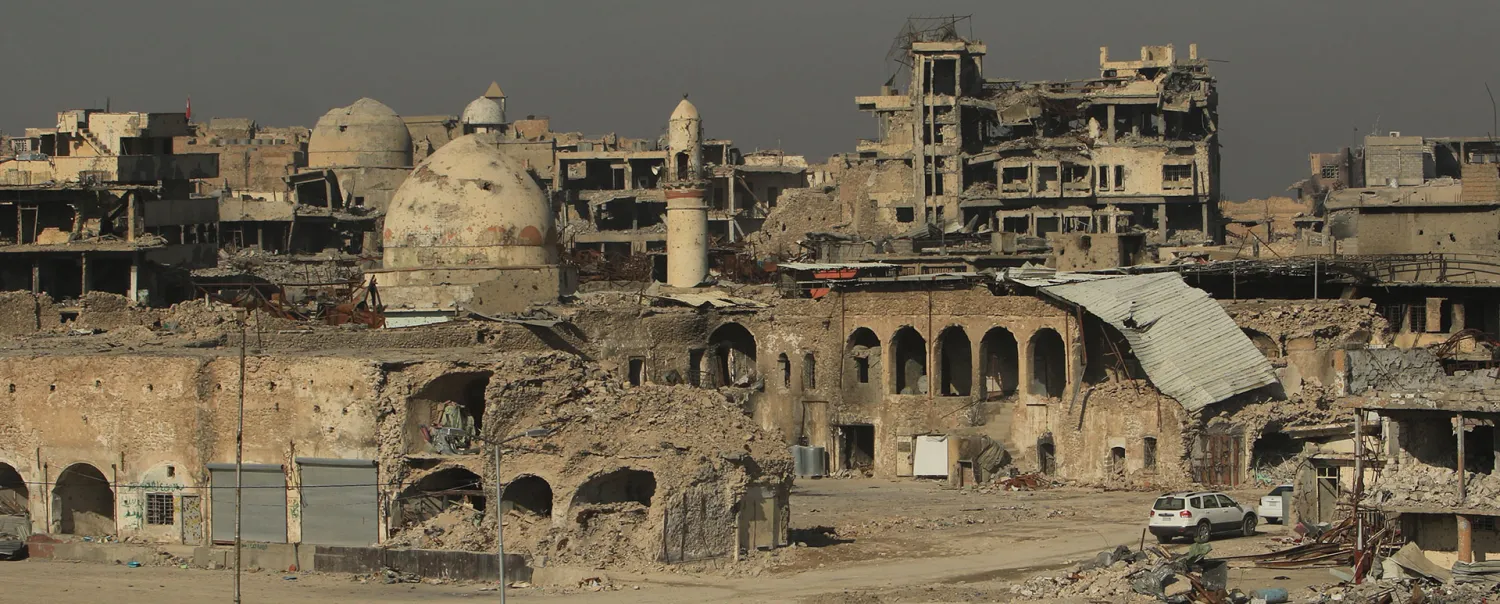
RUINS: The Old City of Mosul in January. In the battle to drive out ISIS, thousands of buildings were damaged or demolished. The city is still struggling to clear the debris. REUTERS/Ari Jalal
TT

In Iraq, Pope to Visit Mosul Churches Desecrated by ISIS

RUINS: The Old City of Mosul in January. In the battle to drive out ISIS, thousands of buildings were damaged or demolished. The city is still struggling to clear the debris. REUTERS/Ari Jalal

In Mosul, adjacent to the Biblical city of Nineveh, four churches representing different denominations occupy a small square surrounded by low-rise houses, testament to the role Iraq's once flourishing Christian community played.

Today, all four churches are either damaged or destroyed after ISIS militants occupied the city from 2014-2017, desecrated many of the buildings and used them to run its administration, including as a jail and a court.

Air strikes as Iraqi forces tried to dislodge the extremist group in fierce fighting did the rest. Those walls still standing are scarred with bullet and shrapnel holes.

"It used to be a bit like the Jerusalem of the Nineveh plains," said Mosul and Akra's Chaldean Archbishop Najeeb Michaeel of "Church Square", the name given to the site that Pope Francis will visit on March 7 during his historic trip to Iraq.

Michaeel fondly recalled how, before the US invasion in 2003, Iraqi Christians from different denominations would attend each other's services on religious festivals.

Those days are gone. Today just one of Mosul's surviving churches offers a weekly Sunday service to a Christian population that has dwindled to just a few dozen families from about 50,000 people, Reuters reported.

Tolerated by former President Saddam Hussein but persecuted by al Qaeda and then ISIS, Iraq's Christians number around 300,000, one fifth of the total before 2003.

Some are trickling back after ISIS's defeat, but others still see little prospect in staying in Iraq and are looking to settle overseas.

A Syriac Catholic, Syriac Orthodox, Armenian Orthodox and Chaldean Catholic church are situated cheek-by-jowl in and around the dusty square. Now the area lies in ruins, as do other parts of the city.

The pope is due to hold prayers for the victims of war at Hosh al-Bieaa, known as Church Square in English, as part of a four-day trip starting on March 5, a visit Archbishop Michaeel described as highly symbolic and a message of hope.

"Where stones fell because of violence, there will always be life," he said.

Workmen have been busy cleaning up the site before Pope Francis arrives.

Funded by the United Arab Emirates, the restoration of the Syriac Catholic church of Al-Tahera is being carried out by UNESCO in collaboration with local partners and began in 2020.

Holding pictures of the church before its destruction, assistant site coordinator for UNESCO in Iraq, Anas Zeyad, pointed to delicate Syriac carvings on pieces of greyish alabaster stone referred to locally as "Mosul marble".

Damaged by ISIS before its roof was shredded by air strikes, the church was used as a tribunal by the extremist movement's religious police, Zeyad said.

The adjacent Armenian Orthodox church, distinguishable by its dome, remains closed off to the public.

"It has not been de-mined yet," Zeyad explained, pointing to the sealed door leading to the church that ISIS commandeered as a prison.

"Nearly all churches in Mosul were used by ISIS," Archbishop Michaeel said.

Standing next to a damaged piece of sculpted alabaster representing the Virgin Mary, Ali Salem, from Iraq's State Board of Antiquities and Heritage, said his team was reviewing many such artefacts to determine which could be repaired and used again.

"As a Muslim I am proud to help rebuild these churches," Zeyad said, adding that he hoped "we see Christians come back to these places, so that we live together again as we have for centuries."



Lebanese PM Says Premature to Talk of Any High-Level Meeting with Israel

Smoke rises as a result of an Israeli strike in the south of Lebanon, as seen from the Upper Galilee in northern Israel, 06 May 2026, amid a ceasefire between Israel and Lebanon. (EPA)
TT

Lebanese PM Says Premature to Talk of Any High-Level Meeting with Israel

Smoke rises as a result of an Israeli strike in the south of Lebanon, as seen from the Upper Galilee in northern Israel, 06 May 2026, amid a ceasefire between Israel and Lebanon. (EPA)

Lebanese Prime Minister Nawaf Salam said it is premature to talk of any high-level meeting between Lebanon and Israel, comments underlining the dim chances of one being held soon as hoped for by US President Donald Trump.

Salam, in comments reported by Lebanon's National News Agency (NNA) on Wednesday, said shoring up a ceasefire would be the basis for any new round of negotiations that might be held by Lebanese and Israeli government envoys in Washington.

Hostilities between Israel and Iran-backed Hezbollah have continued to rage in southern Lebanon despite a US-mediated ceasefire between Lebanon and Israel announced on April 16.

Since ‌Hezbollah triggered the ‌war by opening fire in support of Iran on March ‌2, ⁠the Lebanese administration ⁠led by Salam and President Joseph Aoun has initiated Beirut's highest-level contacts with Israel in decades, reflecting deep divisions between the Shiite group and its Lebanese opponents.

Washington last month hosted two meetings between the Israeli and Lebanese ambassadors to the United States. Hezbollah strongly objects to the contacts.

Announcing a three-week extension of the ceasefire on April 23, Trump said he looked forward to hosting Israeli Prime Minister Benjamin Netanyahu and Aoun in the near future, and that he ⁠saw "a great chance" the countries would reach a peace deal ‌this year.

Salam said Lebanon was not seeking "normalization with Israel, but ‌rather achieving peace".

The current circumstances "are not ripe to talk about high-level meetings," he added, according to NNA.

"Our ‌minimum demand is a timetable for Israel’s withdrawal," he said, adding that the government ‌would develop its plan to restrict weapons to state control - an effort aimed at securing Hezbollah's disarmament.

Aoun said this week the timing was not right for a meeting with Netanyahu. Lebanon "must first reach a security agreement and a halt to the Israeli attacks, before we raise the issue of a meeting ‌between us," he said.

TRADING BLOWS

Israel has occupied a so-called security zone extending as deep as 10 km (6 miles) into southern ⁠Lebanon, saying it aims ⁠to protect northern Israel from Hezbollah militants embedded in civilian areas.

Hezbollah and Israel have continued to trade blows.

Lebanon's Health Ministry said on Wednesday an Israeli airstrike killed four people including two women and an elderly man in the town of Zelaya in southern Lebanon.

The Israeli military said Hezbollah had launched explosive drones and rockets towards Israeli soldiers in southern Lebanon, injuring two Israeli soldiers.

It also said the Israeli air force intercepted a hostile aircraft before it crossed into Israel, and announced strikes on Hezbollah infrastructure in several areas in Lebanon.

More than 2,700 people have been killed in the war in Lebanon since March 2, the Health Ministry says.

The Israeli military says Hezbollah has fired hundreds of rockets and drones at Israel since March 2. Israel has announced 17 soldiers have been killed in southern Lebanon, along with two civilians in northern Israel.


EU Urged to 'Act Now' on West Bank Settlement Project

The Palestinian village of Turmus Ayya (foreground) and the Israeli settlement of Shilo (background), north of Ramallah in the Israeli-occupied West Bank, are pictured on May 6, 2026. (Photo by Zain JAAFAR / AFP)
TT

EU Urged to 'Act Now' on West Bank Settlement Project

The Palestinian village of Turmus Ayya (foreground) and the Israeli settlement of Shilo (background), north of Ramallah in the Israeli-occupied West Bank, are pictured on May 6, 2026. (Photo by Zain JAAFAR / AFP)

More than 400 former diplomats, ministers, and senior officials on Wednesday urged the European Union to "act now" against Israel's "illegal" settlements in the occupied West Bank.

The open letter comes as Israel intends to move forward with E1, a new construction project covering around 12 square kilometers (4.6 square miles) with some 3,400 housing units in the occupied West Bank.

The move would further separate east Jerusalem, occupied and annexed by Israel and predominantly inhabited by Palestinians, from the West Bank.

"The EU and its member states, together with partners, must take immediate action to deter Israel from further advancing its illegal annexation of Palestinian land in the West Bank," said the letter signed by more than 440 figures, including former EU foreign policy chief Josep Borrell and former Belgian prime minister Guy Verhofstadt.

The signatories called for targeted sanctions, such as visa bans and business restrictions, on "all those engaged in illegal settlement activity", calling for measures against those promoting or implementing the E1 scheme.

The Israeli government plans to publish an initial tender on June 1 for the construction of housing for up to 15,000 "illegal settlers", AFP quoted the letter as saying, urging the EU and its member states to "act now".

The plan has been condemned by international leaders, with UN Secretary General Antonio Guterres's spokesman saying it would pose an "existential threat" to a contiguous Palestinian state.

Excluding east Jerusalem, more than 500,000 Israelis live in the occupied West Bank in settlements that are illegal under international law, among some three million Palestinians.

In 2025, the expansion of Israeli settlements reached its highest level since at least 2017, when the United Nations began tracking data, according to a UN report.

There has been a spike in deadly attacks by Israeli settlers in the occupied West Bank since the start of the Iran war on February 28, Palestinian officials and the United Nations have said.

Israel has occupied the West Bank since 1967.


Israel Army Says Striking Hezbollah Targets across Lebanon

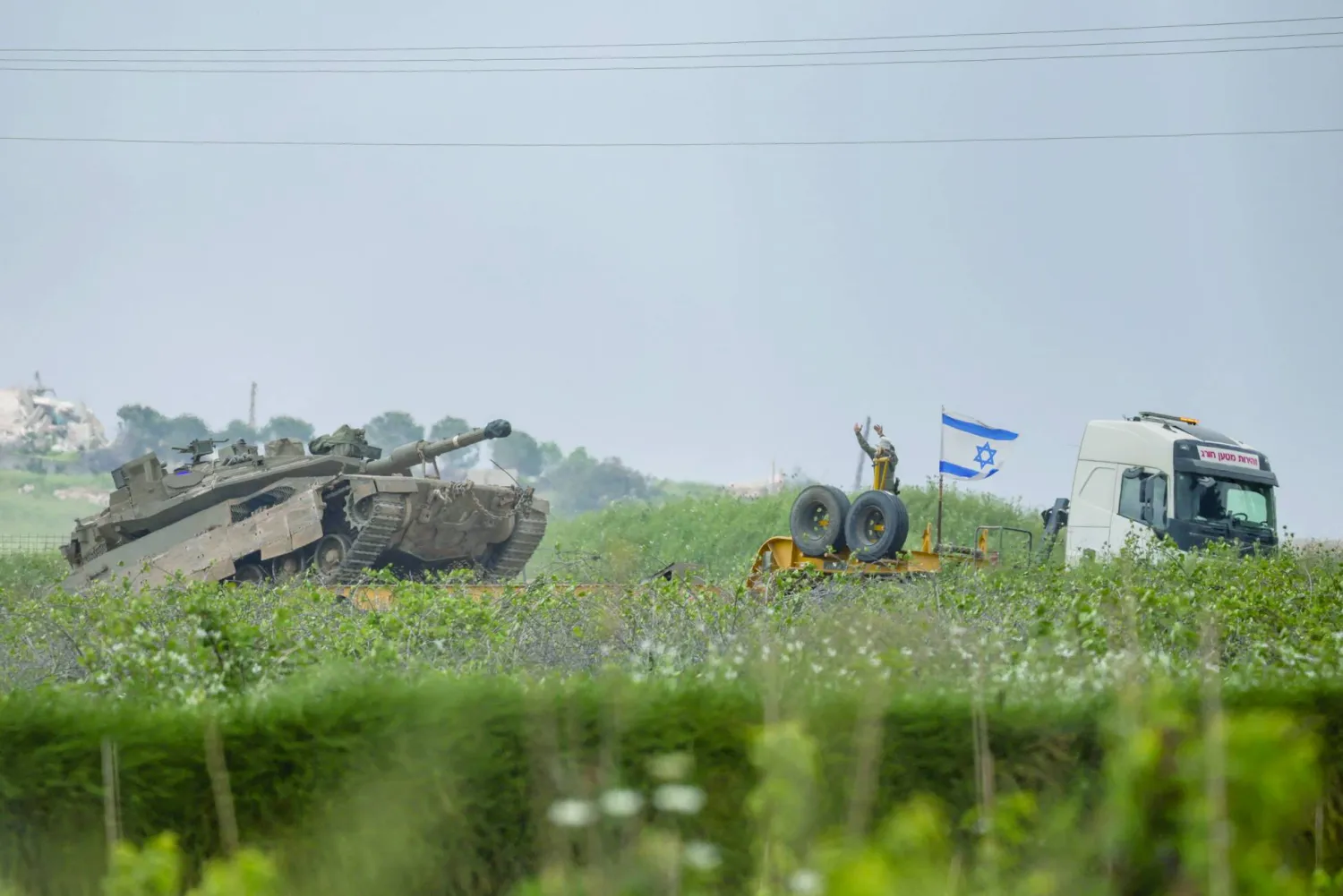
An Israeli soldier gestures next to a tank, on the Israeli side of the border with Lebanon, May 3, 2026. REUTERS/Shir Torem
TT

Israel Army Says Striking Hezbollah Targets across Lebanon

An Israeli soldier gestures next to a tank, on the Israeli side of the border with Lebanon, May 3, 2026. REUTERS/Shir Torem

Israel's army said Wednesday it had begun striking Hezbollah infrastructure in several areas of Lebanon, despite a truce with the neighboring country intended to halt fighting with the Iran-backed militant group. 

"The IDF has begun striking Hezbollah terror infrastructure sites in several areas in Lebanon," a military statement said. 

It came shortly after the army reported "several incidents" during which drones exploded near Israeli soldiers operating in Lebanon's south.  

Lebanon's health ministry said an Israeli strike in Lebanon's eastern Bekaa valley killed four people, with local media reporting the attack took place before the Israeli army issued a warning to evacuate the area along with 11 other towns. 

"An Israeli enemy raid on the town of Zellaya in West Bekaa resulted in four martyrs, including two women and an elderly man," the ministry said. 

Lebanese state media said the attack struck the house of the town's mayor, killing him and three members of his family.