


Covid-19, Unrest: Iraqis Tackle Obstacles to Host Pope

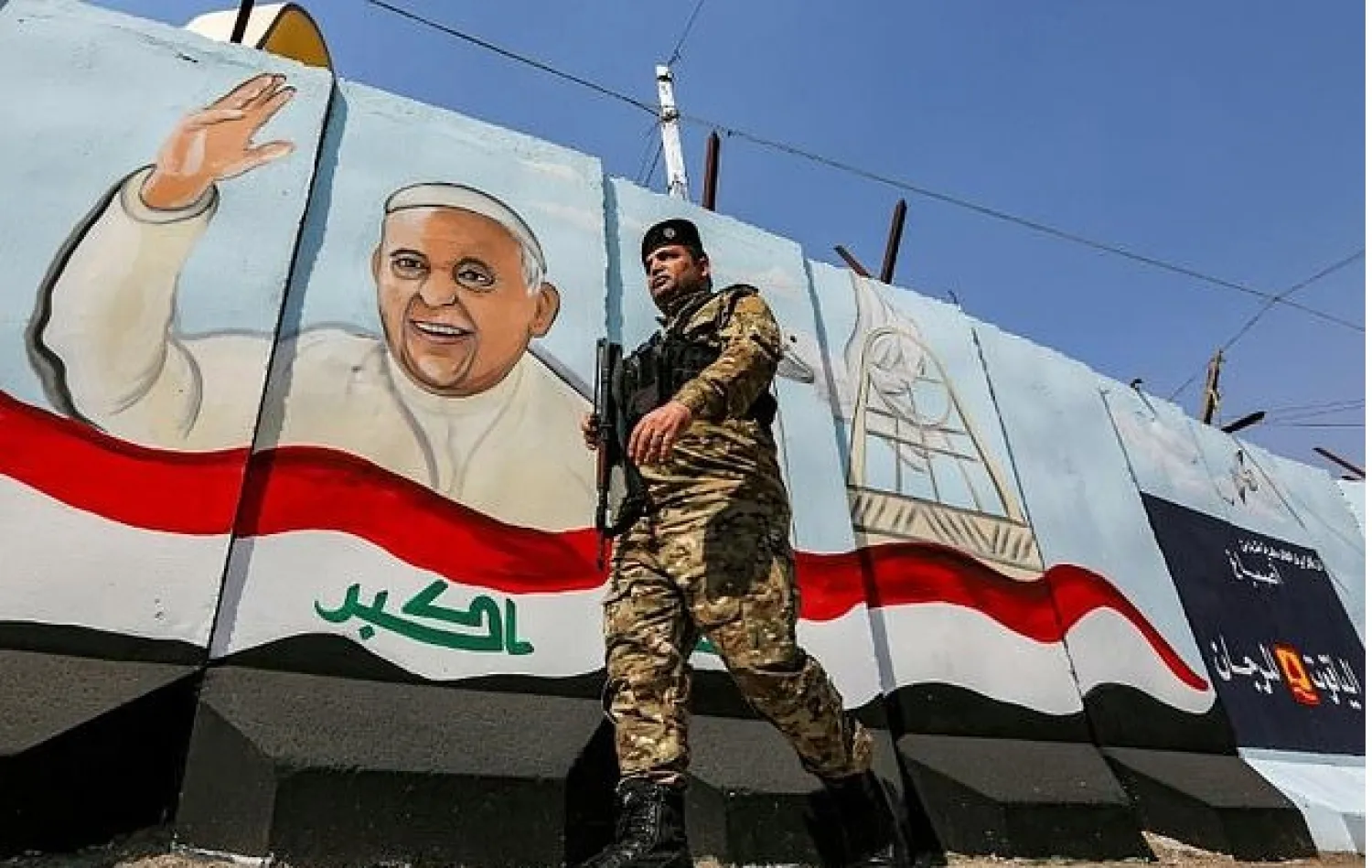
A member of the Iraqi security forces walks past a mural of Pope Francis with an Iraqi national flag, painted on a blast wall outside the Syriac Catholic Church of Our Lady of Deliverance in Baghdad - AFP
TT

Covid-19, Unrest: Iraqis Tackle Obstacles to Host Pope

A member of the Iraqi security forces walks past a mural of Pope Francis with an Iraqi national flag, painted on a blast wall outside the Syriac Catholic Church of Our Lady of Deliverance in Baghdad - AFP

Security threats, the Covid pandemic, war-ravaged infrastructure: Iraqis are facing major challenges as they plan to host Pope Francis later this week.

"We're very happy about this historic visit -- but it does come at a pretty difficult time," confided an official from Iraq's presidency.

Benedict XVI, who resigned as pontiff eight years ago, warned in an interview published Monday that Francis' historic visit to Iraq is "a dangerous trip for reasons of security and for the coronavirus".

A major concern has been Iraq's second wave of Covid-19, with around 4,000 new cases registered daily in the country of 40 million people, AFP reported.

Among those who tested positive just days before the pontiff's arrival was the Vatican's ambassador to Iraq, Mitja Leskovar.

The pope, 84, his staff and the dozens of journalists who will travel with him have been vaccinated, but no inoculation drive has yet been launched in Iraq.

To stem the spread of the virus, authorities imposed overnight curfews as well as full lockdowns on Fridays, Saturdays and Sundays, the three days of the pope's visit this week.

"The lockdown will be extended to include the entirety of the pope's visit, and security forces will be deployed to secure the streets," said Iraq's deputy foreign minister Nizar Khairallah.

Authorities have also barred travel between Iraq's provinces to keep down crowds, which are expected to be much thinner than the usual mass gatherings that welcome a visiting pope.

The prayer services he will host are ticketed events with limited seating, and church officials have told AFP they would implement strict social distancing and require all guests to disinfect regularly.

Baghdad is being spruced up accordingly: church bells are being repaired, new power lines strung up and political and military posters are being replaced with colorful banners welcoming the pope.

"We wanted to fix a few things so that this historic city, this symbol of humanity, can host the pope," Baghdad mayor Alaa Maan told AFP.

Iraq has long been synonymous with conflict, and unrest has again rocked the country in the run-up to the papal visit.

Francis will cover more than 1,445 kilometres (around 900 miles) by plane and helicopter, flying directly over areas that recently saw fighting against extremists sleeper cells.

He will visit Baghdad and Erbil, the capital of the northern Kurdish region -- both of which were shaken by rocket attacks in mid-February against Western targets.

The pope will be accompanied by members of the Swiss Guards, his personal protection force. They will be in plain clothes, not in their colorful uniforms, helmets or carrying axe-like halberds.

It was not clear if the pontiff would use his trademark bulletproof "pope-mobile", with officials refusing to comment for security reasons.

In the southern province of Dhi Qar, workers have been paving roads to the desert site of Ur, where the Prophet Abraham is said to have been born and where the pope will hold an interfaith ceremony on Saturday.

At the pyramid-like ziggurat, workers in hard-hats and neon vests are rushing to lay down wooden walkways and large parasols to create shade for the crowds expected to throng the site.

The pontiff's visit to Dhi Qar comes following deadly protests in the provincial capital of Nasiriyah where six people were shot dead in February while demonstrating against poor public services.

The pope's last full day will take him to Mosul, which was the center of the ISIS group's self-styled "caliphate" until its defeat three years ago, leaving the city in ruins.

Poor infrastructure could compound transport troubles for the pontiff, who has suffered from a painful bout of sciatica this year.

"The Vatican just told us the pope can't walk more than 10 steps. We're not sure what to do," said the official from Iraq's presidency.

Francis will also visit Qaraqosh, a Christian town overrun by ISIS in 2014, and where nuns have been climbing onto church roofs to retouch the paint on wooden crosses.

Iraqi officials, despite sleepless nights in the lead-up to the visit, say they hope the papal trip will improve the image of a country long shunned for its security, political and even health problems.

Once the pope has come and gone, predicted the Iraqi official, "foreign dignitaries will no longer be afraid of coming to Iraq".



Israel Announces Arrest of Prominent Jamaa Islamiya Member in Southern Lebanon

Smoke rises from the site of an Israeli airstrike that targeted a building in the southern Lebanese village of Ain Qana on February 2, 2026. (AFP)
TT

Israel Announces Arrest of Prominent Jamaa Islamiya Member in Southern Lebanon

Smoke rises from the site of an Israeli airstrike that targeted a building in the southern Lebanese village of Ain Qana on February 2, 2026. (AFP)

The Israeli army announced on Monday the arrest of a member of the Jamaa al-Islamiya group in Lebanon.

The military said a unit carried out a night operation in Jabal al-Rouss in southern Lebanon, arresting a “prominent” member of the group and taking him to Israel for investigation.

Israeli army spokesman Avichai Adree revealed that the operation took place based on intelligence gathered in recent weeks.

The military raided a building in the area where it discovered combat equipment, he added, while accusing the group of “encouraging terrorist attacks in Israel”.

He vowed that the Israeli army will “continue to work on removing any threat” against it.

Also on Monday, an Israeli drone struck a car in the southern Lebanese village of Yanouh, killing three people, including a child, Lebanon’s state-run National News Agency. 

Adree confirmed the strike, saying the army had targeted a Hezbollah member.

The Jamaa al-Islamiya slammed the Israeli operation, acknowledging on Monday the kidnapping of its official in the Hasbaya and Marjeyoun regions Atweh Atweh.

In a statement, the group said Israel abducted Atweh in an overnight operation where it “terrorized and beat up his family members.”

It held the Israeli army responsible for any harm that may happen to him, stressing that this was yet another daily violation committed by Israel against Lebanon.

“Was this act of piracy a response to Prime Minister Nawaf Salam’s tour of the South?” it asked, saying the operation was “aimed at terrorizing the people and encouraging them to leave their villages and land.”

The group called on the Lebanese state to pressure the sponsors of the ceasefire to work on releasing Atweh and all other Lebanese detainees held by Israel. It also called on it to protect the residents of the South.

Salam had toured the South over the weekend, pledging that the state will reimpose its authority in the South and kick off reconstruction efforts within weeks.

After the outbreak of the Israel-Hamas war in October 2023, the Jamaa al-Islamiya's Fajr Forces joined forces with Hezbollah, launching rockets across the border into Israel that it said were in support of Hamas in Gaza.

Hezbollah started attacking Israel on Oct. 8, 2023, a day after Hamas attacked southern Israel, triggering the latest Israel-Hamas war. Israel later launched a widespread bombardment of Lebanon that severely weakened Hezbollah, followed by a ground invasion.

The conflict ended with a US-brokered ceasefire in 2024, and since then, Israel has carried out almost daily airstrikes and ground incursions into Lebanon. Israel says it is carrying out the operations to remove Hezbollah strongholds and threats against Israel.

The Israel-Hezbollah war killed more than 4,000 people in Lebanon, including hundreds of civilians, and caused an estimated $11 billion in damage and destruction, according to the World Bank. In Israel, 127 people died, including 80 soldiers. 


Israel Says Killed Four Militants Exiting Tunnel in Gaza’s Rafah

Boys walk past the rubble of destroyed buildings in the Jabalia camp for Palestinian refugees in the northern Gaza Strip on February 8, 2026. (AFP)
TT

Israel Says Killed Four Militants Exiting Tunnel in Gaza’s Rafah

Boys walk past the rubble of destroyed buildings in the Jabalia camp for Palestinian refugees in the northern Gaza Strip on February 8, 2026. (AFP)

Israel's military said it killed four suspected militants who attacked its troops as the armed men emerged from a tunnel in southern Gaza on Monday, calling the group's actions a "blatant violation" of the ceasefire.

Despite a US-brokered truce entering its second phase last month, violence has continued in the Gaza Strip, with Israel and Hamas accusing each other of breaching the agreement.

"A short while ago, four armed terrorists exited an underground tunnel shaft and fired towards soldiers in the Rafah area in the southern Gaza Strip.... Following identification, the troops eliminated the terrorists," the military said in a statement.

It said none of its troops had been injured in the attack, which it called a "blatant violation of the ceasefire agreement" between Israel and Hamas.

Israeli troops "are continuing to operate in the area to locate and eliminate all the terrorists within the underground tunnel route", the military added.

Gaza health officials have said Israeli air strikes last Wednesday killed 24 people, with Israel's military saying the attacks were in response to one of its officers being wounded by enemy gunfire.

That wave of strikes came after Israel partly reopened the Rafah border crossing between Gaza and Egypt on February 2, the only gateway to the Palestinian territory that does not pass through Israel.

Israeli forces seized control of the crossing in May 2024 during the war with Hamas, and it had remained largely closed since.

Around 180 Palestinians have left the Gaza Strip since Rafah's limited reopening, according to officials in the territory.

Israel has so far restricted passage to patients and their accompanying relatives.

The second phase of the Gaza ceasefire foresees a demilitarization of the territory -- including the disarmament of Hamas -- along with a gradual withdrawal of Israeli forces.

Hamas has repeatedly said that disarmament is a red line, although it has indicated it could consider handing over its weapons to a future Palestinian governing authority.

Israeli officials say Hamas still has around 20,000 fighters and about 60,000 Kalashnikovs in Gaza.

A Palestinian technocratic committee has been set up with a goal of taking over day-to-day governance in the strip, but it remains unclear whether, or how, it will address the issue of demilitarization.


Building Collapse in Lebanon's Tripoli Kills 13, Search for Missing Continues

Rescue workers and residents search for survivors in the rubble of a building that collapsed in the northern city of Tripoli, Lebanon, Sunday, Feb. 8, 2026. (AP Photo)
TT

Building Collapse in Lebanon's Tripoli Kills 13, Search for Missing Continues

Rescue workers and residents search for survivors in the rubble of a building that collapsed in the northern city of Tripoli, Lebanon, Sunday, Feb. 8, 2026. (AP Photo)

The death toll from the collapse of a residential building in the Lebanese city of Tripoli rose to 13, as rescue teams continued to search for missing people beneath the rubble, Lebanon's National News ‌Agency reported ‌on Monday. 

Rescue ‌workers ⁠in the ‌northern city's Bab al-Tabbaneh neighborhood have also assisted nine survivors, while the search continued for others still believed to be trapped under the ⁠debris, NNA said. 

Officials said on ‌Sunday that two ‍adjoining ‍buildings had collapsed. 

Abdel Hamid Karameh, ‍head of Tripoli's municipal council, said he could not confirm how many people remained missing. Earlier, the head of Lebanon's civil defense rescue ⁠service said the two buildings were home to 22 residents, reported Reuters. 

A number of aging residential buildings have collapsed in Tripoli, Lebanon's second-largest city, in recent weeks, highlighting deteriorating infrastructure and years of neglect, state media reported, ‌citing municipal officials.