


Israel's Netanyahu Bets All on Vaccine Success to Secure Election Win

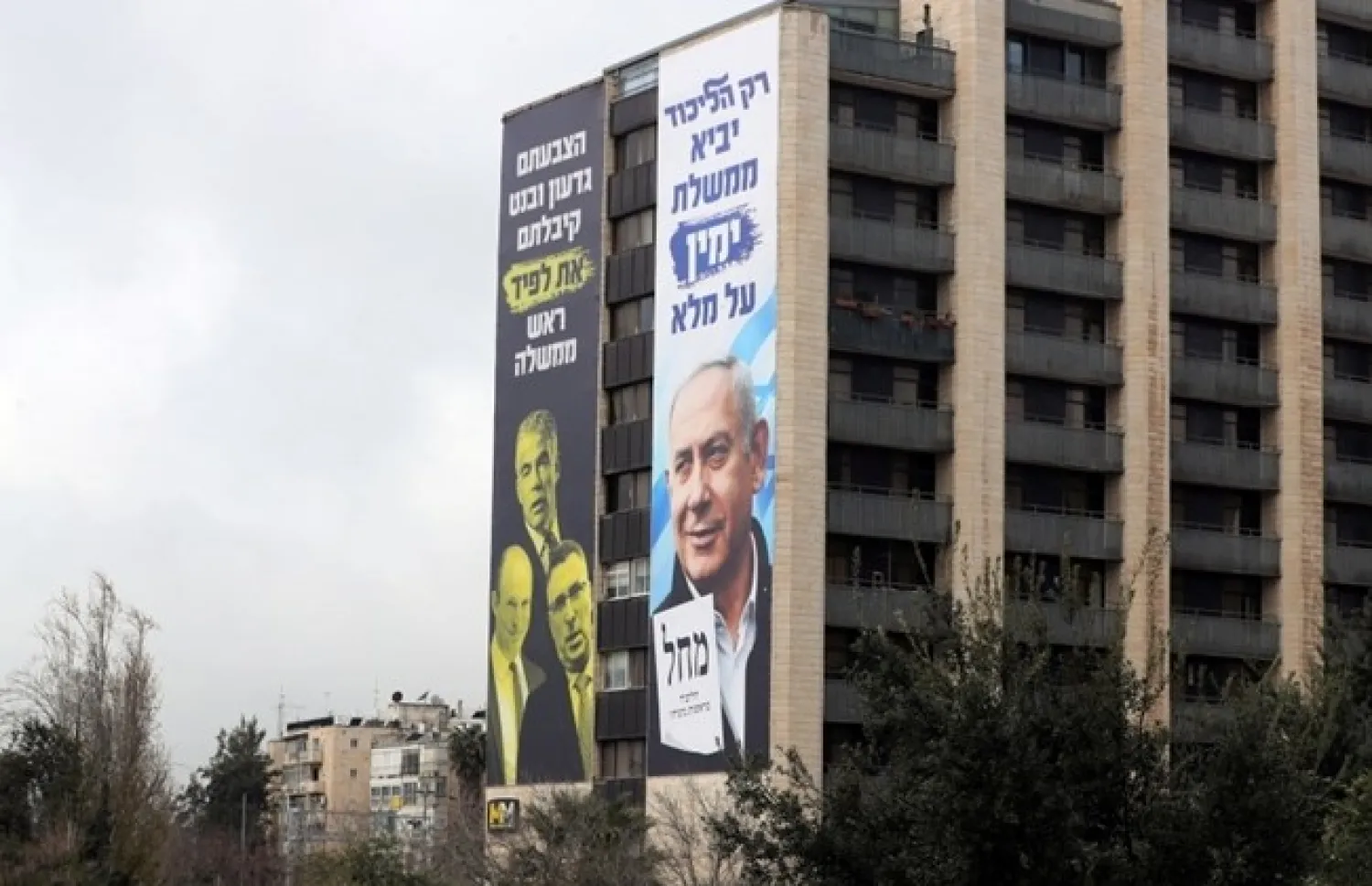
Election campaign posters by Israeli prime minister Benjamin Netanyahu's Likud Party are seen amid coronavirus disease (COVID-19) on a building in Occupied Jerusalem, March 4, 2021. (REUTERS/Ronen Zvulun)
TT

Israel's Netanyahu Bets All on Vaccine Success to Secure Election Win

Election campaign posters by Israeli prime minister Benjamin Netanyahu's Likud Party are seen amid coronavirus disease (COVID-19) on a building in Occupied Jerusalem, March 4, 2021. (REUTERS/Ronen Zvulun)

Heading into Israel's fourth election in two years, Prime Minister Benjamin Netanyahu is hoping the success of his government's COVID-19 vaccination program will also serve as a political lifeline.

The 71-year-old conservative, who is on trial for corruption and accused by critics of mismanaging the pandemic, has made the vaccine front and center of his campaign speeches, social media posts and interviews.

But with opinion polls predicting no clear winner in the March 23 ballot and challengers on Netanyahu's right poised to siphon some of his traditional supporters, it is not clear if his strategy will pay off.

"We are the only ones who can succeed (in emerging from the pandemic) because I brought millions of vaccine doses," Netanyahu said in an interview with Israel's Channel 13 TV last week, Reuters reported.

"Thirty world leaders called me. They told me, 'we tip our hat to the way you ran things, with the health care services,'" he said.

More than half the Israeli population have been given a first dose of the Pfizer /BioNTech vaccine, and nearly 40% have received both shots, far more than in any other country in the world.

Netanyahu has said the economy should be back to full swing by April 5.

But Israel's longest-serving leader is under growing pressure. In addition to his indictment at home on charges of bribery, fraud and breach of trust, all of which he denies, the International Criminal Court has announced an investigation into war crimes in the Israeli-occupied Palestinian territories during his tenure.

And opponents, saying any Israeli leader would have scrambled to secure vaccines, note that the government had to impose three national lockdowns to try to stem spiking infection rates, and that some 6,000 people died of the virus.

Israeli voters have also been feeling the economic strain: official figures showed unemployment at 18% in January.

Ayala Hasson, a Channel 13 news anchor, said Netanyahu's focus on vaccinations stemmed partly from watching his ally Donald Trump's defeat in the US presidential election.

"Netanyahu looked very carefully at what happened in the United States and he saw that Trump lost his presidency because of the COVID issue," Hasson told Reuters. "So he thinks it's going to help him, this matter (of vaccines)."

But she said Netanyahu's theme resonated mainly among those who already support him, and "the majority of voters are already decided."

Netanyahu's vaccination push drew praise among Israelis interviewed on a Tel Aviv street, but some said it wasn't enough to persuade them to vote for "Bibi", who has been in power continuously since 2009.

"I think it's time for a change in Israel and we need someone new, despite the great job he did with the vaccinations," said Itay Levy, 21, a software engineer.

Stephen Segal, 32, who owns a coffee business, said there were more important aspects of the coronavirus crisis.

"Did (Netanyahu) handle the economy well? Did he handle the number of infections? I struggled personally during the pandemic - a lot of other people did - and so this is really what's going to determine my vote," he said.

Many secular Israelis accuse Netanyahu of ignoring lockdown violations within the ultra-Orthodox Jewish community - whose political leaders are key partners in his governing coalition - while enforcing restrictions elsewhere.

Israel's vaccine supplies were ensured, Netanyahu said, through numerous phone calls he made to Pfizer CEO Albert Bourla, and an offer to provide the company with real-world data.

His "proven leadership" would ensure additional vaccine supplies, he says.

But on a popular morning drive-time show on Israel's Kan public radio this week, the familiar sound bite drew only exasperation.

"I'm bringing vaccines for all Israeli citizens," Netanyahu began.

"Vaccinations again? Enough," the radio host interjected.


Nigeria's President to Make a Sate Visit to the UK in March

Nigeria’s President Bola Tinubu gives a joint statement with Brazil’s President Luiz Inacio Lula da Silva, at the Planalto presidential palace, in Brasilia, Brazil, Aug. 25, 2025. (AP Photo/Eraldo Peres, File)
TT

Nigeria's President to Make a Sate Visit to the UK in March

Nigeria’s President Bola Tinubu gives a joint statement with Brazil’s President Luiz Inacio Lula da Silva, at the Planalto presidential palace, in Brasilia, Brazil, Aug. 25, 2025. (AP Photo/Eraldo Peres, File)

Nigeria’s president is set to make a state visit to the UK in March, the first such trip by a Nigerian leader in almost four decades, Britain’s Buckingham Palace said Sunday.

Officials said President Bola Tinubu and first lady Oluremi Tinubu will travel to the UK on March 18 and 19, The AP news reported.

King Charles III and Queen Camilla will host them at Windsor Castle. Full details of the visit are expected at a later date.

Charles visited Nigeria, a Commonwealth country, four times from 1990 to 2018 before he became king. He previously received Tinubu at Buckingham Palace in September 2024.m

Previous state visits by a Nigerian leader took place in 1973, 1981 and 1989.

A state visit usually starts with an official reception hosted by the king and includes a carriage procession and a state banquet.

Last year Charles hosted state visits for world leaders including US President Donald Trump, French President Emmanuel Macron and German President Frank-Walter Steinmeier.


Iran Strikes Hard Line on US Talks, Saying Tehran's Power Comes From Saying 'No'

Traffic moves through a street in Tehran on February 7, 2026. (Photo by ATTA KENARE / AFP)
TT

Iran Strikes Hard Line on US Talks, Saying Tehran's Power Comes From Saying 'No'

Traffic moves through a street in Tehran on February 7, 2026. (Photo by ATTA KENARE / AFP)

Iran's top diplomat insisted Sunday that Tehran's strength came from its ability to “say no to the great powers," striking a maximalist position just after negotiations with the United States over its nuclear program and in the wake of nationwide protests.

Foreign Minister Abbas Araghchi, speaking to diplomats at a summit in Tehran, signaled that Iran would stick to its position that it must be able to enrich uranium — a major point of contention with President Donald Trump, who bombed Iranian atomic sites in June during the 12-day Iran-Israel war.

Iran will never surrender the right to enrich uranium, even if war "is imposed on us,” he noted.

"Iran has paid a very heavy price for its peaceful nuclear program and for uranium enrichment." 

Israeli Prime Minister Benjamin Netanyahu is expected to travel to Washington this week, with Iran expected to be the major subject of discussion, his office said.

While Iranian President Masoud Pezeshkian praised the talks Friday in Oman with the Americans as “a step forward,” Araghchi's remarks show the challenge ahead. Already, the US moved the aircraft carrier USS Abraham Lincoln, ships and warplanes to the Middle East to pressure Iran into an agreement and have the firepower necessary to strike the Islamic Republic should Trump choose to do so, according to The AP news.

“I believe the secret of the Islamic Republic of Iran’s power lies in its ability to stand against bullying, domination and pressures from others," Araghchi said.

"They fear our atomic bomb, while we are not pursuing an atomic bomb. Our atomic bomb is the power to say no to the great powers. The secret of the Islamic Republic’s power is in the power to say no to the powers.”

‘Atomic bomb’ as rhetorical device Araghchi's choice to explicitly use an “atomic bomb” as a rhetorical device likely wasn't accidental. While Iran has long maintained its nuclear program is peaceful, the West and the International Atomic Energy Agency say Tehran had an organized military program to seek the bomb up until 2003.

Iran had been enriching uranium up to 60% purity, a short, technical step to weapons-grade levels of 90%, the only non-weapons state to do so. Iranian officials in recent years had also been increasingly threatening that Tehran could seek the bomb, even while its diplomats have pointed to Iranian Supreme Leader Ali Khamenei’s preachings as a binding fatwa, or religious edict, that Iran wouldn’t build one.

Pezeshkian, who ordered Araghchi to pursue talks with the Americans after likely getting Khamenei's blessing, also wrote on X on Sunday about the talks.

“The Iran-US talks, held through the follow-up efforts of friendly governments in the region, were a step forward,” the president wrote. “Dialogue has always been our strategy for peaceful resolution. ... The Iranian nation has always responded to respect with respect, but it does not tolerate the language of force.”

It remains unclear when and where, or if, there will be a second round of talks. Trump, after the talks Friday, offered few details but said: “Iran looks like they want to make a deal very badly — as they should.”

Aircraft carrier in the Arabian Sea During Friday's talks, US Navy Adm. Brad Cooper, the head of the American military's Central Command, was in Oman. Cooper's presence was apparently an intentional reminder to Iran about US military power in the region. Cooper later accompanied US special envoy Steve Witkoff and Jared Kushner, Trump's son-in-law, to the Lincoln out in the Arabian Sea after the indirect negotiations.

Araghchi appeared to be taking the threat of an American military strike seriously, as many worried Iranians have in recent weeks. He noted that after multiple rounds of talks last year, the US “attacked us in the midst of negotiations."

“If you take a step back (in negotiations), it is not clear up to where it will go,” Araghchi said.


Russia: Man Suspected of Shooting Top General Detained in Dubai

An investigator works outside a residential building where the assassination attempt on Russian Lieutenant General Vladimir Alexeyev took place in Moscow, Russia February 6, 2026. REUTERS/Anastasia Barashkova
TT

Russia: Man Suspected of Shooting Top General Detained in Dubai

An investigator works outside a residential building where the assassination attempt on Russian Lieutenant General Vladimir Alexeyev took place in Moscow, Russia February 6, 2026. REUTERS/Anastasia Barashkova

Russia's Federal Security Service (FSB) said on Sunday that the man suspected of shooting top Russian military intelligence officer Vladimir Alexeyev in Moscow has been detained in Dubai and handed over to Russia.

Lieutenant General Vladimir Alexeyev, deputy head of the GRU, ⁠Russia's military intelligence arm, was shot several times in an apartment block in Moscow on Friday, investigators said. He underwent surgery after the shooting, Russian media ⁠said.

The FSB said a Russian citizen named Lyubomir Korba was detained in Dubai on suspicion of carrying out the shooting.

Russian Foreign Minister Sergei Lavrov accused Ukraine of being behind the assassination attempt, which he said was designed to sabotage peace talks. ⁠Ukraine said it had nothing to do with the shooting.

Alexeyev's boss, Admiral Igor Kostyukov, the head of the GRU, has been leading Russia's delegation in negotiations with Ukraine in Abu Dhabi on security-related aspects of a potential peace deal.
