California OKs Reopening of Ball Parks, Disneyland

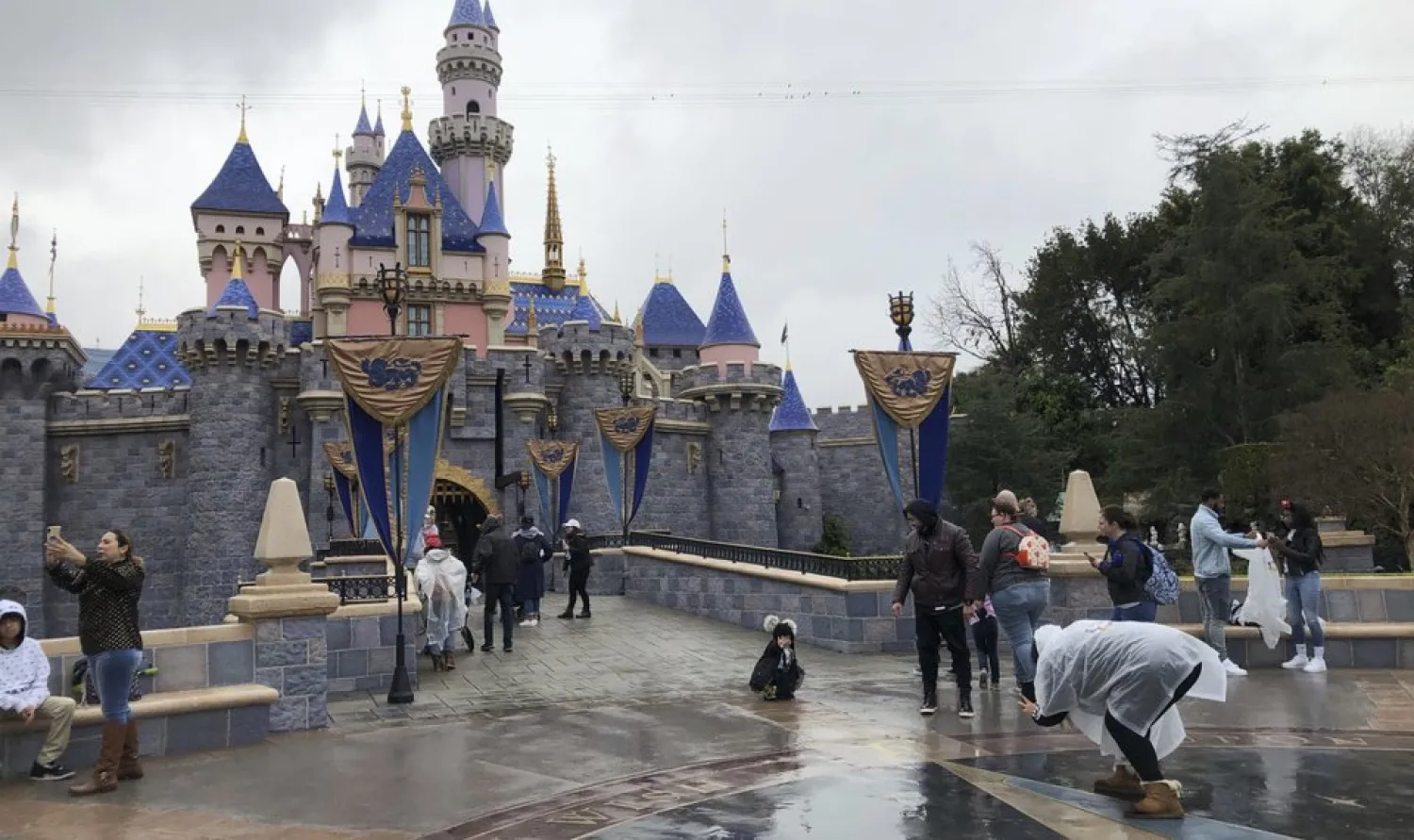
In this March 13, 2020, file photo, visitors take photos at Disneyland in Anaheim, Calif. California officials will allow people to attend Major League Baseball games and other sporting events, go to Disneyland, and watch live performances in limited capacities starting April 1, 2021. (AP Photo/Amy Taxin, File)
TT

California OKs Reopening of Ball Parks, Disneyland

In this March 13, 2020, file photo, visitors take photos at Disneyland in Anaheim, Calif. California officials will allow people to attend Major League Baseball games and other sporting events, go to Disneyland, and watch live performances in limited capacities starting April 1, 2021. (AP Photo/Amy Taxin, File)

California has cleared a path for fans to hit the stands at opening-day baseball games and return to Disneyland nearly a year after coronavirus restrictions shuttered major entertainment spots.

The state on Friday relaxed guidelines for reopening outdoor venues as a fall and winter surge seemed to be ending, with COVID-19 infection rates, hospitalizations and deaths plummeting and vaccination rates rising.

New public health rules would allow live concerts at stadiums and sports arenas to reopen with limited attendance April 1. Amusement parks also will be permitted to reopen in counties that have fallen from the state's purple tier - the most restrictive - to the red tier.

In all cases, park capacities will be limited, and COVID-19 safety rules such as mask-wearing requirements will apply.

The move followed a week of milestones, with California ramping up vaccinations for the poorest neighborhoods, counties reopening more businesses, and Gov. Gavin Newsom passing a measure aimed at encouraging schools that have restricted students to online learning to reopen classrooms this month.

"Steady opening is consistent with the data. As cases decline, we want to return to work and school," said Dr. Jeffrey Klausner, clinical professor of preventive medicine at the University of Southern California. "Outdoor activities, in particular, have always been low risk. Opening these sites makes sense."

The reopening can't come too soon for Kenny King Jr., a resident of Pleasant Hill in the San Francisco Bay Area who became an annual Disneyland passholder a decade ago. He typically takes his family to the Southern California park five times a year, but the last visit was just over a year ago for his birthday.

King, 38, lives in said he's excited to return with his 8-year-old daughter, who had just started enjoying rides such as Big Thunder Mountain Railroad and Space Mountain, and to take his 2-year-old son, who was mesmerized by the lights and sounds when he visited last year.

"That´s something that we just made our family thing - Disney trips," King said. "We´ll sit there at the house sometimes and we´ll be like `man, I just miss Disneyland.' "

Also applauding were the thousands of workers who were laid off by Disneyland, Universal Studios Hollywood, Knott's Berry Farm, and other big locations. Ten thousand lost their jobs alone at Disneyland and its related attractions in Orange County, not to mention the knock-on effect to nearby restaurants and hotels.

Andrea Zinder, president of the local United Food and Commercial Workers Union that represents Disney workers, said employees are "excited to go back to work and provide Californians with a bit more magic in their lives."

Most of the major theme parks are in Southern California, which is still in the purple category. However, Los Angeles, Orange, and San Diego counties there were expecting to reopen within the next few weeks as their COVID-19 numbers fall.

Only 16 of 58 counties currently are in the red tier, and two small counties are in the orange tier. None are yet in the yellow tier, the lowest and least restrictive.

Theme parks in the red tier will be limited to 15% capacity.

Outdoor sports will be limited to 100 people in the purple tier but will increase up to 67% in the yellow tier.

The San Diego Padres, Los Angeles Angels, and Oakland A´s all announced they will have fans in the stands for opening day April 1. The Los Angeles Dodgers and San Francisco Giants both start their seasons on the road and said they would announce their plans later.

Teams and event organizers can only sell tickets regionally in the purple tier. In the other tiers, teams and organizers can sell tickets to anyone living in California. No concessions will be allowed in the purple tier, while in others, concession sales will only be available at seats.

Richard Haick of San Pablo, California, already bought ticket vouchers for the Oakland A´s return and hopes to take his 10-year-old son to a game soon. His son plays Little League baseball and is very excited to attend games.

"It´s nice to have, even in a reduced capacity, some sense of normal," said Haick, a 45-year-old photographer.

The quicker pace of reopening is tied to a new plan to vaccinate California´s most vulnerable residents. Once 2 million people across 400 ZIP codes in the most disadvantaged neighborhoods receive at least one vaccine dose, it will be easier for counties to exit the state´s most restrictive tier. Once 4 million people in those neighborhoods are vaccinated, counties will be able to open up even more.

It all puts California in a drastically different position than a year ago, when Gov. Gavin Newsom imposed the statewide stay-at-home order that restricted travel, shuttered businesses, and forced millions of people onto unemployment. California still has among the most severe restrictions of any state and continues to discourage out-of-state visitors.

The state is pinning its hopes of a full reopening on inoculating enough of its 40 million residents to halt widespread COVID-19 infections.

More than 10 million doses had been given only three months since the first shot was given, the Department of Public Health said.

Just over 3 million people have been fully vaccinated, or about 10% of the population 16 and older.

There are hopeful signs. This week, the seven-day average rate of positive results from tests dropped this week to 2.2%, a record low.

Although pressure has been building to reopen the economy, health officials said the changes in guidelines were a cautious and measured rather than a wholesale approach.

"We will .... keep our foot on the brake, not the gas, our eyes on the road, hands on the wheel and navigate based on data and science," said Dr. Mark Ghaly, secretary of the state Health and Human Services Agency.


Missing Teen Found Alive After 6 Days in Australian Woodlands

In this image made from video and provided by the Victoria State Police 17-year-old William, center right, is embraced by his mother Elizabeth, only first names were provided by police, while in a helicopter in Cowwarr, Australia, Thursday, Nov. 12, 2026, after William spent six days lost in eastern Australian woodlands. (Victoria Police via AP)
TT

Missing Teen Found Alive After 6 Days in Australian Woodlands

In this image made from video and provided by the Victoria State Police 17-year-old William, center right, is embraced by his mother Elizabeth, only first names were provided by police, while in a helicopter in Cowwarr, Australia, Thursday, Nov. 12, 2026, after William spent six days lost in eastern Australian woodlands. (Victoria Police via AP)

A 17-year-old boy with autism was found alive Thursday after six days lost in eastern Australian woodlands.

The boy, whom police identified only as William, had begun camping with a teenage friend when he disappeared last Friday near Walhalla, a former gold-mining town 185 kilometers (115 miles) east of Melbourne, police said.

A police helicopter crew found him surrounded by wilderness lying asleep on a flat rock beside a creek, and he was later reunited with his mother. William was in good spirits and mostly in good health, the police statement said.

Video shot from the rescue helicopter showed he was shirtless and sunburned. He was wearing shorts and boots and was using towels as blankets.

“I’m just over the moon that he’s alive,” his mother, Elizabeth, told reporters.

The AP has decided not to provide her family name to avoid identifying her son.

“And he’s never leaving the house again. He’s grounded for life. He’s not going anywhere ever again,” she joked.

William was later taken to a hospital for his health to be monitored, police said.

William's family have said he has Level 2 autism. That requires “substantial support,” according to the Australian advocacy group Autism360.

Such a person may have marked deficits in verbal and non-verbal social communication and rely heavily on routines and predictable activities.

Disruption can cause significant distress.

The Southern Hemisphere spring weather had been mild for the past week in the alpine region where William was lost and there had been little rain.

Elizabeth had dropped off her son and his friend last Friday for a weekend of camping. William walked a short distance from the campsite to the drop-off location to collect more camping equipment but never returned to his friend, police said.

After becoming lost, William trekked for days up and down “some very steep terrain,” Acting Police Inspector Jason Benbow said.

He spent the last two days where he was found at the creek, trapped by the steepness of his surrounds 2 kilometers (1.2 miles) from his camp site, Benbow said.

“He woke up to the sound of the helicopter, gave them a thumbs up and they winched him to safety,” Benbow told reporters.

The extensive police search for him involved more than 100 emergency services personnel and volunteers.


Europe’s Hera Spacecraft Begins Close Inspections of an Asteroid Rammed by NASA in a 2022 Test

This undated image provided by the European Space Agency on Nov. 5, 2026 and taken by the Hera spacecraft, shows asteroid Didymos. (European Space Agency via AP)
TT

Europe’s Hera Spacecraft Begins Close Inspections of an Asteroid Rammed by NASA in a 2022 Test

This undated image provided by the European Space Agency on Nov. 5, 2026 and taken by the Hera spacecraft, shows asteroid Didymos. (European Space Agency via AP)

A European spacecraft has begun close inspections of an asteroid rammed by NASA four years ago in a planetary defense test.

The European Space Agency announced Wednesday that the Hera spacecraft is now studying Didymos and its moonlet Dimorphos from just 15 miles to 18 miles (25 kilometers to 30 kilometers) away, The AP news reported.

NASA’s Dart spacecraft deliberately slammed into little Dimorphos in 2022 to see whether such a defensive move might help save Earth from a killer space rock one day.

The impact shortened the moonlet’s orbit around Didymos. More importantly, it nudged the moonlet into a slightly different path around the sun.

Next month, the small car-sized Hera, launched in 2024, will venture even closer — just 12 miles (20 kilometers) away.

ESA officials consider this a “crash site investigation” worthy of its finest robotic detective. Hera is carrying 25 science instruments as well as a pair of shoebox-sized Cubesats to survey Dimorphos even more closely and attempt to land on it.

The Dart spacecraft — short for Double Asteroid Redirection Test — sent rubble and even boulders flying off Dimorphos, providing an extra kick to the impact’s momentum. The debris trail extended thousands of miles (more than 10,000 kilometers) into space for months.

Some of that debris could still be in the vicinity, according to scientists.

Dimorphos is an estimated 500 feet (151 meters) in diameter. Didymos is roughly 2,560 feet (780 meters) in diameter.


Euclid Mission Data Release Spans More than 900 Million Galaxies

Looking across vast distances means peering into the past because of the time needed for light from distant objects to reach us (Reuters)
TT

Euclid Mission Data Release Spans More than 900 Million Galaxies

Looking across vast distances means peering into the past because of the time needed for light from distant objects to reach us (Reuters)

The European Space Agency has released its first big collection of data from the orbiting Euclid telescope's mission to map the universe's large-scale structure, including observations of more than 900 million galaxies, as scientists investigate the puzzling cosmic components dark matter and dark energy.

The data unveiled on Thursday covered a survey of the sky equal to about 9,500 times the size of the moon as viewed from Earth. The mission's goal is to complete the largest-ever three-dimensional atlas of the cosmos, spanning more than a third of the sky, in 2031.

Thursday's release encompassed around 13 months of Euclid observations, totaling an enormous 1.7 petabytes — 1.7 million gigabytes — of data, Reuters reported.

"It marks a major milestone for ESA's Euclid mission and for everyone involved," said astrophysicist Valeria Pettorino, ESA's Euclid project scientist.

Euclid, launched from Florida in 2023, is gathering data on how the universe has expanded and how its structure has formed over time while amassing information about the nature of dark energy and dark matter and the role of gravity on large scales.

"Euclid will not just take images of galaxies in the sky, in two dimensions, but will also measure their distance, the third dimension. This will tell us where galaxies are in space and time, across 10 billion years, and in all directions beyond our galactic plane," Pettorino said.

"Galaxies cluster along filaments, surrounded by empty space, and form a network that we call the cosmic web. Euclid will reconstruct the cosmic web and how it has grown over time. This is important because the exact configuration of the cosmic web, how many clusters or voids are there, how fast it changed, depend on the properties of dark energy and dark matter," Pettorino said.

The universe's contents include ordinary matter as well as dark matter and dark energy.

Ordinary matter — stars, planets, gas, dust and all the familiar stuff on Earth — represents about 5% of the contents. Dark matter, known from the gravitational effects it exerts on galactic scales, is invisible material that may make up about 27% of the cosmos. Dark energy, thought to be responsible for the accelerated expansion of the universe, may account for 68%.

Dark matter and dark energy do not emit or absorb light and cannot be directly observed.

Previous Euclid data releases covered only a few days of observations. The newly released dataset includes more than a year of data and still spans only 14% of the total sky area Euclid is due to survey in visible and near-infrared light over six years. This data release will be completed next year with the first results on dark energy and dark matter.

GRAVITATIONAL LENSING

Light traveling toward Earth from faraway galaxies can be bent and distorted by normal matter and dark matter in the foreground, an effect called gravitational lensing. Thus, the nearer galaxy's gravity warps the light coming from the one behind.

Gravitational lensing is one of the tools being used to study dark matter's distribution. The new Euclid data includes about 15,000 strong gravitational lens candidates, exceeding the total number discovered in the previous half century.

"Gravitational lenses are nature's own weighing scales," said Natalie Lines, a doctoral student in astrophysics at the University of Portsmouth in England and a member of the Euclid Consortium of scientists.

"How strongly the light is bent tells us how much matter a galaxy contains, including invisible components like dark matter. With thousands of lenses, we can study how dark matter is spread through galaxies and understand how galaxies form and evolve over cosmic time," Lines said.

Lines noted the sharpness of the Euclid images over a huge area of the cosmos.

"Telescopes on Earth can cover large areas of the night sky, but their view is blurred by the atmosphere. The Hubble and James Webb space telescopes take beautifully sharp images, but only of tiny patches of sky. Euclid does both at once, and that is crucial for finding things that are small and rare, like strong gravitational lenses," Lines said.

Looking across vast distances means peering into the past because of the time needed for light from distant objects to reach us. The most distant objects Euclid has viewed are quasars, the brilliant cores of galaxies powered by supermassive black holes. The telescope has pinpointed 60 million of them.

"Euclid has found some dating back to when the universe was just 5% of its current age, so their light set off around 13 billion years ago," Lines said.