


Lebanon's Army Chief Warns Economic Crisis is Hurting Troops

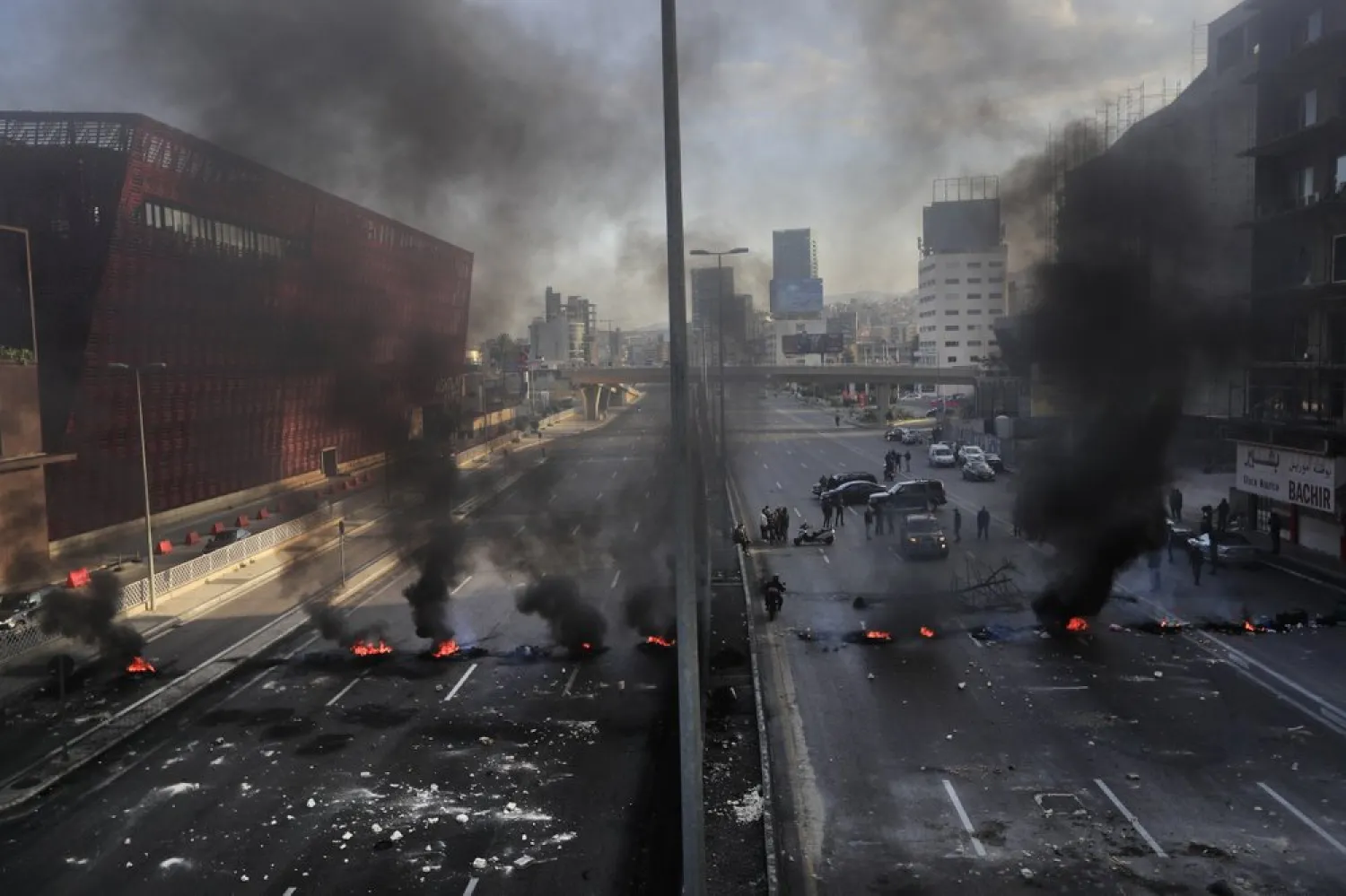
Black smoke rise from burned tires set by protesters to block a main highway, during a protest in the town of Jal el-Dib, north of Beirut, Lebanon, Monday, March 8, 2021. (AP)
TT

Lebanon's Army Chief Warns Economic Crisis is Hurting Troops

Black smoke rise from burned tires set by protesters to block a main highway, during a protest in the town of Jal el-Dib, north of Beirut, Lebanon, Monday, March 8, 2021. (AP)

Lebanon’s army chief warned Monday that soldiers are hurting from the severe economic crisis engulfing the country, voicing rare criticism from the military of a ruling class that has done little to try and resolve a months-long political deadlock.

Gen. Joseph Aoun’s comments came as protesters, angry with Lebanon's political class, blocked major roads leading to the capital for the seventh straight day. They caused traffic jams and prompted the head of the country's hospital union to warn they were preventing oxygen supplies from reaching medical centers treating coronavirus patients.

The protests come against the backdrop of a crash in the local currency, an increase of consumer goods prices and political bickering between rival groups that has delayed the formation of a new government. Lebanon's currency has lost 85% of its value in the past year and a half.

In a rare statement, Aoun said the financial and economic crisis is hurting soldiers whose salaries have lost value, adding that “members of the military are suffering and getting hungry like the rest of the people.”

In unprecedent criticism of the political class, which is doing little to move the country out of the crisis, the general said: “We have warned more than once about the dangers of the situation and how things might blow up.”

Aoun referred to budget cuts to the army over the past few years but also vowed the army would protect civil peace and prevent acts of sabotage against public or private property.

“They don’t care about the army or the suffering of members of the military,” he said.

Before the currency crash, an enlisted soldier earned the equivalent of about $700 a month but that has dropped to about $100 per month. Officers receive higher salaries but currently make no more than $400 a month.

Earlier on Monday, President Michel Aoun, who is from the same family but not closely related to the general, blasted the road closures calling them “organized acts of sabotage that aim to undermine stability.” His comments came during a meeting attended by heads of the country's security agencies and economic and financial officials.

The army and police “should fully perform their duties and implement the law without hesitation,” he said. His comments sparked concerns of a potential crackdown against the protesters to force them to open the roads. But by nightfall, many roads were still blocked.

Starting in the early morning hours, small groups of demonstrators blocked the southern, northern and eastern entrances to Beirut with burning tires and parked vehicles. In other parts of Lebanon, soldiers briefly opened some roads only to have protesters close them again shortly afterward.

In the southern village of Abbasiyeh, a man poured gasoline on his body and tried to set himself on fire before civil defense members and soldiers intervened and sprayed his body with water.

Tens of thousands have lost their jobs over the past year as the economic crisis, the worst in Lebanon's modern history, was made worse by the spread of the coronavirus. According to the World Bank, the crisis is expected to drag more than half of Lebanon’s population into poverty.

Sleiman Haroun, president of the association that represents hospitals in Lebanon, told The Associated Press that after a two-day weekend in which there was no oxygen distribution, some hospitals were running low and in urgent need of supplies, especially to treat COVID-19 patients.

“This is not a joke. It is a matter of life and death,” Haroun said, urging protesters to allow vehicles carrying supplies of oxygen to pass. There are several oxygen plants around Lebanon and they supply hospitals throughout the country, including some in remote areas.

Cases of coronavirus remain high in Lebanon, with 2,283 new cases registered Monday, raising the total since February last year to nearly 400,000. The virus has also killed 5,090 people, including 43 on Monday.

The rapidly deteriorating situation in Lebanon prompted Pope Francis, who has just completed the first papal visit to Iraq, to say he is contemplating visiting the country, which has the largest percentage of Christians in the Middle East.

He said Lebanese Maronite Patriarch Beshara al-Rai had asked him to add a Beirut leg onto his Iraq trip, but he declined.

“It seemed too little, like a crumb considering the problems that the country is suffering. I wrote him a letter and I promised I’d go to Lebanon. But Lebanon in this moment is in crisis,” he told reporters on the flight back to Rome.

In October, former Prime Minister Saad Hariri was named to form a new Cabinet but five months later, disagreements between him and President Aoun on the shape of the Cabinet have stood in the way of a new government’s formation.

The local currency hit a record low against the US dollar on Saturday, nearing 11,000 pounds on the black market.



Israeli Settlers Forcibly Enter Palestinian Home and Kill Sheep in Latest West Bank Attack

 This picture shows sheep grazing on a field in Kafr al-Labad with the Israeli settlement of Avnei Hefetz seen in the background, near the city of Tulkarem in the occupied West Bank on December 18, 2025. (AFP)
This picture shows sheep grazing on a field in Kafr al-Labad with the Israeli settlement of Avnei Hefetz seen in the background, near the city of Tulkarem in the occupied West Bank on December 18, 2025. (AFP)
TT

Israeli Settlers Forcibly Enter Palestinian Home and Kill Sheep in Latest West Bank Attack

 This picture shows sheep grazing on a field in Kafr al-Labad with the Israeli settlement of Avnei Hefetz seen in the background, near the city of Tulkarem in the occupied West Bank on December 18, 2025. (AFP)
This picture shows sheep grazing on a field in Kafr al-Labad with the Israeli settlement of Avnei Hefetz seen in the background, near the city of Tulkarem in the occupied West Bank on December 18, 2025. (AFP)

Israeli settlers attacked a Palestinian home in the south of the Israeli-occupied West Bank overnight, breaking in and killing sheep, a Palestinian official said Tuesday. It was the latest in a surge of attacks by settlers against Palestinians in the territory in recent months.

Israeli police said they arrested five settlers.

The settlers killed three sheep and injured four more, smashed a door and a window of the home, and fired tear gas inside, sending three Palestinian children under the age of 4 to the hospital, said Amir Dawood, who directs an office documenting such attacks within a Palestinian governmental body called the Wall and Settlement Resistance Commission.

Police said they arrested the five settlers on suspicion of trespassing onto Palestinian land, damaging property and dispensing pepper spray, not tear gas. They said they are investigating.

CCTV video from the attack in the town of As Samu’, shared by the commission, showed five masked settlers in dark clothing, some with batons, approaching the home and appearing to enter. Sounds of smashing are heard, as well as animal noises. Another video from inside shows masked figures appearing to strike sheep in the stable.

Photos of the aftermath, also shared by the commission, show smashed car windows and a shattered front door. Bloodied sheep lie dead as others stand with blood staining their wool. Inside the home, photos show broken glass and the furniture ransacked.

Dawood said it was the second settler attack on the family in less than two months. He called it “part of a systematic and ongoing pattern of settler violence targeting Palestinian civilians, their property and their means of livelihood, carried out with impunity under the protection of the Israeli occupation.”

During October’s olive harvest, settlers across the territory launched an average of eight attacks daily, the most since the United Nations humanitarian office began collecting data in 2006. The attacks continued in November, with the UN recording at least 136 by Nov. 24.

Israel captured the West Bank, east Jerusalem and Gaza — areas claimed by the Palestinians for a future state — in the 1967 war. It has settled over 500,000 Jews in the West Bank, in addition to over 200,000 in contested east Jerusalem.

Israel’s government is dominated by far-right proponents of the settler movement, including Finance Minister Bezalel Smotrich and Cabinet Minister Itamar Ben-Gvir, who oversees the nation’s police force. Earlier this week, Smotrich said the Israeli cabinet had approved a proposal for 19 new Jewish settlements, another blow to the possibility of a Palestinian state.


Palestinian Authority Says Israel Tightening Control Over West Bank with New Settlements

Israeli bulldozers level land at the evacuated Israeli settlement of Sanur, near the West Bank city of Jenin, 23 December 2025. (EPA)
TT

Palestinian Authority Says Israel Tightening Control Over West Bank with New Settlements

Israeli bulldozers level land at the evacuated Israeli settlement of Sanur, near the West Bank city of Jenin, 23 December 2025. (EPA)

The Palestinian Authority condemned on Tuesday Israel's recent approval of 19 settlements in the occupied West Bank, accusing it of tightening its control over Palestinian land.

On Sunday, Israel's far-right Finance Minister Bezalel Smotrich announced the authorities had greenlit the settlements, saying the move was aimed at preventing the establishment of a Palestinian state.

The Ramallah-based Palestinian foreign ministry decried the approval as a "dangerous step aimed at tightening colonial control over the entirety of Palestinian land", calling it a continuation of "apartheid, settlement, and annexation policies that undermine the inalienable rights of the Palestinian people".

"The decision provides political cover for accelerating the plunder of Palestinian lands, expanding settlement infrastructure... alongside an escalating pace of settler terrorism against members of our people and their properties," it said in a statement.

The latest move brings the total number of settlements approved over the past three years to 69, Smotrich's office said.

Excluding east Jerusalem, which was occupied and annexed by Israel in 1967, more than 500,000 Israelis live in the West Bank, along with about three million Palestinian residents.

Smotrich's office said the 19 newly approved settlements were located in what it described as "highly strategic" areas, adding that two of them -- Ganim and Kadim in the northern West Bank -- would be re-established after being dismantled two decades ago.

Five of the 19 settlements already existed but had not previously been granted legal status under Israeli law, the statement said.

Israel's decision came days after the United Nations said the expansion of Israeli settlements in the West Bank -- all of which are illegal under international law -- had reached its highest level since at least 2017.

US President Donald Trump recently warned that Israel "would lose all of its support from the United States" if it annexed the West Bank.

Israel has occupied the territory since 1967, and violence there has surged following the outbreak of the Gaza war in October 2023 with Hamas's attack on Israel.

Israeli troops or settlers have killed at least 1,028 Palestinians in the West Bank -- both fighters and civilians -- since the start of the fighting in Gaza, according to an AFP tally based on Palestinian health ministry figures.

At least 44 Israelis have been killed in the West Bank in Palestinian attacks or Israeli military operations during the same period, according to Israeli data.


Germany Deports Man to Syria for First Time Since 2011

People attend a protest against reelection of Syria's president Bashar al-Assad, near Syria's embassy, Berlin, Germany May 26, 2021. (Reuters)
TT

Germany Deports Man to Syria for First Time Since 2011

People attend a protest against reelection of Syria's president Bashar al-Assad, near Syria's embassy, Berlin, Germany May 26, 2021. (Reuters)

Germany deported a man to Syria for the first time since the civil war began in that country in 2011, the interior ministry in Berlin announced on Tuesday.

A Syrian immigrant previously convicted of criminal offences in Germany was flown to Damascus and handed over to Syrian authorities on Tuesday morning, the ministry said.