Saudi Ambassador to US Says Kingdom is Practicing ‘Extreme Restraint’ against Houthi Attacks

Saudi Ambassador to the US Princess Reema bint Bandar, Asharq Al-Awsat
TT

Saudi Ambassador to US Says Kingdom is Practicing ‘Extreme Restraint’ against Houthi Attacks

Saudi Ambassador to the US Princess Reema bint Bandar, Asharq Al-Awsat

Saudi Arabia’s ambassador to the US said that the Kingdom is practicing extreme restraint against the barrage of attacks launched daily by Iran-backed Houthi militias against its territory and expressed her country’s determination to restore peace and security to Yemen.

“We are exercising extreme restraint in the face of a daily barrage of weaponized drones and ballistic missiles,” said Princess Reema bint Bandar in a statement posted to the Saudi Embassy in Washington’s website.

The ambassador emphasized that Saudi Arabia has been determined to restore stability and security to Yemen, through a negotiated settlement, since the beginning of the conflict, and it has supported all UN peace initiatives since 2015.

She stressed that Saudi officials remain active in their support of the efforts of UN Special Envoy for Yemen Martin Griffiths and the US Special Envoy for Yemen Timothy Lenderking.

Princess Reema lashed out at the Iran-backed Houthis for their “egregious terrorist attacks” against the Kingdom, warning the international community that the Yemeni militia group believes it can act with impunity.

In the most recent incident, Saudi-led Arab coalition forces, backing Yemen’s internationally recognized government against the Houthis, intercepted a drone targeting an oil tank yard in Ras Tanura Port and a missile heading for an Aramco residential area in Dhahran on Sunday.

The attacks “represent a threat to the stability of global energy supplies, affecting the entire global economy and endangering the lives of Saudi workers in Aramco and thousands more from 80 different nationalities, including Americans,” noted Princess Reema.

She said that the situation is distressing because despite the Kingdom’s efforts to resolve the conflict in Yemen, Houthi cross-border attacks have escalated in the past few weeks.

In addition, she said, the Iran-backed group has launched an offensive in an attempt to take control of the oil-rich city of Marib, which has been a safe haven for internally displaced people since the conflict began six years ago. The Houthis have also shelled and bombarded the city of Taiz and other Yemeni civilian locations, she added.

“The Kingdom is committed to ending the war in Yemen through a political resolution, but on the other side of this conflict is a group driven by the extremist ideology of the Iranian regime,” the Saudi ambassador said.

“Houthis continue to show callous disregard for the suffering of our Yemeni brothers and sisters. Quite simply, by their actions, they show they are not interested in the type of serious dialogue it will take to end the nightmare in Yemen,” she added.

Meanwhile, Iran continues to provide weapons, training and technical support to the Houthis, she said as she called on the international community to take action to prevent the smuggling into Yemen of Iranian weapons that are “being used to terrorize Yemenis and to launch attacks on civilian targets in Saudi Arabia.”

The princess also pointed out that the Houthis have denied UN teams access to carry out emergency repairs on the Safer oil tanker, which has been moored in the Red Sea off the coast of Yemen for more than five years. Its condition has deteriorated to the extent that it threatens a catastrophic oil spill.

The envoy praised the “brave and remarkable efforts” of the Saudi Armed Forces in successfully intercepting more than 526 Houthi drones and more than 346 ballistic missiles and protecting civilians from all manner of threats.

US State Department spokesman Ned Price said on Monday that the Houthis must demonstrate willingness to engage in a political process to achieve peace in Yemen.

The leaders of the Iran-aligned Houthi movement “have to demonstrate their willingness to engage in a political process. They need to quite simply stop attacking and start negotiating,” said Price.

“Only then will we be able to make progress towards the political settlement that we’re after.”

Price said the attacks were “unacceptable” and put civilians at risk, including Americans.


Saudi Arabia, Egypt, Türkiye, Pakistan Move to Deepen Partnership, Cooperation

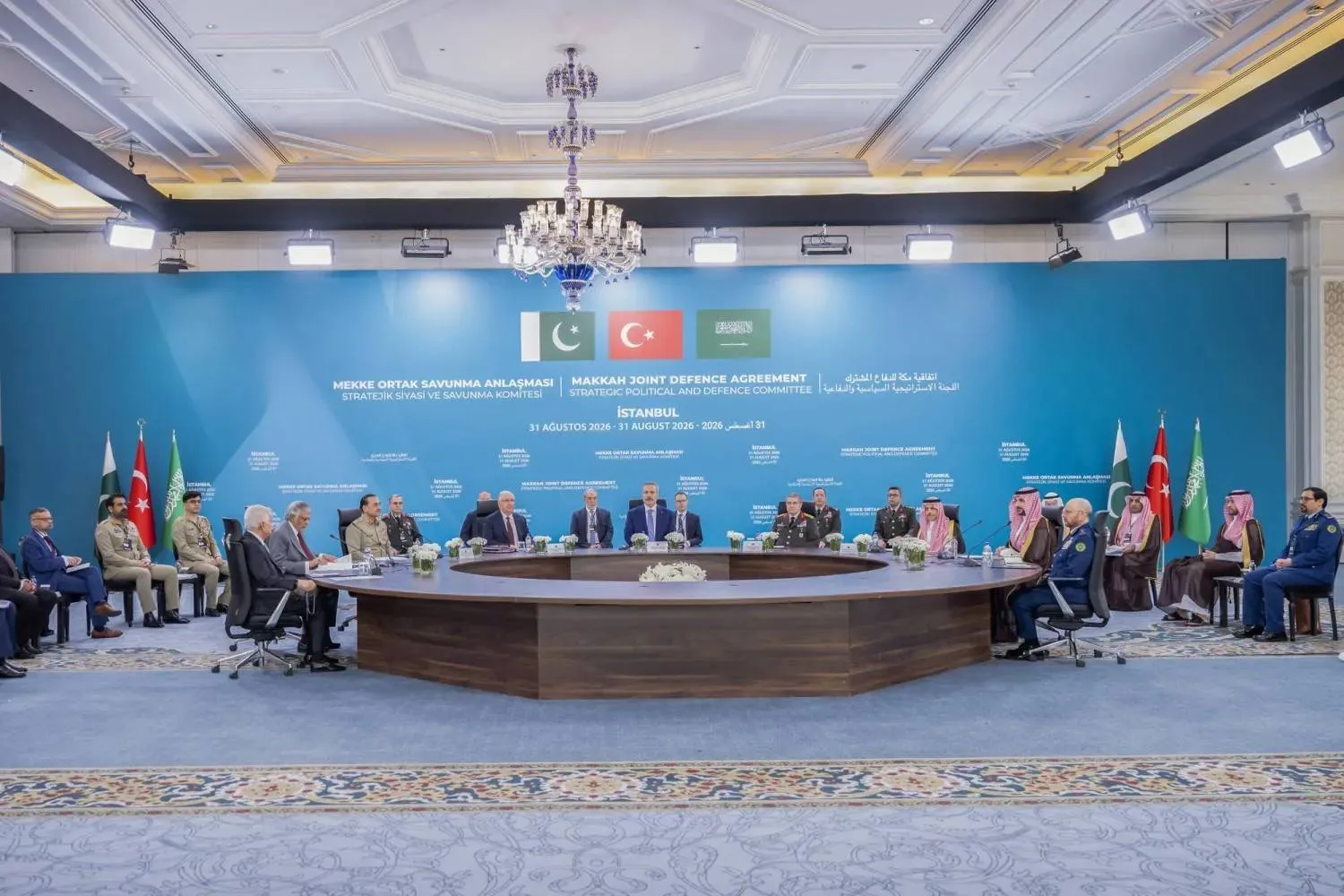
 Foreign ministers attend a four-way meeting in Riyadh on March 20. (Egyptian Foreign Ministry)
Foreign ministers attend a four-way meeting in Riyadh on March 20. (Egyptian Foreign Ministry)
TT

Saudi Arabia, Egypt, Türkiye, Pakistan Move to Deepen Partnership, Cooperation

 Foreign ministers attend a four-way meeting in Riyadh on March 20. (Egyptian Foreign Ministry)
Foreign ministers attend a four-way meeting in Riyadh on March 20. (Egyptian Foreign Ministry)

Egypt will host a four-way meeting with the foreign ministers of Saudi Arabia, Türkiye and Pakistan, days after Washington and Tehran finalized a memorandum of understanding to stop the war that began in late February.

Egyptian Foreign Minister Badr Abdelatty will meet his Saudi counterpart, Prince Faisal bin Farhan, Türkiye’s Hakan Fidan and Pakistan’s Mohammad Ishaq Dar in Cairo on Sunday for a four-way meeting, Egypt’s state news agency reported late on Thursday.

The talks will be followed by an expanded session and a press conference.

A former Egyptian diplomat told Asharq Al-Awsat the meeting would focus on “ways to consolidate cooperation, deepen partnership and coordinate on regional issues, complete efforts to cement de-escalation in the region, and narrow differences during the next 60 days of negotiations between Washington and Tehran.”

The quartet played a prominent role in reaching the US-Iran agreement days ago. Its efforts formally began with a meeting in March in the Saudi capital, Riyadh, followed by meetings in Islamabad and Antalya as part of efforts to end the Iran war.

The meeting comes two days after the Swiss government said negotiations between the United States and Iran, due to begin on Friday in Switzerland, had been postponed indefinitely.

The announcement came hours after a planned visit by US Vice President JD Vance was canceled.

Iranian Supreme Leader Mojtaba Khamenei said earlier on Thursday that he had approved the memorandum of understanding signed by Washington and Tehran, despite expressing reservations about it.

US forces said they had lifted a naval blockade on Iranian ports after the memorandum was signed by the US and Iranian presidents on Wednesday.

Ambassador Mohamed Hegazy, a member of the Egyptian Council for Foreign Affairs and a former assistant foreign minister, told Asharq Al-Awsat the call for the four-way meeting marked an important step in regional consultations at a time of deep strategic shifts in the Middle East.

He cited the ceasefire, the containment of the US-Iran military confrontation, and the risks of the continuing war in Gaza and its impact on regional security and stability.

He said the “consultative quartet” of influential regional states had “proved its presence as an effective regional and international framework capable of addressing problems and issues in coordination with regional states and major powers to calm regional conditions and deal with their problems.”

Hegazy said the meeting’s importance went beyond traditional political coordination. He expected the agenda to include support for consolidating the “Washington-Tehran agreement,” continuing negotiations, discussing Gaza and Lebanon, and backing efforts to secure a sustainable regional calm.

The meeting is also expected to “open the door to deepening partnership and coordination among the quartet, and to studying the possibility of holding a regional or international conference on security and cooperation in the Middle East, similar to successful experiences in other regions,” Hegazy said.

Such a conference, he said, would aim to draft a declaration of principles governing regional relations and establish institutional mechanisms for dialogue, dispute settlement, and stronger economic, security and humanitarian cooperation among the region’s countries.

Egypt’s Foreign Ministry said on Friday that Abdelatty held separate phone calls with Pakistan’s Mohammad Ishaq Dar and Iranian Foreign Minister Abbas Araghchi to discuss regional developments after the US-Iran memorandum of understanding.

An official statement said the Egyptian and Pakistani ministers stressed “the importance of continuing coordination and joint consultation in the coming phase to ensure the implementation of the memorandum of understanding and reach a final and sustainable agreement that takes into account the interests and concerns of all parties and strengthens diplomatic solutions, in a way that achieves security and stability in the region.”

In his call with Araghchi, Abdelatty expressed hope that the memorandum of understanding would become “an important turning point in support of security and stability in the region, and contribute to opening the way to addressing all issues through dialogue and diplomatic means.”

He also voiced hope for a final and sustainable agreement that addresses the concerns of all parties and supports efforts to achieve lasting security and stability in the region.

Hegazy said it was important to maintain “serious dialogue among the main regional powers over the shape of the regional order that should govern relations among the countries of the region in the next phase, ensuring a shift from the logic of managing successive and recurring crises to building a stable system of security, cooperation and development.”

The current phase requires “the formulation of mutual understandings with Iran on the security of the Arabian Gulf, in a way that reassures all parties and lays the foundation for normal relations based on good neighborliness, common interests, and the non-use or threat of force,” Hegazy said.

He also called for strengthening political and security dialogue mechanisms to prevent the region from returning to cycles of escalation and confrontation, and for building frameworks to manage cooperation and development among the region's countries across various fields.


Saudi Foreign Minister Receives Written Message from Chinese Counterpart

Saudi Vice Minister of Foreign Affairs Waleed Elkhereiji and Chinese Ambassador to Saudi Arabia Chang Hua.(SPA)
TT

Saudi Foreign Minister Receives Written Message from Chinese Counterpart

Saudi Vice Minister of Foreign Affairs Waleed Elkhereiji and Chinese Ambassador to Saudi Arabia Chang Hua.(SPA)

Saudi Minister of Foreign Affairs Prince Faisal bin Farhan bin Abdullah received a written message from Foreign Minister of the People's Republic of China Wang Yi concerning relations between the two countries, the Saudi Press Agency reported Thursday.

The message was received by Vice Minister of Foreign Affairs Waleed Elkhereiji during a meeting at the ministry's headquarters in Riyadh with Chinese Ambassador to Saudi Arabia Chang Hua.

During the meeting, the two sides reviewed bilateral relations and discussed regional and international developments.


MWL Condemns Escalating Israeli Settler Violence against Palestinians in West Bank

The Muslim World League (MWL) logo
TT

MWL Condemns Escalating Israeli Settler Violence against Palestinians in West Bank

The Muslim World League (MWL) logo

The Muslim World League (MWL) strongly condemned the continued attacks by Israeli settlers against Palestinians in the occupied West Bank, the Saudi Press Agency reported on Friday.

The latest Israeli aggression in the West Bank targeted the Grand Mosque in the village of Jiljilya and Al-Farouq Mosque north of Ramallah.

In a statement issued by the MWL General Secretariat, Secretary-General and Chairman of the Organization of Muslim Scholars Sheikh Dr. Mohammed Al-Issa denounced the escalating waves of violence carried out by settlers against Palestinians and their property and sacred sites in the occupied West Bank.

He said the attacks constitute a grave violation of the sanctity of places of worship and of all international and humanitarian laws and norms, undermine peace efforts, and threaten security and stability in the region.