



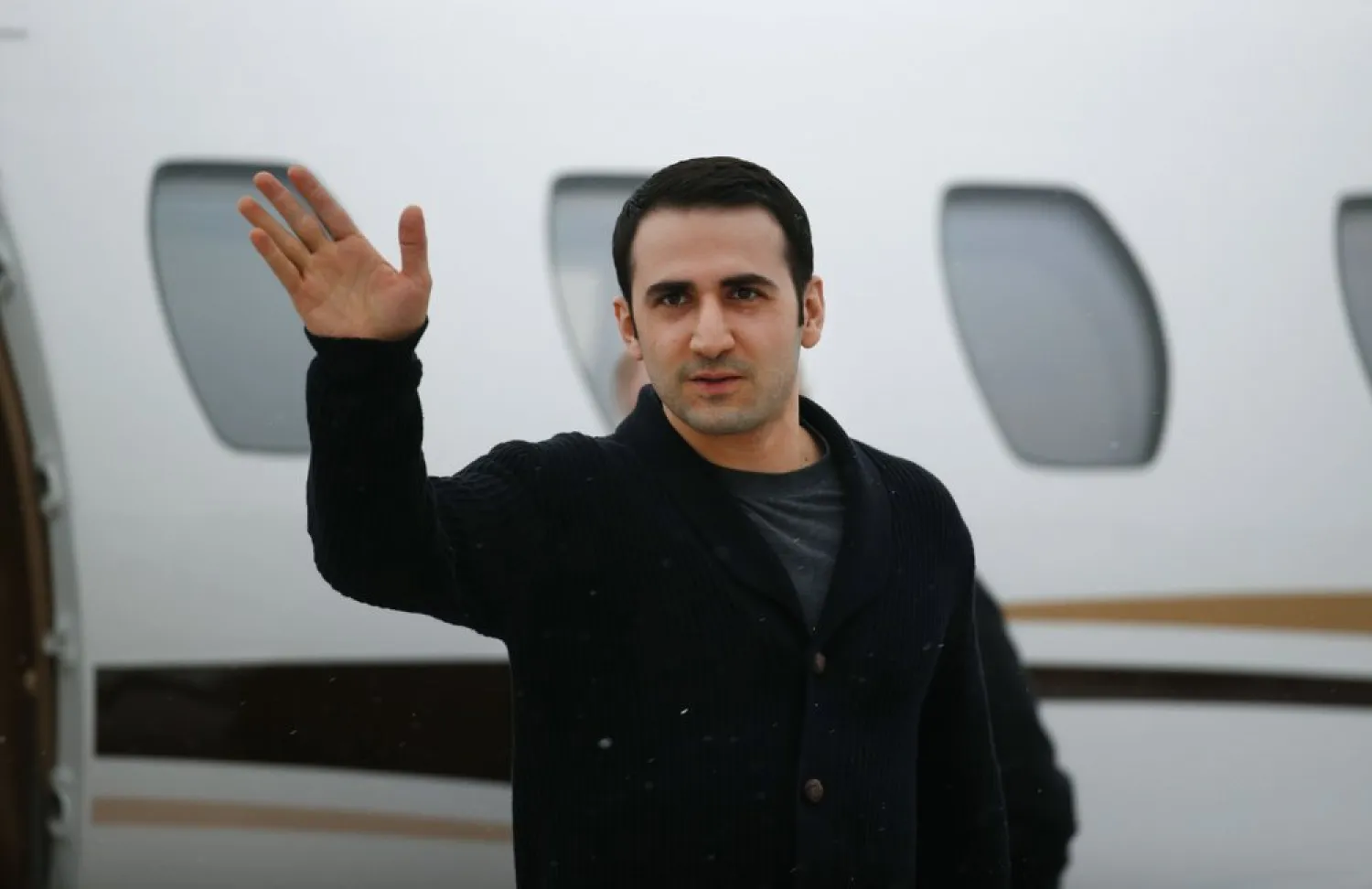

After Amir Hekmati was released from Iranian custody in a 2016 deal trumpeted as a diplomatic breakthrough, he was declared eligible for $20 million in compensation from a special US government fund.
But payday never arrived, leaving Hekmati to wonder why.
The answer has finally arrived: Newly filed court documents reviewed by The Associated Press reveal FBI suspicions that he traveled to Iran to sell classified secrets — not, as he says, to visit his grandmother. Hekmati vigorously disputes the allegations, has never faced criminal charges and is challenging a special master's conclusion that he lied about his visit to Iran and is therefore not entitled to the money.
The FBI investigation helps explain the government's refusal for more than two years to pay Hekmati and muddies the narrative around a US citizen, Marine and Iraq war veteran whose release was championed at the US government's highest levels, including by Joe Biden, then the vice president, and John Kerry, then the secretary of state. The documents offer radically conflicting accounts of Hekmati's purpose in visiting Iran and detail the simmering, behind-the-scenes dispute over whether he is entitled to access a fund that compensates victims of international terrorism.
Hekmati said in a sworn statement that allegations he sought to sell out to Iran are ridiculous and offensive. His lawyers say the government's suspicions, detailed in FBI reports and letters from the fund's special master denying payments, are groundless and based on hearsay.
“In this case, the US government should put up or shut up,” said Scott Gilbert, a lawyer for Hekmati. “If the government believes they have a case, indict Amir. Try Amir. But you, the US government, won't do that because you can't do that. You don't have sufficient factual evidence to do that.”
Gilbert declined to make Hemkati available for an interview while Hekmati's lawsuit seeking compensation is pending.
The FBI and Justice Department declined to comment, but details from the investigation emerge in hundreds of pages of documents filed in the case.
The documents show the FBI opened an espionage investigation into Hekmati as far back as 2011, the same year he was detained in Iran on suspicion he was spying for the CIA.
Hekmati, who was raised in Michigan and served as an infantryman and interpreter in Iraq before being honorably discharged from the Marines in 2005, says he went to Iran to visit an ailing grandmother after a brief, unsatisfying stint as a Defense Department contractor conducting intelligence analysis in Afghanistan.
But the FBI concluded that he went there intent on selling Iran classified information, according to an unsigned five-page summary of their investigation.
The assessment is based partly on accounts from four independent but unnamed witnesses who say Hekmati approached Iranian officials offering classified information, as well as the fact he abruptly resigned his contracting position before his contract was up and left for Iran without telling friends and colleagues, the FBI says. An FBI computer forensics search concluded that while in Afghanistan, he accessed hundreds of classified documents on Iran that agents believe were outside the scope of his job responsibilities, the documents say.
Hekmati, the son of Iranian immigrants, says he researched Iran openly to cultivate an expertise on Iranian influence in Afghanistan. “Everyone knew” about the work he was doing, he said at a hearing last year, and supervisors didn't place restrictions. He says he'd already quit his job when he left for Iran and therefore wasn't obligated to tell colleagues of his trip. At no point in Iran, he said, did he meet with any Iranian officials or tried to sell government secrets.
Hekmati's lawyers say the FBI's suspicions are impossible to square with the treatment he endured in prison, which they say included torture and being forced to record a coerced but bogus confession. Were he actually spying for Iran, Gilbert said, “You’d think the guy would have been a valuable asset, they actually would have wanted to do something with him" rather than abuse him.
He was initially sentenced to life, but the punishment was cut to 10 years.
Hekmati enjoyed support from senior-level officials, including Kerry, who demanded his release, and Biden, who met with his family in Michigan. In January 2016, after four-and-a-half years behind bars, he was freed with several other American citizens, including Washington Post journalist Jason Rezaian, as the Obama administration entered its final year eager for signs of improving relations after the controversial nuclear deal with Iran.
Months later, Hekmati sued Iran over his torture. A federal judge in Washington entered a $63.5 million default judgment after Iran failed to contest the claims. Hekmati subsequently applied to collect through a Justice Department-run fund for terror victims financed by assets seized from US adversaries. He was awarded the statutory maximum of $20 million, his lawyers say.
The fund’s special master then was Kenneth Feinberg, renowned for overseeing payments to victims of the Sept. 11 attacks. In December 2018, he authorized an initial payment of more than $839,000.
But for months, no money came. After Hekmati's lawyers warned they'd have to sue, the Justice Department cryptically indicated it was seeking a reconsideration of the award.
In January 2020, Feinberg formally revoked Hekmati's eligibility for the fund, saying his application contained errors and omissions and that information from the Justice Department supported the conclusion that Hekmati visited Iran with the intent of selling classified information.
A second letter last December didn't repeat that precise allegation, but said Hekmati had given “evasive, false and inconsistent statements” during three FBI interviews, failed to “credibly refute” that most of the classified information he accessed related to Iran and “traveled to Iran for primary purposes other than to visit his family.”
Feinberg declined to comment, saying his decision “speaks for itself.”
The correspondence had been secret until January when Hekmati’s lawyers filed it in the Court of Federal Claims in Washington as part of its lawsuit. Hundreds of additional pages of documents have since been filed outlining the investigation.
The documents include summaries of FBI interviews from 2016 in Germany, on Hekmati's way home from Iran, and in Michigan that show FBI agents grilling him with increasing suspicion.
One summary says Hekmati refused to answer when asked if he'd ever accessed classified information on Iran and replied the FBI could figure it out itself. In a follow-up interview, an agent confronted Hekmati with the FBI's assessment that he went to Afghanistan to obtain classified information that he could sell to Iran. After a back-and-forth, Hekmati told the FBI that he accessed the material to become a subject matter expert on the topic.
Hekmati and his lawyers state the FBI interviews shouldn't be considered credible in part because he was suffering from the effects of post-traumatic stress at the time.
The status of any investigation is unclear, as are Hekmati's prospects of ever receiving payment. But Gilbert, Hekmati's lawyer, says he hopes the decision gets a fresh look by the new Justice Department.
“I am hopeful that we will see the appropriate outcome here and be able to put this saga to bed.”


