
Freefalling Lebanon Currency Hits New Low

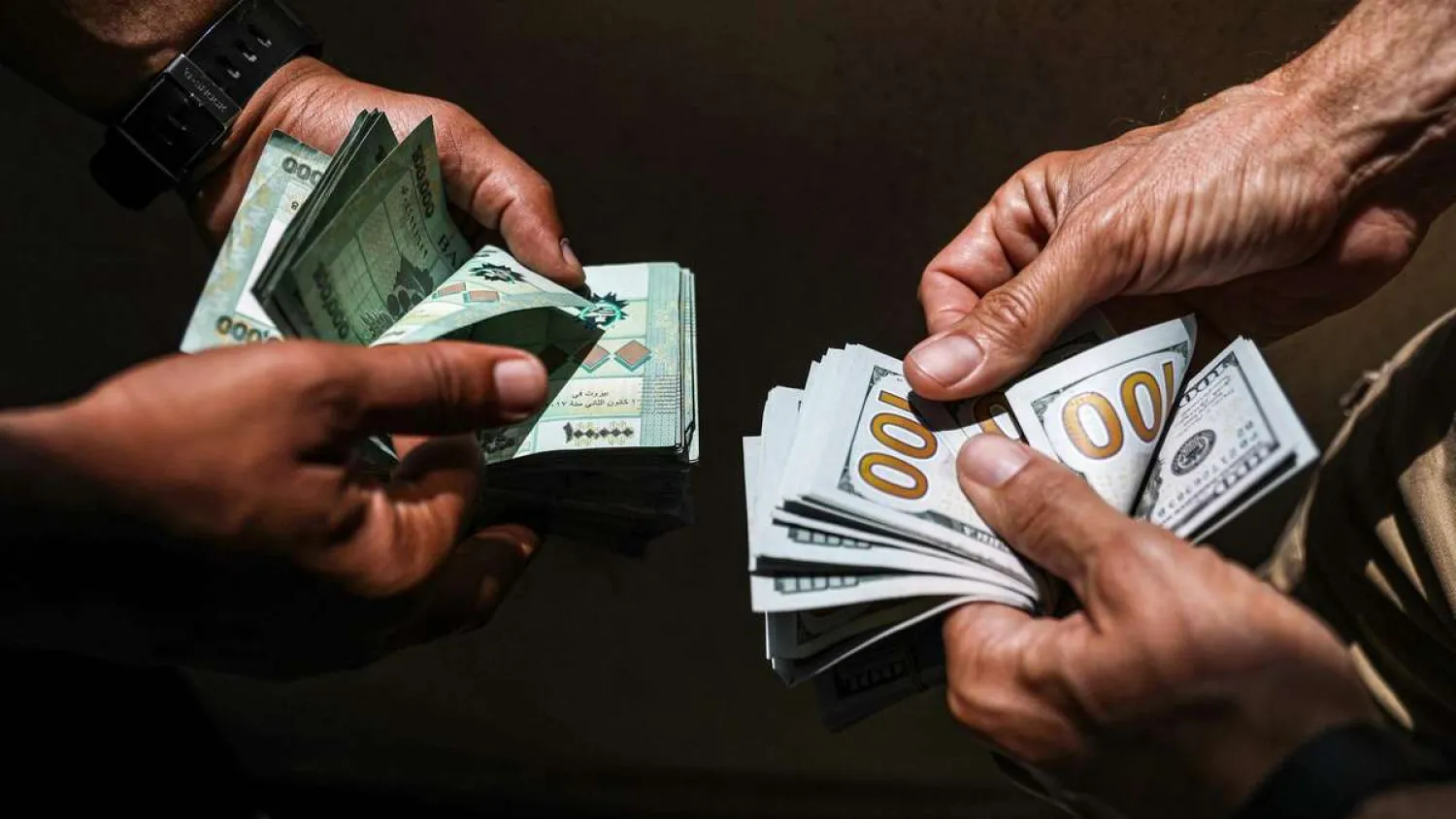
People exchange Lebanese pound and US dollar notes in Lebanon's capital, Beirut. (AFP)
TT

Freefalling Lebanon Currency Hits New Low

People exchange Lebanese pound and US dollar notes in Lebanon's capital, Beirut. (AFP)

Lebanon's currency hit a new low against the dollar on the black market Tuesday, continuing its freefall in a country gripped by political deadlock and an economic crisis.

The latest plunge means the Lebanese pound has lost almost 90 percent of its value on the informal market in about 18 months.

The pound has been pegged to the dollar at 1,500 since 1997, but the country's worst economic crisis since the 1975-1990 civil war has seen its unofficial value plummet.

The slide has picked up speed in the past two weeks, with the exchange rate soaring from 10,000 Lebanese pounds to the dollar on March 2 to around 15,000 on Tuesday.

Three money changers said they were buying dollars for 14,800 to 14,900 pounds, while a customer told AFP they had sold the foreign currency at 15,000 pounds to the dollar.

The pound's fall has led to soaring food prices in a country where more than half of the population now lives below the poverty line.

Gaggles of protesters took to the streets in the capital and elsewhere in the country, in the latest such demonstrations in recent weeks.

"The rate is now 15,000 and rising. We the people are hungry," one protester told local television.

"Political leaders are sitting at home. What more do they want? For a Lebanese to set himself or his children on fire?"

In the afternoon, young protesters on mopeds drove around Beirut calling on shops to shutter, and managed to close down a large supermarket.

Some gas stations closed after they became unable to replenish their tanks over the soaring exchange rate, the National News Agency said.

'Country collapsing'
The smell of burning tires briefly wafted over the capital after they were set alight by protesters.

"Lebanon exchange rate reaches 15,000LL to the 1$. Last night it was 13,250," tweeted analyst Maha Yahya.

"Country collapsing around us & we are unable to do anything," said Yahya, the director of the Carnegie Middle East Center.

Since autumn 2019, banks have largely prevented ordinary depositors from accessing their dollar savings or transferring them abroad, forcing them to resort to the black market to obtain foreign currency.

In a country that needs dollars to import goods, several shops have closed their doors in recent days to re-price goods and some factories have halted production.

The government resigned in August last year after a devastating port blast that killed more than 200 people and ravaged a large part of the capital.

But the deeply divided political class has failed to form a new cabinet to enact desperately needed reforms to unlock billions of dollars in promised international aid.

France and the United States last week hit out at Lebanon's squabbling politicians, with Paris saying they were failing to help the country as it slid towards "total collapse".

France has taken a leading role in trying to break the political deadlock in its former protectorate, with President Emmanuel Macron visiting the country twice last year.

The country was rocked by mass protests in October 2019 against the political class, who demonstrators accuse of being inept and corrupt.

Syria State Media Says 3 Dead in Clashes in Latakia Province

A large Syrian flag flutters above Tishreen Park in Damascus, June 4, 2025. (AFP)
TT

Syria State Media Says 3 Dead in Clashes in Latakia Province

A large Syrian flag flutters above Tishreen Park in Damascus, June 4, 2025. (AFP)

Syrian state media said three people were killed Wednesday in clashes with security forces in coastal Latakia province, the heartland of the country's Alawite minority community.

"Three members of remnants of the former regime were killed after clashes with internal security forces" outside the city of Jableh, state television said.

State news agency SANA had earlier reported "clashes with a group of wanted outlaws" in the area, and said an unspecified number of security personnel were wounded.

Since last December's ousting of longtime ruler Bashar al-Assad, himself an Alawite, Syria's new authorities have frequently reported security operations against remnants of his government.

Syria's coastal areas saw the killing of Alawite civilians in March, with authorities accusing armed Assad supporters of sparking the violence by attacking security forces.

A national commission of inquiry said at least 1,426 members of the minority community were killed at the time.

Last month, thousands of people demonstrated on the Alawite coast in protest of fresh attacks targeting their community.


Israel Demolishes Home of Palestinian Accused of Attack

A picture taken on September 30, 2025 shows the demolished house of Yahya Abu Ghaliyeh, a Palestinian from a Bedouin village near the town of Al-Eizariya, also known as Bethany, east of Jerusalem. (AFP)
TT

Israel Demolishes Home of Palestinian Accused of Attack

A picture taken on September 30, 2025 shows the demolished house of Yahya Abu Ghaliyeh, a Palestinian from a Bedouin village near the town of Al-Eizariya, also known as Bethany, east of Jerusalem. (AFP)

The Israeli army demolished on Wednesday the home of a Palestinian accused of carrying out a stabbing and shooting attack that killed an Israeli earlier this year, the military said, AFP reported.

On July 10, two attackers killed 22-year-old Shalev Zvuluny in a shopping area near Jerusalem, before the Israeli army shot them dead.

On Wednesday, Israeli army bulldozers entered the village of Bazzaryah in the occupied West Bank, destroying the family home of one of the attackers after it had been evacuated.

Israeli forces "demolished the home of the terrorist who carried out the shooting and stabbing attack at the Gush junction, during which Shalev Zvuluny... was murdered", the army said in a statement.

Hazem Yassine, head of the Bazzaryah municipal council, denounced what he called a "heinous crime".

He told AFP that Israeli forces had sealed off the village's entrances since dawn in preparation for the demolition.

"Schools were closed as a precaution," he said, adding that the assailant's family had moved out around a month ago after being notified of the decision to demolish the house.

An AFP photographer saw children climbing on piles of rubble after the demolition, waving the Palestinian flag.

Israel, whose army has occupied the West Bank since 1967, regularly demolishes the homes of Palestinians accused of carrying out deadly attacks against Israelis.

The government defends the deterrent effect of these demolitions, but critics denounce the practice as a form of collective punishment that leaves families homeless.

Violence in the West Bank surged during the war in Gaza, which erupted on October 7, 2023 with Hamas's attack on Israel.

Since then, Israeli soldiers or settlers have killed more than a thousand Palestinians in the West Bank, many of them militants but also including civilians, according to an AFP tally based on Palestinian Authority data.

At the same time, according to official Israeli figures, at least 44 Israelis, including civilians and soldiers, have been killed in Palestinian attacks or during Israeli military raids in the area.


Israel Accuses Hamas of Violating Gaza Truce, Says It Will Respond

A woman sits next to her tent on an alley of a makeshift tent camp for displaced Palestinians in Deir al-Balah, central Gaza Strip, Tuesday, Dec. 23, 2025. (AP Photo/Abdel Kareem Hana)
TT

Israel Accuses Hamas of Violating Gaza Truce, Says It Will Respond

A woman sits next to her tent on an alley of a makeshift tent camp for displaced Palestinians in Deir al-Balah, central Gaza Strip, Tuesday, Dec. 23, 2025. (AP Photo/Abdel Kareem Hana)

Israeli Prime Minister Benjamin Netanyahu accused Hamas on Wednesday of violating the Gaza ceasefire by refusing to disarm, and said Israel would retaliate after a military officer was wounded by what the military described as a bomb. 

In a speech at a graduation ceremony for Air Force pilots, Netanyahu mentioned the attack in Rafah, part of Gaza where Israeli forces still operate, and said Hamas had made clear it had no plan to disarm as foreseen under the October truce deal. 

"Israel will respond accordingly," he said. 

The Israeli military earlier said that an explosive device had detonated against a military vehicle in the Rafah area ‌and that one ‌officer had been lightly injured. 

Hamas denied responsibility. ‌The ⁠blast was "caused ‌by bombs left behind by the enemy that had not exploded previously, and we have informed the mediators of this," said Hamas official Mahmoud Merdawi in an X post. 

A 20-point plan issued by US President Donald Trump in September calls for an initial truce followed by steps towards a wider peace. So far, only the first phase has taken effect, including a ceasefire, release of ⁠hostages and prisoners, and partial Israeli withdrawal. 

Trump's plan ultimately calls for Hamas to disarm and have ‌no governing role in Gaza, and for ‍Israel to pull out. Hamas has said ‍it will hand over arms only once a Palestinian state is ‍established, which Israel says it will never allow. 

Violence has subsided but not stopped since the Gaza truce took effect on October 10, with the sides regularly accusing each other of violating the ceasefire.  

Gaza's health ministry says Israel has killed more than 400 people in the territory since the ceasefire went into effect. Three Israeli soldiers have been killed in militant ⁠attacks. 

Hamas "openly declares it has no intention of disarming, in complete contradiction to President Trump's 20-point plan," Netanyahu said. 

He added that Hezbollah in Lebanon, which Israel severely weakened in strikes last year that also ended in a US-brokered truce, also had no intention to disarm "and we are addressing that as well".  

Israel still needs to settle accounts with Iran-backed Houthis in Yemen as well as Iran itself, he added. 

"As these old threats change form, new threats arise morning and evening. We do not seek confrontations, but our eyes are open to every possible danger," Netanyahu said. 

Netanyahu is set to meet with ‌Trump next week, mainly to discuss the next phase of Trump's Gaza plan.