


Netanyahu Boosts Far-Right Extremist in Re-Election Bid

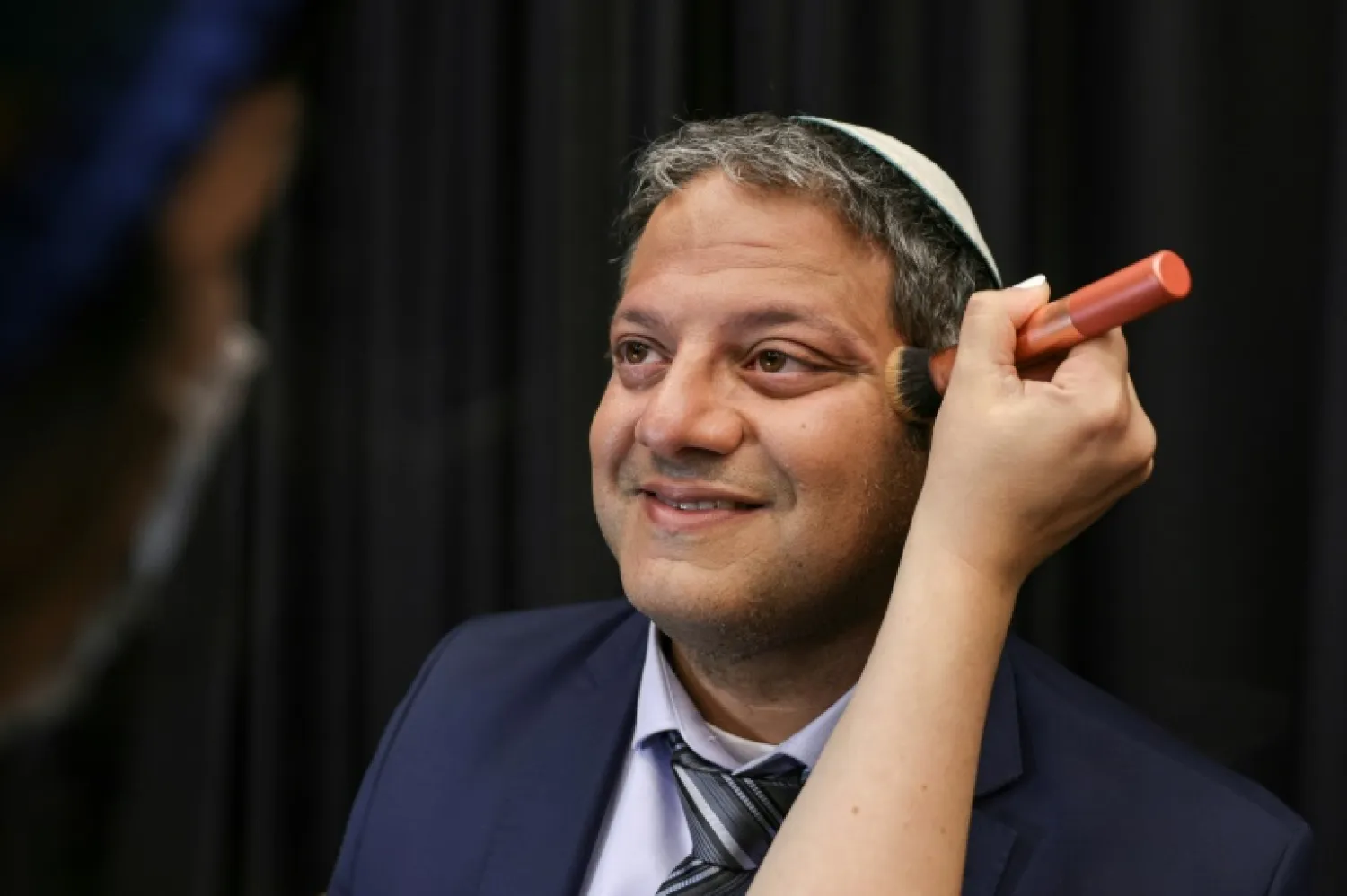
Jewish Power leader Itamar Ben-Gvir has never disavowed his support for Baruch Goldstein, a Jewish extremist who massacred 29 Palestinians in 1994, but with tacit support from Prime Minister Benjamin Netanyahu he could enter parliament next week - AFP
TT

Netanyahu Boosts Far-Right Extremist in Re-Election Bid

Jewish Power leader Itamar Ben-Gvir has never disavowed his support for Baruch Goldstein, a Jewish extremist who massacred 29 Palestinians in 1994, but with tacit support from Prime Minister Benjamin Netanyahu he could enter parliament next week - AFP

Itamar Ben-Gvir has described a Jewish extremist who massacred 29 Palestinians as his "hero", but he could be elected to Israel's parliament next week thanks partly to Prime Minister Benjamin Netanyahu.

Ben-Gvir's political life has had many incarnations, including leader of the Jewish Power party and his current candidacy for the Religious Zionism alliance, which polls show could win four seats in Tuesday's election.

But amid shifting alliances, key aspects of Ben-Gvir's ideology have remained constant.

He was inspired by the late extremist rabbi Meir Kahane, whose Kach movement wanted to expel Arab Israelis from the state, AFP reported.

Kahane was elected to parliament in 1984, but was disqualified from running again in 1988 due to his party's racism.

Kahane, assassinated in New York in 1990, provided ideological inspiration for Baruch Goldstein, who massacred 29 Palestinian worshippers in Hebron in 1994.

Ben-Gvir has on multiple occasions voiced admiration for Goldstein and hung a portrait of the convicted mass-murderer in his home.

His Jewish Power party also backs Israel's annexation of the entire occupied West Bank, which is home to some 2.8 million Palestinians.

Netanyahu is facing his fourth re-election battle in less than two years and polls show he could again struggle to secure a majority in the 120-seat parliament.

Seeking to make up a potential loss of seats to the New Hope party formed last year by prominent defectors from his Likud movement, Netanyahu helped orchestrate a new alliance of far-right religious nationalists.

If this new bloc, Religious Zionism, crosses the minimum threshold required to sit in parliament, it would likely provide the pro-Netanyahu camp with four desperately needed additional seats.

The prime minister has not denied that he helped broker the pact that saw Jewish Home join forces with National Union, led by Betzalel Smotrich, and the Noam party.

Netanyahu has told Israeli media that Ben-Gvir will not get a cabinet position in his government, but would be part of his "coalition."

Opposition leader Yair Lapid of the centrist Yesh Atid said in a tweet last month that it was a "disgrace" Netanyahu was "trying to push" Jewish Power into parliament.

Labour party leader Merav Michaeli has also criticized Ben-Gvir's political re-emergence, citing his incendiary conduct before the 1995 assassination of then prime minister Yitzhak Rabin.

Weeks before Rabin was shot in Tel Aviv by a Jewish extremist opposed to the Oslo peace process, Ben-Gvir snatched the Cadillac badge from the late premier's car.

"Like we reached this symbol, we can reach him too," Ben Gvir boasted at the time.

Michaeli, a Rabin disciple, said recently of Ben-Gvir: "The gun that killed Rabin and the vision of peace in 1995 has returned to assassinate Israeli democracy."

Israeli political analyst Shmuel Rosner told AFP that Netanyahu's tacit boosting of Ben-Gvir is further evidence he has "a great passion to rule and (is) willing to do a lot to remain in power."

"He's less interested in etiquette and what people will say or think and more focused on the simple arithmetics of how to retain power.

"If that means he has to push Ben-Gvir to parliament, that won't stop him," Rosner said.

In pursuing a seat in parliament, Ben-Gvir is seeking to follow another Kahane disciple Michael Ben-Ari, in parliament from 2009 to 2013, who was banned from the legislature by the supreme court over his racist and extremist views.

Rosner noted that Israeli politics had shifted since Ben-Ari's tenure, with the electorate overwhelmingly focused on -- and divided by -- the question of whether Netanyahu deserves to stay or go.

Tolerance of radical voices "has become greater", he said.

"Because the race is so tight and close... more and more psychological barriers are being removed."

While Ben-Gvir remains steadfast in his extremist views and has not disavowed his past support for the mass-murderer Goldstein, he marginally distanced himself from Kahane during the campaign.

Ben-Gvir told the left-wing Haaretz newspaper last month that while he thought Kahane was "wonderful", he did not view himself as the late rabbi's successor and their ideologies were "different."

Following Goldstein's Hebron massacre, Israel branded Kahane's Kach movement a "terrorist" organization.



Iran Guards Chief Says 'Finger on Trigger', Warns US against 'Miscalculations'

Commander of the Iranian Revolutionary Guard Mohammad Pakpour (Archive - Reuters)
TT

Iran Guards Chief Says 'Finger on Trigger', Warns US against 'Miscalculations'

Commander of the Iranian Revolutionary Guard Mohammad Pakpour (Archive - Reuters)

The commander of Iran's Revolutionary Guards on Thursday warned Israel and the US against "miscalculations" in the wake of mass protests, saying the force had its "finger on the trigger".

US President Donald Trump has repeatedly left open the option of new military action against the Iranian republic after Washington backed and joined Israel's 12-day war in June.

A fortnight of protests starting in late December shook the clerical leadership under supreme leader Ali Khamenei, but the movement has petered out in the face of a crackdown that activists say has left thousands dead.

Guards commander General Mohammad Pakpour warned Israel and the United States "to avoid any miscalculations, by learning from historical experiences and what they learned in the 12-day imposed war, so that they do not face a more painful and regrettable fate".

"The Islamic Revolutionary Guard Corps and dear Iran have their finger on the trigger, more prepared than ever, ready to carry out the orders and measures of the supreme commander-in-chief -- a leader dearer than their own lives," he said, referring to Khamenei.

His comments came in a written statement quoted by state television marking the national day in Iran to celebrate the Guards, a force whose mission is to protect the 1979 Iranian revolution from internal and external threats.

Activists accuse the Guards of playing a frontline role in the deadly crackdown on protests. The group is sanctioned as a terrorist entity by countries including Australia, Canada and the United States and campaigners have long urged similar moves from the EU and UK.

Pakpour took over as Guards commander last year after his predecessor Hossein Salami was one of several key military figures killed in an Israeli strike during the 12-day war, losses which revealed Israel's deep intelligence penetration of Iran.

Giving their first official toll from the protests, Iranian authorities on Wednesday said 3,117 people were killed.

The statement from the Iranian republic's foundation for martyrs and veterans sought to draw a distinction between "martyrs", who it said were members of security forces and innocent bystanders, and what it described as "rioters" backed by the US. 

Of its toll of 3,117, it said 2,427 people were martyrs. 

However, rights groups say the heavy toll was caused by security forces firing directly on protesters and that the actual number of those killed could be far higher and even extend to over 20,000. 

Speaking at the World Economic Forum in Davos, Israeli President Isaac Herzog said "the future for the Iranian people can only be in a regime change", adding that the Iranian “regime is in quite a fragile situation". 


Merz Warns Great Power Politics Makes World 'a Dangerous Place'

Germany's Chancellor Friedrich Merz gestures as he speaks during the World Economic Forum (WEF) annual meeting in Davos on January 22, 2026. (Photo by Fabrice COFFRINI / AFP)
TT

Merz Warns Great Power Politics Makes World 'a Dangerous Place'

Germany's Chancellor Friedrich Merz gestures as he speaks during the World Economic Forum (WEF) annual meeting in Davos on January 22, 2026. (Photo by Fabrice COFFRINI / AFP)

German Chancellor Friedrich Merz warned Thursday that the international order is "unravelling at a breathtaking pace" and that "a world where only power counts is a dangerous place".

Speaking at the World Economic Forum in Davos, Merz pointed to Russia's war in Ukraine, a rising China and a United States that is "radically reshaping its foreign and security policy".

"A world where only power counts is a dangerous place," he said. "First for small states and for the middle powers, ultimately for the great ones."

The conservative leader of the top EU economy said Germany went down this road "to its bitter end" during the 20th century, reported AFP.

"It pulled the world into a black abyss," he said.

"So let us bear in mind: our greatest strength remains the ability to build partnerships and alliances among equals based on mutual trust and respect."

Merz called Russia's invasion of Ukraine "the most drastic expression" so far of a global "new era". He added that China, "with strategic foresight, has worked its way into the ranks of the great powers".

"The United States' global pole position is being challenged," Merz said, with Washington responding by "radically reshaping its foreign and security policy".

"We have entered a time of great power politics. The international order of the past three decades anchored in international law has always been imperfect. Today, its very foundations have been shaken."

He said Europe's power rested on three pillars.

"First we must invest massively in our ability to defend ourselves, and we are doing this," he said.

"Second, we must rapidly make our economies competitive, and we are doing this. Third, we must stand closer together among Europeans and among like-minded partners. We are doing this."


Israel President Says Iran's Future 'Can Only Be Regime Change'

Israeli President Isaac Herzog attends the 56th annual World Economic Forum (WEF) meeting in Davos, Switzerland, January 22, 2026. REUTERS/Romina Amato
TT

Israel President Says Iran's Future 'Can Only Be Regime Change'

Israeli President Isaac Herzog attends the 56th annual World Economic Forum (WEF) meeting in Davos, Switzerland, January 22, 2026. REUTERS/Romina Amato

Israel's President Isaac Herzog said on Thursday that "regime change" can be the only future for Iran, where mass protests against the clerical authorities have faced a deadly crackdown.

Demonstrations initially sparked by economic grievances turned into a movement against the theocracy that has ruled Iran since 1979.

People poured into the streets for several days from January 8, but the demonstrations appear for now to have petered out in the face of what activists describe as a crackdown under the cover of a blanket internet shutdown.

"The Iranian people are yearning for change. The Iranian people deserve change," Herzog said in an interview at the World Economic Forum in Davos.

"The future for the Iranian people can only be in a regime change, and that has to be... within the realms of the Iranian people and the international community and its support," he added.

He added saying that the Iranian “regime is in quite a fragile situation."

The Iranian Republic's long-time foe Israel has expressed support for the protesters, without suggesting it would intervene.

Iran accused Israel in early January of trying to undermine its national unity after Prime Minister Benjamin Netanyahu said Israel stood "in solidarity with the struggle of the Iranian people".

Iranian authorities on Wednesday said 3,117 people were killed during the protests that first erupted in late December, but activists said the actual toll risked being many times higher.

Iran and Israel fought a 12-day war last year, after Israel launched a wave of strikes on Iranian nuclear facilities as well as residential areas, saying it aimed to cripple the Iranian republic's atomic research and ballistic missile capabilities.