Middle East Quartet Discusses Reviving 'Meaningful' Israel, Palestinian Peace Talks
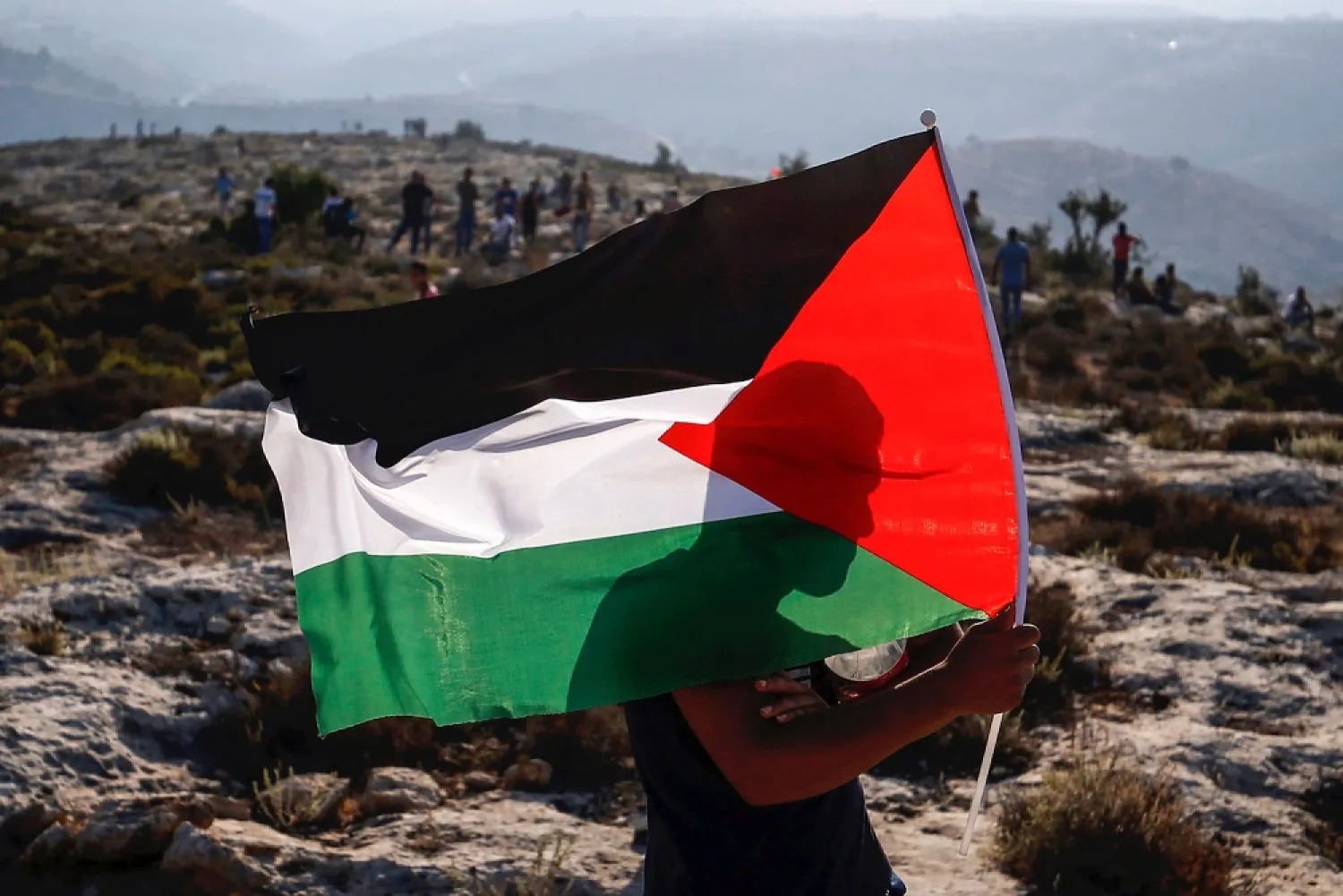
A Palestinian protester waves a Palestinian flag during a demonstration in the village of Ras Karkar in the occupied West Bank, on Sept. 4, 2018. (Getty Images)
Middle East Quartet Discusses Reviving 'Meaningful' Israel, Palestinian Peace Talks
A Palestinian protester waves a Palestinian flag during a demonstration in the village of Ras Karkar in the occupied West Bank, on Sept. 4, 2018. (Getty Images)
The Middle East quartet of mediators - the United States, Russia, the European Union and the United Nations - discussed on Tuesday reviving “meaningful negotiations” between Israel and the Palestinians with the aim of a two-state solution.
In a statement following their meeting, the quartet said that both Israel and the Palestinians need “to refrain from unilateral actions that make a two-state solution more difficult to achieve.”
It appeared to be the first time since September 2018 that envoys from the four mediators have met. Last month, UN Secretary-General Antonio Guterres said he hoped there would be a quartet meeting in coming weeks, now that there was a new president in the White House.
The Palestinians want a state in the West Bank and Gaza Strip with east Jerusalem as its capital - all territory captured by Israel in 1967. Under a failed peace proposal by former US President Donald Trump, Washington would have recognized Jewish settlements in occupied territory as part of Israel.
The new administration of President Joe Biden has said it supports a two-state solution between Israel and the Palestinians and will overturn several decisions made by Trump.
It has said it will continue to urge other countries to normalize ties with Israel, but stressed that is not a substitute for Israeli-Palestinian peace.
In what is widely seen as one of Trump’s few foreign policy successes, Washington secured agreements late last year by four Arab states - the United Arab Emirates, Bahrain, Sudan and Morocco - to start normalizing relations with Israel.
Two Children Die after Ferry Hits Bridge in Eastern Syriahttps://english.aawsat.com/arab-world/5295120-two-children-die-after-ferry-hits-bridge-eastern-syria
FILE: A member of the Syrian Civil Defense, also known as the White Helmets, carries a child after water levels rise due to increased dam releases following heavy rainfall this year, in Deir Ezzor, Syria, May 30, 2026. REUTERS/Khalil Ashawi
Two Children Die after Ferry Hits Bridge in Eastern Syria
FILE: A member of the Syrian Civil Defense, also known as the White Helmets, carries a child after water levels rise due to increased dam releases following heavy rainfall this year, in Deir Ezzor, Syria, May 30, 2026. REUTERS/Khalil Ashawi
At least two children were killed after a ferry carrying more than 35 people collided with a bridge while crossing the Euphrates River in the eastern Syrian city of Deir Ezzor on Sunday, the Syrian Civil Defense said.
More than 15 people were rescued after all those on board fell into the river, the rescue agency said.
Search and rescue operations were continuing for those still missing.
Iraq PM to Meet Trump in Washington Next Weekhttps://english.aawsat.com/arab-world/5295113-iraq-pm-meet-trump-washington-next-week
Iraq's Prime Minister Ali al-Zaidi will travel on Monday to the United States to meet President Donald Trump in his first international visit since taking office, his government spokesperson said.
Zaidi, who came to power this year with Trump's blessing, assumed office amid growing US pressure on Baghdad to disarm pro-Iran armed groups that have frequently targeted US facilities in Iraq.
In Washington, Zaidi hopes to attract US investments to the country, which urgently needs to boost its economy, especially after significant revenue losses caused by the halt in oil exports during the Middle East war, AFP reported.
Zaidi is "heading to Washington on Monday, leading a high-level delegation, at the invitation of the US president", government spokesperson Haidar al-Aboudi said.
The talks will focus on "strengthening economic relations and investments", especially in the oil and power sectors, he added.
The state's monopoly on arms is a necessary requirement to "ensure internal stability... and attract investments capable of boosting" the economy, Aboudi said.
Zaidi has vowed to ensure pro-Iran armed groups hand over their weapons, but he is facing pushback from some powerful factions.
In recent months, Iraq has signed several deals with US companies in the oil sector.
During his one-week trip to Washington, Zaidi is expected to sign several more agreements, including a deal to establish a fund into which Iraq will deposit half a million barrels of oil per day in exchange for boosting the country's electricity supply.
Iraqi Factions Pledge Allegiance to Khamenei, Reject Disarmamenthttps://english.aawsat.com/arab-world/5295006-iraqi-factions-pledge-allegiance-khamenei-reject-disarmament
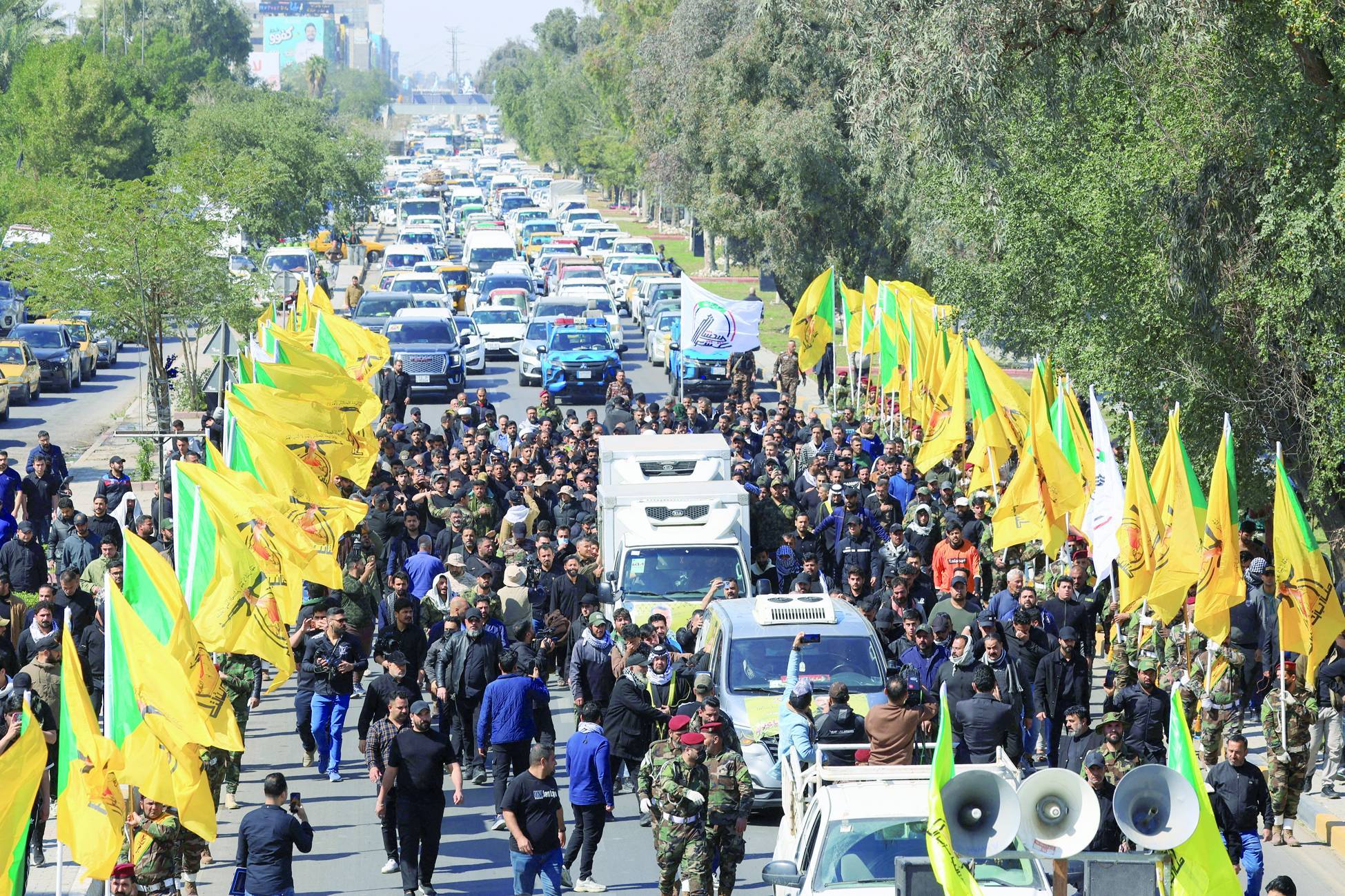
Members of Iraq's Hezbollah Brigades (Kataib Hezbollah) gather in a mourning procession for one of their comrades who was killed the previous day in a strike in Basra, during the funeral in Baghdad on April 8, 2026. (Photo by AHMAD AL-RUBAYE / AFP)
Iraqi Factions Pledge Allegiance to Khamenei, Reject Disarmament
Members of Iraq's Hezbollah Brigades (Kataib Hezbollah) gather in a mourning procession for one of their comrades who was killed the previous day in a strike in Basra, during the funeral in Baghdad on April 8, 2026. (Photo by AHMAD AL-RUBAYE / AFP)
About a week before Iraqi Prime Minister Ali al-Zaidi is due to visit Washington, factions and groups linked to the so-called Islamic Resistance in Iraq have rejected calls to hand over their weapons to the state.
As the US administration presses Baghdad to disarm the factions and sever their ties with Iran, the latest positions of these factions confront al-Zaidi with complex political and security challenges.
The government had previously set the end of September as the final deadline for weapons to be surrendered and dismantled, coinciding with the end of the international coalition’s military presence under an agreement with the Iraqi government.
Al-Zaidi said last week that the government had entered into talks with the factions, whose activities would “later shift to the political and social arenas.”
Once the deadline for disarmament and the transfer of weapons to government security institutions expires, “arms will be held exclusively and entirely by the official institutions of the state and its specialized armed and security forces,” al-Zaidi said.
Kataib Hezbollah warning
In a strongly worded statement, Kataib Hezbollah official Abu Hussein al-Hamidawi demanded that the Iraqi government “submit” to the resistance.
In April, the US State Department offered a reward of up to $10 million for information leading to the capture or conviction of al-Hamidawi, who is regarded as one of the faction leaders closest to Iran.
Al-Hamidawi said Kataib Hezbollah was founded by the late Iranian Supreme Leader Ali Khamenei and on his orders, adding that its members “were and remain loyal to this path.”
“At this historic juncture, we draw the attention of political leaders and government officials to the need to submit to the will of the people of resistance and jihad, and to exercise extreme caution against being drawn into arrogant projects or aligning themselves with their malicious agendas,” al-Hamidawi said, referring to the disarmament plan.
“We warn them that our people will make their position and decision known if the compass deviates,” he added.
A funeral procession in Baghdad for members of Iraq's Kataib Hezbollah killed in a raid targeting a Popular Mobilization Forces headquarters in March 2025 (Reuters)
The so-called Islamic Resistance in Iraq also rejected calls to surrender its weapons. The armed coalition comprises a range of undeclared factions whose agendas align with the activities of Iran’s Revolutionary Guards. They are also widely viewed as covert wings of known Iran-backed factions.
The group said in a statement on Saturday that it remained “committed to the path of resistance.”
“Let the enemies know that the forces of the axis of truth are one body, operating according to the jihadist framework laid down for us by our leader, Khamenei,” it said.
“Hardships will not deter us, but will only strengthen our determination to continue on our path of supporting the oppressed and expelling the occupiers from Iraq and the region.”
“Our weapons have never been open to bargaining. They are a doctrine and a pledge for which we are responsible, and with them we will move forward to break the chains of domination and restrain the arrogant powers,” the group added.
“We therefore affirm to those near and far that we will not stop at what we have achieved. Rather, we will work to develop our military and security capabilities, both quantitatively and qualitatively, and raise our readiness in proportion to the scale of the growing challenges and threats.”
So far, Shiite cleric Moqtada al-Sadr, leader of the Sadrist movement, has responded to calls to bring all weapons under state control. Last month, he ordered his armed faction, Saraya al-Salam, to hand over its weapons and official headquarters to the state.
Asaib Ahl al-Haq and Kataib Imam Ali have also complied with the demand. However, some factions’ continued rejection of the move is likely to increase the challenges and complications the government faces on the issue, according to observers.
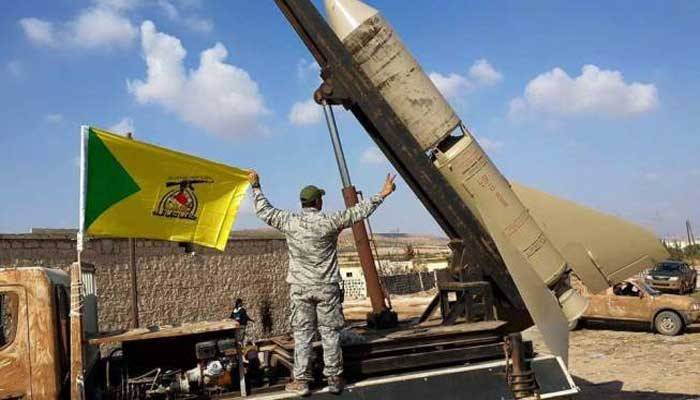
A member of Iraq's Kataib Hezbollah waving the faction's banner on a missile launch platform (Faction media)
Expected judicial action
Observers are divided over the prospect of disarming the factions. Some consider it impossible without flexibility or clear approval from Iran, while others believe the government can achieve it amid rapidly changing regional circumstances.
Political analyst Nizar Haidar told Asharq Al-Awsat that it was necessary to distinguish between what the militias publicly declared and what they concealed.
That included “secret understandings that will ultimately lead to the complete surrender of their weapons and the dismantling of their military formations,” he said.
Haidar said he expected the Iraqi judiciary to take a deterrent position against groups that violated the law by retaining weapons outside state control. He added that the judiciary was preparing, for the first time since 2003, to announce a legal code.
“Any military formation or military activity outside the state is expected to be classified as a terrorist act, punishable under existing Iraqi laws by up to the death penalty,” Haidar said.
He said the legal code, if issued, would “contribute significantly to helping the government implement its plans to place all weapons under state control.”
Efforts to disarm and dismantle the factions would also be reinforced by “government plans to purge the security and military institutions of militia members who refuse to sever their ties with their leaders and place their security and military decisions under the authority of the commander-in-chief of the armed forces, following the example of the factions that have announced such steps in recent months,” Haidar added.
لم تشترك بعد
انشئ حساباً خاصاً بك لتحصل على أخبار مخصصة لك ولتتمتع بخاصية حفظ المقالات وتتلقى نشراتنا البريدية المتنوعة