


Saudi Arabia Sets Stage for New Way for Tackling Carbon Emissions

Saudi Arabia Sets Stage for New Way for Tackling Carbon Emissions
TT

Saudi Arabia Sets Stage for New Way for Tackling Carbon Emissions

Saudi Arabia Sets Stage for New Way for Tackling Carbon Emissions

Saudi Arabia, during its G20 presidency, succeeded in launching a global platform for the circular carbon economy.

The circular carbon economy (CCE) is a system where carbon emissions are reduced, reused, recycled and removed (4R). Such a closed-loop system which was inspired by how nature works will support Saudi Arabia’s march towards achieving its own national transformation plan, dubbed “Kingdom Vision 2030.”

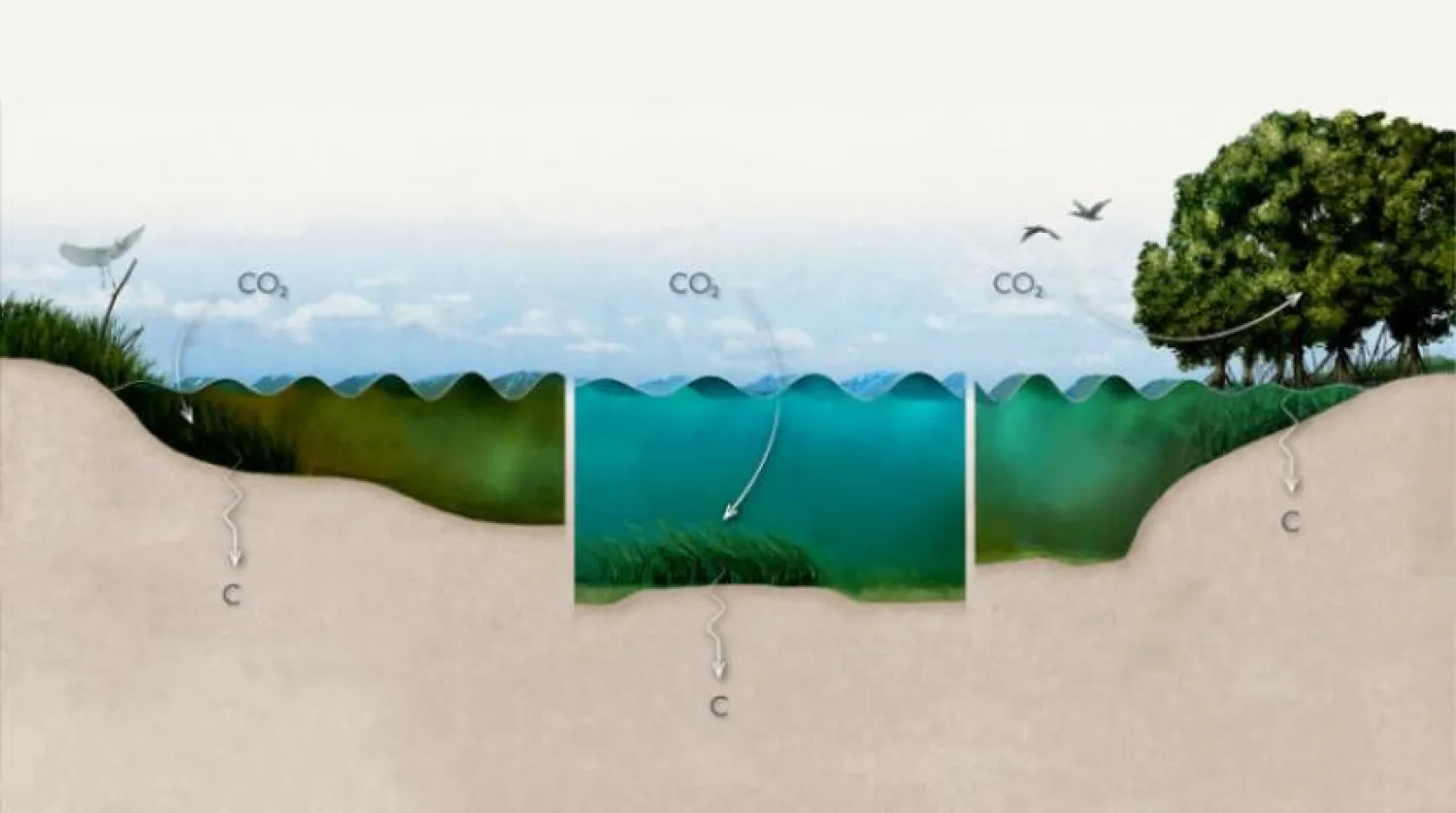
From developing cleaner-burning fuels to optimizing the performance of renewable energy technologies and from maximizing the oceans’ storage of blue carbon to minimizing the energy input needed to drive industrial processes, researchers at the King Abdullah University of Science and Technology (KAUST) aim to change the carbon narrative to reduce, reuse, recycle and remove.

In December 2020, KAUST launched a CCE initiative that focuses on increasing energy efficiency, capturing and storing carbon, transforming carbon into something useful and integrating renewable resources.

KAUST researchers have compiled a preliminary database for CO2 emissions from more than 1,200 industries involved in electricity generation, desalination, oil refineries, the cement industry, petrochemicals and iron and steel production. Future work aims to pinpoint potential CO2 storage sites within subsurface geological formations.

“Before life emerged on Earth, its atmosphere was formed of 98 per[1]cent carbon dioxide (CO2) with sur[1]face temperatures exceeding 240 degrees Celsius. Life modified Earth, particularly photosynthesis from cyanobacteria, releasing oxy[1]gen while reducing atmospheric carbon dioxide by transforming it into living carbon and stored organic matter,” explained KAUST marine ecologist Carlos Duarte.

“KAUST is a reference university for circular-carbon[1]economy-related research,” reaffirmed chemical engineer, Jorge Gascon.

“We cover the whole circularity concept, with very important contributions toward the 4 Rs,” he asserted.

More so, Iain McCulloch and his research group at KAUST are finding ways to reduce CO2 emissions by improving the ability to harness the sun’s energy.

A team led by McCulloch from the KAUST Solar Center, in partnership with researchers from the US and the UK, has developed hydrogen evolution photocatalysts (HEPs) made from two different semiconducting materials. They incorporated these materials into organic nanoparticles that can be tuned to absorb more of the visible light spectrum.



Missile Debris Kills One in Abu Dhabi as Iran Presses Gulf Attacks

A photograph shows Doha's skyline on March 10, 2026. (AFP)
TT

Missile Debris Kills One in Abu Dhabi as Iran Presses Gulf Attacks

A photograph shows Doha's skyline on March 10, 2026. (AFP)

Falling debris from a missile intercept killed one person on Tuesday in the Emirati capital of Abu Dhabi and injured two medical staff in Kuwait, authorities said, as Iran pressed its attacks against Gulf countries. 

The Gulf has borne the brunt of Iran's attacks in response to US-Israeli strikes that sparked the Middle East war, with Tehran targeting US assets but also civilian infrastructure. 

Debris fell in the Bani Yas area "following the interception of a ballistic missile by air defenses", the Abu Dhabi Media Office said on X. 

The day before a Palestinian national was killed on the edge of the city when a missile hit his car. 

As well as hitting ports, airports, residential buildings and hotels along with military sites across the region, Iran has also struck energy facilities across the Gulf. 

On the east coast of the country, the oil industrial zone of Fujairah was hit on Tuesday morning, sparking a fire but causing no injuries, local authorities said. 

It was the second day in a row that the site was hit, with a source telling AFP on Monday that oil storage loading had been shut down by an attack. 

In Kuwait, two medical staff were injured when shrapnel fell on an emergency medical center where they were working, the state's health ministry said. 

An AFP journalist heard several explosions in Doha on Tuesday and Qatar's defense ministry said it had intercepted a missile attack. 

Later, the country's civil defense said it was dealing with a minor fire in an industrial area following the interception, with no injuries reported. 

In nearby Dubai, an AFP journalist heard three explosions after a mobile phone alert warned residents of the United Arab Emirates' most populous city to "immediately seek a safe place" because of "potential missile threats". 

Iran has fired more than 1,900 missiles and drones at the UAE, more than any other country targeted by Tehran since the start of the war. 

The strikes have upended travel plans in the financial hub, despite its air defense intercepting the vast majority of projectiles. 


Saudi Arabia, Kuwait Stress Importance of Security Coordination, Integration

Saudi Minister of Interior Prince Abdulaziz bin Saud bin Naif bin Abdulaziz and Kuwaiti First Deputy Prime Minister and Interior Minister Sheikh Fahad Yusuf Saud Al Sabah. (Saudi Interior Ministry)
TT

Saudi Arabia, Kuwait Stress Importance of Security Coordination, Integration

Saudi Minister of Interior Prince Abdulaziz bin Saud bin Naif bin Abdulaziz and Kuwaiti First Deputy Prime Minister and Interior Minister Sheikh Fahad Yusuf Saud Al Sabah. (Saudi Interior Ministry)

Saudi Minister of Interior Prince Abdulaziz bin Saud bin Naif bin Abdulaziz held telephone talks on Tuesday with Kuwaiti First Deputy Prime Minister and Interior Minister Sheikh Fahad Yusuf Saud Al Sabah on the importance of continued coordination, cooperation and integration between their countries to bolster security and stability.

They reviewed the current regional developments and their security implications amid Iran’s malicious attacks against Gulf countries and the region.

Prince Abdulaziz stressed Saudi Arabia’s solidarity with Kuwait and support for all the measures it takes to preserve its security and stability.


Saudi, Egyptian FMs Discuss Regional De-Escalation Efforts

Saudi Foreign Minister Prince Faisal bin Farhan bin Abdullah and his Egyptian counterpart Badr Abdelatty meet in Riyadh on Monday. (SPA)
TT

Saudi, Egyptian FMs Discuss Regional De-Escalation Efforts

Saudi Foreign Minister Prince Faisal bin Farhan bin Abdullah and his Egyptian counterpart Badr Abdelatty meet in Riyadh on Monday. (SPA)

Saudi Foreign Minister Prince Faisal bin Farhan bin Abdullah received in Riyadh on Monday his Egyptian counterpart Badr Abdelatty for talks on bilateral relations and the latest developments in the region.

The tackled efforts to de-escalate the tensions to help restore regional security and stability.

They reiterated their condemnation of Iran’s malicious attacks against the Kingdom and several Arab countries.

Earlier, Prince Faisal held telephone talks with United Arab Emirates Deputy Prime Minister and FM Sheikh Abdullah bin Zayed Al Nahyan.

They discussed regional developments amid Iran’s unjustified attacks against Gulf countries, as well as means to consolidate security and stability in the Middle East.