


Israeli Minister Says Failure to Oust Assad Was Strategic Error that Favored Iran

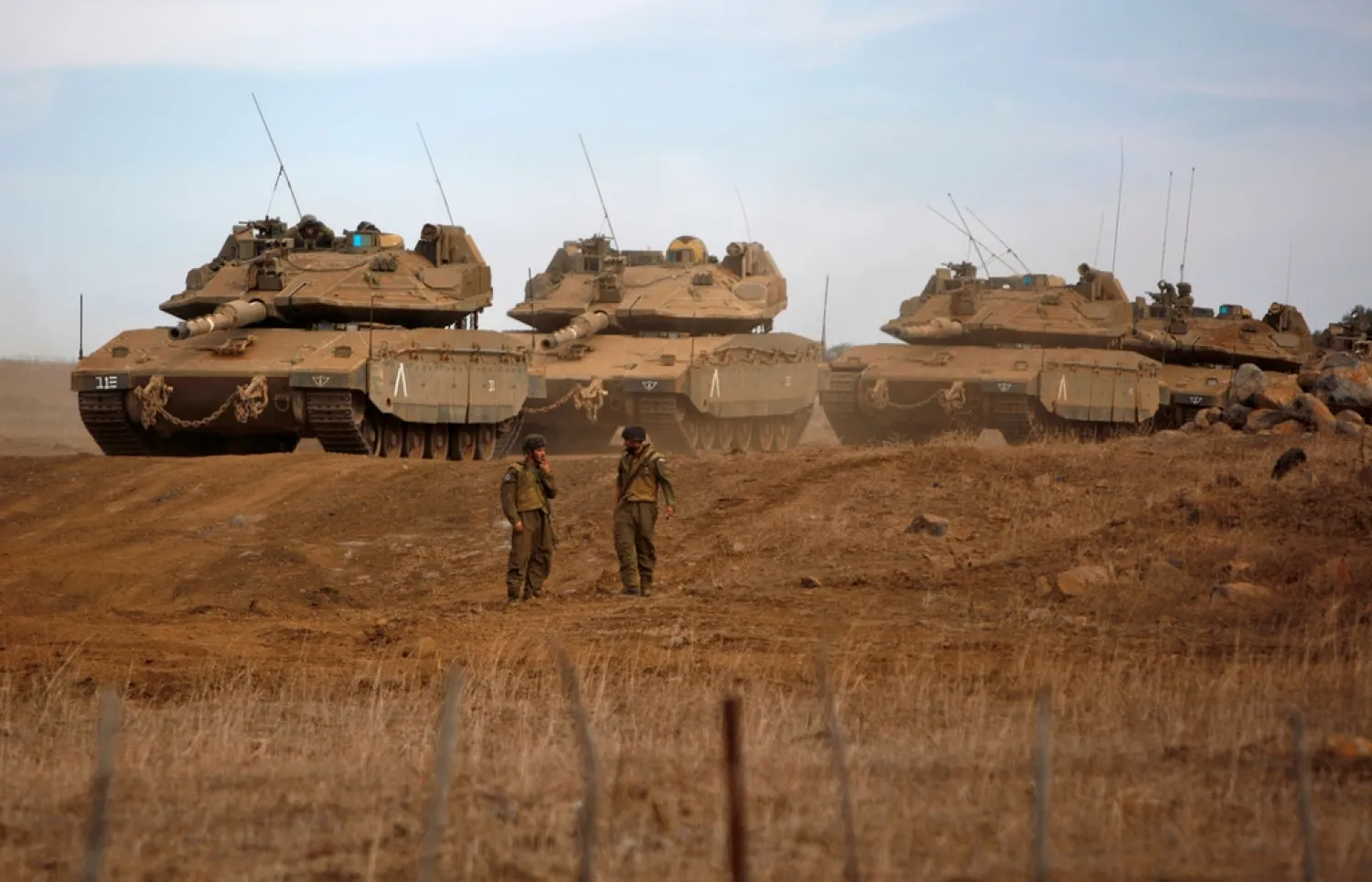
A picture taken on Nov. 20, 2017, shows Israeli Merkava Mk-IV tanks taking part in a military exercise near the border with Syria in the Israeli-occupied Golan Heights. (Getty Images)
TT

Israeli Minister Says Failure to Oust Assad Was Strategic Error that Favored Iran

A picture taken on Nov. 20, 2017, shows Israeli Merkava Mk-IV tanks taking part in a military exercise near the border with Syria in the Israeli-occupied Golan Heights. (Getty Images)

An Israeli minister revealed that the military and government, led by Prime Minister Benjamin Netanyahu, were deeply divided over the Syrian conflict since its eruption in 2011.

He said that some officials viewed the crisis as an opportunity to topple president Bashar Assad, while others supported that he remain in power.

He lamented that Assad’s supporters ultimately came on top, in what was a “grave error that favored Iran.”

“We are paying the price of this mistake today,” said the minister in comments that were leaked to the media on Sunday.

Some of Assad’s opponents in Israel believed that the time was right to oust the president, especially after the Syrian opposition had shown an openness in dealing with Tel Aviv. It was clear that his ouster would not have been possible without Israel.

The minister was referring here to the opposition Free Syrian Army and other factions that had indeed contacted Israel. Some of their members had also openly visited Tel Aviv and stated that they were ready for peace. They also requested Israeli logistic support and weapons to fight the regime.

The minister said that these talks lasted for years until it was no longer possible to topple Assad. That was when ISIS began to emerge in Syria.

Had the Israeli government helped the non-extremist Syrian rebels and taken advantage of the regime’s weakness, Assad would have been ousted and a new regime, which would have been supported by the United States and moderate Arab countries, would have been set up in Damascus, recalled the minister.

Opponents of Assad’s ouster believed that his replacement did not necessarily have to be any less hostile to Israel than the current regime, he added. There was no guarantee that the new political parties and organizations would have been open to Israel.

Indeed, the alternative at the time appeared extremist and no less of a threat than the Iranian mullahs, he remarked.

Moreover, the opponents of the ouster recalled Israel’s failed experience in Lebanon during the 1980s when Bashir Gemayel was elected its president. There were hopes in Israel at the time that peace would be signed with its northern neighbor, but Gemayel was assassinated and Hezbollah was formed soon after. Years later, the party now controls Lebanon, said the minister.

Rather than oust Assad, Netanyahu’s government worked to impose “vital red lines” that ensured Israel’s national security and that avoided dragging it to war in Syria or Lebanon, stressed the minister.

The red lines remained largely unchanged in the past ten years, reported Yedioth Ahronoth. They include preventing any attack against Israel from Syria, barring Syria’s use of chemical weapons and their transfer to Lebanon and thwarting the establishment of an Iranian front in Syria.



Russia Withdrawing Troops from Airport in Northeast Syria

Pro-Kurdish protesters tear down a border fence as they attempt to cross to the Kurdish-controlled northeastern Syrian city of Qamishli during a demonstration in support of Syrian Kurds and against recent military clashes between the Syrian army and Kurdish forces, in Nusaybin, southeastern Turkey, January 20, 2026. REUTERS/Ensar Ozdemir
TT

Russia Withdrawing Troops from Airport in Northeast Syria

Pro-Kurdish protesters tear down a border fence as they attempt to cross to the Kurdish-controlled northeastern Syrian city of Qamishli during a demonstration in support of Syrian Kurds and against recent military clashes between the Syrian army and Kurdish forces, in Nusaybin, southeastern Turkey, January 20, 2026. REUTERS/Ensar Ozdemir

Russia is withdrawing forces from an airport in northeastern Syria, moving to end its military presence in a corner ​of the country where the Damascus government is trying to seize control from Kurdish forces, five Syrian sources said, according to Reuters.

Russia has stationed forces at Qamishli airport in the northeast since 2019, a relatively small deployment compared to its air base and a naval facility on Syria's Mediterranean coast, both of which it is expected to maintain.

Government forces under ‌President Ahmed ‌al-Sharaa have taken swathes of northern ‌and ⁠eastern ​Syria from ‌the Kurdish-led Syrian Democratic Forces this month, as Damascus aims to assert its authority over the entire country.

A fragile ceasefire between the sides was extended on Saturday for 15 days. Two of the sources said Russian forces had begun a gradual withdrawal from Qamishli airport last week. Some of the forces were expected ⁠to move to Russia's Hmeimim air base in western Syria while others ‌would return to Russia, one of ‍the sources said.

Another Syrian security source ‍on Syria's western coast said Russian military vehicles and ‍heavy weaponry had been transported from Qamishli to the Hmeimim military airport over the last two days.

There was no immediate comment from Russia's defense ministry. Russian daily Kommersant reported last week, citing an unnamed ​Syrian source, that the Syrian government might ask Russian forces to leave the base once it had ⁠pushed the Kurds out because "there’s nothing for them (the Russians) to do there".

A Reuters journalist saw Russian flags still flying at Qamishli airport on Monday, where two planes bearing Russian markings were parked on the runway.

Russia, a close ally of Syria's ousted President Bashar al-Assad, has established ties with Sharaa since he seized power some 14 months ago.

Sharaa told Russian President Vladimir Putin last year he would honor all past deals struck between Damascus and Moscow, a pledge suggesting Moscow's two main military ‌bases in Syria are safe.


Israel Says the Remains of Final Hostage in Gaza Are Recovered, Key for Ceasefire’s Next Phase

Palestinians walk amid buildings destroyed by Israeli air and ground operations in Gaza City Thursday, Jan. 15, 2026. (AP Photo/Jehad Alshrafi)
TT

Israel Says the Remains of Final Hostage in Gaza Are Recovered, Key for Ceasefire’s Next Phase

Palestinians walk amid buildings destroyed by Israeli air and ground operations in Gaza City Thursday, Jan. 15, 2026. (AP Photo/Jehad Alshrafi)

The remains of the final hostage in Gaza have been recovered, Israel's military said Monday, clearing the way for the next phase of the ceasefire that paused the Israel-Hamas war.

The announcement that the remains of Ran Gvili had been found and identified came a day after Israel’s government said the military was conducting a “large-scale operation” in a cemetery in northern Gaza to locate them.

Prime Minister Benjamin Netanyahu called it “an incredible achievement” for Israel and its soldiers, telling Israeli media that “I promised we would bring everyone home and we have brought everyone home." He said Gvili, who was killed during the Hamas-led attack on Oct. 7, 2023, that sparked the war, was among the first to be taken into Gaza.

The return of all remaining hostages, living or dead, has been a key part of the Gaza ceasefire’s first phase, and Gvili’s family had urged Israel’s government not to enter the second phase until his remains were recovered and returned.

Netanyahu’s office said Sunday that Israel would open the Rafah crossing between Gaza and Egypt, which Palestinians see as their lifeline to the world, once the search for Gvili was finished. It has been largely shut since May 2024, except for a small period in early 2025.

Israel and Hamas had been under pressure from ceasefire mediators including Washington to move into the second phase of the US-brokered truce, which took effect on Oct. 10.

Israel had repeatedly accused Hamas of dragging its feet in the recovery of the final hostage. Hamas said it had provided all the information it had about Gvili’s remains, and accused Israel of obstructing efforts to search for them in areas of Gaza under Israeli military control.

Israel’s military had said the large-scale operation to locate Gvili’s remains was “in the area of the Yellow Line” that divides the territory.

The Oct. 7, 2023 attack killed about 1,200 people and saw 251 taken hostage. Gvili, a 24-year-old police officer known affectionately as “Rani,” was killed while fighting Hamas militants.

Before Gvili’s remains were recovered, 20 living hostages and the remains of 27 others had been returned to Israel since the ceasefire, most recently in early December. Israel in exchange has released the bodies of hundreds Palestinians to Gaza.

The next phase of the 20-point ceasefire plan has called for creating an international stabilization force, forming a technocratic Palestinian government and disarming Hamas.

Palestinians killed in Gaza Israeli forces on Monday fatally shot a man in Gaza City’s Tuffah neighborhood, according to Shifa Hospital, which received the body. The man was close to an area where the military has launched the search operation for Gvili, the hospital said.

Another man was killed in the eastern side of Bureij refugee camp in central Gaza, according to Al-Aqsa Martyrs hospital, which received his body. The circumstances of his death were not immediately clear.

More than 480 Palestinians were killed by Israeli fire since Oct. 10, according to Gaza's Health Ministry. The ministry, which is part of the Hamas-led government, maintains detailed casualty records that are seen as generally reliable by UN agencies and independent experts.

Israel's top court considers petition to open Gaza for international journalists The Foreign Press Association on Monday asked Israel’s Supreme Court to allow journalists to enter Gaza freely and independently.

The FPA, which represents dozens of global news organizations, has been fighting for more than two years for independent media access to Gaza. Israel has barred reporters from entering Gaza independently since the Oct. 7, 2023, attacks by Hamas, which triggered the war, saying entry could put both journalists and soldiers at risk.

The army has offered journalists brief, occasional visits under strict military supervision.

FPA lawyers told the three judge panel that the restrictions are not justified and that with aid workers moving in and out of Gaza, journalists should be allowed in as well. They also said the tightly controlled embeds with the military are no substitute for independent access. The judges are expected to rule in the coming days.


Salam: Washington Did Not Request France’s Ouster from Mechanism Negotiations

A photograph released by the Lebanese Government Press Office on December 26, 2025, show Prime Minister Nawaf Salam speaking during a press conference after a cabinet session in Beirut on December 26, 2025. (Photo by Handout / Lebanese Government Press Office / AFP)
TT

Salam: Washington Did Not Request France’s Ouster from Mechanism Negotiations

A photograph released by the Lebanese Government Press Office on December 26, 2025, show Prime Minister Nawaf Salam speaking during a press conference after a cabinet session in Beirut on December 26, 2025. (Photo by Handout / Lebanese Government Press Office / AFP)

Lebanese Prime Minister Nawaf Salam assured on Monday that Lebanon does not want any confrontation with the United States, pointing out that Washington has not demanded France’s exit from the “Mechanism negotiations”.

An-Nahar newspaper quoted Salam as assuring that both Beirut and Paris have affirmed that a conference in support of the country’s army will be held in France in March as scheduled.

Salam also said that Beirut expects the arrival of Qatari minister, Mohammed Al-Khulaifi, on Tuesday ahead of a February preparatory meeting before the Paris conference. The February meeting "could be held in a Gulf country, probably Qatar", he told the daily.

The PM ruled out the possibility that the dispute between US President Donald Trump and French President Emmanuel Macron could impact the latter’s role in Lebanon.

“There are more important problems than the matter of Lebanon’s Mechanism. Honestly, the small country of Lebanon is not the center of the world”, he said.

Following his meeting with Macron on Saturday, Salam said that the French President has affirmed adherence to the committee overseeing the ceasefire agreement (Mechanism).

Media reports in Lebanon hinted at a US rejection of any French participation in the Mechanism meetings. But Salam stressed that the US is a “strategic partner for Lebanon. We are not in a confrontation because it is a key partner in the ceasefire monitoring committee”.