Daniel Canogar's work projected on the Zebra Building
Daniel Canogar’s Bifurcation, which is part of the Noor Riyad festival, has drawn many visitors to the Zebra Building who flock to see its facade
Connected to the internet, the building responds to real-time data tracking thunderstorms across the globe.
The Spanish artist, Canogar, is one of the prominent light artists whose artworks have been projected on emblematic facades, including Amalgama El Prado in Madrid and Times Square in New York.
Relying on an algorithm created by Canogar that uses data from a storm-tracking webpage, the Zebra Building in the King Abdullah Financial District has a lightning bolt that sparks with every thunderstorm striking somewhere across the globe. The projected animation gets stronger with the magnitude of thunder.
For his part, Canogar said it was an honor for him to be present this work alongside his colleagues.
"Some of them were my teachers in the field of light art.”
The Noor Riyadh festival is one of the programs of the Riyadh Art project, which aims to place 1,000 original public art installations across the city and transform Riyadh into an open art gallery.
The unprecedented heat in September came after Spain's hottest summer on record. Oscar DEL POZO / AFP
Mainland Spain sizzled in its warmest September since records began in 1961, with exceptional heat effectively making it another summer month, national weather agency AEMET said on Friday.
The announcement is the latest in a series of new temperature records this year across Europe, scorched by successive summer heatwaves that scientists say were turbo-charged by human-driven climate change.
The average temperature in September was 22.5C, 3.4C above the norm for the 1991-2020 reference period, said AEMET, with the unprecedented reading coming after Spain's hottest summer on record, said AFP.
It was the first time the figure for September exceeded the average summer temperature of 22.1C for the 1991-2020 period, AEMET added in a statement.
The country equaled its all-time heat record for the month when 45.7C was registered in the southwestern municipality of El Granado on September 3.
AEMET briefly issued the highest red alert for heat in small areas of the southern region of Andalusia in September, the first time such warnings had been sent in the month since they started in 2007.
Last month was also extremely dry, recording just 36 percent of the normal rainfall expected in September in mainland Spain based on the 1991-2020 reference period.
Extreme temperatures have been linked to tens of thousands of excess deaths across the continent, as well as disrupting daily life and the economy through drought and low river levels.
Indonesian Rescue Center Takes in More Orangutans as Fires Ragehttps://english.aawsat.com/varieties/5330213-indonesian-rescue-center-takes-more-orangutans-fires-rage
An 11-year-old male orangutan named Didik eats on a rehabilitation island at a rehabilitation facility run by wildlife foundation Yayasan Inisiasi Alam Rehabilitasi Indonesia in Ketapang Regency, West Kalimantan, Indonesia, August 31, 2026. REUTERS/Willy Kurniawan
Indonesian Rescue Center Takes in More Orangutans as Fires Rage
An 11-year-old male orangutan named Didik eats on a rehabilitation island at a rehabilitation facility run by wildlife foundation Yayasan Inisiasi Alam Rehabilitasi Indonesia in Ketapang Regency, West Kalimantan, Indonesia, August 31, 2026. REUTERS/Willy Kurniawan
In the jungles of Indonesian Borneo, a rehabilitation center is taking in more orangutans as the country's worst wildfires in a decade sweep through the forest home of the critically endangered animals.
The intense wildfires, burning mainly on the islands of Borneo and Sumatra, began in July and could continue until November, aggravated by a severe El Niño weather pattern, the government has warned.
"I think so far this looks quite similar to the 2015 fires," said Karmele Llano Sanchez, co-founder of Yayasan Inisiasi Alam Rehabilitasi Indonesia (YIARI), who has worked in Indonesia for more than 20 years. "It's possible that in the months to come, they (the orangutans) will also be affected by not having enough to eat, not having enough room, enough habitat, and starvation."
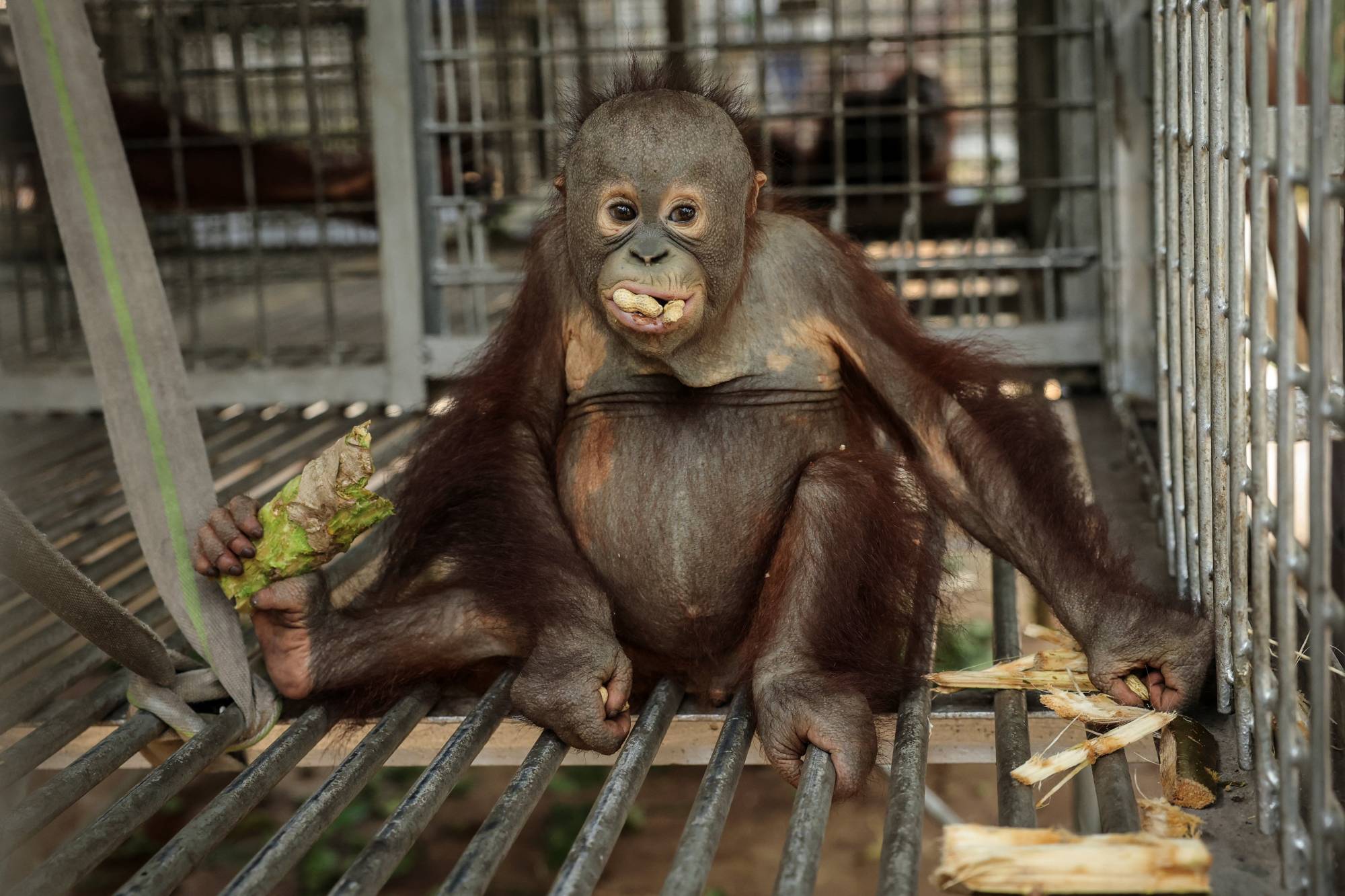
A three-year-old baby orangutan named Xavier holds food inside a medical cage used for orangutans evacuated from a rehabilitation island due to nearby wildfires at a rehabilitation facility run by wildlife foundation Yayasan Inisiasi Alam Rehabilitasi Indonesia in Ketapang Regency, West Kalimantan, Indonesia, August 31, 2026. REUTERS/Willy Kurniawan
The world's three species of orangutan are native only to Borneo and Sumatra.
YIARI, in the Ketapang region of Indonesia's West Kalimantan province, is now looking after 90 orangutans, after rescuing 49 since August, foundation spokesperson Heribertus Suciadi said.
Over the last three years, the center rescued three to five animals a year, he added.
The fires and haze have shrouded parts of Borneo, which also includes the Malaysian states of Sarawak and Sabah, in a hazardous smog that has also spread to Singapore and the Malaysian peninsula, forcing some schools to close and causing a spike in respiratory illnesses.
Sampurna, an orangutan that Reuters encountered in August, was found gasping for air and writhing on the ground in a palm oil plantation.
Sampurna died on August 30, the forestry ministry said last month. Sanchez, who performed the necropsy on the great ape, said Sampurna died less than 12 hours after being rescued and had very dark lungs owing to respiratory problems, likening them to those of a heavy smoker.
From January to July this year, fires burned around 202,000 hectares (500,000 acres) in Indonesia. No official data for subsequent months has been released, but non-governmental organizations estimate fires have burned at least 600,000 hectares more since.
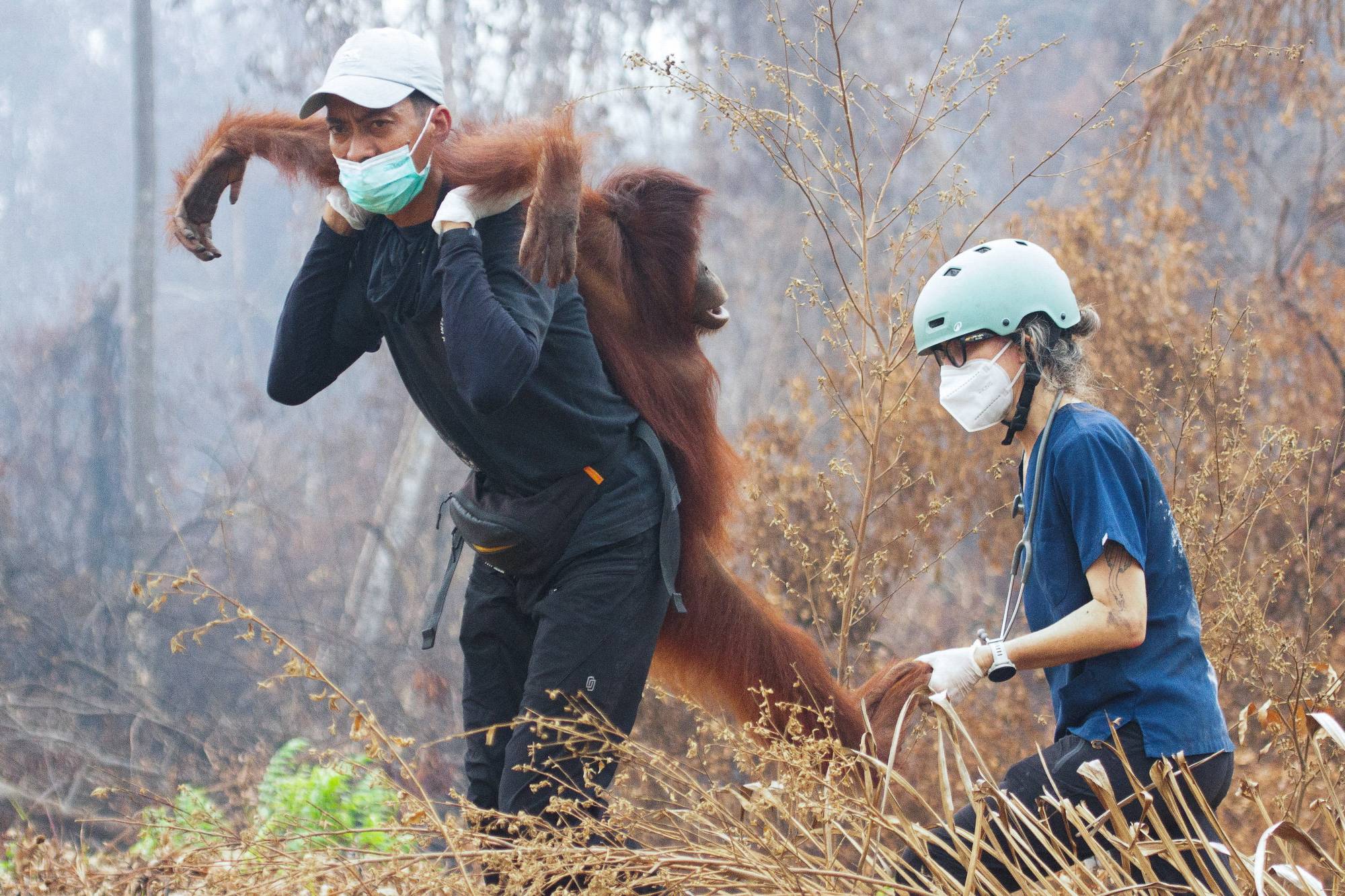
FILE PHOTO: A rescuer and a veterinarian with wildlife foundation Yayasan Inisiasi Alam Rehabilitasi Indonesia (YIARI) carry an orangutan after rescuing it in a palm-oil plantation affected by wildfires in Laman Satong village, Ketapang Regency, West Kalimantan, Indonesia, September 30, 2026. REUTERS/Victor Fidelis Sentosa
In 2015, fires burned nearly 960,000 hectares, forestry ministry data showed.
"I think in general, what we see is that these orangutans that were surviving in these fragments of forest, and the forest fragments are becoming smaller and smaller and smaller," Reuters quoted Sanchez as saying.
Once YIARI volunteers receive reports of orangutan sightings, they use a drone to determine the areas ravaged by the fires and whether orangutans were living there, Heribertus said.
Equipped with tranquilizers, rescuers then drive for hours to the burned forest to find the orangutans, sometimes using a net to capture the apes before taking them to safety.
The foundation has more than 200 staff, including firefighters and veterinarians.
"Fires are occurring in many areas. As a result, the orangutans are being displaced into plantations," said Relly Susanto, a YIARI patroller.
On a recent August day at the YIARI center, orangutans swung through the trees and walked on vines, as youngsters ate fruit next to their mothers. While there is no escape from the smoke even at YIARI, the center is not currently at risk from the fires themselves and some of the rescued orangutans have been returned to the wild in safer locations.
At the moment, YIARI has enough capacity to take in the orangutans, Sanchez said. But with the fires showing little sign of abating, she is not sure how long that will last.
"It's difficult to quantify how many orangutans will need to be rescued," she said. "One of our concerns is whether we'll have enough capacity to really get all of these rescued orangutans into the facility."
Sweden Sets Quota of 72 Wolves for 2027 Cullhttps://english.aawsat.com/varieties/5330211-sweden-sets-quota-72-wolves-2027-cull
FILED - 12 February 2026, Baden-Württemberg, Cleebronn: File Photo - A wolf is walking through an enclosure at the Wildparadies Tripsdrill Zoo. Photo: dpa
FILED - 12 February 2026, Baden-Württemberg, Cleebronn: File Photo - A wolf is walking through an enclosure at the Wildparadies Tripsdrill Zoo. Photo: dpa
Sweden said Thursday it would allow 72 wolves to be culled next year to combat inbreeding, after last year's planned cull of 48 animals was blocked by a court.
Critics of the hunt, including the European Commission and conservationists, have argued that the policy is driven more by politics than science and endangers population numbers.
There are an estimated 355 wolves in Sweden. The government has pushed for their population to be reduced for more than 15 years, to the dismay of conservationists.
"Since the Scandinavian wolf population is small and struggles with inbreeding, the reduction must take place gradually and in step with measures that counteract inbreeding," the county administrative boards said in a statement.
The 72 wolves could be killed in five counties near the capital Stockholm from January 2 to February 15.
Environmental groups last year appealed against the county boards' decision to grant licenses for 48 wolves, and won.
An administrative court said the county boards had failed to prove that the hunt would not be detrimental to a healthy wolf population.
"It is outrageous that one in five wolves in Sweden is going to be shot even though the population is severely threatened," Beatrice Rindevall, chair of the Swedish Society for Nature Conservation told Swedish news agency TT.
"Our wolves are already heavily inbred, and this hunt risks making the situation even worse. It is a reckless gamble with a protected and severely threatened species."
Farmers and hunters meanwhile regard the animals as a menace because of attacks on sheep and hunting dogs and want their numbers more firmly controlled, AFP reported.
Sweden's wolves were hunted to the brink of extinction by the 1960s, prompting the country to declare them a protected species.
The animals started reappearing in the late 1970s and 1980s and their population grew through the 1990s.
Sweden began allowing licensed hunts in 2010 after numbers passed 200, issuing quotas for the number that could be killed during a set period.
لم تشترك بعد
انشئ حساباً خاصاً بك لتحصل على أخبار مخصصة لك ولتتمتع بخاصية حفظ المقالات وتتلقى نشراتنا البريدية المتنوعة