


World Powers Seek to Bring US back into Iran Nuclear Deal

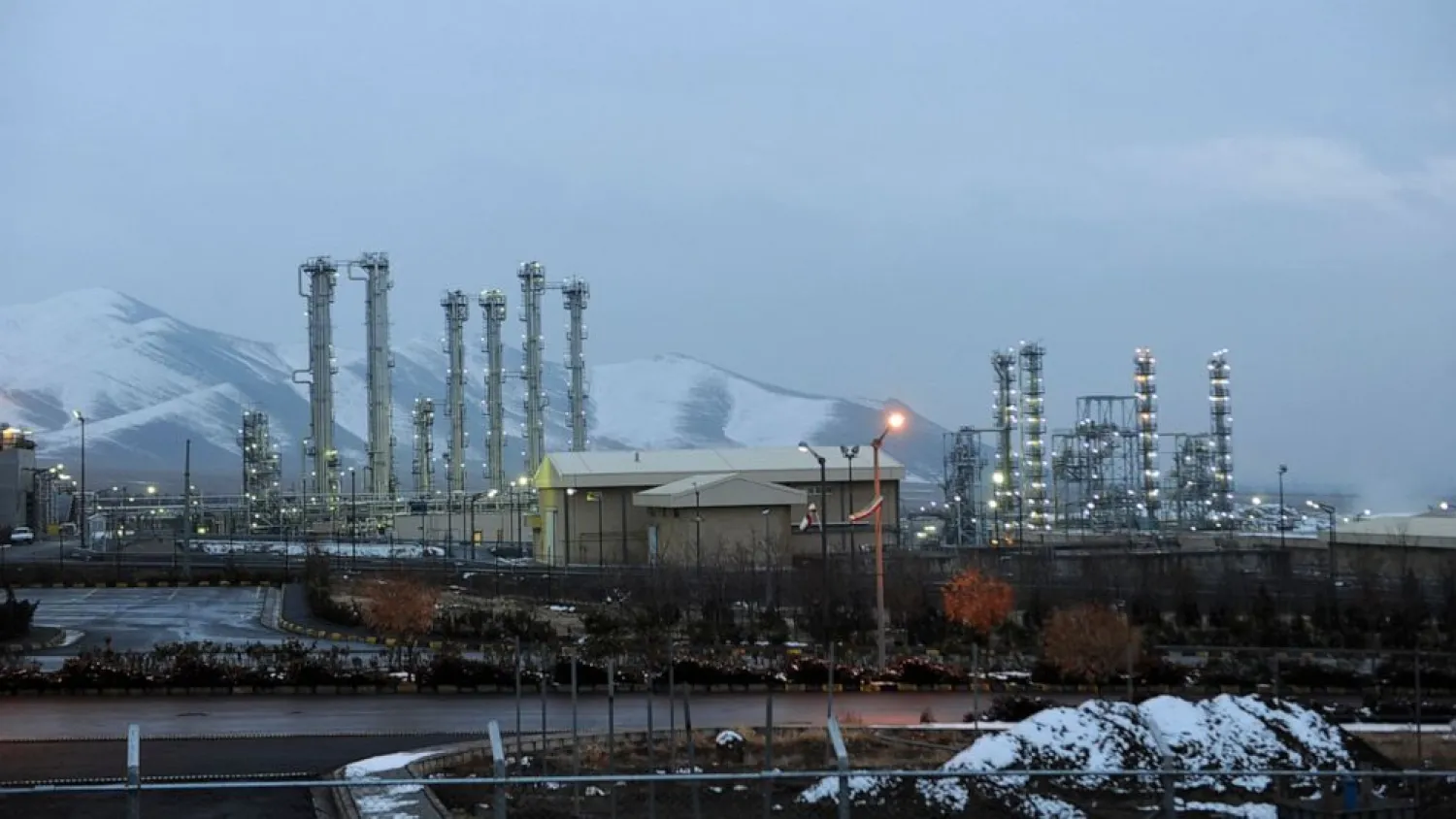
FILE - This Jan. 15, 2011 file photo shows the heavy water nuclear facility near Arak, Iran. Efforts to bring the United States back into the 2015 deal on Iran’s nuclear program are to step up a gear as Iran and the five world powers remaining in the accord meet in Vienna Tuesday April 6, 2021, while the US is due to start indirect talks with Tehran. (AP Photo/ISNA, Hamid Foroutan, File)
TT

World Powers Seek to Bring US back into Iran Nuclear Deal

FILE - This Jan. 15, 2011 file photo shows the heavy water nuclear facility near Arak, Iran. Efforts to bring the United States back into the 2015 deal on Iran’s nuclear program are to step up a gear as Iran and the five world powers remaining in the accord meet in Vienna Tuesday April 6, 2021, while the US is due to start indirect talks with Tehran. (AP Photo/ISNA, Hamid Foroutan, File)

Officials from five world powers began a new effort Tuesday to try to bring the United States back into the foundering 2015 nuclear deal they signed with Iran, a delicate diplomatic dance that needs to balance the concerns and interests of both Washington and Tehran.

The meeting in Vienna of envoys from Russia, China, Germany, France, Britain and Iran came as the US was due to start its own indirect talks with Iran. It would be one of the first signs of tangible progress in efforts to return both nations to the accord, which restricted Iran’s nuclear program in return for relief from US and international sanctions.

Following the closed meetings of the signatories to the deal, known as the Joint Comprehensive Plan of Action, Russia's delegate, Mikhail Ulyanov, tweeted that the initial talks were “successful.”

“The restoration of JCPOA will not happen immediately. It will take some time. How long? Nobody knows,” he wrote. “The most important thing after today's meeting of the Joint Commission is that practical work towards achieving this goal has started.”

In 2018, then-President Donald Trump pulled the US unilaterally out of the accord, opting for what he called a maximum-pressure campaign involving restored and additional American sanctions.

Since then, Iran has been steadily violating restrictions in the deal, like the amount of enriched uranium that it can stockpile and the purity to which it can be enriched. Tehran’s moves have been calculated to pressure the other nations in the deal to do more to offset crippling U.S. sanctions reimposed under Trump.

US President Joe Biden, who was vice president under Barack Obama when the original deal was negotiated, has said he wants to bring the US back into the JCPOA but that Iran must reverse its violations.

Iran argues that the US violated the deal first with its withdrawal, so Washington has to take the first step by lifting sanctions.

Following the meeting in Vienna, Iranian state television quoted Iran’s negotiator, Abbas Araghchi, as reiterating that message during the opening round of talks.

“Lifting US sanctions is the first and the most necessary action for reviving the deal,” Araghchi was quoted as saying. “Iran is fully ready to reverse its activities and return to complete implementation of the deal immediately after it is verified sanctions are lifted.”

At the meeting, participants agreed to establish two expert-level groups, one on the lifting of sanctions and one on nuclear issues, which were “tasked to identify concrete measures to be taken by Washington and Tehran to restore full implementation of JCPOA,” Ulyanov tweeted.

They are to start work immediately, and report their conclusions to the main negotiators.

The ultimate goal of the deal is to prevent Iran from developing a nuclear bomb, something it insists it doesn’t want to do. Iran now has enough enriched uranium to make a bomb, but nowhere near the amount it had before the nuclear deal was signed.

In the latest announced violation, Behrouz Kamalvandi, a spokesman for Iran’s civilian nuclear program, said officials had begun mechanical testing of an IR-9 prototype centrifuge. That centrifuge would enrich uranium 50 times faster than the IR-1s allowed under the accord, he said, according to the semi-official ISNA news agency.

The clock is ticking on trying to get the US back into the deal, with the goal of returning Iran to compliance, with a number of issues to consider.

In late February, Iran began restricting international inspections of its nuclear facilities, but under a last-minute deal worked out during a trip to Tehran by Rafael Grossi, the head of the Vienna-based UN atomic watchdog, some access was preserved.

Under the agreement, Iran will no longer share surveillance footage of its nuclear facilities with the IAEA but it has promised to preserve the tapes for three months. It will then hand them over to the IAEA if it is granted sanctions relief. Otherwise, Iran has vowed to erase the recordings, narrowing the window for a diplomatic breakthrough.

Iranian Foreign Minister Mohammad Javad Zarif in March also urged the US to act quickly, noting that as his country's June elections approach, Washington will find itself dealing with a government unable to make progress in the nuclear talks.

In addition, one of the JCPOA's major so-called sunset clauses, a United Nations arms embargo on Iran, expired last year and others are set to expire in the coming years.

The small window for negotiation will make it even more difficult for the US to try to bring new concerns into the deal, such as Iran's regional influence and its ballistic missile program.

Though not taking part in the JCPOA talks, a US delegation headed by the administration's special envoy for Iran, Rob Malley was also in the Austrian capital.

State Department spokesman Ned Price said the delegation was there to hold talks structured around the working groups being formed by the Europeans.

Price said Monday the talks are a “healthy step forward” but added that “we don’t anticipate an early or immediate breakthrough, as these discussions, we fully expect, will be difficult.”

“We don’t anticipate at present that there will be direct talks with Iran,” he said. “Though of course we remain open to them. And so we’ll have to see how things go.”

White House press secretary Jen Psaki said Tuesday there was value to having US diplomats on the ground in Vienna even though they won’t be in direct talks with Iran.

“I think it’s important to convey to our partners ... that we believe diplomacy is the best step forward,” Psaki said.

Zarif on Friday reiterated Iran's position that no additional talks on the JCPOA are needed, since the deal and its parameters have already been negotiated.

“No Iran-US meeting. Unnecessary,” he tweeted.

The JCPOA Joint Commission was expected to meet again Friday, and in the meantime, Enrique Mora, the European Union official who chaired the talks, said he would be reaching out individually to all sides.

“As coordinator I will intensively separate contacts here in Vienna with all relevant parties, including US,” he tweeted.



Russia's FSB Says Ukraine's SBU Was behind Assassination Attempt on Top General

In this image made from video and provided by the Russian Defense Ministry Press Service, on June 23, 2023, Lt. Gen. Vladimir Alexeyev speaks to servicemen in an undisclosed location. (Russian Defense Ministry Press Service via AP)
TT

Russia's FSB Says Ukraine's SBU Was behind Assassination Attempt on Top General

In this image made from video and provided by the Russian Defense Ministry Press Service, on June 23, 2023, Lt. Gen. Vladimir Alexeyev speaks to servicemen in an undisclosed location. (Russian Defense Ministry Press Service via AP)

Russia's Federal Security Service said on Monday that the men suspected of shooting one of the country's most senior military intelligence officer had confessed that they were carrying out orders from the Security Service of Ukraine (SBU).

Ukraine has denied any involvement in Friday's attempted assassination of Lieutenant General Vladimir Alexeyev, deputy head of Russia's ‌GRU military ‌intelligence service. Alexeyev has regained ‌consciousness ⁠after surgery, reported Reuters.

Russia ‌said that the suspected shooter, a Ukrainian-born Russian citizen named by Moscow as Lyubomir Korba, had been questioned after he was extradited from Dubai. A suspected accomplice, Viktor Vasin, has also been questioned.

The FSB said in ⁠a statement that both Korba and Vasin had "confessed their ‌guilt" and given details ‍of the shooting which ‍they said was "committed on behalf of ‍the Security Service of Ukraine."

The FSB did not provide any evidence that Reuters was able to immediately verify. It was not possible to contact the men while they were in detention in Russia. The SBU could ⁠not be reached for immediate comment on the FSB statement.

The FSB said Korba was recruited by the SBU in August 2025 in Ternopil, western Ukraine, underwent training in Kyiv and was paid monthly in crypto-currency. For killing Alexeyev, Korba was promised $30,000 by the SBU, the FSB said.

The FSB said Polish intelligence was involved in his recruitment. ‌Poland could not be reached for immediate comment.


Venezuela's Machado Says Ally 'Kidnapped' after His Release

Venezuelan political leader Juan Pablo Guanipa gestures after their release outside Zona 7 prison in Caracas on February 8, 2026.  (Photo by Juan BARRETO / AFP)
Venezuelan political leader Juan Pablo Guanipa gestures after their release outside Zona 7 prison in Caracas on February 8, 2026. (Photo by Juan BARRETO / AFP)
TT

Venezuela's Machado Says Ally 'Kidnapped' after His Release

Venezuelan political leader Juan Pablo Guanipa gestures after their release outside Zona 7 prison in Caracas on February 8, 2026.  (Photo by Juan BARRETO / AFP)
Venezuelan political leader Juan Pablo Guanipa gestures after their release outside Zona 7 prison in Caracas on February 8, 2026. (Photo by Juan BARRETO / AFP)

Venezuela's Nobel peace laureate Maria Corina Machado said on Monday that armed men "kidnapped" a close ally shortly after his release by authorities, following ex-leader Nicolas Maduro's capture.

The country's Public Prosecutor's Office confirmed later that same day that former National Assembly vice president Juan Pablo Guanipa, 61, was again taken into custody and to be put under house arrest, arguing that he violated the conditions of his release.

Guanipa would be placed under house arrest "in order to safeguard the criminal process," the office said in a statement on Monday. The conditions of Guanipa's release have yet to be made public.

Machado claimed that her close ally had been "kidnapped" in the capital Caracas by armed men "dressed in civilian clothes" who took him away by force.

"We demand his immediate release," she wrote on social media platform X.

The arrest came after his release from prison on Sunday along with two other opposition figures, and as lawmakers prepared to vote Tuesday on a historic amnesty law covering charges used to lock up dissidents in almost three decades of socialist rule, reported AFP.

Shortly after his release, Guanipa visited several detention centers in Caracas, where he met with relatives of political prisoners and spoke to the press.

Guanipa had appeared earlier Sunday in a video posted on his X account, showing what looked like his release papers.

"Here we are, being released," Guanipa said in the video, adding that he had spent "10 months in hiding, almost nine months detained here" in Caracas.

- 'Let's go to an electoral process' -

Speaking to AFP later on Sunday, he had called on the government to respect the 2024 presidential election, which opposition candidate Edmundo Gonzalez Urrutia was widely considered to have won. Maduro claimed victory and remained in power till January.

"Let's respect it. That's the basic thing, that's the logical thing. Oh, you don't want to respect it? Then let's go to an electoral process," Guanipa said.

The opposition ally of Machado was arrested in May 2025, in connection with an alleged conspiracy to undermine legislative and regional elections that were boycotted by the opposition.

He was charged with terrorism, money laundering and incitement to violence and hatred.

Guanipa had been in hiding prior to his arrest. He was last seen in public in January 2025, when he accompanied Machado to an anti-Maduro rally.

Following Maduro's capture by US special forces on January 3, authorities have started to slowly release political prisoners. Rights groups estimate that around 700 people are still waiting to be freed.

A former Machado legal advisor, Perkins Rocha, was also freed on Sunday. So was Freddy Superlano, who once won a gubernatorial election in Barinas, a city that is the home turf of the iconic late socialist leader Hugo Chavez.

"We hugged at home," Rocha's wife Maria Constanza Cipriani wrote on X, with a photo of them.

Machado, who was awarded the 2025 Nobel Peace Prize for her efforts to advance democracy in Venezuela, had initially celebrated Guanipa's release.

"My dear Juan Pablo, counting down the minutes until I can hug you! You are a hero, and history will ALWAYS recognize it. Freedom for ALL political prisoners!!" she wrote on X on Sunday.

NGO Foro Penal said it had confirmed the release of 35 prisoners on Sunday. It said that since January 8 nearly 400 people arrested for political reasons have been freed thus far.

Lawmakers gave their initial backing to a draft amnesty last week which covered the types of crimes used to lock up dissidents during 27 years of socialist rule.

But Venezuela's largest opposition coalition denounced "serious omissions" in the proposed amnesty measures on Friday.

Meanwhile, relatives of prisoners are growing increasingly impatient for their loved ones to be freed.

Acting president Delcy Rodriguez, who was Maduro's vice president, is pushing the amnesty bill as a milestone on the path to reconciliation.

Rodriguez took power in Venezuela with the blessing of US President Donald Trump, who is eyeing American access to what are the world's largest proven oil reserves.

As part of its reforms, Rodriguez's government has taken steps towards opening up the oil industry and restoring diplomatic ties with Washington, which were severed by Maduro in 2019.


SKorea Grounds Aging Attack Choppers after Fatal Training Crash

South Korean military officials secure the site where an AH-1S Cobra attack helicopter crashed in Gapyeong, South Korea, February 9, 2026. Yonhap via REUTERS
TT

SKorea Grounds Aging Attack Choppers after Fatal Training Crash

South Korean military officials secure the site where an AH-1S Cobra attack helicopter crashed in Gapyeong, South Korea, February 9, 2026. Yonhap via REUTERS

South Korea grounded an aging fleet of military helicopters on Monday after a chopper crashed during a training exercise and killed two people on board.

The AH-1S Cobra was training for emergency landings when it "crashed due to an unidentified cause" in Gapyeong county west of Seoul, the army said in a statement.

Two service members were taken to hospital and later pronounced dead, AFP reported.

Photos in local media showed the helicopter's crumpled fuselage lying on a rocky river bank.

"Following the accident, the Army has suspended operations of all aircraft of the same model" and is investigating the cause, the forces said.

The AH-1S Cobra is a US-made, single-engine anti-tank attack helicopter.

Some of those used by South Korea's military are more than 30 years old. It is not clear how many are currently in service.

The country's defense acquisition agency said in 2022 that the Army's Cobra helicopters were "scheduled to be retired" as domestically developed light-armed choppers started flying.