

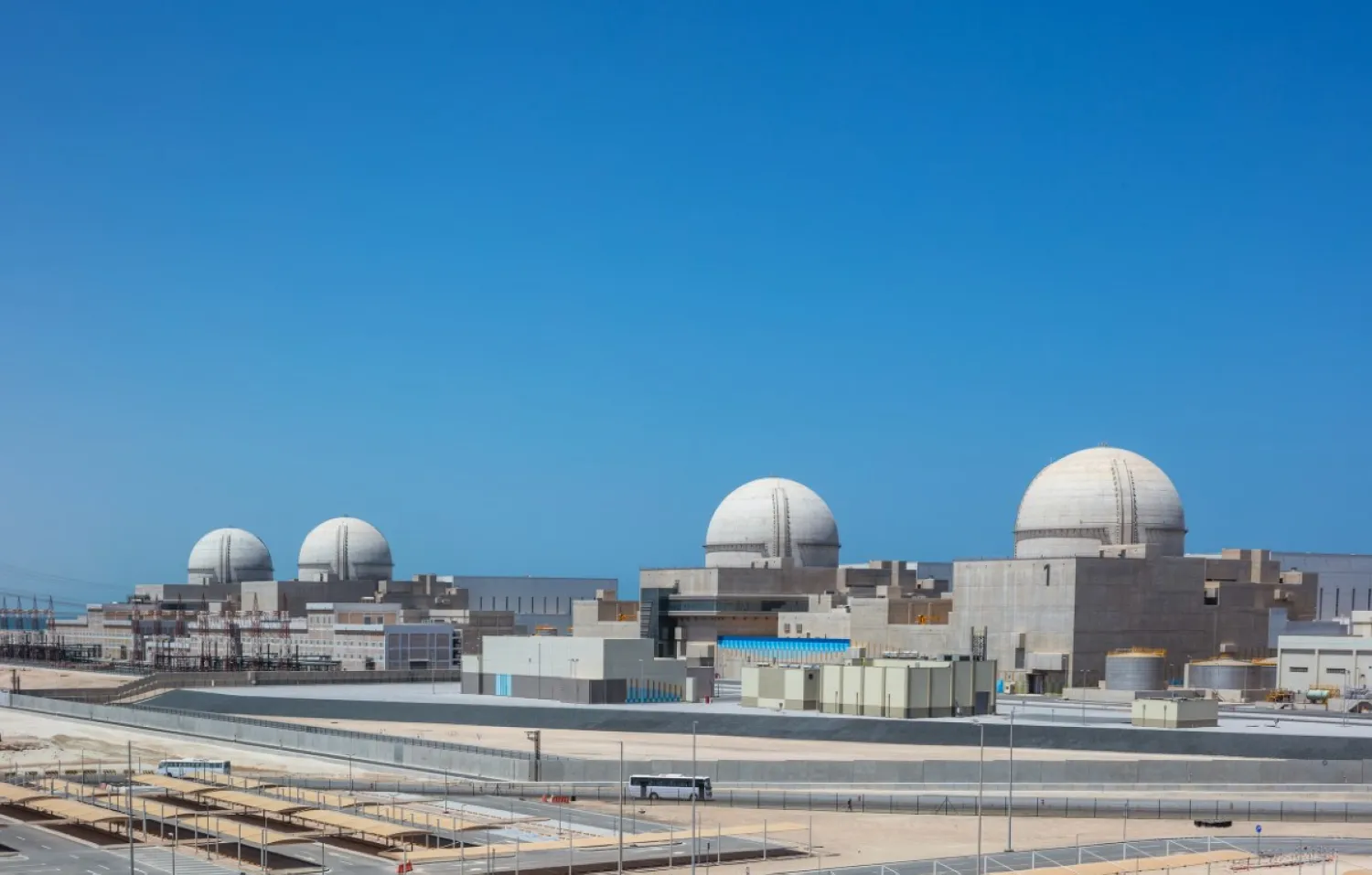

Unit 1 of Barakah Plant Starts Commercial Operations

Construction of Units 3 and 4 are in the final stages. WAM
TT

Unit 1 of Barakah Plant Starts Commercial Operations

Construction of Units 3 and 4 are in the final stages. WAM

The Emirates Nuclear Energy Corporation (ENEC) announced on Tuesday that the Unit 1 of Barakah Nuclear Energy Plant has started commercial operations.

Sheikh Mohamed bin Zayed Al Nahyan, Crown Prince of Abu Dhabi and Deputy Supreme Commander of the Armed Forces hailed the achievement, describing it as a significant milestone in the UAE’s long-term roadmap for sustainable, knowledge-based economic prosperity, benefiting many generations to come.

He said that the UAE Peaceful Nuclear Program will be a game changer of the energy sector in the country, noting that the UAE Program has become a global and pioneering role model in close international cooperation in such strategic projects.

The UAE government entity mandated to deliver the UAE program, the ENEC, part of ADQ, one of region’s largest holding companies, confirmed that its operating and maintenance subsidiary, Nawah Energy Company (Nawah) has successfully started commercial operations of the first Unit of Barakah Plant, following the completion of all testing activities, state news agency WAM reported.

The 1400 MW Unit 1 is now providing constant, reliable, and sustainable electricity around the clock, with three further units to begin generating in the coming years. As a result, ENEC is now leading the largest decarbonisation effort of any industry in the UAE to date.

Khaldoon Khalifa Al Mubarak, Chairman of ENEC, said: "The UAE set a clear roadmap with solid principles to ensure this project’s development in accordance with the highest international industry standards of safety and quality with full transparency."

Mohamed Ibrahim Al Hammadi, Chief Executive Officer of ENEC, said: "After more than a decade of strategic planning, program development and construction, today we are confidently marking the start of a new chapter in for the UAE’s transition to cleaner energy sources."

The Barakah Nuclear Energy Plant, located in the Al Dhafra region of the Emirate of Abu Dhabi, is one of the largest nuclear energy plants in the world, with four APR-1400 Units.

Construction of the Plant began in 2012 and has progressed steadily ever since. Unit 2 has now completed the fuel load process and is working through all of the required processes prior to start-up, scheduled for later in 2021.



Leading Harvard Trade Economist Says Saudi Arabia Holds Key to Success in Fragmented Global Economy

Professor Pol Antràs speaks during a panel discussion at the AlUla Conference for Emerging Market Economies (Asharq Al-Awsat).
TT

Leading Harvard Trade Economist Says Saudi Arabia Holds Key to Success in Fragmented Global Economy

Professor Pol Antràs speaks during a panel discussion at the AlUla Conference for Emerging Market Economies (Asharq Al-Awsat).

Harvard University economics professor Pol Antràs said Saudi Arabia represents an exceptional model in the shifting global trade landscape, differing fundamentally from traditional emerging-market frameworks. He also stressed that globalization has not ended but has instead re-formed into what he describes as fragmented integration.

Speaking to Asharq Al-Awsat on the sidelines of the AlUla Conference for Emerging Market Economies, Antràs said Saudi Arabia’s Vision-driven structural reforms position the Kingdom to benefit from the ongoing phase of fragmented integration, adding that the country’s strategic focus on logistics transformation and artificial intelligence constitutes a key engine for sustainable growth that extends beyond the volatility of global crises.

Antràs, the Robert G. Ory Professor of Economics at Harvard University, is one of the leading contemporary theorists of international trade. His research, which reshaped understanding of global value chains, focuses on how firms organize cross-border production and how regulation and technological change influence global trade flows and corporate decision-making.

He said conventional classifications of economies often obscure important structural differences, noting that the term emerging markets groups together countries with widely divergent industrial bases. Economies that depend heavily on manufacturing exports rely critically on market access and trade integration and therefore face stronger competitive pressures from Chinese exports that are increasingly shifting toward alternative markets.

Saudi Arabia, by contrast, exports extensively while facing limited direct competition from China in its primary export commodity, a situation that creates a strategic opportunity. The current environment allows the Kingdom to obtain imports from China at lower cost and access a broader range of goods that previously flowed largely toward the United States market.

Addressing how emerging economies should respond to dumping pressures and rising competition, Antràs said countries should minimize protectionist tendencies and instead position themselves as committed participants in the multilateral trading system, allowing foreign producers to access domestic markets while encouraging domestic firms to expand internationally.

He noted that although Chinese dumping presents concerns for countries with manufacturing sectors that compete directly with Chinese production, the risk is lower for Saudi Arabia because it does not maintain a large manufacturing base that overlaps directly with Chinese exports. Lower-cost imports could benefit Saudi consumers, while targeted policy tools such as credit programs, subsidies, and support for firms seeking to redesign and upgrade business models represent more effective responses than broad protectionist measures.

Globalization has not ended

Antràs said globalization continues but through more complex structures, with trade agreements increasingly negotiated through diverse arrangements rather than relying primarily on multilateral negotiations. Trade deals will continue to be concluded, but they are likely to become more complex, with uncertainty remaining a defining feature of the global trading environment.

Interest rates and artificial intelligence

According to Antràs, high global interest rates, combined with the additional risk premiums faced by emerging markets, are constraining investment, particularly in sectors that require export financing, capital expenditure, and continuous quality upgrading.

However, he noted that elevated interest rates partly reflect expectations of stronger long-term growth driven by artificial intelligence and broader technological transformation.

He also said if those growth expectations materialize, productivity gains could enable small and medium-sized enterprises to forecast demand more accurately and identify previously untapped markets, partially offsetting the negative effects of higher borrowing costs.

Employment concerns and the role of government

The Harvard professor warned that labor markets face a dual challenge stemming from intensified Chinese export competition and accelerating job automation driven by artificial intelligence, developments that could lead to significant disruptions, particularly among younger workers. He said governments must adopt proactive strategies requiring substantial fiscal resources to mitigate near-term labor-market shocks.

According to Antràs, productivity growth remains the central condition for success: if new technologies deliver the anticipated productivity gains, governments will gain the fiscal space needed to compensate affected groups and retrain the workforce, achieving a balance between addressing short-term disruptions and investing in long-term strategic gains.


Aljadaan: Emerging Markets Account for 70% of Global Growth

Al-Jadaan speaking to the attendees at the "AlUla Conference for Emerging Market Economies" (Asharq Al-Awsat
TT

Aljadaan: Emerging Markets Account for 70% of Global Growth

Al-Jadaan speaking to the attendees at the "AlUla Conference for Emerging Market Economies" (Asharq Al-Awsat

Saudi Minister of Finance Mohammed Aljadaan stressed Sunday that the world economy is going through a “profound transition,” saying emerging markets and developing economies now account for nearly 60 percent of the global Gross Domestic Product (GDP) in purchasing power terms and over 70 percent of global growth.

In his opening remarks at the AlUla Conference for Emerging Market Economies, organized by the Saudi Ministry of Finance and the IMF in AlUla, the minister said these economies have become an increasingly important driver of global growth with their share of global economy more than doubling since 2010.

“Today, the 10 emerging economies in the G20 alone account for more than half of the world growth. Yet, they face a more complex and fragmented environment, elevated debt levels, slower trade growth and increasing exposure to geopolitical shocks.”

“Unfortunately, more than half of low income countries are either in or at the risk of debt distress. At the same time global trade growth has slowed at around half of what it was pre the pandemic,” Aljadaan added.

The Finance Minister stressed that the Saudi experience over the past decade has reinforced three lessons that may be relevant to the discussions at the two-day conference, which brings together a select group of ministers and central bank governors, leaders of international organizations, leading investors and academics.

“First, macroeconomic stability is not the enemy of growth. It is actually the foundation,” he said.

“Structural reforms deliver results only when institutions deliver. So there is no point of reforming ... if the institutions are unable to deliver,” he stated.

Finally, he said that “international cooperation matters more, not less, in a fragmented world.”


Georgieva from AlUla: Growth Still Lacks Pre-pandemic Levels

Kristalina Georgieva speaking to attendees at the second edition of the AlUla Conference for Emerging Market Economies (Asharq Al-Awsat)
TT

Georgieva from AlUla: Growth Still Lacks Pre-pandemic Levels

Kristalina Georgieva speaking to attendees at the second edition of the AlUla Conference for Emerging Market Economies (Asharq Al-Awsat)

International Monetary Fund (IMF) Managing Director Kristalina Georgieva said Sunday that world growth still lacks pre-pandemic levels, expressing concern as she expected more shocks amid high spending and rising debt levels in many countries.

Georgieva spoke at the AlUla Conference for Emerging Market Economies, organized by the Saudi Ministry of Finance and the IMF in AlUla.

The two-day conference brings together a select group of ministers and central bank governors, leaders of international organizations, leading investors and academics to deliberate on policies to global stability, prosperity, and multilateral collaboration.

Georgieva said that the conference was launched last year in recognition of the growing role of emerging market economies in a world of sweeping transformations.

“I came out of this gathering .... With a sense of hope for the pragmatic attitude and determination to pursue good policies and build strong institutions,” she said.

Georgieva stressed that “good policies pay off,” and said that growth rates across emerging economies reached four percent this year, exceeding by a large margin those of advanced economies that are around 1.5 percent.