

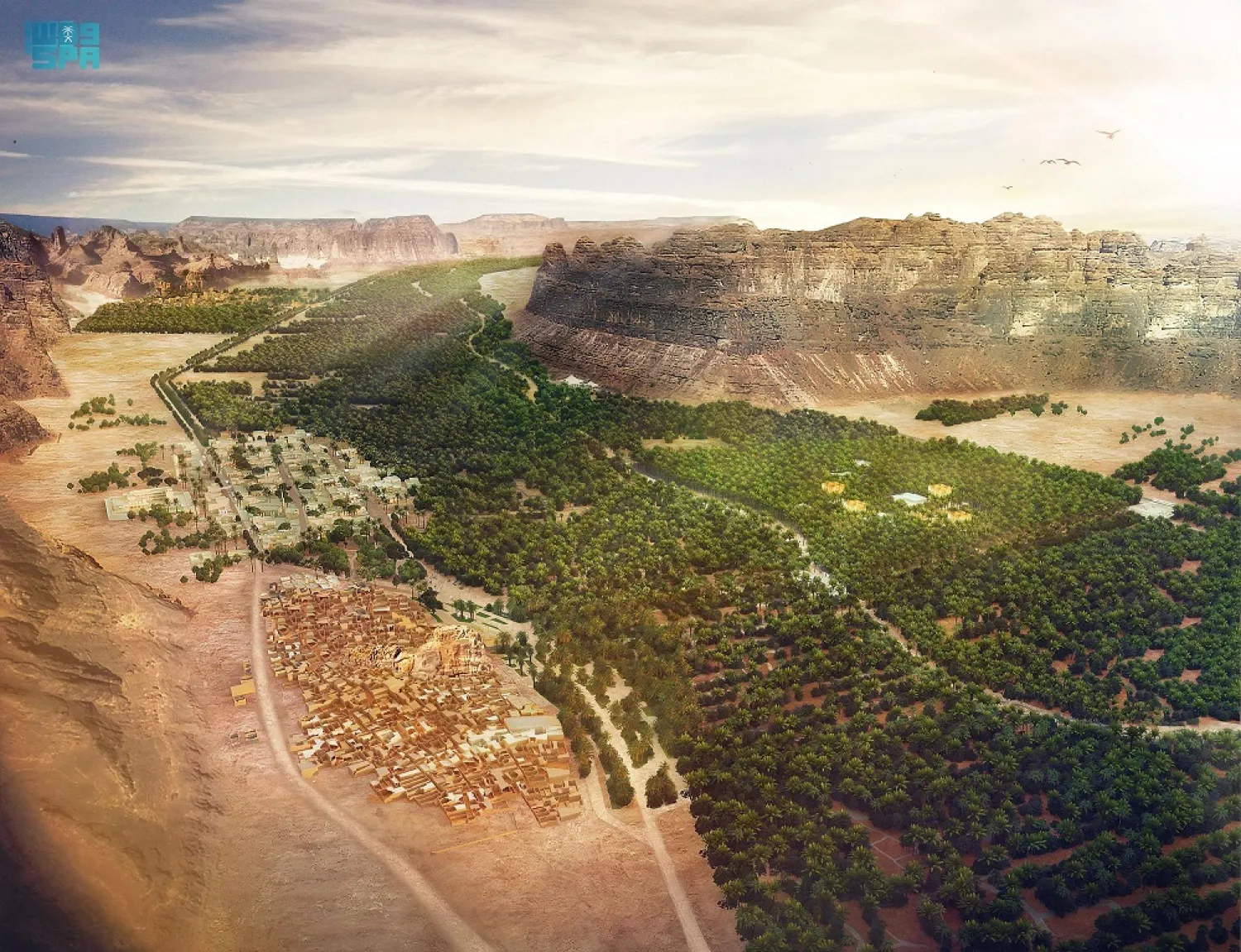

Saudi Crown Prince Launches ‘The Journey Through Time’ Masterplan for AlUla

“The Journey Through Time” represents a key milestone in the transformation of AlUla into a global destination for heritage. (SPA)
TT

Saudi Crown Prince Launches ‘The Journey Through Time’ Masterplan for AlUla

“The Journey Through Time” represents a key milestone in the transformation of AlUla into a global destination for heritage. (SPA)

Saudi Crown Prince Mohammed bin Salman, Chairman of the Royal Commission for AlUla, launched on Wednesday a visionary masterplan that sets to responsibly and sustainably develop the core historical area of AlUla, a unique cultural landscape located in northwestern Arabia.

“The Journey Through Time” represents a key milestone in the transformation of AlUla into a global destination for heritage, culture and nature, and contributes to the advancement of Saudi Arabia’s Vision 2030.

Under the leadership of the Crown Prince and the guidance of Prince Badr, the Saudi Minister of Culture, and the Governor of the Royal Commission for AlUla (RCU), the plan will be implemented in three phases until 2035, with the first phase set to be completed by 2023.

The masterplan represents the first phase of a wider development strategy for AlUla, which is being overseen by the RCU. Upon completion in 2035, the Commission aims to create 38,000 new jobs amid a population grown to 130,000, with AlUla contributing SAR 120 billion to the Kingdom’s GDP.

The masterplan draws on the deep-rooted essence of what AlUla already is – an oasis of unique culture, heritage, nature, and community – promoting the inclusion of the local community in AlUla’s development process to inform the future and open new chapters in AlUla’s unfolding history.

As part of the masterplan, five districts spanning the 20km heart of AlUla will serve as waypoints on the “Journey Through Time”, representing a Living Museum.

The five key districts envisioned in the masterplan include the AlUla Old Town, Dadan, Jabal Ikmah, Nabataean Horizon and Hegra Historical City.

Each of these districts is a cultural landmark in its own right and reflective of the topography and nature that is unique to each location. The highly differentiated experiences and cultural assets are designed to be visitor-centric, rewarding more immersive discovery of the region’s rich culture and history.

Fifteen new cultural assets including museums, galleries and cultural centers are planned as part of the masterplan, serving as landmarks across each district. Besides, 5,000 room keys will also be added, with each district offering its tailored blend of living and hospitality options, ranging from hotels and eco-tourism resorts to exclusive lodges and canyon farms carved into the sandstone rocks.

The Kingdoms Institute, one of the plan’s flagship components, will be a global hub for archaeological knowledge and research dedicated to the cultures and civilizations that have inhabited this area for more than 7,000 years. This includes the ancient kingdoms of Dadan and Lihyan and the magnificent Nabataeans, who built the city of Hegra, a UNESCO World Heritage Site.

The masterplan offers several sustainable mobility solutions to help visitors traverse each of the districts, to minimize road congestion and noise levels. A scenic roadway as well as bicycle, equestrian, and pedestrian trails will promote a smooth and experiential approach to mobility, championing low-carbon journeys.

Reflecting AlUla’s standing as a historic crossroads and the cultural center of northwestern Arabia, the historical tramway will ensure that visitors enjoy a memorable and historically stimulating experience, connecting from AlUla’s International Airport to the five districts.

The masterplan also serves as an investment in AlUla’s citizens and their future, emphasizing RCU’s commitment to community inclusivity. Fully embedded within the plan, new community-driven services, amenities as well as cultural and educational facilities will together promote the development of the local tourism, cultural and agricultural economies for AlUla, helping to nurture a thriving and vibrant society in a great place to live, work and explore. Also, the masterplan will contribute to the revitalization and rehabilitation of the cultural oasis, and the sustainable development of its agricultural community, as a commitment to developing the agricultural sector in AlUla.

Reinforcing Saudi Arabia’s renewed commitment to the preservation and protection of world heritage, knowledge and research, the masterplan is backed by extensive scientific studies on AlUla’s human patterns, environmental and geological evolution, led by a team of international and Saudi experts over three years. It seeks to achieve the concept of coexistence with nature and to celebrate the cultural and historical heritage of AlUla.

As a direct result, the revitalization of AlUla's cultural oasis and the sustainable development of its community is an integral part of the plan, in response to the challenges of sustainably and responsibly developing in a fragile desert environment. At the heart of this are several robust resiliency policies, including circularity commitments, as well as flood and improved water management and sustainable agricultural production.

Together, the two flagship projects of the masterplan – the Kingdoms Institute and the Cultural Oasis – reflect Saudi Arabia’s commitment to offering the world a viable model for protecting, preserving and contributing to the world’s cultural and natural legacy.

Solid policies have been adopted regarding development in heritage and environmentally sensitive areas, development of AlUla community, sustainable agricultural production, improvement of water management, in addition to promoting the principles of circular economy in the masterplan.

Contributing to the Saudi Green Initiative, the regeneration of AlUla is underpinned by a strategy to rehabilitate the land and reverse the course of desertification in the area. Enabling a major expansion of AlUla’s green and open spaces up to 10 million square meters, 80 percent of AlUla province is also being designated as nature reserves with key flora and fauna reintroduced, as well as the conservation of wild animals.

This will be achieved through income generated by welcoming two million visitors annually, offering over 9,000 hotel keys in total across the six areas, and further promoting agriculture, arts and culture, and tourism as key economic drivers for AlUla. Unique opportunities brought on by the development of the masterplan will further encourage and accelerate business and investment from partners who share RCU’s values of sustainability, responsible development and community inclusivity.



King Salman International Airport Kicks of Construction of 3rd Runway to Boost Operational Efficiency

 The airport will incorporate the King Khalid terminals - SPA
The airport will incorporate the King Khalid terminals - SPA
TT

King Salman International Airport Kicks of Construction of 3rd Runway to Boost Operational Efficiency

 The airport will incorporate the King Khalid terminals - SPA
The airport will incorporate the King Khalid terminals - SPA

King Salman International Airport (KSIA), a PIF company, has commenced construction works on the third runway, marking a strategic step that reflects continued progress in airfield development and enhances the airport’s operational readiness to support long-term growth in air traffic demand.

The third runway forms a key component of the KSIA Master Plan and represents a major milestone in the airport’s expansion journey.
According to a press release issued by the KSIA, the project is being delivered in collaboration with FCC Construcción SA and Al-Mabani General Contractors Company and has been designed in alignment with Riyadh’s prevailing wind patterns to ensure safe and efficient aircraft operations under all operating conditions, SPA reported.

The current operational capacity stands at 65 aircraft movements per hour. With the implementation of operational enhancements and the introduction of the third runway, capacity is expected to increase to 85 aircraft movements per hour, contributing to improved operational efficiency and supporting long-term growth.

The third runway incorporates multiple access taxiways to ensure smooth aircraft flow and will span 4,200 meters in length.

Acting CEO of KSIA Marco Mejia said: “Launching construction of the third runway marks a pivotal step in delivering the KSIA Master Plan and reflects our commitment to developing world-class infrastructure capable of supporting future growth, enhancing operational efficiency, and expanding long-haul connectivity without constraints.”

King Salman International Airport is a strategic and transformative national project that reflects the Kingdom’s ambition to position Riyadh as a global capital and a leading aviation hub. The project was announced by His Royal Highness Prince Mohammed bin Salman bin Abdulaziz, Crown Prince, Prime Minister, Chairman of the Council of Economic and Development Affairs and Chairman of the Board of Directors of King Salman International Airport, underscoring its national significance and its role in advancing the objectives of Saudi Vision 2030.

Located on the existing site of King Khalid International Airport in Riyadh, the airport will incorporate the King Khalid terminals, in addition to three new terminals, residential and leisure assets, six runways, and logistics facilities. Spanning 57 square kilometers, it is designed to accommodate 100 million passengers annually and handle over two million tons of cargo by 2030.

This phase of construction contributes to strengthening King Salman International Airport’s international flight network across multiple global destinations, reinforcing Riyadh’s position as an internationally connected aviation gateway and supporting national development objectives within the air transport sector.


Mawani, Arabian Chemical Terminals Sign Land Lease for Jubail Port Storage Tanks

Mawani, Arabian Chemical Terminals Sign Land Lease for Jubail Port Storage Tanks
TT

Mawani, Arabian Chemical Terminals Sign Land Lease for Jubail Port Storage Tanks

Mawani, Arabian Chemical Terminals Sign Land Lease for Jubail Port Storage Tanks

The Saudi Ports Authority (Mawani) signed a contract with Arabian Chemical Terminals Ltd. to establish storage tanks for chemical and petrochemical materials at Jubail Commercial Port, with an investment exceeding SAR500 million on an area of 49,000 square meters.

The project will contribute to enhancing operational efficiency and increasing handling capacity in line with the objectives of the National Transport and Logistics Strategy to consolidate the Kingdom’s position as a global logistics hub, SPA reported.

This step is part of Mawani’s efforts to strengthen the role of the private sector in supporting the gross domestic product and to reinforce the position of Jubail Commercial Port as a driver of commercial activity. The project’s storage capacity will reach 70,000 cubic tons, boosting the competitiveness of the Kingdom’s ports at both regional and international levels.

The project aims to develop and expand storage capacity and the export of chemical and petrochemical materials in accordance with the highest international standards while supporting supply chains. It includes the establishment and development of specialized facilities for storing and exporting chemical and petrochemical products, as well as the provision of storage and distribution services for local and international import and export of chemicals in line with global quality and safety standards.

The project will contribute to supporting national supply chains, boosting the Kingdom’s chemical logistics capabilities, and raising operational efficiency and capacity, thereby improving customer competitiveness. It also supports the achievement of Saudi Vision 2030 objectives by promoting the development of infrastructure to advance the energy, industry, and supply chain sectors in the Kingdom.


Oil Prices Stable as Investors Seek Clarity on Russia-Ukraine Talks

A view shows the crude oil terminal Kozmino on the shore of Nakhodka Bay near the port city of Nakhodka, Russia August 12, 2022. REUTERS/Tatiana Meel
TT

Oil Prices Stable as Investors Seek Clarity on Russia-Ukraine Talks

A view shows the crude oil terminal Kozmino on the shore of Nakhodka Bay near the port city of Nakhodka, Russia August 12, 2022. REUTERS/Tatiana Meel

Oil prices were little changed on Tuesday as investors took stock of ​dented hopes of a Russia-Ukraine peace deal and rising geopolitical tensions in the Middle East around Yemen, Reuters reported.

Brent crude futures for February delivery, which expire on Tuesday, were up 15 cents at $62.09 a barrel as of 0918 GMT. The more active March contract was at $61.61, up 12 cents.

US West Texas Intermediate ‌crude gained 14 ‌cents to $58.22.

The Brent and ‌WTI ⁠benchmarks ​settled ‌more than 2% higher in the previous session as Saudi Arabia launched airstrikes against Yemen and after Moscow accused Kyiv of targeting Putin's residence, denting hopes of a peace deal.

Kyiv dismissed Moscow's accusation as baseless and designed to undermine peace negotiations. After a phone call ⁠with Putin, US President Donald Trump said he was angered by details ‌of the alleged attack.

"I think the ‍markets are sensing that ‍a deal is going to be very hard ‍to come by," said Marex analyst Ed Meir.

Traders also watched other Middle East developments after Trump said the United States could support another major strike on Iran were Tehran to resume rebuilding its ballistic missile or nuclear weapons programs.

Despite renewed fears of potential supply disruptions, perceptions of an oversupplied global market remain and could cap prices, analysts say.

Marex's Meir said prices would trend downwards in the first quarter of 2026 due to ‌a "growing oil glut".