


Football Grapples Slowly with Brain Injury, 19 Years on from Jeff Astle's Death

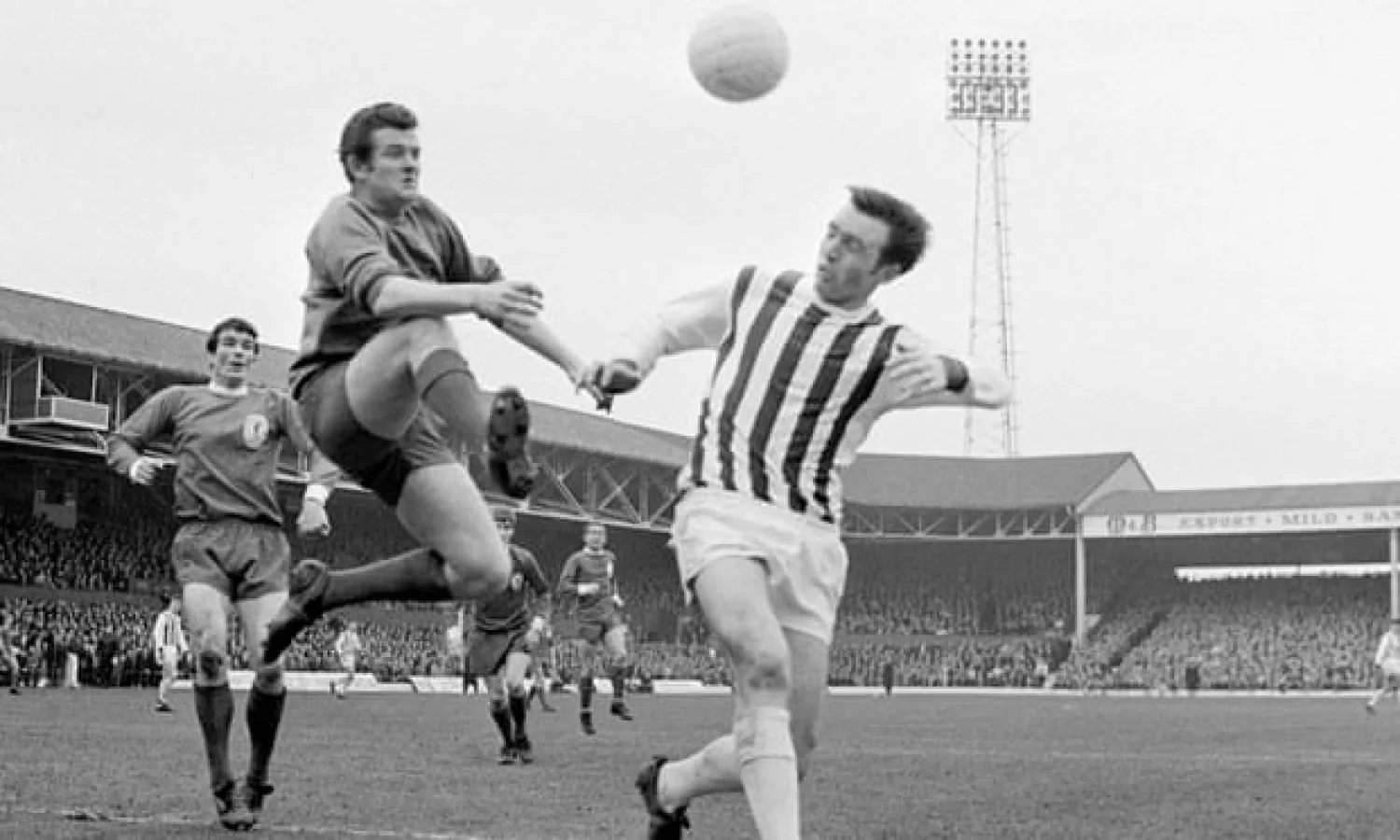
Jeff Astle in action in 1968. The former West Brom forward’s death in 2002 prompted a promise to tackle brain trauma but progress has been slow. Photograph: PA
TT

Football Grapples Slowly with Brain Injury, 19 Years on from Jeff Astle's Death

Jeff Astle in action in 1968. The former West Brom forward’s death in 2002 prompted a promise to tackle brain trauma but progress has been slow. Photograph: PA

On 11 November 2002, the South Staffordshire coroner Andrew Haigh recorded a verdict of “death by industrial disease” in the case of the former England striker Jeff Astle who had died, aged 59, after years suffering with dementia. At that point there was already 30-odd years’ worth of anecdotal evidence that heading the ball caused brain trauma. The Astle verdict meant there was now an official recognition of a link. The Guardian called it a “landmark verdict”. An official at the Professional Footballers’ Association reassured the players, and public, that the PFA and the FA had “begun joint research” into how heading a football affects the brain.

“We cannot do anything about what has gone on in the past,” the spokesman said, “but maybe we can do something about the future.”

Eighteen years into that future, on 15 October 2020, the North Wales coroner John Gittins reached the same verdict in the case of the former Wales midfielder Alan Jarvis. It was the first such case since Astle’s. Jarvis’s family said at the time that they felt the authorities had been trying to “sweep the issue under the carpet”. The Daily Mail called the case a “landmark verdict”. And in the weeks afterward, as the relatives of more and more retired footballers spoke about how their families were suffering, an official at the PFA came forward again.

The language was more urgent now, and came with a clear acknowledgment that the game had a problem, but it still ended with the promise that the union and the FA “were committed to funding further research”. Which sounded wearisomely familiar. “All scientific work is incomplete,” wrote the epidemiologist Sir Austin Bradford Hill, who was instrumental in establishing the links between smoking and lung cancer. “Whether it be observational or experimental. All scientific work is liable to be upset or modified by advancing knowledge. That does not confer upon us a freedom to ignore the knowledge that we already have, or to postpone the action that it appears to demand at a given time.”

A lot changed in those last two decades. There has been progress in football, and across all contact and collision sports, but the question of whether more could have been done sooner, whether sport should have gone further, faster, remains. It seemed to hang over the opening day of the digital, culture, media and sport committee’s inquiry into concussion in sport on Tuesday. You could hear hints of it in the MPs’ questions about who was funding the current research, and how much they were paying, whether there was material out there that hadn’t been published, about the workings of the Concussion in Sport group, and whether we need more transparency in research.

It came up directly after the neuropathologist Willie Stewart described football’s current concussion substitute protocols as “a shambles”. The Astle case was 19 years ago, said the committee chair, Julian Knight. “Yet we are talking about football protocols being ‘a shambles’. Why are we letting people down in this way? What is the problem in terms of our sporting bodies?”

Stewart said he shared Knight’s “frustration”, but preferred to look forward: “The challenge is not to make the same mistake again, where we all get together in 20 years’ time and say: ‘What has happened? Nothing!’”

This is an argument that comes up a lot in conversations with, and between, the growing number of academics, campaigners and researchers working in this field. There’s a theory that the reason the pace of change has been so slow is because the threat of litigation has put the governing authorities on the defensive, that the worry about whether they will be blamed for what they did wrong has made them reluctant to engage with suggestions about what they might do right. Advocates argue that everyone involved needs to take a more collaborative and constructive approach. It’s an idea that underpins some of the new campaign groups that have been set up in recent months, such as Head For Change.

Which figures. Back is not the best way to move forward. Only it does leave a lot of awkward questions unanswered. Questions such as, to pick one of many, what became of the work published in 1998, four years before the Astle verdict, by a team of researchers working in the Netherlands under Dr Erik Matser? The Guardian reported at the time that Matser’s team had found clear evidence that “heading a football can cause long-term brain damage”. One of the co-authors explained: “The mental impairment of the players is subtle and would go unnoticed by many people, however this type of brain injury may last forever.” In the long term, though, Matser’s work didn’t lead anywhere. He has his own ideas about what happened and why, which he has spoken about in a recent interview with the Dutch newspaper NRC.

The inquiry itself already feels too small, and underresourced, to dig into these issues in this kind of detail. Ninety minutes into the opening session the chair was already asking interviewees to “keep their answers concise” because “we’re relatively short of time”. There’s so much to cover, complicated questions of science, sociology and policy, across so many sports at youth, amateur and professional level. It has made for some awkward moments, with neurologists asked to provide expert testimony on issues of public health policy, and population psychology, and meant there have been some conspicuous gaps in the range of topics covered.

It is valuable work. But, 19 years after the Astle verdict, it still feels like late in the day to be beginning all over. And we’ll have to wait and see whether, this time, it leads to a real step forward in how sport handles these issues.

The Guardian Sport


Thomas Tuchel Extends Contract as England Coach Until Euro 2028

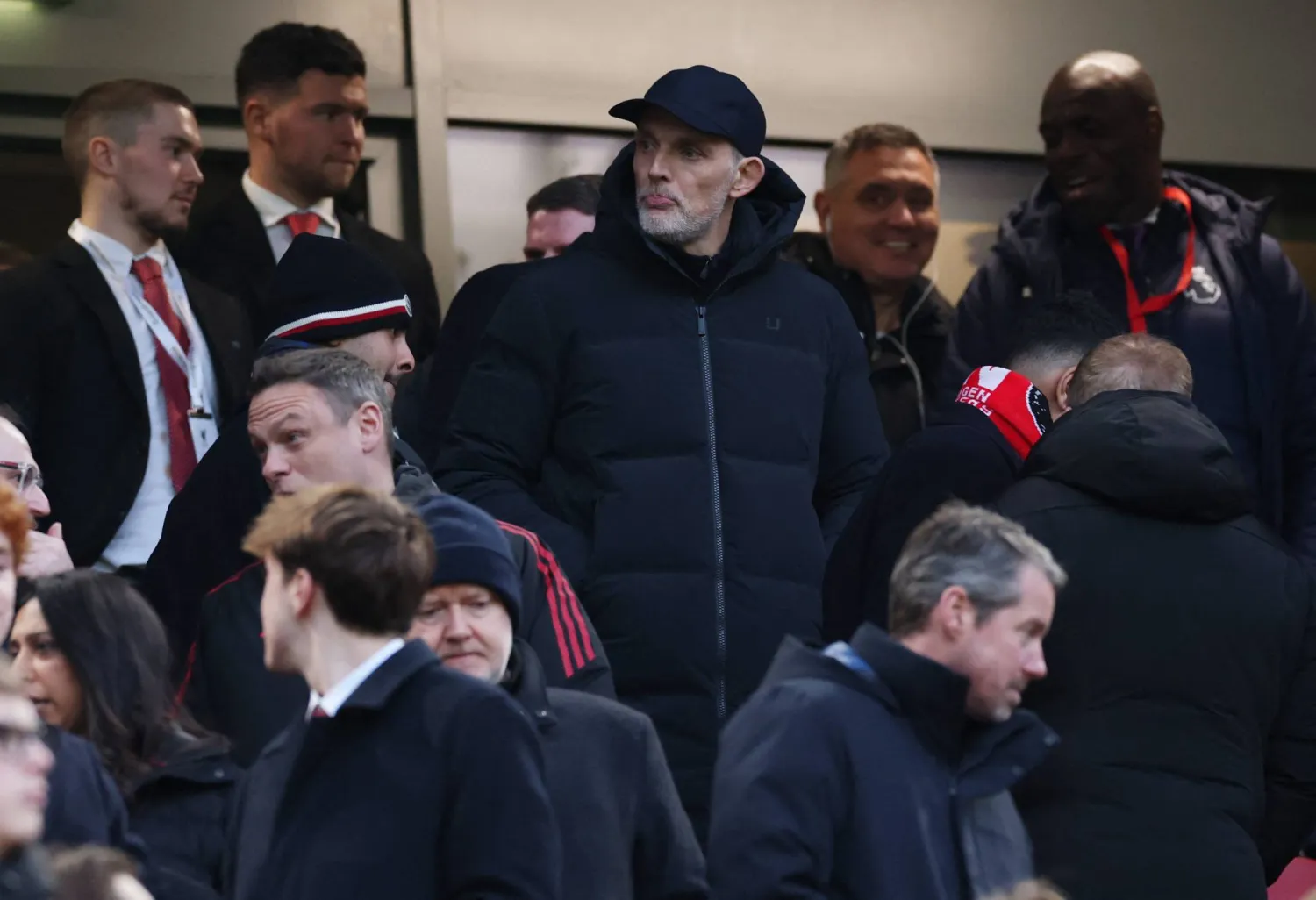
Soccer Football - Premier League - Liverpool v Manchester City - Anfield, Liverpool, Britain - February 8, 2026 England manager Thomas Tuchel in the stands REUTERS/Phil Noble
TT

Thomas Tuchel Extends Contract as England Coach Until Euro 2028

Soccer Football - Premier League - Liverpool v Manchester City - Anfield, Liverpool, Britain - February 8, 2026 England manager Thomas Tuchel in the stands REUTERS/Phil Noble

Thomas Tuchel has signed a new contract that will see him remain head coach of the England national football team through to the end of Euro 2028 in the UK and Ireland, the Football Association announced on Thursday.

Tuchel was confirmed as the successor to Gareth Southgate in October 2024 and has overseen an unbeaten qualification run to this year's World Cup in North America, with England winning all eight group games under their German boss.

"I am very happy and proud to extend my time with England," said the 52-year-old former Chelsea boss, whose previous deal with the national side ran only until the end of the 2026 World Cup.

"It is no secret to anyone that I have loved every minute so far of working with my players and coaches, and I cannot wait to lead them to the World Cup.

"It is an incredible opportunity and we are going to do our very best to make the country proud."

According to AFP, the FA said the new agreement with Tuchel would provide "clarity and full focus" on the World Cup.

Tuchel had been previously touted as a possible permanent successor to sacked former Manchester United manager Ruben Amorim, even though the English giants have experienced an upturn in form under caretaker boss Michael Carrick.

But in signing a new England contract, Tuchel appears to have ruled himself out of a post-World Cup move to Old Trafford.


Ukraine Skeleton Racer Disqualified from Olympics over Memorial Helmet

(FILES) Ukraine's Vladyslav Heraskevych wears a helmet which depicts Ukrainian sportsmen and women, victims of his country's war with Russia, as he takes part in the skeleton men's training session at Cortina Sliding Center during the Milano Cortina 2026 Winter Olympic Games in Cortina d'Ampezzo on February 9, 2026. (Photo by FRANCK FIFE / AFP)
TT

Ukraine Skeleton Racer Disqualified from Olympics over Memorial Helmet

(FILES) Ukraine's Vladyslav Heraskevych wears a helmet which depicts Ukrainian sportsmen and women, victims of his country's war with Russia, as he takes part in the skeleton men's training session at Cortina Sliding Center during the Milano Cortina 2026 Winter Olympic Games in Cortina d'Ampezzo on February 9, 2026. (Photo by FRANCK FIFE / AFP)

Ukrainian skeleton racer Vladyslav Heraskevych was disqualified from the Winter Olympics on Thursday after refusing to back down over his banned helmet, which depicts victims of his country's war with Russia.

The International Olympic Committee said he had been kicked out of the Milan-Cortina Games "after refusing to adhere to the IOC athlete expression guidelines".

Heraskevych, 27, had insisted he would continue to wear the helmet, which carries pictures of Ukrainian sportsmen and women killed since Russian forces invaded Ukraine in 2022, during the men's skeleton heats on Thursday.

After the decision, a defiant Heraskevych posted on X "this is price of our dignity", alongside a picture of his headwear, AFP reported.

Ukraine President Volodymyr Zelensky had defended the athlete's right to wear the helmet but he knew he was taking a risk as gestures of a political nature during competition are forbidden under the Olympic charter.

The IOC said in statement on Thursday that the skeleton racer's accreditation for the Games had been withdrawn.

"Having been given one final opportunity, skeleton pilot Vladylsav Heraskevych from Ukraine will not be able to start his race at the Milano Cortina 2026 Olympic Winter Games this morning," the IOC statement said.

"The decision followed his refusal to comply with the IOC's Guidelines on Athlete Expression. It was taken by the jury of the International Bobsleigh and Skeleton Federation (IBSF) based on the fact that the helmet he intended to wear was not compliant with the rules."

Athletes are permitted to express their views in press conferences and on social media, and on Tuesday the IOC said it would "make an exception" for Heraskevych, allowing him to wear a plain black armband during competition.

"Mr. Heraskevych was able to display his helmet in all training runs," the IOC said.

"The IOC also offered him the option of displaying it immediately after the competition when going through the mixed zone."

Olympic chiefs said that IOC president Kirsty Coventry had spoken with Heraskevych on Thursday morning in a vain bid to make him change his mind.


Premier League's Nottingham Forest Fires Head Coach Sean Dyche

FILE PHOTO: Soccer Football - Premier League - Nottingham Forest v Wolverhampton Wanderers - The City Ground, Nottingham, Britain - February 11, 2026 Nottingham Forest manager Sean Dyche reacts Action Images via Reuters/Andrew Boyers
TT

Premier League's Nottingham Forest Fires Head Coach Sean Dyche

FILE PHOTO: Soccer Football - Premier League - Nottingham Forest v Wolverhampton Wanderers - The City Ground, Nottingham, Britain - February 11, 2026 Nottingham Forest manager Sean Dyche reacts Action Images via Reuters/Andrew Boyers

Nottingham Forest has fired Sean Dyche and the Premier League team is looking for its fourth head coach of the season.

Dyche was relieved of his duties late Wednesday following a goalless draw with the last-place Wolves, having been in charge for just 114 days. Forest’s failure to convert any of their numerous chances against Wolves left them three points clear of the relegation zone.

“Nottingham Forest Football Club can confirm that Sean Dyche has been relieved of his duties as head coach," the club said in a statement early Thursday. "We would like to thank Sean and his staff for their efforts during their time at the club and we wish them the best of luck for the future.

“We will be making no further comment at this time,” The Associated Press quoted the club as saying.

Forest finished seventh in the Premier League under Nuno Espirito Santo last season, missing out on a Champions League spot after a poor end to the campaign. Nuno signed a new three-year deal at the City Ground in June 2025, but was fired in September after a breakdown in his relationship with owner Evangelos Marinakis.

Former Tottenham boss Ange Postecoglou was swiftly brought in as the Portuguese coach’s replacement, but lasted only 40 days in the job with Marinakis ending his tenure within minutes of a 3-0 defeat to Chelsea.

The draw Wednesday’ left Forest with just two wins from their last 10 matches in the Premier League — a run during which they also exited the FA Cup to Championship side Wrexham.
